The Cold Calculus of Iron and Paper: How a Retired Sergeant Major Dismantled a Suburban Empire
CHAPTER 1: THE FIRST ENGINE REVOLUTION
The sun had not yet burned the mist off the lower pasture when the pink tracksuit appeared at the tree line.
Jack Callahan did not look up immediately. He kept his hands buried deep inside the greasy folds of an old red rag, his thumbs working methodically against the machined steel of the John Deere 790 injector pump. To his left, the diesel engine idled with a rhythmic, concussive thrum—a deep, mechanical pulse that he had tuned by ear over three long winters. It was a clean sound. A predictable sound.
“That machine is a public nuisance.”
The voice cut through the air with the brittle snap of dry kindling. Jack paused his thumb, the grease smearing across his knuckle in a dull gray streak.
“And if I see you start it one more time,” the voice continued, rising in pitch as it closed the distance between the Oakidge Estates manicured turf and his overgrown fence line, “I will have it seized and sold for scrap. And you’ll be footing the bill for the impound fees.”
Jack slowly raised his head. He did not turn his shoulders; he pivoted only his neck, adopting the flat, unblinking posture he had perfected across twenty-five years of service in places where threats were measured in muzzle velocity rather than property values.
She stood at the boundary wire—a woman in her late fifties encased in a pastel pink tracksuit that strained violently against the geometry of her posture. Her arms were crossed so tightly across her chest it appeared she was trying to apply a tourniquet to her own authority. Her face was mottled with a furious, puce coloration, her eyes wide behind designer frames that had slipped half an inch down a damp bridge of a nose.
This was Karen. The architect, founder, and self-appointed magistrate of the Oakidge Homeowners Association.
Jack let out a slow, measured breath through his nose. He did not reach for anger; anger was an uncalibrated variable, a waste of metabolic energy. Instead, he filed away her proximity, her vocal cadence, and the exact distance between the bottom wire of the fence and the toes of her pristine white walking shoes.
“Mrs. Miller,” Jack said, his voice flat, low, and devoid of regional inflection. “You’re standing on an agricultural easement.”
“I am standing on the perimeter of a civilized community,” she snapped, her chin jerking upward. “A community whose property values are being systematically murdered by the smell of diesel exhaust and the eyesore of industrial salvage rotting in broad daylight. You have seventy-two hours to remove that antique pile of scrap before I involve our legal counsel.”
Jack stared at her for three unbroken seconds. He noted the slight tremor in her left thumb—a microscopic tell of nervous exhaustion masked as righteous indignation. People who wielded authority with that much desperation were never defending rules; they were defending a perimeter against their own irrelevance.
“The tractor stays,” Jack said softly. “The engine needs to run. The oil has to circulate.”
“We’ll see about that,” she spat, turning on her heel with a sharp, synchronized pivot that cost her balance for a fraction of a second before she recovered and marched back toward the sea of beige siding.
Jack watched her retreat until the pink blur vanished behind the third oak tree. Then, deliberately, he reached down, turned the fuel throttle another quarter-inch to the right, and let the John Deere settle into a deeper, harder, more resonant growl.
CHAPTER 2: THE PAPER FORTRESS
The kitchen was quiet, save for the dull, rhythmic drip of the faucet and the faint, high-frequency hum of the refrigerator. Jack walked across the wide-plank oak floor, his boots leaving dry traces of dust that he did not bother to brush away. He pulled out the heavy Windsor chair, the wood groaning slightly under his weight, and sat down with a slow, deliberate economy of motion.
Before him lay the multi-page document delivered by courier three mornings ago. It was heavy bond paper, crisp and intimidating, printed with an ink that smelled faintly of cheap corporate toner. At the top, the letterhead bore the official crest of the Oakidge Estates Homeowners Association: a stylized image of interlocking gates framing a pair of pristine colonial houses.
Jack did not touch the pages immediately. He reached out, his calloused fingertips brushing against the cool ceramic surface of his coffee mug, feeling the residual warmth of the dark roast. His mind was compartmentalized, a habit drilled into him during decades of service where raw intelligence briefings had to be stripped of emotional static before evaluation. Karen’s threat was loud, public, and aggressive. That meant it was a reconnaissance-in-force—designed to test his defenses, measure his reaction time, and see if he would fold under the pressure of administrative shock.
With a steady thumb, Jack flipped open the compliance document to page four, section seven, paragraph two.
“Violation one,” he muttered softly, his voice a gravelly drone in the quiet room. “Noise ordinance 7.4b for operating heavy machinery outside of approved hours. Five hundred dollars.”
He reached for a red ballpoint pen and pulled a fresh, unlined yellow legal pad toward him. At the top of the page, he wrote a single heading in block capitals: TARGET DOCTRINE ANALYSIS.
Beneath it, he began to map out the flaws in Karen’s logic. The jurisdiction of the Oakidge Homeowners Association was strictly defined by the subdivision plat maps filed with the county clerk when the development was approved in the late nineties. Jack’s property, thirty acres of rolling hills and ancient oak trees, had been farmed by the same family since the Eisenhower administration. It predated the concrete curbs, the uniform mailboxes, and the pastel-colored siding by more than a century.
A sudden, sharp memory flared at the edge of his consciousness—the image of a dusty perimeter map spread across a folding table in a dusty command tent somewhere outside Fallujah, checking coordinates against a disputed grid line. The principle remained identical. If you are fighting an enemy who relies on manufactured authority, you do not attack their bluster; you look for the administrative boundary where their jurisdiction legally evaporates into thin air.
Jack slid the compliance notice aside and pulled the actual deed of his property from the leather binder where he kept his vital records. He ran his index finger down the legal description of the metes and bounds, checking the iron pin coordinates recorded by the county surveyor.
The HOA’s boundary line stopped dead at the twenty-foot-wide gravel track running parallel to his fence line. That track—the emergency access road—was designated on the master plat as a non-exclusive public utility and emergency easement. It did not belong to the Oakidge Homeowners Association. It was a neutral zone, a legal demilitarized strip separating his agricultural zone from their suburban sanctuary.
Karen had issued fines for a tractor operating on private agricultural land, citing bylaws that explicitly applied only to members within her subdivision. Furthermore, she had levied penalties under catch-all aesthetic clauses that lacked any statutory backing outside the internal covenants signed by the homeowners themselves.
It was a house built entirely of paper cards.
Jack pulled his phone across the table, unlocked the screen with a firm swipe, and searched his contacts. He did not call a local attorney who might be intimidated by the political influence of a wealthy suburban board. Instead, he scrolled past the local listings and tapped the number for Dave Jensen—a man who had spent twelve years as a Judge Advocate General sorting through logistical nightmares and jurisdictional gridlock before retiring to private real estate law.
The phone rang twice before a sharp, familiar voice answered on the other end. “Jensen here.”
“Dave,” Jack said, his tone flat and unhurried. “It’s Jack Callahan. I need you to pull a file for me down at the county records office. It involves a development called Oakidge Estates and a parcel designated as an emergency easement.”
There was a brief pause on the line, followed by the sound of a heavy book slamming shut in the background. A dry, knowing chuckle came through the speaker. “Jack. Good to hear from you. Sounds like you’ve got yourself a target-rich environment. What kind of mess are we looking at?”
“A suburban association president thinks her jurisdiction extends across a three-strand wire fence,” Jack replied, leaning back in his chair as his eyes scanned the yellow legal pad where he had neatly outlined the discrepancies in the HOA’s fine schedule. “She’s trying to tax my diesel engine and fine me for aesthetic blight on land that isn’t even in her zip code.”
“Oh, this is going to be surgical,” Jensen said, the unmistakable sound of a keyboard clicking to life echoing through the line. “Send me whatever documentation you’ve got—the notices, the subdivision plat numbers, the deed. Let’s give this micro-tyrant a formal education in property law.”
Jack hung up the phone a few minutes later, the screen going dark against the polished wood of the table. He picked up his coffee mug, took a slow, deliberate sip, and looked out the kitchen window. Through the glass, the vintage John Deere sat quietly in the morning light, its iron frame casting a long, steady shadow across the grass.
The first counter-offensive was already in motion. All he had to do now was wait for the paperwork to clear the perimeter.
CHAPTER 3: THE FLIMSY BARRICADE
The transition from the cool interior of the kitchen to the glaring midday glare of the Virginia acreage was marked by the dry, crunching snap of gravel under boot heels. Jack walked with a measured, rhythmic cadence, his hands tucked loosely into the pockets of his canvas jacket. The morning air carried the faint, metallic scent of heated engine oil drifting from the shed, mingling with the dry, earthy aroma of cut hay.
He did not rush. A perimeter check required total absorption in the immediate environment, a deliberate refusal to let impatience dictate movement.
As he cleared the line of ancient oak trees that marked the old boundary, the gravel track came into sharp focus. The fire road stretched twenty feet wide between his wire fence and the manicured rear lawns of the subdivision. It was designed as an emergency lane, a neutral corridor cleared for heavy vehicles, ambulances, or fire trucks in the event of a crisis.
Today, however, the corridor was occupied.
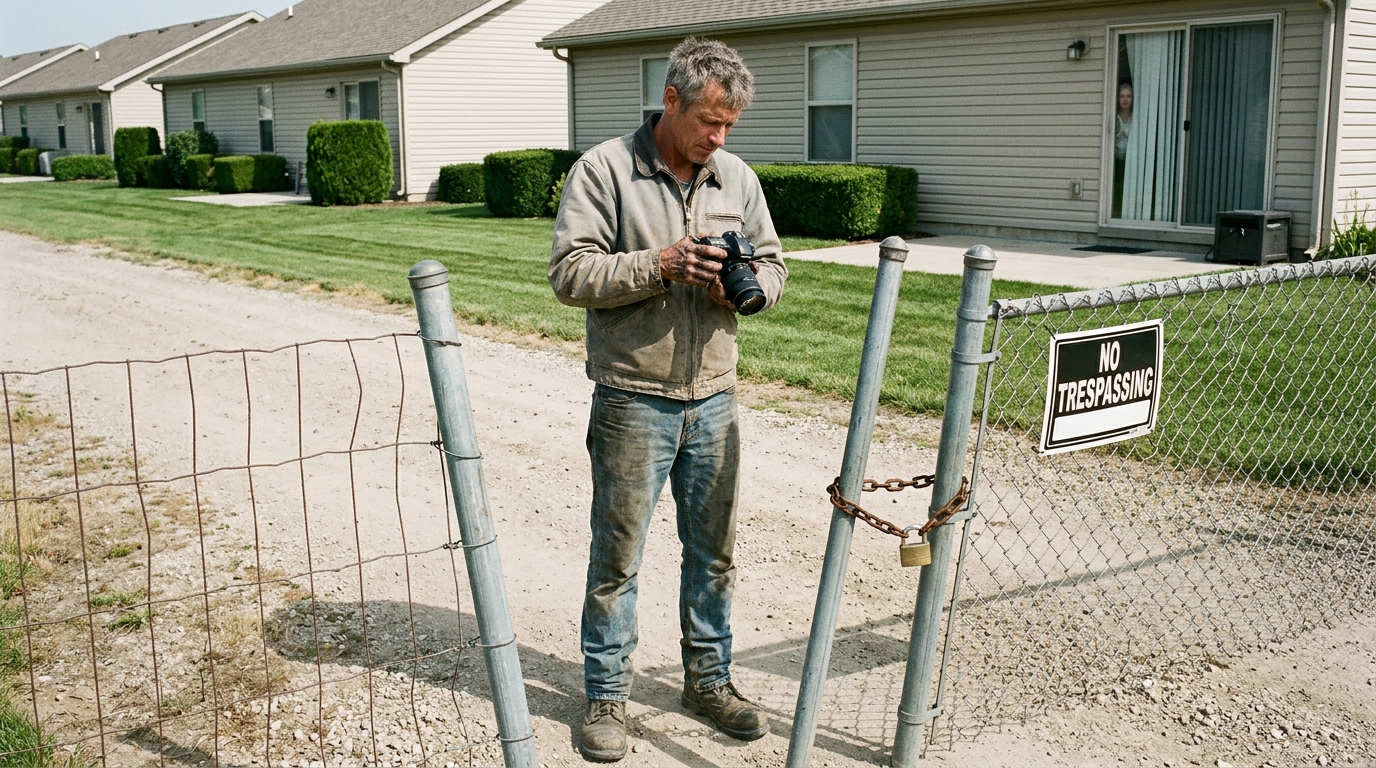
Two flimsy galvanized metal posts had been driven haphazardly into the dirt shoulders of the track, leaning outward at slight, unprofessional angles. Stretched tight between them was a length of rusted industrial chain, secured at the left post by a heavy, brass-bodied padlock that looked cheap enough to be cracked with a sharp blow from a heavy hammer. Dangling from the center of the chain was a professionally laminated placard, its corners sharp and white against the dark iron links: PROPERTY OF OAKIDGE HOA — NO TRESPASSING.
Jack stopped ten paces short of the barrier. He did not touch the chain. He simply stood there, his eyes tracking the structural integrity of the posts and the tension on the links.
It was a pathetic barricade, an amateur’s interpretation of a military checkpoint. A standard-issue tractor idling in first gear could have rolled right over the posts without losing torque or chipping the paint on the differential. Yet the intent behind it was glaringly transparent. Karen was not trying to physically stop heavy machinery; she was staking a claim, drawing an arbitrary psychological line in the dirt to see if he would flinch, back down, or lose his temper and commit a punishable offense.
A sudden, sharp breeze rustled the dry leaves overhead, carrying the faint, sterile sound of a lawn sprinkler operating behind one of the distant beige houses. For a fleeting second, the warped perspective of the barrier seemed almost surreal—a child’s game played with adult legal threats. But Jack knew better than to underestimate the danger of small minds wielding misplaced administrative power. Unchecked bureaucracy was like a slow leak in a hydraulic line; left unattended, it would bleed the system dry until the whole machine seized up.
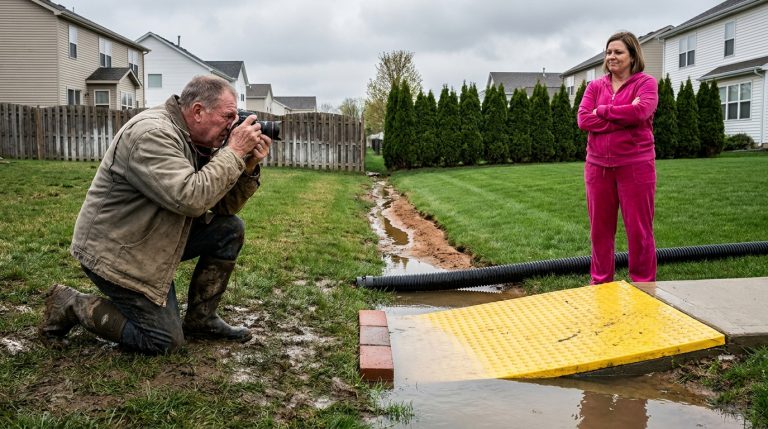
He pulled a small, heavy-duty digital camera from his pocket, flipped the power switch with his thumb, and began to document the scene with clinical detachment.
He took wide shots framing the chain against the backdrop of the Oakidge backyards, capturing the precise encroachment of the metal posts onto the public safety easement. He stepped closer, adjusting the focal length to record a crisp, high-resolution close-up of the padlock, the texture of the links, and the bold, bureaucratic lettering on the warning sign. Every angle was calculated, every frame timestamped automatically by the internal clock. If this dispute was going to be fought on the terrain of documentation and compliance, he intended to hold the high ground.
As the camera shutter clicked for the fourth time, a shadow shifted behind the sliding glass door of the house directly across the easement. A pale face peered out from behind vertical blinds—someone watching from the safety of an air-conditioned living room, peering through a cracked slit to see how the outsider would react to the president’s decree. Jack did not look away or break his rhythm; he simply panned the camera lens toward the window, letting the cold glass reflection catch the red indicator light of the device. The face vanished instantly behind the slats.
He lowered the camera, slipping it back into his jacket pocket with a quiet, deliberate zip.
The physical challenge had been planted, but cutting the chain or tearing down the posts with his bare hands would have played directly into Karen’s narrative. It would have reduced a systemic legal overreach into a petty neighborhood brawl. Instead, Jack turned on his heel, his eyes sweeping the length of the easement one final time to memorize every rut, every weed, and every inch of unauthorized iron.
He walked back toward his property line, his boots grinding rhythmically against the stone. The trap was visible now, laid out in plain sight across the gravel. All that remained was to let the other side tighten the snare.
CHAPTER 4: THE PINSIR MOVEMENT
The white SUV bearing the county seal rolled to a deliberate stop twenty feet short of the rusted chain. The engine idled with a clean, low hum, perfectly maintained and entirely devoid of the raw, mechanical growl of agricultural machinery. Jack did not move from his position by the boundary wire. He stood motionless, his boots planted firmly on the dirt shoulder, his hands resting easily inside his jacket pockets.
The door of the SUV swung open with a solid, weighty thud. Fire Marshal Chief Miller stepped out into the crisp morning light, his polished black shoes crunching against the loose gravel. He wore a crisp, dark uniform shirt bearing crisp gold insignia, his expression set in the hard, unyielding lines of a man accustomed to enforcing compliance where negotiation had long since failed.
Miller’s gaze swept over the makeshift barricade—the leaning metal posts, the cheap brass padlock, and the bold, laminated warning sign declaring private jurisdiction over a public safety corridor. A faint, knowing twitch touched the corner of the chief’s mouth before he smoothed his expression back into professional neutrality.
“Morning, Callahan,” Miller said, his voice carrying clearly across the quiet twenty-foot gap.
“Chief,” Jack replied, offering a brief, level nod. “Looks like you caught this stretch on a restricted day.”
“Or someone decided to play surveyor without a license,” Miller muttered, stepping closer to the chain. He pulled a heavy, ruggedized digital tablet from his side holster and tapped the screen, bringing up a detailed geographic overlay. “We pulled the master plat map for this section thirty minutes ago. This gravel track isn’t an HOA driveway. It’s a designated county emergency access easement, established under ordinance fourteen-b.”
Before Jack could answer, the front door of the beige house directly across the easement flew open with a violent slam.
Karen marched across her manicured lawn like an infantry officer executing an unauthorized advance. The pastel pink tracksuit was a jarring, fluorescent beacon against the muted tones of the dry Virginia grass. Her stride was stiff, her shoulders hunched with defensive fury, and her face flushed to a dark, mottled crimson.
“Can I help you?” she demanded, her voice cutting through the morning air with a brittle, glass-sharp edge as she directed her words at the fire marshal while fixing Jack with a look of pure venom. “You are standing on private HOA property. That barrier is there to secure this community from outside disturbances.”
Chief Miller did not turn around immediately. He completed a final swipe on his tablet, locked the screen with a sharp click, and then turned to face her. His posture remained entirely relaxed, an immovable wall of institutional authority.
“Ma’am,” Miller said, his tone flat and level. “I’m Chief Miller with the County Fire Marshal’s Office. Are you the individual who ordered the placement of this obstruction?”
“I am the president of the Oakidge Homeowners Association,” she announced, puffing out her chest as she closed the distance to the edge of the asphalt. “This road belongs to the association, and we have every legal right to restrict unauthorized access to protect our residents from nuisances.”
Miller pulled a folded county document from his back pocket and snapped it open with a crisp flick of his wrist. “According to county fire code section four, paragraph two-b, any unauthorized obstruction of a designated emergency access route is a class one misdemeanor, carrying fines up to twenty-five hundred dollars per day. Furthermore, ma’am, this easement guarantees unrestricted, perpetual access to the adjacent agricultural parcel.”
He gestured with the edge of the document toward Jack.
Karen’s breath hitched. For a second, the color drained entirely from her face, leaving her skin a pasty, sickly gray before rushing back in a hot, mottled wave. “That’s a lie,” she snapped, her voice rising an octave. “Our covenants cover every inch of this perimeter! We have the authority to regulate—”
“You have the authority to manage your private lots,” Miller interrupted, his voice dropping into a register that brook no argument. “You do not have the authority to override state safety codes or block emergency vehicles. You have twenty-four hours to remove this chain, these posts, and the signage. If they are still here tomorrow morning, my department will bring heavy cutters, remove them at your personal expense, and hand a full report to the county prosecutor.”
Miller did not wait for a rebuttal. He turned on his heel, walked back to the white SUV, and climbed inside. The engine revbed smoothly, and within seconds, the vehicle was executing a three-point turn, kicking up a fine spray of dust before heading back down the subdivision street.
Karen stood frozen by the edge of the gravel track, her hands clenched into white-knuckled fists at her sides. She looked at the rusted chain, then across the wire fence at Jack, her eyes wild with the frantic realization that her carefully constructed system of rules had just collapsed under the weight of actual law.
Jack met her gaze without expression. He did not gloat, and he did not speak. He simply turned away, walking slowly back toward his workshop, knowing full well that the first line of defense had been breached.
CHAPTER 5: THE TRIBUNAL
The fluorescent tubes in the Oakidge community clubhouse hummed with a sterile, high-frequency drone that cut through the low, muttering tension of the packed room. Extra metal folding chairs lined the pale walls, every seat occupied by homeowners leaning forward with stiff, watchful postures. The air smelled of damp wool, commercial floor wax, and the collective anxiety of an assembly that knew its quiet order had been permanently fractured.
At the front of the room, behind a long, utilitarian laminate table, sat the four remaining members of the Oakidge Homeowners Association board. Treasurer George Soil sat rigid, his hands clamped tightly around a manila folder as if it were a life raft. To his left, Maria the secretary stared fixedly at her notes, refusing to look up at the crowded rows.
In the center sat Karen.
She wore a severe navy blue pantsuit that stood in sharp, defensive contrast to her usual pastel pink authority. Her posture was ramrod straight, her jaw locked into a hard, unyielding line, but the micro-tremor in her right hand—visible as she adjusted a stack of printed bylaws—betrayed the frantic calculation of a commander whose perimeter had been entirely overrun.
Jack stood near the back corner of the room, leaning his shoulder quietly against the beige-painted drywall. He carried no stack of papers, no thick binders, and no weapons save for the absolute weight of recorded facts.
George cleared his throat, the sound rattling through the cheap PA system with an uncomfortable hiss. “We… we have the preliminary findings of the independent forensic audit,” he began, his voice tight and nervous. He gestured clumsily toward a man in an ill-fitting gray suit standing near the podium. “Mr. Vance, if you please.”
Vance stepped up to the microphone, his expression flat and devoid of dramatic inflection. For the next twenty minutes, the accountant unspooled a ledger of institutional rot. He detailed the inflated landscaping invoices funneled directly through Prestige Lawn Care LLC—a company wholly owned by Karen’s cousin, operating without a single competing bid. He laid out the phantom consulting fees for the community gazebo project, tracking four thousand dollars of neighborhood reserve funds straight into a shell corporation registered to a residential address that matched Karen’s own kitchen table.
Every word dropped into the silent room like lead shot hitting water. A low, ugly murmur rippled through the front rows as homeowners realized the strict, obsessive rules enforced upon their paint colors and garden hoses had been a smokescreen for systematic embezzlement.
Karen sprang to her feet before Vance could even step back from the podium.
“This is a witch hunt!” she shouted, her voice cracking slightly before she caught her register and forced it back down into a harsh, commanding pitch. “Organized by a small group of bitter malcontents and an outright trespasser who refuses to respect our standards! I have dedicated ten years of my life to protecting the equity of this neighborhood, and you are sitting there listening to a disgruntled outsider tear down everything we built!”
Her eyes locked onto Jack across the crowded room, blazing with a desperate, cornered fury.
Jack did not blink. He pushed himself off the drywall, his steps slow and deliberate as he walked down the center aisle. The murmurs died instantly, the crowd parting just enough to let him pass. He reached the front of the room, turned to face the assembly, and placed a single sheet of paper down on the laminate table.
“My name is Callahan,” Jack said, his voice flat, low, and perfectly modulated. “I’m not here to talk about paint chips, garden hoses, or personal grievances. Those are finished.”
He turned his gaze directly toward Karen, whose breath hitched as she met his steady stare.
“As of forty-eight hours ago,” Jack continued, his tone devoid of triumph, “the county public works department executed a maintenance contract for the emergency access easement bordering my property. My equipment, the very machine your former president attempted to seize, is now officially designated county maintenance machinery. I am being paid by the state to keep that road clear for public safety.”
He let the silence stretch across the room, heavy and absolute.
“Every time I start that engine,” Jack said softly, “I am fulfilling a public service for this community. Your community.”
Karen sank slowly back into her chair, the rigid geometry of her posture collapsing as the final, inescapable checkmate settled over her. The room erupted into a sharp, unified demand for a vote of no confidence. George fumbled with the ballot box, his hands shaking, but the outcome was never in doubt. The reign of the Oakidge micro-tyrant was over, dismantled not by anger or force, but by the cold, unyielding mechanics of the truth.
CHAPTER 6: THE QUIET AFTERMATH
The autumn sun hung low over the western ridge, casting long, clean shadows across the thirty acres of rolling Virginia hills. Jack stood by the edge of the lower pasture, his boots planted firmly in the dry earth. The air was cool, carrying the sharp, iron scent of turned soil and the faint, familiar tang of heated engine oil.
Beside him, the vintage John Deere 790 idled with a deep, rhythmic thrum—a concussive pulse that vibrated softly through the soles of his boots. The engine was fully warmed, its mechanical heart settled into a steady, unhurried cadence that he had tuned by ear.
He reached down, his calloused fingers tracing the worn green paint of the tractor’s hood, feeling the smooth cool metal where the afternoon light caught the edge of the steel. It was more than a restored machine now; it was an anchor, a testament to the fact that persistence and precision would always outlast manufactured bluster.
The legal fallout from the clubhouse tribunal had moved with the swift, inescapable momentum of a falling weight. Within forty-eight hours of Karen’s deposition, the remaining board members had formally voided every arbitrary fine levied against his property, reimbursing his legal fees directly from the HOA reserve accounts. Forensic accountants, working under the new emergency mandate, had uncovered the full extent of the shell corporation paper trail, forcing Karen to list her beige-siding house and vanish from the neighborhood before the civil embezzlement filings could even be served at her front door.
Yet, as Jack’s eyes drifted past the old wire fence toward the western edge of Oakidge Estates, a deeper truth sat quietly beneath the administrative victory. While reviewing the historical land registry files during the final settlement audit, Dave Jensen had uncovered the foundational document from the subdivision’s original construction thirty years prior—a pristine, yellowed blueprint revealing that the entire eastern residential block had been platted across a miscalculated topographical grid. The original surveyors had missed a natural water table shift, meaning the entire boundary line of Oakidge Estates sat three hundred feet further west than its legal deeds claimed. The subdivision was, by strict legal definition, resting on an unrecorded administrative overlap.
Jack had chosen not to weaponize that ultimate blueprint. Exposing it would have dragged dozens of innocent families into a chaotic bureaucratic nightmare of property claims and title disputes. True protection of a sanctuary did not mean burning down the surrounding forest; it meant holding the line so firmly that unauthorized trespassers simply broke themselves against it.
A low crunch of gravel drew his attention back toward the perimeter.
Tom walked slowly down the edge of the access road, carrying a pair of cold bottles by the neck. He wore an old flannel shirt, his shoulders relaxed in a way Jack hadn’t seen since the first day the pink tracksuit had marched across the grass.
“Evening, Jack,” Tom said, stopping at the boundary wire and offering one of the bottles across the three-strand fence.
Jack took it, feeling the cold condensation against his palm. “Tom. Road looks clean.”
“Road looks like a proper thoroughfare,” Tom corrected with a dry grin, leaning back against a sturdy oak post. “Mrs. Gable held her first official meeting as president this morning. The Chantilly lace paint rule is officially dead, and the new bylaws explicitly state that nobody is ever allowed to use the words ‘aesthetic blight’ again.”
Jack let out a low, gravelly chuckle, lifting the bottle in a silent toast. “Progress.”
“Quiet progress,” Tom agreed, taking a long pull from his drink and looking out over the expansive, sunlit pasture. “Funny how things settle out once the noise stops.”
After Tom drifted back toward the subdivision, swallowed by the long evening shadows, Jack climbed back up onto the iron tread of the John Deere. He disengaged the idle throttle, let the transmission slip smoothly into gear, and pointed the heavy green nose down the length of the gravel fire road.
Twice a month, he would fire it up, attach the grader blade, and smooth the track, keeping the emergency path wide, clear, and open. The sound of the diesel engine rose steadily, echoing off the ancient trees and rolling out across the valley. It was no longer a sound of conflict. It was the rhythm of endurance—the steady, unyielding heartbeat of a man who had stood his ground, kept his council, and restored the peace.