The Weight of a Century: A Veteran’s Calculated War Against Suburban Tyranny
CHAPTER 1: THE INCURSION
The structure had to go, and Jack Miller would pay a ten-thousand-dollar fine for erecting it without approval.
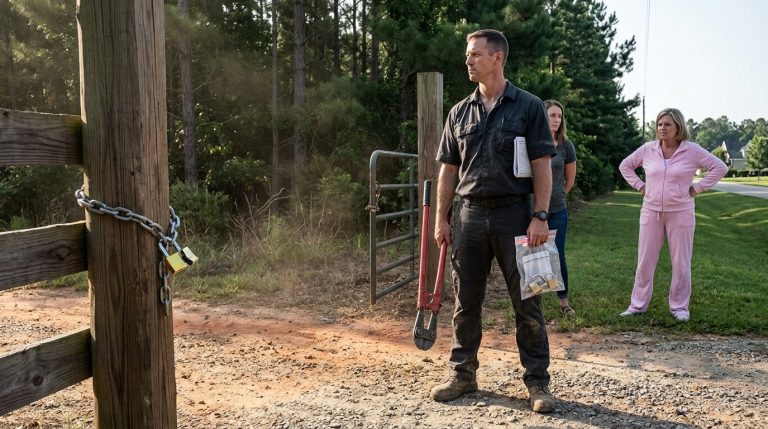
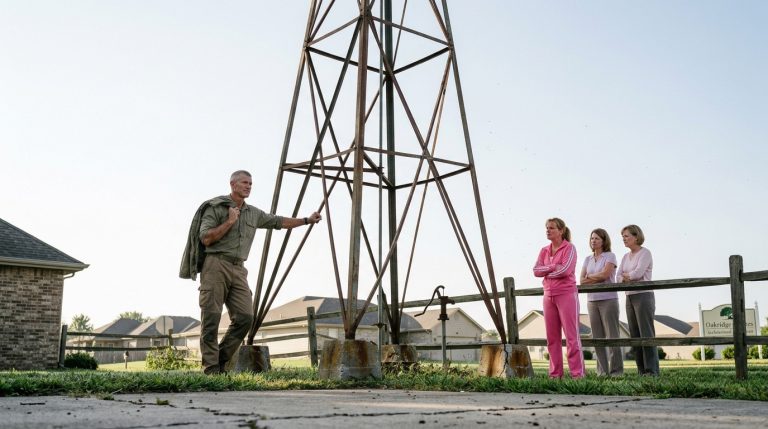
Jack stood on his own porch, a ceramic mug of rapidly cooling black coffee cradled in his hand, staring down at the woman planted squarely on his lawn as if she owned the dirt beneath her designer shoes. This was Karen, president of the Oakwood Preserve Homeowners Association—a caricature of suburban tyranny whose brightly colored pantsuit strained to contain her perpetual self-righteous indignation. Flanking her were two board cronies: Carol, a pinched-faced woman clutching a clipboard like a religious relic, and Bob, a beefy, silent shadow of a man standing just beyond the ancient, gnarled oak that marked the property’s unofficial boundary line.
The tree was older than the state itself, its roots blissfully ignorant of the meticulously manicured, HOA-approved lawns just a few feet away. The structure in question was Jack’s newly completed smokehouse—a rustic monument of fieldstone and thick cedar built by his own hands to honor a grandfather who had taught him the slow, patient art of curing meat. It sat a hundred yards back, tucked near the tree line of his acre.
Karen’s eyes did not see a tribute. They saw a violation.
“I think you’re mistaken,” Jack said, his voice dropping into the flat, dangerously controlled register he had honed over twenty years in the infantry. “You’re on my property, and that smokehouse is on my property. It has nothing to do with you.”
Karen let out a short, sharp laugh that sounded like a startled bird. “Mr. Miller, your property is within the Oakwood Preserve community. That makes it our business. Article Seven, Section Four clearly states any outbuilding over one hundred square feet requires pre-approval from the architectural review committee.” She tapped a manicured nail against her clipboard. “You never submitted a plan. You never paid the fee. The fine is ten thousand dollars, plus five hundred dollars per day until it is removed.”
Jack’s jaw tightened. He looked past her at the endless rows of identical houses with their identical mailboxes. His great-grandfather had staked this claim in 1903, long before a developer ever printed a glossy brochure for Oakwood Preserve. He took a slow sip of the bitter coffee, letting the silence stretch until Karen’s confident smile began to fray at the edges.
“Karen,” Jack said, stripping her name of any polite prefix. “My property is not part of your association. You have no jurisdiction here.”
Her smile vanished, replaced by a cold, hardened glare. “We’ll see what the county court says when we place a lien on your home. Remove it, or we will.”
She turned with a sharp pivot, her cronies falling into formation behind her as they marched back toward the pristine suburban sidewalk. Jack stood frozen on the porch as the screen door slammed behind him with a sharp crack, his pulse hammering a steady, tactical rhythm against his ribs. She thought she was bullying another compliant homeowner, entirely unaware that she had just crossed paths with a land patent older than her entire subdivision.
CHAPTER 2: THE CEDAR VAULT
The vibration of the slammed screen door still thrummed through the floorboards of the kitchen, a sharp, metallic reminder that the front line had officially moved from the perimeter to the porch.
Jack did not blink. He stood frozen for a beat, his gaze locked on the empty stretch of manicured lawn where Karen’s brightly colored pantsuit had vanished. The autumn wind kicked up suddenly, a cold gust that rattled the dry leaves of the gnarled oak against the windowpane with a dry, scratching rasp. It was an abrupt, minor atmospheric shift, but it forced an instant physical adjustment; Jack pulled his light jacket tighter across his chest, his boots shifting on the hardwood. The bitter coffee in his mug had gone completely cold, the dark surface flat and unmoving.
He turned away from the glass. The transition was immediate, driven by cold calculation rather than raw fury. Rage was a sloppy, inefficient fuel; what burned beneath his ribs now was the quiet, methodical heat of a veteran running a threat assessment.
He crossed the length of the kitchen, his steps heavy and measured against the floor, and walked down the short hallway toward his office. The door was half-open, casting a pale rectangular slice of morning light across the worn carpet. Inside, the room smelled of old paper, aged oak, and the faint, sweet trace of pipe tobacco left behind by a generation that had vanished decades ago.
Jack bypassed the clean expanse of his modern mahogany desk—the one cluttered with laptop screens and project management notes—and walked straight to the back corner of the room. There, half-tucked beneath a heavy wooden shelving unit, sat the footlocker.
It was a relic from a different era. Bound in darkened, oxidised iron straps and constructed from thick, fragrant red cedar, the trunk had weathered two world campaigns in the Pacific before finding its final resting place in this quiet corner of the Idaho foothills. Jack knelt, his joints popping with a dull ache, and reached out. His fingers brushed against the cold iron latch. The metal was frigid, biting sharply into his skin.
He flipped the latches open with two sharp, metallic snaps that echoed loudly in the confined space of the office.
Lifting the heavy lid required a deliberate surge of leverage. The hinges groaned, a dry, protesting squeal that seemed to peel back the layers of decades past. Instantly, the dense, suffocating scent of historical preservation billowed upward—a rich cocktail of dry wood pulp, fading ink, and chemical protectants.
Beneath a neat arrangement of his grandfather’s tarnished service medals and his father’s dog-eared high school yearbooks lay the true objective: a heavy, oil-tanned leather portfolio secured by a hardened leather thong.
Jack did not hesitate. He slid his hand beneath the portfolio, lifting it with the gentle, reverent care one might afford an unexploded ordinance, and carried it over to the desk. He set it down with a muted thud. The leather surface was scarred and cracked like old skin, mapped with the history of a family that had dug its roots deep into this dirt while the rest of the world paved over its history.
His fingers worked the leather knot, untying the strap with practiced efficiency. The flap folded back, revealing a dense stack of documents protected by stiff interleaving vellum.
He bypassed the tax receipts of the nineteen-twenties, the water-stained bills of sale from post-war livestock purchases, and the handwritten farming ledgers. At the very bottom, shielded beneath a translucent sheet that had yellowed gracefully over the decades, rested the crown jewel.
Land Patent Number 78,432.
Jack pulled the document into the center of the desk, adjusting the angle of the brass desk lamp to catch the delicate play of light across the page. The paper was not modern copy stock; it was thick, heavy vellum with the distinct texture of beaten cloth. The text was rendered in the immaculate, sweeping copperplate script of a nineteenth-century clerk, preserved in iron-gall ink that had aged to a deep, bruised charcoal.
At the bottom, bold and unyielding, sat the handwritten signature: executed by a designated clerk on behalf of President Theodore Roosevelt in the spring of 1903.
It was a direct grant from the United States government, issued under the absolute authority of the Homestead Act. It declared that the sovereign tract of land known as Parcel ID 123-45-678 was granted unto Elias Miller, his heirs, and his assigns forever. No conditions of modern municipal incorporation. No surrender of sovereignty to private developers. No carve-outs for neighborhood architectural committees that wouldn’t exist for another hundred years.
Jack traced the edge of the signature with the pad of his thumb. The paper was cool, rigid, and impossibly durable.
A sharp, vibrating chime broke the silence of the office.
Jack didn’t jump. He simply glanced up at his cell phone resting near the corner of the desk. The screen flashed with an incoming text notification, the name Sarah glowing in bright letters against the dark glass. She must have finished her coffee in the kitchen, watching him from the periphery of the storm. He ignored the screen, letting it fade back to black.
The digital age could wait. Karen and her board were operating under the arrogant delusion that they held all the cards, armed with bylaws printed on glossy cardstock last Tuesday and enforced by clipboard-wielding tyrants who couldn’t read a real legal chain of title if it bit them. They were playing a game of municipal intimidation on a board where the rules had been written by the federal government a century before their subdivision was even a developer’s pipe dream.
Jack pulled his phone closer, unlocked it with a firm swipe, and opened the camera application. He switched the resolution to its absolute maximum, disabling the flash to prevent glare against the vellum.
He leaned over the desk, keeping his breathing steady, and framed the top header of the land patent within the digital viewfinder. The red focus square snapped shut with a tiny electronic click. He tapped the shutter. The silent capture flashed across the screen. He took a second shot of the signature block, a third of the boundary survey map drawn in faded blue ink, and a fourth of the original government seal embossed into the lower corner.
Each photo was crisp, high-definition, and captured every micro-fiber of the historical paper.
Jack locked the phone and tossed it onto the blotter. He picked up the leather portfolio, carefully smoothing the vellum back over the document before retying the leather thong. The rustling of the paper sounded like dry brush moving in the wind.
He stood up from the desk, his muscles coiling with a sharp, focused energy. The reconnaissance phase was over. The enemy had marched onto his lawn, issued an unconstitutional decree, and set a fourteen-day countdown clock ticking. What they didn’t understand was that every single day they spent waiting for him to capitulate was another day he was fortifying his position.
The screen door in the kitchen creaked open again as Sarah stepped down the hall, her footsteps light but hesitant. Jack walked toward the office door, the leather portfolio clutched firmly in his left hand, ready to begin drafting the response that would tear their little suburban empire apart piece by piece.
CHAPTER 3: THE FIRST VOLLEY
The rustle of vellum settling back into its leather housing sounded dry and final against the polished mahogany of the desk. Jack did not linger over the document. He slid the portfolio aside, leaving only the glowing screen of his cell phone and a blank legal pad within his field of vision. The air in the office felt dense, heavy with the silent accumulation of history, but his focus was entirely trained on the immediate tactical horizon.
He picked up the phone, unlocked it with a firm press of his thumb, and dialed a number etched into his memory as clearly as a tactical grid coordinate.
The phone rang twice before a sharp, no-nonsense voice cut through the line. “Jensen.”
“Dave,” Jack said, his tone flat and level. “They didn’t waste time. The threat window is open.”
On the other end of the line, a sudden shift in ambient noise—the scrape of a leather chair and the heavy thud of a file drawer closing—signified that Dave was instantly on high alert. “Give me the coordinates, Jack. Did they drop the formal notice yet?”
“Not yet, but the advance elements were on my lawn this morning,” Jack replied, keeping his eyes fixed on the rain-streaked windowpane across the room. A stray thought brushed the edge of his consciousness—a cold, fleeting flash of doubt regarding whether nineteenth-century federal land grants could withstand modern municipal zoning amendments before he ruthlessly suppressed it. The law was the law; a chain of title that began with Theodore Roosevelt did not dissolve because a suburban developer planted turf over the perimeter. “Karen and two of her board members showed up. They cited Article Seven, Section Four. Demanded a ten-thousand-dollar fine and threatened a property lien if the smokehouse isn’t demolished within fourteen days.”
A low, humorless whistle hissed through the receiver. “Ten grand plus daily penalties. Textbook shock-and-awe intimidation. They’re trying to force a quick capitulation before anyone looks at the plat maps.” Dave’s voice dropped into a gravelly, clinical register, the tone he used when prepping a case briefing before a tribunal. “Good. Let them overextend. Did you pull the patent?”
“High-res scans are sitting on my local drive right now,” Jack said. “Along with the original survey maps and the 2001 developer plat showing our acre carved out as a non-included parcel.”
“Perfect. That’s our anchor,” Dave said, papers rustling sharply in the background. “Here’s how we run the counter-offensive. We don’t yell, and we don’t argue on the phone. We draft a formal legal instrument. You are going to lay out the chain of title as an unbroken series of indisputable facts, and then you are going to drop a tactical warning regarding slander of title under state statute. Make it cold. Make it surgical. If they proceed with a lien knowing they have zero jurisdiction, they aren’t just overreaching—they’re handing us a loaded weapon with their own signatures on the trigger.”
“Drafting it now,” Jack said.
“Send me a draft before you print,” Dave instructed. “We want absolute zero legal bleed. If we leave a single loophole, their corporate insurance lawyers will try to wiggle through it. Hit hard, hit clean, and make sure they understand that any further trespass or communication is documented for court.”
The line clicked dead with a sharp tone. Jack dropped the phone onto the blotter and pulled the mechanical pencil toward him.
For the next two hours, the office fell into a deep, rhythmic silence broken only by the steady scratch of graphite against paper and the rhythmic clack of the keyboard as Jack translated his tactical resolve into formal prose. He did not write out of anger; anger was an uncalculated expenditure of energy. He wrote with the cold, methodical precision of an operator drafting an after-action report. He cited the parcel ID, quoted the exact legal precedents Dave had rattled off, and embedded high-resolution references to the 1903 patent directly into the body of the text.
When the final document was polished to a razor-sharp edge, he forwarded it to Dave, received an immediate, approving confirmation, and printed ten pristine copies on heavy bond paper. Each envelope was addressed with meticulous care—one for each board member, one for their management company, one for their listed legal counsel, and one for his own permanent archive.
Jack stood up from the desk, stretching his shoulders against a dull knot of tension, and walked out of the office toward the front door. The house was quiet, save for the faint hum of the refrigerator down the hall. He slipped into his jacket, picked up the stack of heavy envelopes, and stepped out onto the porch.
The autumn air hit him with a crisp, biting edge, smelling faintly of woodsmoke and damp earth. He walked down the long driveway toward the roadside mailbox, his boots crunching rhythmically against the gravel. The street was dead silent, lined with its uniform rows of beige houses and identical mailboxes—a fragile facade of absolute control built over a foundation of sand.
Jack opened the heavy metal door of the box, slid each certified envelope into place with deliberate slaps of paper against metal, and pulled the red flag up with a sharp metallic snap.
The first volley was away. The bureaucracy had tried to weaponize paper against him; he had answered with an anvil. He turned back toward the house, his gaze lingering on the distant silhouette of the cedar smokehouse standing firm against the tree line, knowing the shock wave from his response would hit their desks by morning.
CHAPTER 4: THE SURVEILLANCE GRID
The red metal flag of the roadside mailbox remained rigidly upright, a stark, solitary marker against the uniform rows of beige stucco and trimmed turf across the asphalt. Jack did not rush his return. He turned on his heel, his heavy boots crunching deliberately back up the long, gravel-paved driveway as the cold autumn wind whipped through the branches of the ancient oak overhead.
The first volley was out in the postal stream, but in asymmetric conflicts, stationary defenses were liabilities. If Karen and her board operated like an undisciplined insurgent force relying on surprise intimidation, his response had to be absolute terrain dominance.
He pushed open the side door of the house and stepped into the mudroom, the smell of seasoned hickory and cold autumn air clinging to his jacket. Shedding his outerwear, he walked straight to the kitchen island where a large cardboard carton sat half-unpacked, its contents bristling with weatherproof composite lenses, mounting brackets, and spools of heavy-duty conduit cable.
Jack hauled the box over to the kitchen table, slicing through the packing tape with a utility knife with sharp, efficient strokes. Inside sat a commercial-grade security kit—four high-definition pan-tilt-zoom cameras equipped with night-vision infrared arrays and an independent network video recorder.
He didn’t wait for a professional installation crew. This was perimeter security, and like every outpost he had ever maintained, it was a task that brooked no margin for error.
For the next four hours, Jack worked with methodical precision. He hauled a heavy aluminum extension ladder out from the garage, leaning it against the sharp roofline of the front porch. The physical exertion was grounding; every lift of the ladder, every twist of a stainless-steel mounting screw into the dense cedar siding, felt like driving stakes into a defensive line. He positioned the first camera high above the front entry, its wide-angle lens sweeping the entirety of the approach walkway and the property line where Karen had planted her feet during the incursion.
A sudden, sharp memory flickered unbidden through his mind—an old sector defense patrol in a jagged mountain valley years ago, where missing a single blind spot behind an outcropping meant inviting an unannounced flank. Jack suppressed the phantom echo with a cold breath, adjusting the camera angle downward by two degrees until the digital feed on his pocket monitor locked onto the exact perimeter boundary.
He mounted the second camera above the garage door, commanding the long stretch of the driveway where trash cans and delivery trucks habitually passed. The third unit was rigged high on the back corner of the main house, trained down the grassy corridor leading straight to the rustic cedar smokehouse.
Inside his office, Jack set up the dedicated Network Video Recorder, hardwiring it into a secure secondary router tucked behind the bookshelves. He spent an hour configuring the motion-detection zones, setting up instantaneous push notifications to his phone and an automated hourly cloud backup that mirrored every frame off-site. If anyone stepped foot across the unapproved boundary line—whether to steal trash cans, plant fraudulent violation notices, or trespass on his land—the system would capture them in pristine four-thousand-pixel definition from three distinct angles.
As the sun dipped below the distant jagged line of the foothills, casting long, bruised shadows across the manicured lawns of Oakwood Preserve, Jack sat back in his desk chair. He tapped the mouse, bringing up a split-screen quad-grid on his monitor. Four live feeds stared back at him: the dark, empty front porch; the quiet, sloping driveway; the silent wooden silhouette of the smokehouse bathed in faint infrared glow; and the side yard where the dry autumn grass swayed in the wind.
His cell phone vibrated sharply against the desk wood.
Jack picked it up. A new text message blinked on the screen from an unknown local number, but the preview text told the entire story: Mark.
He unlocked the screen and opened the message. She got the certified letter about two hours ago, Mark wrote, his digital words clipped with nervous tension. I was at the management office dropping off a maintenance form. Karen went into her office, came out ten minutes later looking like she’d swallowed glass, and called an emergency closed-door board meeting for tomorrow night. They’re panicking, Jack, but she’s doubling down. Watch your back.
Jack stared at the glowing text, a cold, hard satisfaction settling deep in his chest. Panic was the first stage of structural collapse. They had received the legal warning, reviewed the immovable facts of the 1903 land patent, and instead of backing down, their collective pride was driving them straight toward the trap.
He set the phone face down on the blotter, locked his office door with a heavy mechanical click, and walked over to the window. Out in the gathering dusk, the neighborhood looked peaceful, bathed in the warm, artificial glow of porch lamps and manicured streetlights. But beneath the pristine surface, the fault lines were fracturing. Karen had fired the opening shot of a petty neighborhood war, entirely unaware that she had just walked her entire board into the kill zone.
CHAPTER 5: THE COMMUNITY FRACTURE
The glow of the quad-screen monitor cast a steady, pale blue light across the dark grain of the desk. Jack did not stay glued to the chair. He pushed himself up from the leather seat, the casters rolling slightly against the low-pile carpet, and turned his back on the digital grid. The perimeter was secured, the cameras were streaming clean feeds, but wars were never won entirely from a command console.
The text message from Mark sat glowing faintly on his phone screen. They’re panicking, Jack, but she’s doubling down.
A low-grade insurgency required more than a strong defensive perimeter; it required intelligence from inside the enemy’s camp.
Forty-eight hours after the security grid went live, the coordinates shifted from Jack’s office to a dimly lit basement three doors down. Mark’s house looked identical to every other beige stucco box on the block from the exterior, but beneath the floorboards lay an entirely different ecosystem—a finished den smelling faintly of old sports memorabilia, damp carpet, and stale malt.
Jack stepped through the sliding basement door, ducking slightly beneath the low header. The room was not crowded, but the men gathered around the scarred laminate poker table carried an unmistakable intensity. Mark stood near a small kitchenette, nervously wiping his hands on a dish towel, while George—a retired accountant whose classic car had once earned him an arbitrary HOA citation—sat nursing a glass of bourbon.
“You got my text,” Mark said, his voice dropping to a cautious whisper as Jack walked over.
“I got it,” Jack replied, his voice flat and controlled. He pulled out a folding metal chair and sat down, resting his forearms on the edge of the table. “If Karen called an emergency closed-door meeting right after receiving the certified letter, it means the legal warning hit the target. They aren’t ignoring us anymore.”
George let out a dry, humorless chuckle, swirling the amber liquid in his glass. “Ignoring you? Not a chance. My wife ran into Carol at the mailbox yesterday. Poor woman looked like she hadn’t slept in a week. Karen’s been screaming behind closed doors, telling the board that your land patent is a sovereign citizen fairy tale and that if they back down now, the whole community will fall apart.”
Jack’s eyes narrowed slightly, catching a minor detail across the room—a missing coaster on the edge of the laminate table where a wet ring had formed, mirroring the quiet erosion of order upstairs. “She’s protecting her narrative,” Jack said softly. “If she admits my property is outside her jurisdiction, the rest of the homeowners will start asking where their fine money actually went.”
“That’s the exact problem,” Mark leaned in, lowering his voice further. “Word is leaking out. The board has been pulling money from the general operating account into an unlisted line item for discretionary legal defense. They aren’t just spending association dues on lawn warnings; they’re draining the reserve fund to finance this personal vendetta.”
Jack listened without interrupting, cataloging every piece of intelligence. The pieces were falling into place with mathematical precision. Karen’s autocratic control over the board was entirely dependent on maintaining the illusion of absolute authority, but her aggressive overreach was beginning to fracture her own lines of support.
“We need a formal counter-weight,” George said, leaning forward, his accountant’s eyes sharp and analytical. “If they try to push a formal lien through county records, a single homeowner fighting back looks isolated. But if a collective block of residents formally petitions the management company to audit the board’s financial allocations… well, that changes the battlefield entirely.”
Jack reached into his jacket pocket and pulled out a slim manila folder, sliding it silently across the laminate table. Inside sat anonymized transcripts of state statutes regarding fiduciary duty and corporate overreach that Dave had helped outline as a contingency framework.
“Don’t file a petition yet,” Jack instructed, his tone brooking no argument. “Let them make the next move. If they file that lien, they cross a legal threshold from civil annoyance into slander of title. Once they commit that document to the public record, the corporate shield protecting individual board members shatters.”
Mark opened the folder, his fingers brushing the edge of the crisp paper. “And if they do?”
“Then we drop the hammer,” Jack said quietly. “We don’t just defend this acre. We tear their entire administrative structure down to the studs.”
The basement fell silent, save for the low hum of the refrigerator in the corner. The alliance was forged not in anger, but in cold, calculated strategy. Upstairs, the quiet streets of Oakwood Preserve remained wrapped in their artificial suburban peace, unaware that the ground beneath their feet was about to give way.
CHAPTER 6: THE RED INK
The heavy metal door of Mark’s basement closed with a dull, muffled thud behind Jack as he stepped back out into the cool Idaho night. The air was sharp, biting lightly against his skin, carrying the faint, distant scent of woodsmoke and damp earth. He did not linger on the manicured pavement. He walked the three doors down in silence, his boots rhythmic against the concrete, his mind already cycling through the actionable data extracted from Mark’s briefing.
The strategy was set. The underground alliance was forming. But a war of attrition required hard financial proof to crack the corporate shield Karen had wrapped around her board.
Jack unlocked the side door of his house, stepping past the mudroom into the quiet warmth of the hallway. He bypassed the kitchen and walked straight down to his office, his fingers flicking the wall switch to bathe the room in a sharp, focused beam of white light from the brass desk lamp. The quad-screen monitor glowed softly in the corner, its infrared camera feeds casting ghostly monochrome shadows of the empty driveway and the distant cedar smokehouse.
He sat down in the leather chair, pulling the keyboard toward him with a quiet scrape of plastic against wood.
The digital evidence locker on his encrypted secure drive was already filling up, but the missing piece—the financial plumbing of the Oakwood Preserve Homeowners Association—remained locked behind proprietary management software. Dave’s legal offensive had triggered a formal request for production, but corporate boards didn’t hand over their accounting ledgers out of polite cooperation. They stalled, they redacted, and they concealed.
A sharp crackle of static suddenly sliced through the quiet room, followed by an electronic chime from the desktop speakers as an encrypted file transfer completed from Dave’s secure server.
Jack clicked the notification icon. A compressed archive popped up on his screen, labeled HOA_FINANCIAL_DISCLOSURES_UNREDACTED.PDF.
He opened the document. The first few pages were standard corporate boilerplate—inflated landscaping invoices, routine electricity bills for the common-area streetlamps, and standard management fees. But as Jack scrolled deeper into the subsidiary ledgers, past the clean rows of standardized community maintenance, the ink began to tell a very different story.
The numbers didn’t match the public disclosures distributed at annual homeowner meetings.
Jack leaned closer to the monitor, his eyes scanning the columns of transaction codes with the cold, analytical intensity of an intelligence officer reading an intercepted signal intercept. There was a separate, unlisted account—a discretionary slush fund routed through a secondary corporate entity registered under a management alias. And feeding that account were thousands of dollars collected from arbitrary, punitive homeowner fines.
The fine levied against George for an oil stain on his driveway. The fee extracted from Maria for an unapproved door color. The escalating penalties threatened against Jack’s smokehouse. None of that capital went back into community reserves or infrastructure upkeep.
Jack traced a line of transactions down the page, his jaw tightening into a hard line. The money was being funneled outward.
A series of recurring charges caught his eye: a three-hundred-dollar expenditure at a high-end regional spa, billed under administrative consulting; a luxury hotel reservation in a neighboring resort city; and recurring payments made to a local landscaping subcontractor owned by a relative of Karen’s inner circle. The fines collected from residents under the guise of protecting property values were essentially serving as a personal piggy bank for Karen’s lifestyle and patronage network.
The smokehouse wasn’t a genuine covenant violation. It was simply the largest target they had manufactured yet—a high-dollar penalty designed to feed a corrupt executive slush fund that was rapidly running dry.
Jack picked up his phone, dialed Dave’s direct line, and waited through a single ring before the lawyer answered.
“I’m looking at the ledger drops,” Jack said, his voice flat and controlled.
“Pretty, isn’t it?” Dave replied, a cold, sharp edge of satisfaction cutting through his tone. “They thought they could hide behind corporate confidentiality clauses. What you’re looking at isn’t just a breach of fiduciary duty—it’s systematic financial exposure. They’ve been using homeowner penalties as a slush fund.”
“It’s more than that,” Jack said, his eyes fixed on the glowing line items detailing the spa and resort charges. “They aren’t just overreaching. They’re structurally vulnerable. If we drop this into the public record alongside the land patent, her entire administrative base collapses.”
“Hold your fire just a little longer,” Dave cautioned. “Let them make one final procedural mistake. Let them file that formal lien at the county recorder’s office. Once they attach a fraudulent claim to your title using funds from an unverified slush fund, the slander-of-chapter charge becomes airtight. We won’t just win a settlement; we’ll completely obliterate their legal standing.”
“Understood,” Jack said.
He ended the call, dropped the phone back onto the blotter, and saved a local encrypted copy of the financial ledger. The puzzle was complete. The perimeter was secured, the alliance was anchored, and the enemy’s internal corruption was fully mapped. All that remained was for Karen’s pride to drive her straight into the trap they had meticulously laid.
CHAPTER 7: THE PUBLIC EXPOSURE
The cursor blinked steadily against the edge of the encrypted ledger file on the desktop screen. Jack did not blink. The digital evidence of Karen’s financial embezzlement lay exposed in stark black and white, but raw data sitting on a private hard drive was nothing more than an unexploded round buried in the dirt. To neutralize an autocrat who weaponized public perception, the data had to be deployed into the light.
He leaned back in his leather chair, the leather groaning under his shift in weight, and reached out to pick up his cell phone.
The strategy was already mapped with Dave. While the legal machinery ground forward toward the county courts, the court of public opinion offered a far faster detonation vector.
Jack dialed a direct number he had saved earlier that afternoon—the desk line of Jessica, an investigative reporter for the local television affiliate who had spent months sniffing around municipal overreaches. The phone rang twice before a crisp, professional voice answered.
“News desk, this is Jessica.”
“Jessica,” Jack said, his voice flat, steady, and devoid of performative anger. “This is Jack Miller. 150 Old Farm Road.”
There was a sharp rustle of papers on the other end of the line, the immediate sharpening of an investigative instinct locking onto a developing lead. “Mr. Miller. The property with the historical land patent fighting the Oakwood Preserve HOA. You said you had documentation regarding financial irregularities within the association.”
“I don’t just have documentation,” Jack replied, his gaze flickering to the quad-screen monitor where the infrared camera caught the empty, silent stretch of his driveway. “I have the unredacted subsidiary ledgers, internal board email chains proving willful disregard of legal jurisdiction, and a documented paper trail showing homeowner fines being diverted into personal slush funds for luxury expenses.”
A brief pause hung over the line, thick with professional calculation. “Can you verify authenticity?”
“Every file is time-stamped, digitally signed, and backed by sworn discovery requests currently moving through the county legal system,” Jack said evenly. “If you want a masterclass in how a suburban homeowners association operates as an unaccountable skimming operation, come out to the property. I’ll lay the evidence out on the table.”
“Name a time,” Jessica said without hesitation. “Tomorrow morning at ten.”
“Done.”
Jack ended the call and tossed the phone onto the blotter. He stood up, stretching his arms, and walked over to the window. The night outside was pitch black, broken only by the amber glow of the distant streetlamps lining the uniform subdivisions of Oakwood Preserve. Karen thought she was playing a quiet game of municipal intimidation, protecting her pristine little kingdom from a perceived outsider. She had no idea that the architecture of her entire regime was about to be blown wide open on the six o’clock news.
By the following morning, the tactical preparations were complete. The website—oakwoodpreserve-reform.com—was primed to go live simultaneously with the broadcast launch, hosting clean, public-facing copies of the land patent, the survey maps, and the financial spreadsheets with the incriminating line items circled in red.
When the news van pulled up the long gravel driveway at precisely ten o’clock, Jack was waiting on the porch. He wore a simple, unbranded dark polo shirt, refusing to hide behind military service or dramatic posturing. He was simply a landowner defending his home.
Jessica stepped out of the van with a small production crew trailing behind her, their camera lenses catching the rugged, beautiful lines of the cedar smokehouse standing proudly against the tree line in the background.
“Mr. Miller,” Jessica greeted him, shaking his hand with a firm, professional grip. “Let’s start with the basics. Walk me through what this land actually means to you.”
Jack didn’t rush. He guided her through the history of the acre, pulling the heavy leather portfolio out and laying the 1903 land patent across the wooden table on the porch. He explained the chain of title with absolute, unyielding clarity, his voice carrying the calm authority of a man who knew the law was entirely on his side.
When the interview shifted from history to current events, Jack laid out the reality of the harassment—the arbitrary fines, the missing trash cans, the relentless surveillance, and finally, the fraudulent lien filed against his title.
“This was never about a smokehouse,” Jack said, looking directly into the camera lens with a steady, unblinking gaze. “It was never about property values or architectural compliance. It was about control, and about funding a system that preys on homeowners who don’t know their rights.”
The interview aired that evening, perfectly synchronized with the activation of the reform website. The impact was instantaneous.
Within hours of the broadcast, the digital traffic on the reform site spiked into the thousands. The local neighborhood Facebook groups, once tightly moderated bastions of Karen’s cheerleading squad, erupted into an open revolt as residents shared screenshots of the unredacted financial ledgers showing where their hard-earned fines had actually gone.
Karen had built a fortress of petty bylaws and intimidation, but she had constructed it entirely out of glass. And the first stones were already falling.
CHAPTER 8: THE DEPOSITION TRAP
The fluorescent lights of the conference room hummed with a flat, sterile vibration that seemed to strip the oxygen from the air. Jack did not fidget. He sat upright in the ergonomic chair at the end of the long mahogany table, his hands resting flat against the wood on either side of a thick, tabbed binder of evidence. Across the table, behind a barrier of legal pads and corporate retainer agreements, sat Karen.
She looked entirely different from the woman who had marched onto his lawn weeks ago. The vibrant colors of her signature pantsuit had been replaced by a muted, charcoal-grey blazer, her posture rigid and her face tight with a brittle, defensive tension. Flanking her were two attorneys: Todd, the slick young counsel whose confidence had visibly evaporated since his name was added to the slander-of-title suit, and a grim-faced insurance defense lawyer sent by the carrier to contain the corporate hemorrhage.
Dave sat directly to Jack’s right, flipping a stainless-steel pen back and forth between his fingers with rhythmic, controlled precision.
The court reporter, sitting quietly behind a stenograph machine near the corner, gave a slight nod. “We are on the record. State your name for the stenographer, please.”
“Jack Miller,” he said, his voice flat, even, and devoid of inflection.
The deposition had begun. Under standard civil procedure rules, this was the crucible where testimony was locked under oath before ever reaching a courtroom jury. Dave leaned forward, resting his forearms on the table, and fixed his gaze squarely on the insurance defense lawyer before shifting his attention to the HOA president.
“Let’s direct our attention to the morning of October twelfth,” Dave began, his tone deceptively conversational, carrying the cold edge of an investigator reviewing a tactical map. “Mrs. Karen, prior to authorizing the formal lien recorded against parcel ID one-twenty-three-forty-five-dash-six-seventy-eight, did you or anyone on your executive board personally inspect the original county plat maps or verify the sovereign land patent status with the county recorder?”
Karen’s jaw tightened. She shifted her weight, the leather of her chair squeaking softly in the quiet room. “The association operates under established community covenants. My duty as president is to protect property values from unauthorized structures. I don’t have to waste time entertaining historical fairy tales.”
Dave didn’t blink. He didn’t raise his voice. He simply reached into his binder and slid a single sheet of paper across the polished mahogany toward her—a certified copy of the first warning letter Jack had mailed months prior, bearing Karen’s own spiky, arrogant signature on the green return receipt.
“That is a very interesting speech, ma’am,” Dave said smoothly. “Let’s stick to the record. On September fourteenth, my client delivered this formal legal notice containing photographic and document-based proof of United States Land Patent Number 78,432. Did you read this document?”
Karen glanced down at the paper as if it were contaminated. “I saw it. It was garbage.”
“Did you forward that document to independent legal counsel specializing in real estate property law before you initiated the fine?”
“I consulted with Todd,” she snapped, gesturing sharply toward the young lawyer beside her.
Dave turned his cold gaze onto Todd. The junior attorney swallowed hard, his eyes darting nervously toward the insurance counsel. “For the record, Mr. Todd,” Dave asked, his voice dropping an octave, “did Mrs. Karen permit you to examine the land patent’s legal chain of title, or did she instruct you to bypass the verification process to enforce the fine?”
The room fell into an absolute, suffocating silence. The hum of the fluorescent lights suddenly sounded deafening. Todd looked down at his legal pad, his fingers gripping the edges of the desk so tightly his knuckles turned stark white.
“She… she instructed the board to proceed with the enforcement action,” Todd murmured, his voice barely rising above a whisper.
“Objection, foundation,” the insurance lawyer interjected sharply, leaning into his microphone, his face flushed with panic. “That question calls for privileged internal communications.”
“Withdrawn as to privilege, but the witness has answered,” Dave said smoothly, not breaking eye contact with Karen. He leaned back, letting the weight of the admission settle over the table like lead.
The trap was fully sprung. Karen had been formally warned, had been presented with indisputable federal documentation, and had willfully chosen to bypass the law to fund her personal slush fund. The corporate shield protecting her personal assets was effectively dissolving in real time under the glare of the sworn record.
Karen’s chest rose and fell in rapid, shallow breaths. The brittle mask of suburban authority was cracking, revealing the raw, unmitigated panic beneath. She knew, with sudden and absolute clarity, that her reign was over.
CHAPTER 9: THE RATS DESERT
The heavy silence inside the conference room stretched thin, brittle as old glass, holding the exact weight of Todd’s broken confession. Karen’s breath hitched, a sharp, ragged sound that cut through the low hum of the fluorescent lights. Her fingers clawed slightly at the charcoal-grey fabric of her blazer, her knuckles whitening as she stared across the table at the sworn deposition record.
Across the aisle, the insurance defense lawyer let out a slow, heavy sigh of absolute defeat, scrubbing a hand down his face as he realized the liability trap had snapped shut.
Dave didn’t press the attack immediately. In tactical interrogations, leaving a vacuum of silence was often more destructive than a barrage of questions; it allowed the enemy’s panic to do the work. He simply picked up his stainless-steel pen, twirled it once, and set it down.
Before Karen could recover her footing or launch into another defensive tirade, the heavy oak door of the conference room swung open with a soft click.
A local attorney specializing in civil liability slipped into the room, leaning down to whisper urgently into the ear of the insurance counsel, accompanied by the faint, rhythmic scratching of a fountain pen outside in the hallway. The insurance lawyer’s expression darkened from stressed to terminal. He whispered back a sharp reply, then looked directly across the table at Dave.
“We need a five-minute recess,” the insurance lawyer said, his voice clipped and strained. “My clients need a moment to confer outside the record.”
“Take ten,” Dave replied calmly, leaning back in his chair. “The record isn’t going anywhere.”
Karen stood up abruptly, her chair scraping harshly against the industrial carpet. Without a word to her legal counsel or the board members sitting down the hall, she turned on her heel and marched out of the room, her footsteps clicking with a frantic, desperate rhythm down the linoleum corridor.
Outside the conference room doors, the internal fractures of the board finally broke into the open.
Carol, the pinched-faced board member whose cousin was a paralegal, had been waiting in the adjacent holding room. As Karen stormed past, Carol’s personal attorney stepped forward, intercepting her in the hallway. Jack watched the exchange through the reinforced glass panel of the conference room door. He didn’t need to hear the words; he could read the physical posture—Carol’s attorney holding up a signed stipulation document, Carol shrinking away from Karen’s furious, stabbing finger, and the ultimate, undeniable body language of absolute surrender.
The rats weren’t just deserting the sinking ship; they were cutting their own lifeboats loose.
A few minutes later, the door creaked open again. Carol’s personal attorney poked his head inside, looking directly at Dave. “My client, Carol, is prepared to offer a full, unvarnished statement detailing the board’s internal voting irregularities and the deliberate bypassing of jurisdictional checks, in exchange for an immediate stipulation of dismissal and release from personal liability as a named defendant.”
Dave looked over at Jack, raising a single eyebrow in silent consultation. Jack gave a slow, deliberate nod.
“Put it in writing, sign it, and bring it back inside,” Dave said. “If her testimony matches the financial ledgers we pulled from the discretionary accounts, we’ll agree to sever her name from the slander-of-title claim.”
A second knock followed shortly after. Bob, the silent, beefy board member who had driven slowly past Jack’s house at two in the morning, sent his own legal representation through the door with an identical surrender offer. They were terrified—not of Jack, and not of the historic land patent, but of the very real prospect of losing their homes, their savings, and their retirement accounts to a multi-count civil judgment for malicious financial abuse.
Karen had demanded absolute loyalty while treating the board as her personal feudal domain. The moment the corporate shield shattered under the weight of actual accountability, her subjects scrambled over one another to escape the blast radius.
Jack sat quietly at the table, watching the paperwork slide across the mahogany. The legal offensive had evolved from a localized property dispute into a complete administrative collapse. Karen was entirely isolated now, trapped by her own ego, her own slush fund ledgers, and a board that had finally realized too late what kind of tyrant they had empowered.
The trap was no longer just baited; it was snapping shut with absolute, mechanical finality.