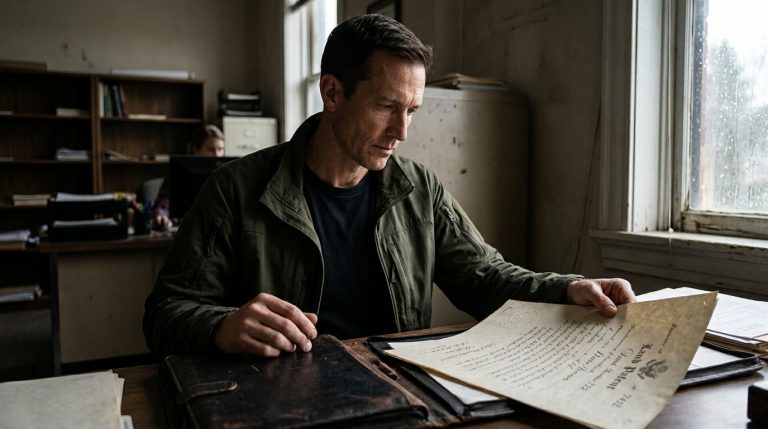
A Symphony of Sparrows: How a Blind Man and a Found Child Mended a Fractured Legacy
CHAPTER 1: The Weight of a Whisper
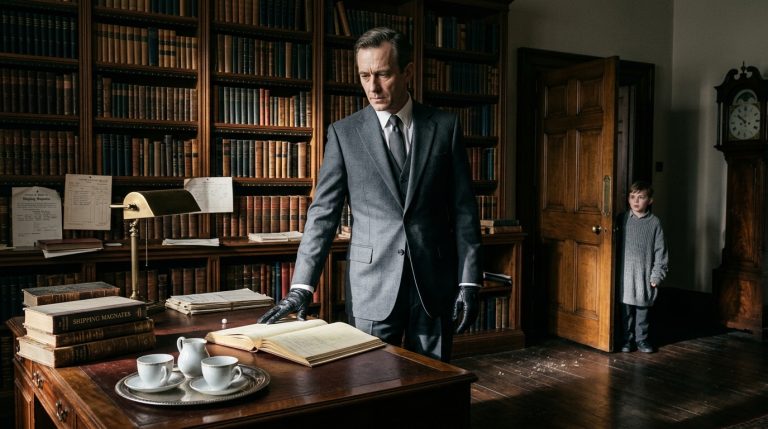
Theodore Whitlock did not jump. He had spent twenty-two years—seven thousand, nine hundred, and forty-two days—learning to control the instinctive flinch that claimed the lives of lesser men. His heart rate remained the steady, metronomic beat of a grandfather clock in a silent room.
“Son,” Theodore said, his voice a flat, polished stone. “Say that again.”
The boy, no more than six, shifted his weight. The scent was unmistakable: damp wool, the sharp, metallic tang of a life lived on street grates, and beneath it, the faint, sweet ghost of an orange. A child who was hungry, but who was also, for this specific second, a predator of details.
“He’s been watching you for three blocks,” the boy whispered, his fingers curling tighter into the charcoal wool of Theodore’s cuff. “He’s tall. Gray coat. Gloves. It’s sixty-eight degrees, sir. People don’t wear gloves unless they want to keep their prints off something.”
Theodore processed the math. Gloves on a warm morning. A man watching. A child who looked at the world through the serrated edges of necessity.
“Where is your hand right now?” Theodore asked, his cane hanging suspended, an extension of his own steady nerves.
“By your sleeve. I won’t let go.”
“Then we walk,” Theodore said. “Not like we’re afraid. We walk like two people who have nowhere to be and all the time in the world to get there.”
They stepped off the curb. The rhythm of the city—the aggressive blare of a taxi horn, the wheeze of the bus, the distant, frantic chatter of the vendor—seemed to recede, leaving only the sound of their own footsteps. Theodore felt the boy’s tremor. It wasn’t fear; it was the vibrating anticipation of a rabbit sensing the hawk.
They reached the far side. Theodore steered them toward the bakery awning, where the air was thick with the smell of yeast and burnt sugar. He didn’t turn back, but he didn’t need to. He could feel the shadow of the gray coat tracing the geometry of his movement.
“Is he still there?” Theodore asked, his voice barely a breath.
“He’s stopped,” the boy breathed, his eyes darting toward the street with a predator’s precision. “He’s pulled something from his pocket. It’s small, black, and heavy.”
Theodore’s hand drifted toward his phone, his thumb finding the raised, tactile bump he’d customized years ago. He pressed it twice. A single, disturbing realization settled into his bones: this wasn’t a mugging. This was a calculation. And for the first time in two decades, Theodore felt the terrifying, electric pull of a life that was finally, dangerously, moving again.
He leaned down, his face a mask of iron, but his heart hammering against his ribs like a bird in a cage. “What is your name, son?”
“Eli,” the boy whispered.
“Eli,” Theodore said, his voice lowering to a sharp, transactional whisper. “Keep looking. If that man moves toward us, you tell me the second his shoe leaves the pavement.”
As the boy tightened his grip, the air beneath the awning grew cold—not with the wind, but with the sudden, sharp scent of ozone, like a storm gathering just out of reach.
CHAPTER 2: The Geometry of Silence
Theodore did not move. He stood beneath the awning of the bakery, his back pressed against the cool, painted brick. The scent of burnt flour and yeast felt suddenly, unnaturally heavy, a suffocating blanket intended to mask the sharper, colder odor of the man with the gloves.
He could feel the boy’s breath, shallow and rapid, against his side. Eli’s hand remained locked onto the charcoal cuff of his overcoat. It was a small, frantic grip, the kind of tether a drowning man keeps on a life raft.
“He’s moving again,” Eli whispered. The words were a vibration against Theodore’s ribs. “He’s crossed the street. He’s walking toward the corner. He isn’t looking at the phone anymore, sir. He’s looking at us.”
Theodore’s internal clock ticked over—a precise, cold calculation. He had spent years transforming his blindness into a radar of shifting air currents and auditory shifts. He heard the friction of the gray coat against the damp morning air, the rhythmic, heavy tread of leather soles on cracked pavement, and the sudden, unnatural silence of the traffic as a taxi slowed, seemingly in response to the man’s trajectory.
“Eli,” Theodore said, his voice as steady as an anchor. “Are there people between us and him?”
“A lady with a stroller,” Eli murmured, his eyes fixed on the man. “She’s stopping at the crosswalk. There are men in suits—three of them—moving toward the coffee shop entrance. He’s weaving through them.”
“Good.” Theodore reached into his pocket. He did not pull the phone out, but he gripped it, his thumb finding the raised tactile marker. He knew Margaret was already monitoring the precinct feeds, but that was for later. For now, he had to navigate the immediate physics of the threat.
The man in the gray coat was closing the distance. Theodore could hear the change in the air—the way the ambient noise of the block seemed to warp as the man approached. It was the presence of a predator who believed he was invisible.
“When he is five steps away,” Theodore whispered, his head turning with subtle, controlled precision toward the street, “you are going to let go of my cuff, run into the bakery, and call out to the baker. Use the name I’m going to tell you. Do not look back.”
“I can’t leave you, sir,” the boy whispered back, his voice thick with a sudden, fierce loyalty that Theodore had not expected and had no room to process.
“You aren’t leaving me. You’re securing the perimeter. Do it, Eli.”
The footsteps grew closer. Theodore heard the man inhale—a sharp, efficient sound—and then stop. The distance narrowed. Theodore felt the air pressure change as the man stood just feet away, the synthetic fabric of the gray coat whispering against the morning stillness.
“Nice morning for a walk, isn’t it, Mr. Whitlock?” The man’s voice was smooth, hollow, and entirely devoid of warmth. It sounded like paper being shredded.
Theodore turned his face toward the sound. He didn’t smile. He simply stood, his white cane resting against his boot, the epitome of a man who had nothing to hide and everything to calculate. “It depends on one’s definition of a walk,” Theodore replied, his tone polite, detached, and utterly unreadable.
The man in the gray coat shifted, his weight moving from his heels to his toes. Theodore heard the subtle click of a glove tightening over knuckles.
“Some people find the rhythm of the city distracting,” the man continued, drifting a step closer. The smell of cold rain and ozone rolled off him. “Others find it a perfect place to lose track of what’s important.”
“I have found,” Theodore said, his voice dropping into the quiet, resonant register he used in the boardroom, “that the things people try to lose are usually the things they eventually have to answer for.”
He felt Eli’s fingers tremble against his cuff, a signal of imminent movement. The moment was hanging by a wire. Theodore could feel the man’s tension, the way he was preparing to move, to speak, or to strike.
“Eli, now,” Theodore commanded.
The boy vanished. The sudden absence of the weight on Theodore’s arm was a physical shock. He heard the quick, sharp tap of small sneakers against tile as Eli bolted into the bakery.
The man in the gray coat lunged forward, but Theodore had already shifted his center of gravity. He tapped his cane once against the pavement—a sharp, percussive sound that echoed off the brick. In that same heartbeat, a delivery truck rumbled past on 5th, its engine a low, guttural roar that masked the scuffle.
Theodore did not flinch. He stood his ground, the center of a gathering storm, waiting to see what the man in the gray coat would do when he realized he was no longer alone.