Shattering the Beige Facade: How an Ancient Steel Windmill Broke a Tyrant and Restored Justice
CHAPTER 1: THE IRON FRAME
The rusted lattice of the windmill caught the pale morning light, casting long, geometric shadows across the dew-soaked grass. I kept my hand resting against the weathered steel leg, feeling the faint, rhythmic vibration of the gears turning high above. It was a familiar pulse, steady and unhurried, marking the passage of time in a world that had grown increasingly frantic and smooth-edged.
“That rustic monstrosity has to go,” Karen said. Her voice cut through the stillness like a dry saw. “You have thirty days to remove it, or the fines will be biblical.”
I did not turn around immediately. I studied the horizon where the line of manicured lawns met the distant treeline, a uniform expanse of beige and green that looked as though it had been stamped out by a machine. Karen stood just over the property line, her arms crossed tightly over a bright pink tracksuit that seemed to strain against the sheer force of her indignation. Her lips were pursed into a thin, white line, the universal sign of petty authority exercising its favorite muscle.
She was flanked by her usual retinue, Barb and Janice, two shadows who existed solely to nod in synchronized agreement. They looked at my grandfather’s property not with curiosity, but with a visceral, twitchy resentment. To them, a five-acre homestead in the middle of a planned development was an affront to their collective delusion of total control.
“Thirty days,” I murmured, finally letting my gaze shift toward her.
“Every day past that deadline adds two hundred dollars to your assessment,” she snapped, stepping an inch closer to my grass as if daring the sod to contaminate her sneakers. “The architectural committee has reviewed your file. That structure violates Article Nine. It is temporary, unauthorized, and frankly, an eyesore to anyone trying to maintain property values in this neighborhood.”
I let the silence stretch for a beat. Twenty years in the Army Corps of Engineers teaches you a great deal about structures, stress loads, and, most importantly, the difference between a real engineer and someone playing dress-up with a rulebook. Karen had the vocabulary of a bureaucrat and the temperament of an inquisitor, but she possessed zero understanding of what lay beneath her feet.
She assumed the windmill was a decorative whim. She assumed the old barn, the split-rail fence, and the towering steel wheel were relics of a bygone era left behind for aesthetic amusement. She had no idea that the silent mechanics above us were currently pressurizing the very pipes that fed her morning shower, her dishwasher, and the sprawling sprinkler system keeping her prize-winning petunias alive in the summer heat.
“Biblical,” I repeated, letting a slow, neutral smile touch the corners of my mouth. It didn’t reach my eyes. “That sounds like quite a flood.”
Karen blinked, momentarily derailed by my lack of panic. She was built for cowering compliance; resistance confused her calculus. “It’s not a joke, Major. We have legal precedent on our side.”
“Do you?” I asked softly.
I turned my back on her then, ignoring the sputter of indignation that immediately followed. I gave the steel leg of the windmill a solid, affectionate pat. The heavy iron gave off a dull, resonant clang that vibrated up through my palm. Let her write her letters. Let her draft her fines. She had just initiated a sequence of events she lacked the structural integrity to survive.
As I walked toward the old house, the sharp edge of the morning breeze carried a sudden, unexpected scent—not just the damp earth and cut grass, but the faint, metallic tang of copper, entirely unrelated to the windmill, lingering near the old pump house door as if someone had forced the rusted padlock just hours before.
CHAPTER 2: THE PAPER TRAIL AND THE PUMP HOUSE
I stood for a long moment by the heavy timber frame of the pump house door, my boots sinking slightly into the wet thatch of grass. The faint scent of copper didn’t belong to the elements; it belonged to fresh tools biting into aged brass locks. Someone had been testing the perimeter before Karen had even opened her mouth at the property line.
I reached down, my fingers wrapping around the iron padlock that secured the heavy oak door. It didn’t yield easily, but a sharp, practiced twist revealed what my eyes had already suspected: the shackle had been lightly scored, filed down just enough to weaken its integrity without snapping it completely. A subtle, deniable act of harassment, designed to test the physical defenses of the homestead while the legal battle was fought upstairs.
Inside the old house, the shadows stretched long across my grandfather’s roll-top desk. I didn’t turn on the overhead light. I preferred the gray, honest illumination of mid-morning filtering through the multipaned windows, catching the dust motes suspended in the quiet air.
Opening the heavy leather-bound folder was like opening a time capsule of practical engineering. The leather was cracked and dry, smelling of old paper, gun oil, and linseed. Inside rested the foundational documents of Oakridge Estates—not the glossy marketing brochures that current residents kept on their refrigerators, but the raw, unvarnished county filings from 1952 through 1978.
I pulled out Deed Book 412, Page 88.
The text was typewritten on onion-skin paper, crisp and indelible. It wasn’t just an easement; it was an infrastructural umbilical cord. When the original developer, Henderson, had carved the ten luxury lots out of the rolling hills surrounding my grandfather’s property, he hadn’t spent a dime on deep-rock granite trenching for a municipal water main. Instead, he had negotiated a permanent utility partnership. My grandfather’s artesian well, driven one hundred feet into the water-bearing strata, powered by the massive steel air-motor windmill outside, supplied every gallon of water to the cul-de-sac. In exchange, the five-acre homestead was granted perpetual exemption from all aesthetic HOA covenants and dues.
It was ironclad. It was registered with the county clerk. And Karen, in her infinite administrative ignorance, had just threatened to tear down the very heartbeat of her own pristine subdivision because she didn’t like the shade of red on my barn or the industrial silhouette of the wheel.
I didn’t reach for the phone to call her. A man trained in logistics doesn’t argue with a hostile force when they are busy making a tactical error; he steps back and lets their momentum carry them over the edge. But I did need to map out the response.
The first step was a digital archive. I placed the fragile onion-skin sheets one by one onto the bed of the scanner, listening to the rhythmic, electronic hum as each page translated into high-resolution pixels. I cross-referenced the property identification numbers with the current county tax assessor database. Every single one of the ten homes on the cul-de-sac—including Karen’s garish pink-trimmed colonial at the bend—carried the exact same deed restriction. They had all signed legal acknowledgment of the easement when they purchased their homes, bound by the ink of past owners who understood that clean water was worth more than uniform mailboxes.
As the scanner light flashed its final blue sequence, a sharp rap sounded at the front door. Not the aggressive, entitled hammering of an HOA president, but a short, heavy double-knock.
I walked through the dim hallway, the hardwood floorboards groaning slightly beneath my boots, and pulled the heavy oak door back.
Marcus stood on the porch, his shoulders squared, holding a grease-stained clipboard under one arm. His eyes were sharp, scanning the treeline before meeting my gaze with a dry, knowing smirk.
“Thought you might want to know,” Marcus said, his voice a low rumble that barely carried past the porch rail. “Karen just booked the community center for an emergency town hall this Thursday. Word is, she’s drafting a formal grievance to slap a daily lien on your fence line.”
I leaned against the doorframe, letting the cool morning breeze brush past us. “Let her draft it, Gunny. She’s building a very expensive paper trail for someone else to sign.”
Marcus chuckled, a short, dry sound, and shifted his weight. “She thinks she’s running a four-star campaign. She doesn’t realize she’s standing on a trapdoor with the pin already pulled.”
“That’s because she’s never had to look at the structural integrity of what she’s standing on,” I replied, looking past him toward the distant line of cookie-cutter roofs gleaming under the noon sun. “Let’s make sure we’re ready for when the floor gives out.”
CHAPTER 3: THE ESCALATION OF CERTIFIED CORRESPONDENCE
The certified mail notice sat squarely in the center of the wooden blotter, its barcode stark against the dark grain of the mahogany. Marcus had barely cleared the threshold of the porch before the orange slip had fluttered through the mail slot, dropped with the efficient indifference of a postal carrier unaware of the explosive cargo it carried.
I did not open it immediately. I walked back to the window, watching Marcus’s silhouette cross the gravel driveway and disappear into his own workshop. The neighborhood was deceptively quiet. Two doors down, a pristine electric lawnmower hummed a high-pitched, sterile tune, chewing away at blades of grass forced into unnatural uniformity. They were all tending to their surface-level illusions while the structural foundation of their daily lives remained entirely unexamined.
My fingers brushed the edge of the orange slip. I picked it up, turned it over, and broke the adhesive strip with deliberate slowness.
Inside was a masterpiece of passive-aggressive administrative theater. Printed on heavy cream-colored cardstock embossed with the Oakridge Estates logo—a stylized oak leaf that looked more like a corporate seal than a community symbol—the notice cited Article 9, Section 4 of the Covenants. It classified my seventy-year-old steel-lattice windmill as a “temporary, non-permanent outbuilding” erected without prior written consent from the architectural review committee. It warned of a two-hundred-dollar daily fine, retroactive to the date of our initial roadside confrontation, and demanded a comprehensive removal plan within thirty days.
Karen had signed it with an aggressive flourish, her handwriting sprawling wildly across the signature line. She had even misspelled her own surname in the typed portion below, a minor clerical error that revealed the rushed, adrenaline-fueled arrogance behind the decree.
In the old days, when I was managing logistics and drainage infrastructure under monsoon conditions in foreign sectors, dealing with a hostile force meant looking for the structural flaw in their supply chain. Karen’s supply chain was her absolute conviction that nobody would ever look past page one of the community rulebook.
I sat down at the roll-top desk, pulled a clean sheet of heavy bond paper toward me, and uncapped a fountain pen. This was the opening move of a controlled demolition, and every stroke had to be measured, clinical, and utterly unassailable.
I did not mention the easement yet. That was the primary asset, the heavy ordnance, and you do not deploy your heavy ordnance in the first skirmish. Instead, I drafted a response designed to lock her into a corner of her own making.
“Dear Mrs. Miller,” I wrote, keeping the tone impeccably polite, almost chillingly formal. “I acknowledge receipt of your notice dated the current week. To ensure we are operating from a sound procedural baseline and maintaining absolute compliance with community standards, could you please furnish the board’s official architectural assessment and engineering reports that led to the determination of the windmill’s temporary status? Furthermore, I would appreciate a copy of the committee minutes authorizing the retroactive penalty structure.”
I leaned back, reading the words over. It was a paper trap. I knew for a fact that no engineering reports existed. I knew the architectural committee had never inspected the heavy concrete footings or the deep-driven anchor bolts my grandfather had sunk into the bedrock. By asking for documentation that did not exist, I was forcing her to either admit she acted without due diligence or double down with an official falsehood on record.
I printed a high-resolution scan, saved the digital file to my encrypted archive, and placed the physical letter into an envelope.
As I walked out to my truck to drive to the local post office, a sharp, metallic clinking sound caught my attention from across the cul-de-sac. I paused beside the driver’s side door, my hand resting on the cool metal of the fender.
Karen was standing on her manicured front lawn, directing a landscape worker who was trimming her prize-winning petunias with surgical precision. She wore her bright pink tracksuit, her posture rigid, her chin tilted up as she surveyed her domain with the self-appointed grace of a monarch reviewing her troops. She caught me looking. She didn’t wave; she simply turned her back with a sharp, dismissive jerk of her head, marching toward her front steps as if the mere sight of my truck offended the local air quality.
Let her turn her back. The letter was already stamped. The gears were turning. By the time Thursday’s town hall rolled around, she would walk right into the perimeter I had mapped out for her, entirely unaware that the floorboards beneath her had already been unscrewed.
CHAPTER 4: THE COMMUNITY BRIEFING
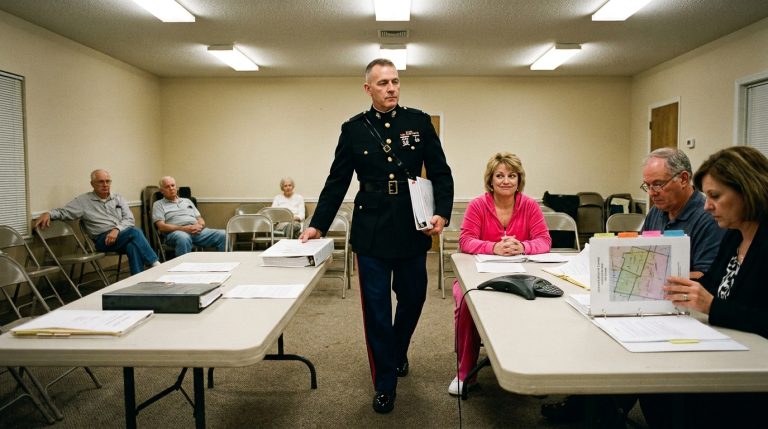
The folding chairs arranged in a rigid semi-circle around the linoleum island of the Oakridge community room smelled of stale coffee and industrial floor wax. When I walked through the double doors, the ambient chatter dropped instantly, replaced by a tense, heavy silence that clung to the walls like humidity before a storm.
Karen stood at the front of the room, clutching a plastic clipboard like a general inspecting a crumbling defensive line. She wore her bright yellow pantsuit, a stark contrast to the desaturated, anxious faces of the fifteen residents seated before her. To her immediate left and right sat Barb and Janice, their arms crossed in synchronized hostility, acting as the silent flanking guard for an executive branch about to overreach its mandate.
I did not take a seat near the back. I walked deliberately down the center aisle, my boots clicking sharply against the hard tile floor, drawing every eye in the room. I chose a single metal chair near the front corner, leaning my forearms against my knees and locking my gaze forward.
“Thank you all for coming,” Karen began, her voice pitched slightly higher than usual, betraying the tight knot of adrenaline driving her performance. “We have a critical matter of community preservation to address tonight. As you know, visual harmony is the cornerstone of our property values.”
She gestured grandly toward a projector screen where an oversized photograph of my grandfather’s windmill loomed, its steel lattice captured under harsh midday light.
“This rustic eyesore,” Karen continued, her finger tapping the clipboard with theatrical precision, “represents a direct violation of Article Nine. It is a temporary, unapproved structure that lowers the baseline value of every home on this cul-de-sac. The board has issued its final notice, and compliance is mandatory.”
A sharp memory flickered unbidden—briefing an operations command where intelligence had been replaced by administrative vanity, officers ignoring cracked foundations because the paint on the walls looked orderly. The parallel was striking, and dangerously fragile.
She paused, expecting the usual chorus of passive nods. Instead, the room remained entirely flat. At the back, Marcus sat with his arms folded over his chest, his expression carved from granite. Near the middle, Tim Peterson stared down at his hands, his knuckles white.
“Karen,” Tim said, his voice quiet but carrying clearly across the dry air. “My kids’ plastic slide was flagged last month as a temporary structure under that exact same clause. But the windmill has been standing here for over forty years. How is a seventy-year-old foundation the same thing as a three-week-old toy?”
Karen’s smile tightened, her lips compressing into a bloodless line. “Tim, that is an entirely separate administrative issue. We are addressing unauthorized structural modifications to the primary common view.”
“Have you reviewed the county property plats from 1978?” I asked, my voice flat, measured, and devoid of heat.
The question hit the room like a cold draft. Karen’s hand froze mid-gesture above her clipboard. She blinked, her eyes narrowing as she tried to anchor herself back to her script.
“The active bylaws supersede any outdated paperwork,” she snapped, her voice sharpening with defensive friction. “The board’s determination is final.”
“Bylaws don’t override recorded county easements, Karen,” Marcus rumbled from the back row, his voice vibrating with low, steady authority. “You can’t legislate away a legal utility corridor just because it clashes with your color palette.”
Murmurs rippled through the semi-circle of chairs. Heads turned back and forth between the front table and the back row. The illusion of unassailable executive power began to fray at the edges, the rigid discipline of the neighborhood breaking down under the simple weight of legal reality.
Karen slammed the clipboard down onto the folding table, the sharp plastic crack echoing off the cinderblock walls. “This meeting is not a debate! The violation stands, the daily fines are accumulating, and the board will proceed with legal action if necessary!”
She spun on her heel and marched toward the side exit, her loyal lieutenants scrambling to keep pace, abandoning the room before a single vote could be called or a single question answered. The town hall dissolved instantly into a chaotic knot of whispered arguments and anxious speculation.
I stood up slowly, smoothing the front of my jacket, knowing the first phase of the tactical trap had fully closed. The board had officially locked themselves into a public stance of willful ignorance, leaving no path backward and every reason to walk straight off the cliff.
CHAPTER 5: THE STRATEGIC REALIGNMENT
The gravel crunched beneath our boots as Marcus walked up the incline toward my front porch, his silhouette sharp against the dark facade of the old barn. The community center doors had barely finished swinging shut behind Karen’s retreating entourage before the real work of consolidating our position had begun.
“She’s doubling down,” Marcus said, his voice low as he reached the bottom step. He pulled a folded piece of paper from his jacket pocket—a printout of the private neighborhood listserv update Karen had fired off from her phone before she even reached her driveway. “She’s claiming the town hall was adjourned due to disruptive behavior, and she’s pushing the board to expedite the formal lien by Monday morning.”
I took the paper from his hand, scanning the typed lines under the amber glow of the porch light. The language was frantic, dripping with defensive authority, attempting to reframe her public flight into an executive command decision. It was the classic error of an isolated commander cutting off incoming intelligence to protect a collapsing narrative.
“Let her expedite it,” I replied, folding the paper and slipping it into my pocket. “A paper trail built on administrative panic is the easiest thing in the world to dismantle, provided you have the right leverage.”
“David reviewed the files you sent over,” Marcus noted, stepping up onto the porch and leaning against the scarred wooden railing. His eyes flicked toward the towering silhouette of the windmill, its steel blades catching the faint, dry wind that whipped down from the hills. “He called it a guided missile. But are we certain the HOA board realizes what they’re signing off on?”
“They don’t,” I said, looking out over the dark expanse of the cul-de-sac where rows of identical suburban homes sat in quiet, artificial slumber. “Because Karen kept everything centralized under her personal oversight. She never submitted the architectural notices to the full board for a formal vote. She bypassed the standard checks and balances because she wanted total control.”
“Which means when the structure comes down on her timeline,” Marcus said, a slow, grim smile cutting across his face, “she takes one hundred percent of the liability.”
“Precisely. And we make sure the physical conditions for that demonstration are absolute.”
We spent the next hour in the dim warmth of the old house, laying out the final logistics. Marcus had spent the afternoon talking quietly with the Petersons and a handful of other families on the street who had grown weary of the constant stream of petty violations and mailbox fines. They weren’t just sympathetic observers anymore; they were an informed contingency, prepared to keep emergency reserves of water tucked away in their garages before Saturday morning arrived.
The air inside the house smelled faintly of old paper and machine oil, grounding every calculation in physical reality. I pulled out the deployment schedule for the heavy equipment rental and confirmed the arrival time for the professional crew I had coordinated through old military contacts. Everything was locked into a strict, zero-skip timeline.
When Marcus finally stepped down off the porch and headed back toward his house, the wind shifted, catching the windmill’s heavy gear housing with a low, metallic groan that resonated through the floorboards. The machinery was primed. The legal trap was set. All that remained was for the target to pull the final pin on Saturday morning.
CHAPTER 6: THE TEN OCLOCK DISCONNECTION
Saturday morning arrived with the bright, surgical clarity of a postcard designed to mock a catastrophe. By nine-thirty, the cul-de-sac island had been transformed into an open-air theater of smug triumph. Karen had set up a folding table draped in white plastic, complete with boxes of pastries and ceramic carafes of coffee. Dressed in a brilliant yellow pantsuit and a wide-brimmed sun hat, she presided over her cluster of lawn chairs like a monarch receiving tribute. Barb and Janice sat flanking her, their coffee mugs raised in silent toasts to impending aesthetic purity.
Across the drive, my contracted riggers—Mike and Rick—pulled up in a clean white utility truck, followed closely by the heavy shadow of a thirty-ton crane. Their heavy-duty steel-toed boots crunched rhythmically on the asphalt as they stepped out, donning hard hats with practiced efficiency. The visual performance was airtight. To Karen and her loyalists, it looked like the final surrender of my grandfather’s legacy.
I walked out to meet them, my old military work fatigues pressed and clean, my expression neutral.
“Morning, Major,” Mike said, his eyes scanning the rooftop assembly of the windmill with professional detachment. “We got the green light?”
“Proceed with the exact scope,” I replied quietly, handing over the precise schematics. “Unbolt the primary drive shaft at the upper gearbox. Lock out the mechanical linkage to the sucker rod. Do not touch the tower structure itself.”
“Surgical and literal,” Mike grinned, tapping the wrench against his palm. “Consider it done.”
While Rick secured the lower stabilization lines, Mike made the steady, methodical climb up the steel lattice ladder. Across the street, Karen leaned forward in her folding chair, her phone raised to record the moment for her digital archive, her face split by a wide, predatory grin. She believed she was watching her absolute victory.
At precisely ten o’clock, I gave Mike a single, sharp nod.
From the top of the tower came the metallic clank of heavy bolts sliding from their sockets, followed by the grating screech of rusted steel yielding to leverage. Then came the deep, resonant thud of the hundred-foot sucker rod dropping half an inch as the power transfer unit disengaged. The old windmill’s heavy steel blades, freed from any functional resistance, began to spin silently and uselessly in the morning breeze. The familiar, rhythmic creek that had anchored the valley for seventy years vanished into dead air.
And across ten homes on the cul-de-sac, the invisible infrastructure snapped.
The crisis began not with a dramatic roar, but with a sudden, localized vacuum. On Karen’s lawn, Barb stood up abruptly, pointing down at her pristine turf. “Karen… my sprinkler head just drooped.”
Before Karen could dismiss the complaint, the front door of the nearest colonial flew open. Gary stumbled out onto his porch, his face twisted in utter confusion. “Karen! The toilet won’t refill. There’s zero pressure.”
Within ninety seconds, the street erupted. Doors slammed. Voices rose in overlapping waves of panic and disbelief. Phones buzzed and rang simultaneously up and down the blacktop. Women stepped out onto front steps mid-shower, hair dripping, while homeowners stared blankly at dry kitchen faucets.
Karen’s triumphant smile fractured, dissolving into a chalky, ashen mask of denial. She stood up so fast her lawn chair tipped backward into the grass. “It’s a municipal water main break! Call the public works department!”
“They won’t help you, Karen,” I said, my voice cutting through the rising hysteria with the cold precision of a razor.
Every head in the cul-de-sac snapped toward me. Karen stared, her mouth opening and closing without sound.
“The Oakridge Estates cul-de-sac isn’t connected to the city water main,” I continued, stepping forward so the entire neighborhood could hear every syllable. “It never has been. The granite bedrock made municipal trenching too expensive for the original developer. For forty years, every drop of water used by these ten houses—including yours, Karen—has come from the artesian well located right here.” I stamped my boot hard against the packed earth at the base of the tower. “And it has been pumped to you entirely by the rustic monstrosity you just ordered me to decommission.”
A collective gasp echoed across the asphalt. Marcus stepped off his porch, moving alongside Tim Peterson, who immediately pulled a stack of heavy manila envelopes from beneath his arm.
“He’s lying!” Janice shrieked, her hands flying to her face.
“He’s not,” Marcus said, his deep voice carrying an undeniable weight. “Check your envelopes.”
Tim and Marcus moved through the stunned crowd, handing out the dossiers David and I had compiled. Hands trembled as neighbors tore open the heavy paper, pulling out the 1978 utility easement, the recorded deed restrictions, the infrastructural maps, and Karen’s own public social media boasts about forcing the removal. The silence that followed was heavy, cold, and toxic with betrayal.
The final element of the trap clicked into place as a white news van with local television markings turned the corner, braking smoothly to a halt near the cul-de-sac island. The reporter and cameraman spilled out, drawn instantly toward the vortex of angry homeowners surrounding a now-petrified HOA president.
“Ma’am, can you tell us why an entire neighborhood has been cut off from its water supply?” the reporter asked, thrusting a microphone toward Karen’s face.
Karen backed up a step, her eyes darting frantically from the camera lens to the glare of her neighbors. “The board… we were just enforcing the aesthetic bylaws! The windmill is an eyesore!”
“It’s our water pump, you absolute idiot!” Gary screamed, shoving the easement document directly into her face. “Did you read a single word of this before you shut us down?”
The crowd surged inward, a chorus of furious voices drowning out her stuttered excuses while the camera captured every humiliating second. I turned my back on the spectacle, walking slowly toward the old house as Mike and Rick packed their gear into the truck bed with quiet, respectful efficiency. The public exposure was absolute, and Karen’s reign of administrative terror was vaporized in real-time.
The aftermath moved with the unyielding force of a legal tide. The evening news broadcast a brutal five-minute segment featuring Karen’s incoherent defense juxtaposed against the irrefutable text of the county easements. By the following night, an emergency library meeting was convened, where a unanimous vote of no confidence stripped Karen of her presidency and drove her board to resign in total disgrace. Faced with a crippling five-figure special assessment from the city for an emergency pipeline through the granite, the neighborhood turned collectively toward reason.
Two days later, David finalized a new, structured utility agreement with the newly formed interim board headed by Marcus. The terms were clean, fair, and legally unassailable, establishing my grandfather’s well as an officially recognized private utility with protected operational status.
The transition back to normalcy was slow, measured by the quiet passage of weeks rather than grand gestures. Karen put her house on the market at a steep discount, loading her belongings into a nondescript moving truck under the heavy, silent stares of the entire street before driving away for good.
On a crisp autumn afternoon six months later, I stood out on the front porch with a cup of black coffee, watching the golden afternoon light catch the restored steel blades of the windmill. The rhythmic, steady creek-thump, creek-thump echoed across the valley—a sound of raw physics, enduring legacy, and unyielding truth. Marcus walked up the driveway, dropping a fresh wrench onto my workbench before leaning against the rail to share a quiet nod. The world had settled back into its proper alignment, anchored by the simple, permanent reality that competence will always outlast noise.