The Weight of Silence: A Reluctant Genius Finds Beauty in the Ordinary Along the Florida Coast
CHAPTER 1: THE FIRST BELL
The fluorescent lights of the classroom hummed with a low-frequency buzz that felt like a drill against the back of Mary’s skull. Beside her, a boy with messy hair chewed on the end of a yellow pencil, the wood splintering under his molars. It was a frantic, rhythmic sound, and it set Mary’s teeth on edge.
She looked down at her notebook. The margins were empty, invitingly white, but her mind was elsewhere. She was calculating the structural integrity of the desk, the friction coefficient of the linoleum floor, and the exact probability that this day would end before she reached a point of absolute, crushing despair.
“Mary?”
The teacher’s voice was too loud, a sharp intrusion into the sanctuary of her internal calculations. Bonnie stood over her, a faint crease of concern between her eyebrows. The class had gone silent. Thirty pairs of eyes—curious, judging, indifferent—swiveled toward her.
“Yes?” Mary’s voice was thin, practiced. She kept her gaze fixed on the corner of the desk, where the laminate was peeling away in a small, jagged curl.
“I asked for the square root of sixteen,” Bonnie said, her smile brittle. “We’re just warming up.”
Mary felt a flicker of annoyance, quickly suppressed. She reached out, her index finger tracing the edge of the peeling laminate. The sensation of the rough, dry texture was a grounding anchor. Four, she thought. The answer is four. But that’s too simple. That’s a child’s answer.
She didn’t look up. “Four.”
“Right. And the square root of sixty-four?”
“Eight.”
Bonnie’s posture shifted. The casual, maternal rhythm of her teaching style hardened, turning into something more clinical, more inquisitive. “And the square root of one hundred and forty-four?”
“Twelve,” Mary said, her tone as flat as the paper in front of her. She looked up then, just for a second. Bonnie’s eyes were wide, the pupils dilated with a sudden, dawning realization. It was the same look the neighbors gave her when they realized the cat had one eye. A mixture of pity and confusion.
Mary hated it. She hated being a puzzle to be solved.
The bell rang, a shrill, piercing sound that sent the other children into a frenzy of movement. Chairs scraped against the floor, a cacophony of screeching metal. Mary remained perfectly still, her hands folded neatly on the desk. She could feel the vibration of the chaos around her, a storm she was forced to weather.
She had planned to leave, to walk out the front door and find the familiar, rusted silhouette of her uncle’s truck. But as she stood, she noticed something that made her blood run cold. On the teacher’s desk, tucked beneath a stack of standardized tests, was a book. It wasn’t a textbook. It was a worn, cloth-bound volume on advanced topology, its edges frayed in a way that looked achingly, hauntingly familiar.
It was her mother’s handwriting on the flyleaf, barely visible from where she stood.
Mary stepped toward the desk, her breath hitching. She reached out, her fingers hovering inches from the cover, when Bonnie turned back, her smile no longer brittle, but guarded.
“Is something wrong, Mary?” the teacher asked.
Mary pulled her hand back, her heart hammering against her ribs like a trapped bird. “I… I think I left my lunch in the car.”
She turned and walked toward the door, her pace measured, her mind racing. The hallway was a gauntlet of shifting shadows and shouting children, but she didn’t see them. She saw only the book. The book that shouldn’t be here. The book that belonged to the woman who had left her nothing but a name and an absence.
She reached the heavy metal exit, pushed it open, and stepped out into the blinding, unfiltered heat of the Florida sun. She was halfway to the parking lot when she stopped. A black sedan was idling at the curb, and standing by the driver’s side, leaning against the frame with a look of predatory grace, was a woman in a perfectly pressed white suit.
Evelyn.
Mary felt the air leave her lungs. The math, the school, the hidden book—they all suddenly felt like threads being pulled tight in a web she hadn’t known she was caught in.
CHAPTER 2: THE ANATOMY OF A SHADOW
The air in the parking lot was thick enough to taste, a heavy, humid soup of exhaust fumes and drying asphalt. Evelyn didn’t move. She stood as if she were a statue carved from imported marble, perfectly still, perfectly composed. Even the heat didn’t seem to touch her; her white blazer remained unwrinkled, a stark, aggressive contrast to the scuffed, salt-stained gravel beneath her feet.
Mary stood frozen, the metal exit door still pressed against her shoulder blade. She felt the heavy, cold sensation of the iron grate against her skin, a physical reminder of the boundary she had just crossed. Inside the school, the bells and the shouting of children had faded into a dull, rhythmic thrumming, like a distant pulse.
Evelyn turned her head. It was a slow, deliberate movement, the grace of a predator who had all the time in the world. When her eyes found Mary’s, there was no surprise in them, only a calm, terrifying certainty.
“Mary,” Evelyn said. Her voice was like polished glass—smooth, cold, and capable of cutting. “You look tired.”
Mary’s lungs felt tight. She didn’t answer. Her mind was already running the numbers: distance to the truck, the probability of Evelyn’s driver intervening, the exact angle at which she would need to turn to avoid being steered toward that sedan. She wasn’t just a child anymore; she was a variable in an equation she hadn’t written.
“I’m not tired,” Mary said. The lie was automatic, a thin shield.
Evelyn took a step forward. The sound of her heels on the asphalt was a sharp, percussive click that seemed to echo across the entire empty lot. “You’ve been hidden away for a long time. It’s natural to feel overwhelmed. But Frank… Frank has always been a sentimentalist. He thinks the world is a gentle place, provided you stay in the shade.”
Mary felt a sharp spike of defensive anger. She thought of the boatyard, the smell of sawdust and varnish, the quiet, steady hum of her uncle’s voice explaining how a piston functioned. It wasn’t the shade; it was a life. “He’s my uncle.”
“He’s a man who gave up on a legacy because he couldn’t bear the weight of it,” Evelyn countered, stopping just a few feet away. She leaned in, her scent hitting Mary—expensive perfume, sandalwood, and the faint, metallic tang of an old library. “I have the proofs, Mary. I know what your mother left behind. I know what you’re capable of.”
The mention of the proofs felt like a physical blow to Mary’s stomach. That was the Layer 1 decoy, the thing the world wanted: the math, the prestige, the accolades. But it was just the surface. Beneath it lay the deeper, darker reality: the reason her mother had died, the reason she had hidden the work. Mary felt a ghost-memory surface—the texture of the worn, cloth-bound volume she had seen on Bonnie’s desk, the way the paper felt like dead skin under her fingertips. It was the same feeling she got when she looked at the equations on the chalkboard. It wasn’t just math; it was a warning.
Mary’s hand went to her pocket, clutching a small, smooth piece of driftwood she had carried since the beach yesterday. The grit of the wood against her thumb served as an anchor. “I don’t know what you’re talking about.”
Evelyn smiled, a thin, tight line that didn’t reach her eyes. She gestured toward the sedan. “It’s all right. You don’t have to admit it to me. Not yet. But don’t mistake your uncle’s protection for safety. Silence is just another way of being forgotten.”
A car horn blared in the distance—the final dismissal bell ringing for the older students. The sudden sound shattered the tension, forcing Mary to blink, to tear her eyes away from the suffocating pressure of her grandmother’s gaze.
“I have to go,” Mary said, her voice stronger now, though her hands were trembling in her pockets.
She turned and began to walk, her pace quickening, her footsteps uneven on the gravel. She didn’t look back. She could feel Evelyn’s eyes on her back, a lingering, icy weight that followed her all the way to the weathered, rusted truck sitting in the back of the lot.
She climbed inside and locked the door. The interior of the truck smelled like old coffee, salt, and her uncle’s worn flannel. It was the smell of the real world—the world where things got dirty, where things were repaired rather than replaced, and where secrets were kept not to be leveraged, but to be protected.
She sat in the driver’s seat, though her feet couldn’t reach the pedals, and rested her head against the steering wheel. Her heart was still racing, a frantic rhythm against the metal. She closed her eyes and saw the equation again, the one from the classroom. It was incomplete. It was a fragment. Just like her life.
She wasn’t a genius. She wasn’t a project. She was just a girl who wanted to know why her mother had left, and why the man who had raised her was currently sitting at a bar, pretending the world was as simple as a boat engine.
The sedan pulled away, the tires kicking up a fine, gray dust that settled over the windshield, blurring her vision. Mary watched it go, her knuckles white as she gripped the steering wheel, her internal map shifting. The game had changed. The decoy was on the table, and the real truth—the truth that was currently buried in the silence of her uncle’s house—felt heavier than ever.
She needed to know what was in that book. She needed to know why Bonnie, a teacher she had only just met, possessed a piece of her mother’s history.
She reached for the ignition, her hand shaking as she fumbled for the keys. She wasn’t going to wait for Frank to tell her. She was going to find out for herself.
CHAPTER 3: THE BITTERNESS OF BOURBON AND TRUTH
Mary turned the key, and the engine coughed into life with a shuddering, metallic groan that vibrated through her seat. She didn’t wait. She shifted the truck into reverse, the gears grinding with a protest that mirrored the tension in her own chest. She drove slowly, the truck’s suspension creaking over the uneven gravel of the school parking lot, her eyes scanning the rearview mirror until the white flash of her grandmother’s sedan had completely vanished into the shimmering Florida heat.
She didn’t head home. She didn’t return to the boatyard where Uncle Frank would be waiting, wiping grease from his calloused hands. Instead, she took the long way, the road that wound past the local tavern where she knew he spent his Friday nights. Her mind was a singular, fixed point, revolving around the image of the book on Bonnie’s desk—the frayed edges, the familiar handwriting, the implication that her teacher knew something about the ghost of her mother that she herself did not.
The parking lot of Ferg’s Bar was a patch of cracked pavement littered with cigarette butts and discarded pull-tabs. She pulled the truck into a dark corner, the headlights cutting a swath through the humid evening air before she killed the engine. The silence that followed was absolute, save for the distant, muffled sound of a jukebox playing a song that felt too slow, too heavy.
Mary hopped down from the cabin, her boots hitting the dirt with a thud. She walked toward the front entrance, her small frame dwarfed by the looming, darkened architecture of the tavern. She wasn’t supposed to be here. She wasn’t supposed to know about the places where Frank went to lose himself. But the curiosity was a gnawing, physical presence, an itch under her skin that wouldn’t stop until she saw what was inside.
She pushed the door open. The interior was a cavern of amber light and thick, blue-gray cigarette smoke. The smell was suffocating—stale beer, old wood, and the bitter, sharp scent of unwashed floors. She scanned the room, her eyes adjusting to the dimness. She didn’t have to look for long.
Frank was there, hunched over a scarred wooden counter at the far end of the bar. He looked older than he did at home, his shoulders slumped, his face illuminated by the flickering, sickly glow of a neon sign. He was staring into a glass of amber liquid as if it held the answers to a question he was too afraid to ask.
And then, she saw her. Bonnie.
The teacher was sitting two stools away from him, her posture guarded, her hands wrapped tightly around a tall glass. She wasn’t looking at him, but she was leaning in, her voice low, a secret thread woven into the ambient noise of the room. Mary felt a cold, sharp sensation creep up her spine. She stepped into the shadows of a wooden booth, the rough grain of the upholstery catching on her sleeve, and stopped.
She couldn’t hear their words, but she could see the way they moved. They were sharing a burden—the same kind of weight she had seen in her grandmother’s eyes, though this one felt different. It was softer, perhaps, but no less significant. Frank made a sudden, abrupt gesture with his hand, shaking his head, and Bonnie responded by reaching out, her fingers just brushing the sleeve of his flannel shirt.
The sight of it felt like a betrayal. The person she had trusted to hold the world together, to keep the chaos of her mind contained, was leaking secrets to a stranger. Mary felt her breath hitch in her throat. She stayed in the darkness, the texture of the booth scratching her skin, a physical reminder of her own invisibility.
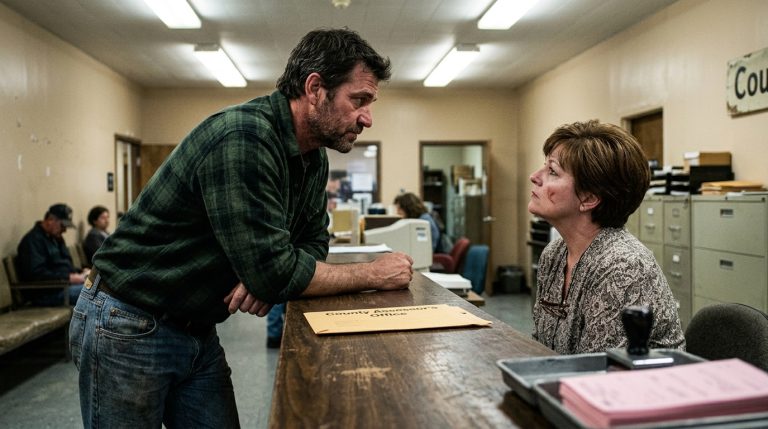
She watched Frank pull a crumpled envelope from his pocket. It was thick, yellowed with age, and held together by a fraying rubber band. He laid it on the bar, but he didn’t open it. He just pushed it toward Bonnie.
Mary felt the world tilt. She knew that envelope. She had seen it tucked deep inside the bottom drawer of Frank’s workbench, beneath the manuals for boat motors and the spare parts. She had been told, since she was a child, that it was off-limits, a relic of a past that was better left undisturbed. Seeing it here, in the dim, smoke-filled air of a bar, stripped it of its sanctity. It made it a commodity, a piece of leverage in a game she was only now beginning to understand.
She took a step backward, the floorboard beneath her boot giving a soft, agonizing creak. The sound was microscopic, but in the hush of the room, it felt like a gunshot.
Frank’s head snapped up.
He didn’t see her—not yet—but his gaze swept the room with the alertness of a man who spent his life expecting the past to catch up with him. Bonnie followed his gaze, her expression shifting from curiosity to a sharp, defensive wariness.
Mary retreated deeper into the shadows, her pulse hammering against her ribs like a trapped bird. She knew she had to leave. She knew that if they saw her here, the fragile, Kintsugi-like integrity of their home would shatter beyond repair. But she couldn’t move. She was anchored by the sight of the envelope, by the terrifying realization that the math, the legacy, and the ghosts were all circling her, closing in, waiting for her to stumble.
She turned, her movements frantic, and navigated the maze of tables, her hand brushing against a sweating beer glass, the cold moisture stinging her palm. She reached the door and slipped out into the night, the humid air rushing into her lungs like a tonic. She didn’t stop until she reached the truck, her chest heaving, the darkness of the parking lot feeling like a shroud.
She looked back at the tavern once. The door had opened, and a sliver of yellow light spilled out onto the pavement. Frank stood in the doorway, scanning the darkness, his silhouette solitary and burdened. Mary didn’t wait for him to see her. She climbed into the truck, started the engine, and pulled away into the night, the weight of the secret she had just glimpsed pressing down on her, heavier than the very roof of the world.
CHAPTER 4: THE CATALYST
The vibration of the truck’s steering wheel lived under the skin of Mary’s palms all through the weekend, a phantom pulse that wouldn’t let her sleep. By Monday morning, the world had taken on a thin, brittle quality, like paper that had been left out in the sun too long. She sat at her small wooden school desk, her thumb unconsciously testing the rough grain of its underside. The classroom smelled of wet umbrellas and sour milk, a heavy, damp atmosphere that clogged her throat.
At the front of the room, Bonnie was writing spelling words on the chalkboard, the dry scuff of the chalk a steady, rhythmic scratch. Mary didn’t look at her. She kept her eyes fixed on the scuffed linoleum between her boots. Every time she looked at the teacher, she saw the dim amber light of Ferg’s Bar, the amber liquid in Frank’s glass, and that thick, yellowed envelope changing hands. The logic didn’t balance. Frank had told her the past was dead, a closed book, yet he was handing chapters of it away to a woman who had only known Mary for five days.
To her right, a boy named Justin was carefully positioning a model bridge made of toothpicks across the gap between two desks. It was a fragile, intricate construction, held together by translucent blobs of dried wood glue. Mary watched him out of the corner of her eye. Her mind instantly calculated the load-bearing capacity of the balsa segments, identifying three distinct points of structural vulnerability near the center piers. It was an imperfect design, born of clumsy, eight-year-old fingers, but there was a quiet, earnest focus in the way Justin adjusted the tiny supports. It was a physical manifestation of effort without calculations—something built simply because he wanted to see it stand.
“Don’t touch it,” Justin whispered defensively, noticing her gaze. His voice was small, guarded, his fingers hovering protectively over the toothpick span.
“I wasn’t going to,” Mary said softly. She pulled her arms closer to her chest, making herself small. She felt a strange, unfamiliar ache in her chest—a quiet envy of his freedom to build something poorly and still be proud of it. Her work was never allowed to have errors; it was either an absolute truth or a failure.
The teacher turned from the board, her eyes sweeping over the rows until they rested on Mary. There was a subtle shift in Bonnie’s expression, a lingering shadow of the conversation from Friday night. She looked at Mary not just as a student, but as an equation with too many unknown variables.
“All right, class, please open your workbooks to page fourteen,” Bonnie announced, her voice carrying a practiced, professional warmth that felt entirely manufactured to Mary’s ears.
Before the rustle of paper could begin, the classroom door swung open with a heavy, administrative click. An older student from the fifth-grade hall stepped inside, delivering a stack of permission slips to Bonnie’s desk. As the older boy turned to leave, his movements were careless, aggressive with the casual cruelty of a slightly larger child. He didn’t look down. He cut too close to Justin’s row, his heavy backpack swinging out like a pendulum.
Mary saw the trajectory before it happened. The nylon fabric caught the edge of the toothpick bridge.
There was a sharp, brittle snap. The delicate structure didn’t just fall; it imploded, the tension within the bent wood pins sending fragments scattering across the floor. Justin froze, his hands still shaped around an object that no longer existed, his face flushing a deep, sudden crimson.
The older boy didn’t even pause. He kept walking toward the exit, his scuffed sneakers squeaking against the floor.
Something broke inside Mary’s chest—a sudden, uncalculated surge of heat that bypassed her internal filters entirely. The numbers, the risks, the rules about not causing trouble—all of them evaporated. She didn’t see a classmate’s project; she saw the heavy, careless hand of the world crushing something small and fragile simply because it could. She saw Evelyn’s sedan; she saw the yellow envelope on the bar counter.
She stood up so fast her chair screeched against the linoleum, the metal legs producing a sound like tearing tin. The classroom went dead silent.
“Hey!” Mary’s voice didn’t sound like her own. It was sharp, transactional, dangerous.
She didn’t wait for the older boy to turn around. She grabbed the heavy, hardbound spelling dictionary from the corner of her desk, her small fingers digging into the textured buckram binding. The weight of the book was comforting, a dense, physical reality in a world of breaking toothpicks. She took two rapid, real-time steps across the aisle, the distance closing according to a simple, unyielding physics engine of momentum and anger.
“Mary, no!” Bonnie’s voice came from the front of the room, a distant, useless warning.
Mary swung the book. She didn’t aim for a cinematic blow; she acted out of pure, tactical leverage, driving the heavy corner of the binding upward toward the boy’s face as he turned his head in confusion. The impact was loud—a dull, wet crunch that traveled up the bones of her arm, followed instantly by the sharp, metallic tang of blood in the dry classroom air.
The boy stumbled backward against the doorframe, his hands instantly flying to his nose as a bright, crimson bead began to bloom between his fingers. He let out a low, shocked whimper, his eyes wide with the sudden realization that the rules of the playground no longer protected him.
Mary stood her ground, the heavy dictionary dangling from her right hand, her breathing shallow and fast. Her knuckles were white, the skin split slightly across the first digit from the force of the collision. She didn’t feel pain. She felt a cold, crystalline clarity. The bridge was broken, the boy was bleeding, and the teacher was moving toward her with a look of absolute horror.
She turned her head slowly, looking past the weeping boy, past the stunned children in their rows, until her gaze locked directly with Bonnie’s. The subtext between them was no longer hidden under desks or tucked into envelopes. It was right there, raw and bleeding on the floor.
“He destroyed it,” Mary said, her voice dropping into a quiet, chilling flatline that belonged to a person three times her age. “He didn’t have the right to break it.”
CHAPTER 5: THE ARRIVAL OF THE PAST
The silence in the classroom was so thick it felt pressurized, humming against Mary’s eardrums. The older boy was still clutching his nose, his sobs muffled and wet, while Bonnie stood paralyzed near the front desk, her hand reaching for the intercom but not quite touching it. She looked at Mary not with anger, but with a terrifying, clinical fascination—the same way a scientist might look at a specimen that had unexpectedly shattered its containment jar.
Mary didn’t move. She held the dictionary at her side, the weight of it pulling at her shoulder, a anchor in the sudden storm of her own making. The room felt smaller now, the walls encroaching with every breath. She looked down at the floor, where the toothpick bridge lay in a splintered, chaotic heap. It was just wood and glue, yet the sight of it felt like a mirror of her own internal architecture.
“Mary,” Bonnie whispered. It wasn’t a command; it was a plea.
Mary finally dropped the book. It hit the floor with a heavy, final thud that caused the other children to flinch. She turned away from the teacher, away from the boy, and walked toward the door. She didn’t need to be told to leave. She knew the sequence of events as clearly as a math problem: action, reaction, consequence. She was currently in the transition period, the uncomfortable, liminal space between the deed and the judgment.
She walked out into the hallway. The air here was cooler, devoid of the classroom’s stifling, chalk-heavy heat. She could hear the muffled, frantic tone of Bonnie’s voice on the intercom, calling for the principal. Mary didn’t run. She walked with a stiff, measured gait toward the office, her eyes fixed on the baseboards, counting the distance in three-foot increments.
The principal’s office was a room of glass and gray plastic, a space designed for efficiency rather than comfort. Mrs. Davis, the principal, was already standing behind her desk, her posture as rigid as the filing cabinets against the wall. She looked at Mary as she entered, her expression neutral—an empty, unreadable mask.
“Sit,” Mrs. Davis said, gesturing to the plastic chair.
Mary sat. The chair was cold, the plastic smooth and unforgiving against the back of her legs. She stared at the desktop. It was perfectly clean, save for a single, glass-covered photograph of a family. It felt like a stage set, a place where people were brought to be dismantled.
The door opened behind her. It wasn’t the police, and it wasn’t a social worker. It was the click-clack of heels on linoleum—a familiar, rhythmic, and perfectly calibrated sound. Mary didn’t need to turn around to know who had arrived. The air in the room seemed to sharpen, the smell of sandalwood and cold paper cutting through the sterile scent of the office.
Evelyn.
“I trust we’re handling this with the appropriate gravity,” Evelyn said. Her voice wasn’t elevated; it was steady, cultured, and utterly detached. She didn’t look at Mary; she looked at the principal, her gaze holding the quiet authority of someone who owned the room.
Mrs. Davis shifted slightly, her hand hovering over a folder. “Mrs. Adler, we are discussing a severe incident of physical escalation.”
“Escalation,” Evelyn repeated, the word carrying a note of dry amusement. “Or perhaps, an inevitable reaction to a substandard environment.”
Mary gripped the edge of the plastic chair, her knuckles turning ivory. She felt a sudden, dizzying sense of displacement. This wasn’t happening; it couldn’t be. She was supposed to be at the boatyard with Frank. She was supposed to be learning the difference between a bolt and a screw. She was supposed to be safe.
“I want to go home,” Mary said. Her voice was thin, almost a whisper, but it cut through the room like a shard of glass.
Evelyn finally turned her eyes to her. They were clear, blue, and empty of any maternal warmth. “Home is a relative term, Mary. Frank is a good man, but he is a drowning man. He’s trying to hold you under the water because he doesn’t know how to swim in the world you belong to.”
Evelyn reached into her handbag and withdrew a sleek, silver fountain pen. She set it on the desk—an object of such precise, clinical beauty that it made the principal’s cheap plastic surroundings look like a wasteland. “This school has failed you. Not because they are unkind, but because they are incapable of seeing what you are.”
“I’m just a kid,” Mary insisted, the words tasting like ash in her mouth.
“You are a rare, dangerous, and beautiful anomaly,” Evelyn replied. “And you are currently being kept in a cage made of sticks and glue.” She pointed a manicured finger toward the window, toward the distant, hazy horizon where the ocean met the sky. “You are an Adler. And you will be treated as one, beginning today.”
Mary looked at her grandmother, and for the first time, she saw not a savior, but a vacuum—a person whose life was a series of calculations designed to strip away everything that couldn’t be quantified or controlled. The decoy was gone. The bridge was shattered. Mary realized with a terrifying, visceral chill that the “protection” she had relied on—the boatyard, the cat, the weekend fights, the pretense of a normal life—wasn’t just fragile. It had been an illusion, one that Evelyn was now dismantling with the cold, effortless precision of a surgeon.
She leaned back in the plastic chair, the material groaning under her slight weight. She was trapped, and for the first time in her life, she had no equation, no formula, and no escape route. The silence that filled the room wasn’t the silence of peace; it was the heavy, suffocating silence of a life being rewritten by someone else’s hand.
CHAPTER 6: THE COURTROOM CRUCIBLE
The air inside the principal’s office had become thin, a pressurized vacuum that made every movement feel labored. Mary sat motionless, her fingers curled around the edge of the hard plastic seat, the material smooth and cold against her palms. Evelyn remained standing, a statue of pristine, white-suited composure, her gaze oscillating between Mrs. Davis and the stack of documents that had been placed on the mahogany desk.
“This is not a discussion, Mrs. Davis,” Evelyn said, her voice devoid of any jagged edges. “It is an administrative necessity. Mary’s potential—her obligations—are no longer contained by the parameters of this institution. I have the power of attorney from the biological father, and I have the medical assessment from the academy. We are leaving.”
Mrs. Davis looked from Evelyn to Mary, her expression flickering with a rare, human hesitation. “Mrs. Adler, the legal process in Florida is quite specific about custody. A unilateral decision like this—”
“Will be resolved by the bench,” Evelyn interrupted, a soft, predatory smile gracing her lips. “I have already arranged the emergency hearing. The judge is waiting.”
Mary felt a sudden, sharp clarity pierce through the haze of her panic. She looked down at the desk. Among the papers, partially obscured by a legal binder, lay a corner of a document with her name on it—Mary Adler, Guardian Nomination. It was a physical remnant of a life she had been living, now being folded, stamped, and archived by someone who saw it as nothing more than a clerical error.
She stood up. The movement was sudden, the plastic chair skidding backward against the hardwood floor with a harsh, abrasive sound that silenced the room. Evelyn’s eyes snapped toward her, the mask of detachment slipping for the smallest fraction of a second, revealing a flicker of raw, focused intent.
“I’m not going,” Mary said. Her voice didn’t waver. It was the same tone she used to explain the structural failure of a bridge—simple, direct, and based entirely on evidence. “You don’t get to choose where I go.”
Evelyn didn’t get angry. She didn’t raise her voice. She simply leaned forward, the scent of sandalwood and cold paper suddenly overwhelming. “You think you’re choosing, Mary? You’re acting out a script written by a man who taught you to hate your own mind. You aren’t choosing; you’re reacting. There’s a difference.”
Evelyn reached out and took Mary’s arm, her grip surprisingly firm—a physical, unyielding anchor. “The car is waiting.”
The journey to the courthouse was a blur of movement, a transition of scenery that Mary felt but did not see. She sat in the back of the sedan, the leather cool and expensive, watching the familiar Florida landscape slide past the window—the dusty, salt-crusted docks, the weathered roofs of the shacks, the fading, sun-bleached colors of the town she had called home. Every turn of the tire was a removal, a distance growing between her and the boatyard.
The courthouse was a brutalist structure of concrete and glass, a place that felt designed to crush the spirit of anyone who entered. Inside, the corridors were echoing chambers of marble and fluorescent light. They were directed toward a small, dimly lit courtroom, a room that felt too old for the speed of the events unfolding within it.
Frank was already there. He sat at the defense table, his frame slumped, his flannel shirt looking jarringly out of place against the polished wood of the legal furniture. When he saw them enter, his face went pale, his eyes tracking Mary with a look of profound, aching exhaustion.
The hearing was a rapid, discordant sequence of legal jargon. Evelyn’s lawyer, a man with thin, precise movements and a voice like dry parchment, paced the floor, his points accumulating like a series of inescapable weights. He spoke of “educational negligence,” of “developmental stifling,” and of the “inherent right of the gifted to reach their zenith.” He didn’t speak of Mary; he spoke of an asset, a statistical anomaly that needed to be relocated to a more productive climate.
Frank’s lawyer, a man who looked as though he had spent his entire life fighting lost causes, countered with words about “childhood,” “attachment,” and “the sanctity of promise.” But as he spoke, Mary noticed a subtle, shifting reality in the courtroom: the judge was looking at her, not with empathy, but with a cold, administrative assessment. She was already being classified. The court didn’t care about the boatyard. It cared about the math.
“Mary,” the judge called out, her voice echoing in the small room.
Mary stood. She felt the weight of the moment, the way the eyes of everyone in the room—Frank, Evelyn, the lawyers—converged on her, waiting for a verdict she hadn’t yet formulated.
“Do you know what is being decided here?” the judge asked.
“Yes,” Mary said. She felt the texture of the wooden railing beneath her fingertips, worn smooth by the touch of a thousand frightened, desperate hands. “You’re deciding who gets to keep me.”
“And who do you believe should decide?”
Mary looked at Frank. He looked small, tired, and defeated, his eyes filled with a love that had no leverage in a room like this. Then she looked at Evelyn, who watched her with the calm, terrifying expectation of a gardener waiting for a rare flower to bloom.
The silence stretched, long and brittle. The room felt like it was shrinking, the walls closing in until there was nowhere left to stand, no more equations to solve, no more decoy secrets to hide behind. She realized, with a sudden, sinking weight, that the truth wasn’t about the math, or the custody, or the boatyard. It was about the fact that she was the only one in the room who understood the cost of what was being bartered away.
“I don’t think,” Mary said, her voice clear and absolute, “that anyone gets to keep me.”
CHAPTER 7: THE ARCHITECTURE OF COMPROMISE
The judge’s gavel didn’t fall. Instead, there was a heavy, suffocating silence that seemed to expand to fill every corner of the room, turning the air into something solid and immovable. Mary remained standing, her heart a frantic, uneven rhythm against her ribs. She didn’t look at the judge; she looked at the space between Frank and Evelyn, the literal and metaphorical distance that had defined her entire existence for six years.
“Mary,” Frank began, his voice rough, a gravelly sound that spoke of too many nights at the bar and too many apologies unsaid. He made a move to stand, his chair screeching against the floor, but the bailiff’s hand landed firmly, warningly, on his shoulder.
“Mr. Adler, stay seated,” the judge commanded, her gaze shifting back to Mary with a newfound, unsettling curiosity. “That is a significant statement, young lady. But the court must operate on the basis of legal standing, not philosophical abstraction. You are a minor. You require guardianship.”
Evelyn didn’t move, but her hands—folded neatly on the table—tightened. The knuckles, usually soft and pale, were white. She knew. She realized that the “anomaly” she had sought to claim was not a piece of math; it was a person who had just recognized the leverage she held over her own life.
“I have the documents, Your Honor,” Evelyn said, her voice a shade tighter, the mask of cultured detachment fraying. “The biological father’s consent is clear. The educational placement is ready. We are prepared to proceed.”
“I am not going,” Mary repeated. She didn’t shout. She simply stated the fact as if it were a law of physics.
She turned and walked out of the courtroom. No one stopped her—the sheer audacity of the movement left the bailiff and the lawyers in a state of arrested motion. She pushed through the heavy, oak doors and stepped into the hallway. The fluorescent lights flickered, a jagged, broken rhythm that made her vision swim. She felt the sudden, crushing weight of the decision. She had no destination, no plan, and no one to lean on.
She reached the stairs, her feet moving of their own accord, and found herself in a quiet, narrow alcove—a space between floors where the sound of the courtroom was reduced to a distant, muffled hum. She leaned against the cold marble wall, the rough, unpolished texture biting into her back.
A memory flooded her—not a math problem, but a sensory fragment. Diane, sitting on the floor of a sun-drenched bathroom, her voice low and desperate, the smell of damp paper and charcoal. ‘Don’t let them count you, Mary. Once they start counting, they own the total. They own the result. You have to be the variable they can’t define.’
The memory was so vivid she could see the way Diane’s fingers had traced the grain of the floorboards—the same way Mary had traced her school desk just days ago. The “proof” Evelyn kept talking about, the one hidden in the envelope, wasn’t a discovery. It was a map. A map for a life that had no place for a little girl who just wanted to watch the sunset at the beach with a one-eyed cat.
The heavy door at the top of the stairs groaned, and Frank stepped out. He looked defeated, his face a landscape of lines and shadows. He stopped when he saw her, his hands hanging uselessly at his sides. He didn’t approach; he gave her the space he had been denying her for years.
“I’m sorry,” he said. The words were small, stripped of all the complex justifications he had used to mask his own fear. “I thought I was keeping you safe. I thought if I hid you away from the world, I could keep you from ending up like her.”
“You weren’t keeping me safe, Frank,” Mary said, her voice trembling, not with fear, but with the raw, jagged edge of a truth that had been kept in the dark for too long. “You were just hiding the proof.”
Frank went still. “What are you talking about?”
“The envelope,” she said. “The one you gave to Bonnie. The one that Evelyn is killing to get. You didn’t hide it because it was dangerous for me. You hid it because it was the only thing you had left of her, and you couldn’t stand the idea of it being out there, being judged, being used to define what I was supposed to be.”
Frank didn’t deny it. He leaned his head back against the wall and closed his eyes. The confession wasn’t a victory; it was a devastating realization. The “protection” he had provided was just another layer of the same possessive, categorizing madness that Evelyn represented.
“I have to fix it,” Frank whispered.
“No,” Mary said, stepping toward him, her hand brushing his arm—a gesture of tentative, fragile reconciliation. “We have to fix it. Together. But we don’t do it for them. We don’t do it for the court, and we don’t do it for the math.”
She looked at him, her eyes clear, the internal noise that had plagued her for years finally settling into a sharp, focused intensity. She wasn’t just a child anymore. She was a person who had seen the mechanisms of her own life and had decided to break the gears.
“Evelyn wants a deal,” Mary said. “Let’s give her one. Let’s give her exactly what she wants—but it’s going to be on our terms. And if she doesn’t like the result, then we let the court see exactly what kind of math she’s actually interested in.”
Frank looked down at her, and for the first time, he didn’t see a niece, a ward, or a math prodigy. He saw an equal. He reached out and squeezed her shoulder, a brief, solid contact that grounded them both in the center of the hallway.
“How?” he asked.
“By finishing the equation,” Mary said. “But not the one on the wall. The one that actually matters.”
CHAPTER 8: THE BALANCE OF THE EQUATION
The walk back to the courtroom felt longer, a slow, deliberate march through corridors that seemed to lose their oppressive weight with every step Mary took. She felt the texture of the air change—the sterile, recirculated chill of the hallway giving way to the faint, salt-laden breeze drifting through the building’s main entrance. She kept her pace rhythmic, matching Frank’s stride, their movements synchronized by a new, unspoken alignment.
When they stepped back through the heavy oak doors, the courtroom had transformed from a theater of judgment into a space of anticipation. Evelyn was still seated, her posture impeccable, but her eyes held a spark of unrest—the flicker of a strategist who realized the board had been reset. The judge peered down from the bench, her expression hovering between impatience and curiosity.
“We are ready, Your Honor,” Frank said, his voice steady, stripped of the ragged uncertainty that had defined his testimony earlier. He reached into his jacket pocket and pulled out the yellowed envelope, the one that had been the silent antagonist of their entire lives.
Mary stood beside him, her presence anchoring the room. She looked at Evelyn, who watched the envelope with a gaze of singular, possessive intensity. For a moment, it seemed as if the entire legal apparatus of the court—the bailiffs, the lawyers, the very architecture of the building—faded into insignificance, leaving only the three of them and the weight of what was held in that paper.
“This is the proof my mother left behind,” Mary said, her voice clear, filling the quiet space without effort. She stepped forward, the floorboards smooth and polished beneath her soles. “But it isn’t a discovery. It’s a termination.”
She reached out and took the envelope from Frank, her hands steady. She didn’t open it. She held it up, displaying the faded handwriting on the front—the mark of a brilliant, suffering mind. “My grandmother believes this is the key to a future of prestige and academic conquest. She believes that because the math is correct, it belongs to the world. But my mother didn’t hide this because she was afraid of failing. She hid it because she knew that once it was published, she would cease to exist as a person. She would become a variable. A tool.”
Mary turned her gaze to the judge. “I am not here to argue for custody. I am here to fulfill the final instruction of the person who actually owned this work.”
She handed the envelope to the judge. It was a simple, physical act, yet it felt like the release of a massive, accumulated pressure.
“The deal is this,” Mary continued, her eyes fixed on Evelyn. “The research stays private. It will be archived, kept under seal, and will never be published. In return, I stay with Frank. If you attempt to challenge this, if you attempt to use the law to force a re-categorization, then I will release the entire contents to the public domain, effectively rendering the value of the ‘legacy’ you’re trying to build completely worthless. You can have the truth, or you can have the control. You don’t get both.”
The silence that followed was different from the one before; it was the heavy, settling quiet of a trap closing. Evelyn stared at Mary, the mask of the strategist finally shattering. She saw in Mary’s eyes the same cold, analytical fire that had once burned in Diane—a force that had looked at the world, calculated its cost, and chosen a different path.
Evelyn slowly looked at the judge, then back at Mary. She saw the defeat in the realization that Mary had leveraged the very thing Evelyn valued most—the reputation of the work—to buy her own autonomy. Evelyn stood up, her movements fluid and controlled, but the sharp, predatory edge was gone. She adjusted her blazer, turned, and walked toward the exit without a word, the sound of her heels fading into the cavernous hallway.
The resolution wasn’t dramatic. The judge looked at the envelope, looked at Mary, and simply nodded, the gavel falling with a quiet, final click that signaled the end of the conflict.
Later that afternoon, the sun was beginning to dip toward the horizon, painting the sky in soft, bruised colors of violet and gold. Frank and Mary stood on the quiet beach where they had gone before, the sand fine and cool against their feet. The air was thick with the scent of brine and the low, rhythmic roar of the tide.
Frank leaned down and picked up a rusted piece of metal—a part from a boat engine he had lost months ago. He turned it over in his hands, then looked at Mary. “It’s over,” he said. The words were a quiet, simple realization.
Mary looked out at the water, the horizon a clean, unbroken line of potential. She felt a lightness in her chest, a sense of space where there had once been only noise. She reached down and picked up a smooth, white stone, the texture cool and grounding against her thumb.
“No,” she said, watching the waves roll in, each one washing away the indentations they had left in the sand. “It’s just beginning.”
They turned and started the walk back to the truck, the distance between them gone, replaced by a quiet, steady rhythm. The boatyard, the cat, the math, the legacy—they were all still there, but they were no longer the parameters of her life. They were just the scenery. And for the first time, Mary felt that the equation was balanced, not because the numbers matched, but because she had finally decided what was worth calculating.