The Weight of a Pine Branch: How a Single Act of Quiet Decency Upended a Quiet Mountain Town
CHAPTER 1: THE MOUNTAIN MORNING
The pine needles crunched under heavy boots, but Robert didn’t look up from the split-log fence he was mending.
His thumb rubbed against the scarred hinge of his pocketknife, smoothing down a splinter of cedar.
Eight-year-old Emma sat on the bottom step of the porch, her colored pencils scattered across the weathered wood like fallen leaves.
“Daddy, the blue one rolled under the floorboards,” she said, her voice small against the vast silence of the valley.
Robert laid the hatchet down, his knees popping with a dull ache that lingered from years of desert gravel.
He didn’t complain about the stiffness; it was just part of the morning routine, like boiling water over the propane stove or clearing pinecones off the metal roof.
He knelt beside the porch stairs, sliding two fingers into the cool, dark gap beneath the cedar planks.
His fingertips brushed against grit and dust before they found the smooth hexagonal barrel of the pencil.
He pulled it out and handed it back without a word.
Emma took it, her smile bright enough to cut through the mountain chill settling down from the peaks.
“Thanks, Daddy. Are we staying here forever?” she asked, looking out toward the tree line where the morning fog still clung to the dark green canopy.
Robert stood up, wiping his palms on his flannel shirt, feeling the weight of the metal Citizen Service Medal pinned inside his breast pocket.
It was a quiet reminder of an airport terminal two days ago, of a woman named Sarah Mitchell, and of a choice that felt entirely ordinary at the time.
He didn’t mention the medal to Emma.
Medals didn’t mend fences or keep the mountain wind from rattling the windowpanes.
“We’re staying as long as the roof holds up and the well runs clear,” Robert said, his voice flat and practical.
He turned back toward the split-log fence, picking up the heavy mallet to drive another iron spike into the oak post.
The sound echoed sharply against the ridge, flat and dry in the thin air.
He raised the mallet again, but stopped midway as a strange flash of bright orange caught his eye near the edge of the timberline.
It wasn’t a wildflower or a fallen branch.
It was a plastic surveyor’s ribbon, tied tightly around the trunk of an old-growth pine that stood squarely inside their property line.
Robert lowered the mallet slowly, his gaze narrowing as he stared at the neon marker fluttering in the crisp morning breeze.
CHAPTER 2: THE UNWELCOME NOTICE
A heavy, grease-stained manila envelope slid across the porch table, stopping an inch from Robert’s calloused knuckles.
“County assessor’s office,” a flat, mechanical voice recited. “You’re sitting on disputed acreage, Mr. Hayes. Effective immediately.”
Robert kept his fingers wrapped tightly around the wooden handle of his mallet, the cold iron biting into his palm.
He didn’t blink, his gaze shifting from the official seal on the envelope up to the stranger standing on his deck—a county zoning inspector whose pressed shirt reeked of cheap cologne and city air.
“This cabin’s been in my family since nineteen-seventy-five,” Robert said, his voice level, carrying the dry rasp of mountain dust. “The deed is filed down at the county seat in a fireproof vault.”
The inspector didn’t flinch, merely tapping a thick laminated badge clipped to his breast pocket.
“Filing cabinets get updated, Mr. Hayes,” the man replied, his tone dripping with institutional indifference. “Or in this case, corrected. Turns out the southern boundary line includes an old logging easement that was never properly closed.”
Emma peeked out from the cabin door, her fingers clutching the hem of Robert’s flannel shirt, her eyes wide with sudden apprehension.
Robert felt a familiar, heavy tightening in his chest—not fear, but the cold, grinding irritation of dealing with someone who viewed a home as a spreadsheet entry.
“Take your stakes off my timberline,” Robert said, stepping forward until the height difference forced the inspector to tilt his chin upward. “And take your paperwork with you.”
The inspector backed down one step, his hand brushing against the manila folder as if testing its weight.
“You can fight it in front of the board next Tuesday,” the man said, turning sharply toward his idling pickup truck parked in the meadow. “Or you can save yourself the trouble and let the bulldozers clear the brush by Friday.”
The truck door slammed shut, the heavy engine drowning out the wind through the pines as the vehicle kicked up a cloud of gravel and sped down the mountain road.
Robert looked down at the envelope, his thumb unconsciously rubbing the scarred hinge of his pocketknife inside his pocket.
The neon surveyor’s ribbon still fluttered at the edge of the timberline, a bright, unnatural scar against the green ridge.
CHAPTER 3: THE COLD RECEPTION
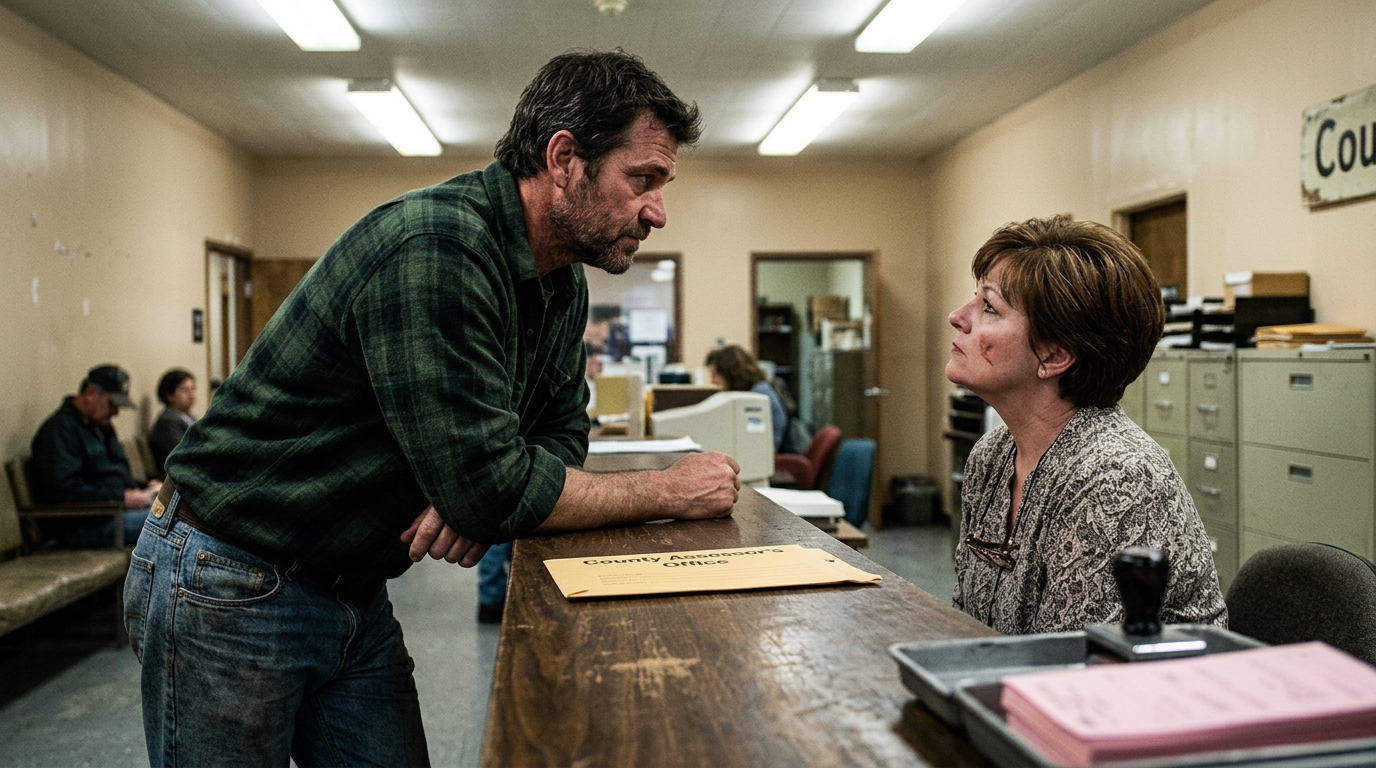
The linoleum floor of the county clerk’s office scuffed under Robert’s boots as he pushed through the swinging double doors.
A wall of stale fluorescent light and ozone hit him instantly, smelling faintly of old copy machine toner and cheap carpet cleaner.
Behind the high counter, a clerk named Brenda—her hair shellacked into an unmoving helmet—did not look up from her screen as the heavy doors banged shut behind him.
“Public hearing docket’s full until next month, mister,” Brenda said, her fingernails clicking a rapid, impatient tattoo against the plastic keyboard.
Robert laid the manila envelope flat on the scarred wood of the counter, aligning its sharp corner precisely with the grain.
“I’m not here for a hearing,” Robert said, his voice dropping an octave into that flat, gravelly register he used when machinery jammed on deployment. “I’m here to pull the original nineteen-seventy-five land patent and parcel maps for Section Twelve.”
Brenda stopped typing, her eyes flicking up with a cold, practiced irritation that telegraphed years of bureaucratic gatekeeping.
“Records from the seventies are down in the sub-basement archive,” she said, crossing her arms over a faded blouse. “And without an appointment filed thirty days in advance, that drawer stays locked.”
Robert didn’t blink, his thumb rhythmically pressing the unyielding metal plate of his pocketknife inside his pocket.
“The notice on my porch said the boundary correction was filed this morning,” Robert said, leaning forward until his forearms rested on the counter ledge. “If the county can update a deed by breakfast, I can look at the vault before lunch.”
Brenda’s jaw tightened, a faint twitching muscle jumping near her left cheek as she recognized the stubborn set of a man who wouldn’t be dismissed by an administrative wall.
“Regulations are regulations,” she snapped, snatching up a rubber stamp and slamming it onto a stack of pink slips with enough force to rattle the metal tray. “You want to dispute a municipal easement, you talk to the district developer’s legal representative in Room Four-B down the hall.”
Robert didn’t move an inch, his gaze locked onto her until Brenda finally dropped her eyes and looked away.
“Room Four-B’s door is locked,” Robert said, his voice terrifyingly calm. “Open the archive drawer, Brenda. Or I’ll sit right here on your lobby bench until the county commissioners open it for me.”
CHAPTER 4: THE SURVEY STAKES
A heavy red-handled sledgehammer swung down with a dull, echoing thud, driving a wooden stake another two inches into the damp mountain soil.
“I told you once, mister, this strip belongs to the syndicate now,” a contractor in a high-visibility yellow vest growled, wiping sweat from his forehead with a grease-stained rag.
Robert didn’t stop swinging, his shoulders burning with the familiar, rhythmic strain of hard physical labor.
Emma stood on the porch steps a few yards away, clutching a blue colored pencil like a shield as she watched the heavy iron head of the sledgehammer strike the wood again.
The contractor, a bulky man named Vance who wore a heavy gold chain outside his collar, stepped right over the orange plastic ribbon fluttering from the pine tree.
“You can swing that hammer till your arms fall off, Hayes,” Vance said, spitting a bit of tobacco into the pine needles. “The county judge signed off on the expanded right-of-way this morning. Your cabin’s access road cuts right through our planned staging zone.”
Robert lowered the sledgehammer, letting the heavy head rest flat against the dirt as he straightened his back with a slow, deliberate pop of his vertebrae.
He didn’t yell, and he didn’t lean on any high-ranking military names or federal favors—those tools didn’t exist out here on the dirt trail.
“The patent from nineteen-seventy-five covers twenty feet past this exact pine,” Robert said, his voice flat, steady, and utterly devoid of fear. “Your paperwork is a shortcut written by someone sitting in a carpeted office three counties away.”
Vance stepped closer, his chest puffed out as he tried to use sheer bulk to intimidate a man who had stared down worse in desert wadis.
“Try driving your truck out tomorrow morning and see whose paperwork wins,” Vance laughed, turning on his heel toward his idling utility quad. “We’re laying down crushed stone right across your front gate by noon.”
The quad engine roared to life, kicking up a thick cloud of grey dust that hung heavy in the damp mountain air as Vance tore down the trail.
Robert stood in the settling grit, his thumb rhythmically finding the scarred hinge of his pocketknife inside his pocket.
The surveyor stakes were still planted firmly in his dirt, mocking him with their bright orange plastic.
CHAPTER 5: THE CORPORATE OVERREACH
A wide-track excavator ground to a halt fifty feet from the cabin’s porch, its diesel engine belching a thick plume of black exhaust into the clear mountain air.
A sleek silver sedan pulled up right behind it, kicking up a shower of gravel before a man in a sharply tailored charcoal suit stepped out.
He didn’t wear muddy boots or safety vests; his shoes remained immaculate, stepping carefully around the ruts as he approached the split-log fence.
“Mr. Hayes, I presume,” the man said, adjusting a pair of gold-rimmed glasses while glancing around the clearing with patent disdain. “I’m Sterling, regional acquisitions director for the valley project.”
Robert didn’t move an inch from where he stood beside the sledgehammer, his fingers resting firmly on the seasoned hickory handle.
“You’re past the boundary line,” Robert said, his voice flat and unyielding. “Turn that machine around before it damages the root system of these pines.”
Sterling offered a smooth, practiced smile that didn’t reach his eyes, pulling a thick leather folio from beneath his arm.
“Let’s be pragmatic, Mr. Hayes,” Sterling said, flipping open the folder to reveal a typed cashier’s check clipped to a stack of release forms. “The county has already rezoned this entire watershed for commercial staging, and a single-family timber claim from the seventies isn’t going to hold up in a protracted injunction.”
Emma watched from the open doorway, her small hands gripping the frame as the deep rumble of the excavator vibrated through the floorboards.
Robert’s thumb brushed the scarred hinge of his pocketknife inside his pocket, feeling the cold metal ground him against the rising wave of corporate arrogance.
“My father built this cabin with his bare hands,” Robert said, his gaze narrowing as he stared down the corporate director. “And I’m not selling it for a fraction of its worth just to give your investors a shortcut.”
Sterling’s smile vanished, his expression hardening into cold, corporate menace as he tapped the check with a manicured fingernail.
“You can take the buyout now, or you can spend every cent you have fighting municipal eminent domain until the county seizes the land for unpaid administrative fees,” Sterling snapped, slamming the folio shut. “You have until sundown to sign, Mr. Hayes—after that, the bulldozers roll right through your front door.”
CHAPTER 6: THE SETTLED DUST
Sterling didn’t reach for the folio again; instead, his face flushed a dull, mottled red as he realized the cash offer wasn’t going to buy compliance.
“You’re making a massive mistake, Hayes,” Sterling snapped, his voice rising in an ugly, desperate crack as he tried to claw back his dwindling authority. “The county marshal will be up here with a demolition order before dawn, and you’ll be out on the street with nothing!”
Robert didn’t raise his voice, merely lifting the heavy hickory handle and driving the butt of the sledgehammer into the packed earth with a solid, resonant thud.
“The nineteen-seventy-five deed is locked in the county vault, Sterling,” Robert said, his words falling like cold lead between them. “And the original surveyor’s iron pins are still buried three feet deep beneath your orange plastic ribbon.”
Sterling’s breath hitched, a bead of sweat cutting a clean path through the expensive powder on his cheek as he realized the bluff had completely disintegrated under the weight of hard fact.
Without another word, the director spun on his heel, wrenched his car door open, and slammed it shut with a force that rattled the sedan’s frame.
The silver car fishtailed violently across the loose gravel, tearing down the mountain road in a desperate retreat while the excavator idled uselessly in the clearing.
Emma walked out onto the porch, her small hand reaching out to wrap around Robert’s calloused fingers as they stood together in the quiet settling dust.
“Did the bad men go away, Daddy?” she asked softly, looking up with wide, trusting eyes.
Robert knelt down, pulling off his worn cap and resting his hand gently on her shoulder, feeling the solid, living warmth of his daughter in the crisp mountain air.
“They’re gone, sweetheart,” Robert said, a genuine, easy smile finally breaking across his face. “The road belongs to us, and the cabin isn’t going anywhere.”
They sat together on the front steps as the sun dipped below the jagged western peaks, painting the sky in deep shades of gold and amber.
The heavy iron sledgehammer leaned quietly against the cedar post, its work finished, leaving only the steady rustle of the pine branches in the evening breeze.
Robert pulled a small silver pocketknife from his pocket, his thumb brushing the scarred hinge once before snapping it shut with a clean, satisfying click.
The mountain was quiet, the air smelled of pine and damp earth, and for the first time in a very long time, everything was exactly where it belonged.