A Fragile Equilibrium: The Quiet Architecture of Grace in a World of Roaring Noise
CHAPTER 1: THE LOBBY SIEGE
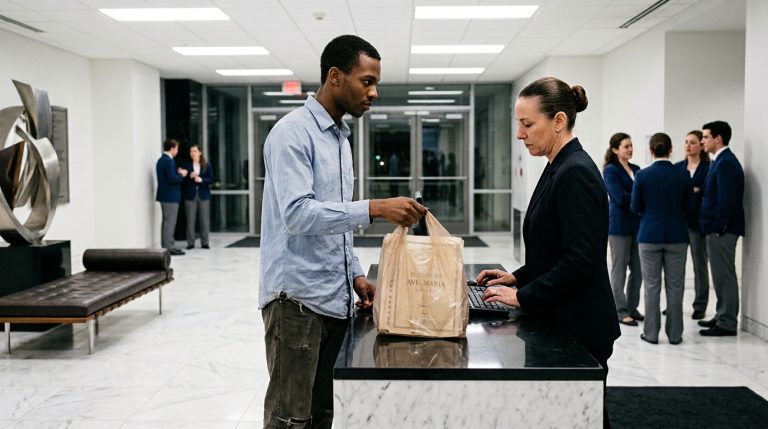
The lobby of the Hayes Hotel was designed to make people feel small. With its vaulted ceilings, polished marble that reflected every movement like a dark mirror, and the constant, rhythmic clinking of crystal from the lounge, it was an environment built for order. Today, however, that order had fractured.
Linda stood by her cleaning cart, her knuckles white against the metal handle. She had just finished a ten-hour shift in the high-altitude silence of the penthouse suites, and her body hummed with a bone-deep, familiar exhaustion. She wanted nothing more than to slip out through the employee exit and disappear into the evening. But she couldn’t move.
In the center of the vast, hollow space, eight-year-old Billy Hayes—the heir to the very empire that owned the floorboards beneath them—was thrashing. He was a small, frantic motion against the stillness of the room. His hands were pressed so hard against his ears that his skin had turned a bruised, pale white. He was trying to block out the world, but the world was screaming back.
Three men in dark, expensive suits stood in a loose triangle around him. They looked like statues—immobile, panicked, and utterly useless. One of them held a radio to his lips, his voice cutting through the air with a static-filled, sharp command that only seemed to make Billy’s thrashing more violent.
“Stand back,” the security chief barked, pushing a curious, tuxedo-clad guest away with a stiff arm. “Give the boy room.”
Linda felt a tug on her apron. Her daughter, Jenny, stood beside her. At ten years old, Jenny had a way of watching the world that made her feel older than the adults around her. Her blond hair was braided tightly, and her eyes were fixed, not on the frantic guards, but on the boy on the floor.
“Mom,” Jenny whispered, her voice barely audible over the chaotic symphony of the lobby. “It’s too loud for him.”
“Hush, honey,” Linda murmured, pulling her daughter closer, trying to shield her from the spectacle. “Don’t look. It’s Mr. Hayes’s son. We can’t get involved. We’ll lose our jobs.”
But Jenny was already moving. It wasn’t a sudden rush, but a shift in weight—the fluid, calculated motion of someone who knew exactly where they were going. She reached into her backpack, her movements deliberate and calm. She didn’t look at the guards or the men in suits. She ignored the shouting. She simply walked toward the center of the marble expanse, her worn, gray-soled sneakers making absolutely no sound.
A guard stepped into her path, his face stern. “Kid, get back. This isn’t a playground.”
Jenny didn’t answer. She didn’t even break stride. She performed a simple, graceful sidestep—a movement Grandma Ruth had taught her for navigating crowded marketplaces—and slipped past him as if he were nothing more than a pillar of cold stone.
She stopped five feet from the boy. She didn’t try to touch him. She didn’t try to compete with the sound of his ragged, uneven breathing. She simply sat down on the polished floor, cross-legged, a small, still anchor in a sea of agitation.
From the side pocket of her backpack, she pulled out a small, yellow plastic bottle. She dipped the wand, took a long, measured breath, and blew.
One bubble emerged, shimmering with the fragile, iridescent colors of a rainbow under the massive lobby chandelier. Then another. A stream of them drifted through the air, completely ignoring the tension, the shouting, and the panicked men.
One landed on the boy’s shoe and popped with a sound so quiet it was almost a thought. Billy’s screaming cut off instantly, replaced by a sharp, surprised gasp. He opened his eyes. He stopped rocking. His hands, which had been clawing at the stone, slowly lowered from his ears.
The lobby fell silent. It wasn’t the fearful, constrained silence of a moment ago. It was a stunned, heavy stillness. Jenny blew again. More bubbles. They danced in the air currents. The boy sat up, his movements stiff and trembling, and reached out a hand. He didn’t grab; he waited. When a bubble landed on his finger, he stared at it as if he were seeing the world for the first time.
“Blue,” Jenny whispered.
The boy looked at her, his eyes wide and dark. “Blue,” he repeated, his voice a ghost of a sound.
Up on the mezzanine balcony, a man in a charcoal suit gripped the glass railing until his hands shook. Robert Hayes, a man who could command armies of lawyers and negotiate deals in boardrooms across the globe, stood frozen. He was looking down at his son, and for the first time in five years, he realized he didn’t know how to move.
CHAPTER 2: THE GLASS OFFICE
The transition from the lobby to the mezzanine felt less like walking and more like moving through a vacuum. Robert’s hand was still clamped to the railing, the wood beneath his palm feeling strangely foreign—a relic of a man who thought he controlled the environment. He watched the girl, Jenny, stand up from the floor. She did it with a quiet, efficient grace that stung him. She looked at his son, then at the bubbles dissipating in the air currents, and then, for a fraction of a second, her gaze flicked upward to the balcony.
She saw him. And for the first time in his life, Robert felt observed rather than admired.
He turned toward his assistant, who was still trembling slightly. “Bring them up,” Robert said. The command was sharp, jagged, and entirely devoid of the polished, authoritative rhythm he usually employed in boardrooms.
“Sir?” the assistant stammered. “They’re… they’re housekeeping staff. It’s against protocol to bring them into the private executive suite. We should send them home, and I’ll have the head of security—”
“I said bring them up,” Robert snapped, the air around him tightening. “Now.”
He didn’t wait for a response. He walked away from the railing, his footsteps sounding like gunshots on the plush carpet. He entered his office—a sprawling expanse of glass and steel that overlooked the city. It was a space designed to intimidate, but as he stood behind his mahogany desk, he suddenly felt exposed. The room felt cold, like the interior of a refrigerator.
His mind flickered to a memory: the silence of the penthouse suites during his own childhood, a silence he had spent his entire adult life trying to replicate in his own empire. It was a sterile, perfect silence, one that demanded compliance. He realized, with a jarring sense of vertigo, that he had built his son’s world out of that same brittle glass.
A moment later, the heavy oak doors opened. Linda walked in, her housekeeping uniform looking terribly thin and worn against the backdrop of modern, minimalist luxury. She was twisting her apron in her hands, her shoulders hunched. Behind her, Jenny followed, her backpack slung over one shoulder. She didn’t look impressed. She looked around with the clinical curiosity of an architect inspecting a faulty foundation.
“Mr. Hayes,” Linda began, her voice brittle. “I am so sorry. She knows she isn’t supposed to… to bother the guests. She’s just a child. Please, I really need this job.”
Robert didn’t look at Linda. He couldn’t. His gaze was locked on Jenny. He looked at the girl as if she were a puzzle that had just upended everything he believed about how the world worked.
“Who taught you that?” Robert asked, his voice rough.
Linda stumbled, her apology cut short. “Sir?”
“The bubbles,” Robert said, gesturing vaguely at the air, as if he could still see the shimmering ghosts of them. “The counting. The sitting on the floor. I’ve hired specialists from Europe. Doctors with three degrees. They try to hold him down, to sedate him. You… you blew soap and water.”
Jenny shrugged, one shoulder rising slightly. She didn’t shrink under his scrutiny. “My Grandma Ruth taught me.”
Robert narrowed his eyes, leaning forward, the glass-topped desk feeling like a shield he no longer knew how to use. “Is your grandmother a doctor?”
“No, sir,” Jenny said. Her voice was clear, ringing with a maturity that was almost unsettling. “She was a medic in the army. She flew in helicopters to get people out of bad places.”
“And what does that have to do with bubbles?”
“Grandma said that when people are scared, their heads get too loud,” Jenny explained. She didn’t look intimidated. She stood with a stillness that suggested she was the only one in the room who actually felt grounded. “She said panic is like a siren in a small room. You can’t shout over it. You have to open a window. The bubbles are the window. They give your eyes something slow to watch, so your heart remembers how to beat slow, too.”
Robert stared at her. The silence in the room stretched, heavy and profound. He looked at the window behind him, out at the city lights—a sprawling, frantic network of people, all trying to be heard, all adding to the noise.
“Grandma Ruth,” Robert repeated. “Where is she now?”
“She passed away last winter,” Linda said, her voice dropping, her hand moving to hover near her daughter’s shoulder as if to pull her back from a ledge. “She lived with us. She… she had a way with people.”
Robert looked at Linda, really seeing her for the first time. He saw the fraying threads on her cuffs, the tired lines etched deep around her eyes, the sheer, weary resilience it took to carry her daughter through the lobby of his world. Then, he looked back at Jenny.
“My son, Billy,” Robert started, but his throat seized. He cleared it, the sound harsh in the quiet room. It was a rare, painful admission of weakness. “Billy has been diagnosed with severe sensory overload. The doctors say he is difficult. They say he can’t connect.”
“He connected with the bubble,” Jenny said. It wasn’t a rebuke; it was a simple, mathematical fact.
“Yes,” Robert said. He walked around the desk, his movements heavy. He stopped in front of Linda, ignoring her nervous twitching. “I want you to bring her back.”
Linda blinked, stunned. “Back? To the hotel? She usually stays with a neighbor, but today—”
“No,” Robert interrupted. “To my home. The estate outside the city.”
Linda took a step back, her eyes wide. “Mr. Hayes, I clean rooms. I don’t… we aren’t babysitters.”
“I don’t need a babysitter,” Robert snapped, the edge returning to his voice, though it lacked its usual bite. “I have five of those. They are useless. I need…” He looked at Jenny again, and for a fleeting moment, he seemed to be asking for permission. “I need someone who knows how to open a window.”
“I can’t,” Linda said, desperation creeping into her tone. “I have shifts. I have to work.”
“I will pay you double your current salary,” Robert said. He didn’t even consider the cost. “For three hours, twice a week. You bring her to the house. She sits with Billy. That is all.”
“I’m ten,” Jenny said. “I’m not a doctor.”
“You’re better,” Robert said. He looked at her with an intensity that made Linda’s skin crawl. “You got him to speak. He whispered ‘blue.’ He hasn’t spoken a word to me in six months.”
The pain in his voice was raw, spilling out like blood from a wound. It cut through the cold, calculated luxury of his office, leaving him looking like exactly what he was: a father who had run out of walls to build.
Jenny looked at her mother, then back to the billionaire. “Can I bring my drawing pad?”
Robert let out a breath he seemed to have been holding for half a decade. “You can bring whatever you want.”
“Okay,” Jenny said. She looked at her mother. “Mom, it’s okay. Billy isn’t scary. He’s just loud because nobody listens.”
Linda looked at her daughter, then at the man who held their livelihood in his hands. She saw the desperation, the genuine, bleeding need in his posture. She remembered the look on Billy’s face in the lobby—the way the boy had finally, for the first time in years, looked peaceful.
“Okay,” Linda whispered. “We’ll try.”
Robert nodded once, the sharp, decisive gesture of a man who had secured his asset. But as they turned to leave, he hesitated. “What color were they?”
Jenny paused at the heavy glass door.
“The bubbles?”
“Yes.”
“They were rainbow,” Jenny said. “But you have to start with blue. Grandma said blue is the color of ‘it’s going to be okay.'”
Robert looked down at his own expensive leather shoes. I haven’t felt blue in a long time.
“Then you should watch the bubbles, too,” Jenny said, and walked out, leaving the richest man in the building standing in the center of his glass cage, waiting for a silence that wouldn’t come.
CHAPTER 3: THE FIRST SESSION AT THE ESTATE
Two days later, the gravel driveway of the Hayes estate crunched under the tires of Linda’s old sedan like breaking glass. The car, a battered relic of a machine, looked absurdly out of place against the backdrop of the massive wrought-iron gates. The mansion itself rose behind the perimeter, a structure of sharp lines and aggressive, cold geometry that seemed designed to keep the world—and anyone fragile—at a distance.
“It looks lonely,” Jenny whispered from the backseat. She was clutching her sketchbook to her chest, her knuckles slightly pale.
“It looks like a lot of windows to clean,” Linda muttered, her grip on the steering wheel tight, her eyes darting toward the security cameras mounted on the pillars. She was trying to project an air of professional indifference, but the tremble in her breath betrayed her. “Remember, Jen. Be polite. Don’t touch anything unless you have to. And if the boy gets violent, you move away. Immediately. Do not wait for me.”
“He won’t,” Jenny said, her voice quiet but absolute.
A butler, stiff-necked and dressed in livery that seemed to belong to another century, opened the heavy oak door as they pulled to a stop. The air inside the foyer was conditioned to a precise, chilling temperature. Everything was white, gray, or charcoal. The furniture was made of glass and sharp-edged metal; there was nothing soft to lean against, nothing that suggested a child lived here.
Robert Hayes was waiting by the foot of the sweeping staircase. He wasn’t wearing his usual armor of a three-piece suit, but he looked no less imposing in a stiff, perfectly pressed button-down shirt. He looked like a man who hadn’t slept, the lines around his eyes deepened by a hunger he couldn’t quite name.
“He’s in the playroom,” Robert said, bypassing any attempt at social pleasantries. The urgency in his tone was frantic, dampened only by his habit of command. “The nanny is on standby, but I’ve told her to stay in the hallway. I can’t… I can’t reach him today.”
“Where should I go?” Linda asked, her eyes scanning the sterile expanse of the foyer with an instinctive housekeeper’s unease.
“The kitchen,” Robert said, gesturing toward a hallway that seemed to lead into the bowels of the house. “The cook has tea. Stay there.”
Linda nodded, though she hovered, her gaze lingering on her daughter. Jenny stood alone in the vast, echoing hallway, looking smaller than ever against the monolithic walls.
“This way,” Robert said, beckoning Jenny toward a corridor that felt miles long. They walked in silence, the rhythm of Robert’s leather shoes hitting the hardwood with a staccato precision that made Jenny instinctively adjust her own pace to match his—a deer trying to move through the woods without snapping a single twig.
They reached a heavy, double-paneled door. Robert stopped, his hand hovering over the handle for a long moment. He looked, for a fleeting heartbeat, like a man afraid of what he might find on the other side.
“He had a bad morning,” Robert confessed, his voice dropping to a whisper. “He threw his breakfast. He bit the doctor. He’s… he’s gone inward again.”
Jenny looked up at the tall man, her eyes steady. “Did you yell at him?”
Robert stiffened, his jaw tightening into a line of steel. “I tried to discipline him. He needs structure. He has to learn how to exist in the real world.”
“Grandma Ruth said you can’t build a house during an earthquake,” Jenny said, her voice devoid of judgment, just stating a law of physics. “You have to wait for the ground to stop shaking before you start laying bricks.”
Robert stared at her, his expression caught somewhere between offense and a profound, reluctant awe. Then, he opened the door.
The playroom was a catalog of modern excess. Electronic robots that whirred, tablets mounted to walls, towers of plastic blocks, and shelves overflowing with high-end toys. It was a space designed for stimulation, yet it felt like a cage. In the far corner, behind a heavy velvet curtain that had been drawn shut to block out the morning light, there was silence.
“Billy,” Robert said, his voice attempting a command that didn’t quite land. “We have a guest.”
No movement. No sound from behind the curtain.
Jenny gently pushed past Robert. “You can’t talk to him from up there,” she whispered to the father, not looking back. “You’re too high up. You look like a giant.”
She walked into the center of the room. She didn’t approach the curtain. She didn’t plead. She simply walked to the center of the plush, expensive rug and sat down. She opened her sketchbook, took out a box of worn crayons, and started to draw.
The sound of the crayon against the paper—scratch, scratch, scratch—was rhythmic, soft, and unhurried. It was a sound that didn’t demand a reaction. It just existed, a steady heartbeat in the cold room.
Robert watched from the doorway, his arms crossed over his chest, his knuckles white. Every instinct he possessed screamed for him to go over there, to force the issue, to compel the boy to acknowledge the guest he was paying to see. But the silence Jenny had created was so absolute, so commanding, that he found himself pinned to the doorframe.
Three minutes passed. Five. Robert checked his watch, a nervous twitch. This was a waste of time. This was a failure.
Then, the velvet curtain moved.
A small, pale face peeked out from the shadows. Billy looked at the girl. He looked at the box of crayons. Jenny didn’t look up; she kept her eyes on her paper, drawing a sweeping, curved line. She didn’t seek his attention; she simply occupied the space.
Slowly, she reached into the box, pulled out a single blue crayon, and slid it across the rug. It rolled with a gentle momentum and came to rest three feet from the curtain.
“It’s a good blue,” she said to the air. “Like the ocean.”
Billy stared at the crayon as if it were an artifact from another planet. He took a hesitant step out from behind the curtain, then another, his movements mirroring the skittish nature of a wild thing. He crept toward the crayon. He picked it up. He looked at Jenny.
Jenny kept drawing. She didn’t acknowledge him.
Billy sat down. He wasn’t next to her, but he was close enough to be in her orbit. He put the crayon to the paper, and a jagged, uncertain line appeared next to her drawing.
Robert, standing in the doorway, felt a sudden, sharp lump form in his throat. He realized he had been holding his breath for twenty minutes. He wanted to reach out, to intervene, to be the father who could finally witness the breakthrough, but the air in the room felt fragile, like a bubble that would burst if he so much as blinked.
CHAPTER 4: THE CLOSET MAP
Robert’s instinct was to rush forward, his heart hammering against his ribs like a bird in a cage. He wanted to scoop his son up, to demand he speak, to bridge the distance that had grown between them like a canyon of ice over the last five years. But he felt the weight of Jenny’s earlier warning—the memory of how quickly the birds flew away when the ground trembled.
He stayed on his knees, his expensive leather shoes squeaking softly against the hardwood, a sound he had never noticed until now. He looked at the drawing on the rug. It was a chaotic, beautiful mess of wax crayon—a fish, a circle, and the jagged, aggressive lines Billy had added. For a man whose life was dictated by contracts, bottom lines, and absolute clarity, the drawing was an agonizing, indecipherable code.
Billy, however, was no longer looking at the drawing. He had retreated slightly, his eyes darting toward the heavy velvet curtain that led to his makeshift shelter—the walk-in closet. He was like a creature sensing a change in the weather, his body coiled and ready to vanish.
“He’s lonely,” Jenny whispered, not to Robert, but to the air, pointing her crayon at the drawing of the fish.
Billy stopped. He looked at the fish, then at Jenny. The silence in the room wasn’t empty anymore; it was thick with the weight of things unsaid. Slowly, with a hesitation that looked almost physical, Billy picked up a green crayon. He leaned forward, his small hand moving with a newfound, shaky confidence, and drew a lopsided, green blob next to the fish.
“Now he has a friend,” Billy said. The voice was rusty, unused, like a heavy door hinge struggling to open.
Robert’s breath hitched. He felt a sting in his eyes—a sensation so alien he almost panicked. He took a single, deliberate step forward, the movement slow and measured. Billy flinched. The green crayon snapped in his hand, a sharp crack that seemed to reverberate off the high ceilings. Billy pulled his knees up, hiding his face behind his arms, the protective reflex snapping back into place as if the breakthrough had never happened.
“Don’t,” Jenny said, her voice sharp as a blade. She didn’t look at Robert, but the command hit him with the force of a physical strike. “You broke the water.”
Robert froze, his skin flushing with a hot, sudden shame. “I… I just wanted to see,” he defended himself, though his voice sounded thin, inadequate.
“You walked heavy,” Jenny said. She stood up, her movements calm, brushing the flecks of green wax from her jeans. “Grandma Ruth said you have to walk like a deer in the woods. If you stomp, the birds fly away.”
She didn’t look at the billionaire, the man who owned half the city’s real estate and could ruin a career with a single phone call. She looked only at Billy, who was still huddled in the corner of the rug, his breathing becoming shallow and panicked.
“We have to go now, Billy,” Jenny said softly. “My mom has to cook dinner.”
Billy didn’t look up, but his hand crept out from his knees and touched the edge of Jenny’s worn sneaker. It was a plea, a silent, desperate tether. Stay.
“I’ll come back,” Jenny promised. She nudged the sketchbook toward him. “Keep the fish safe.”
She walked toward the door, passing Robert without a second glance. Robert stayed kneeling on the floor, the cold hardwood biting into his shins. He watched his son, who slowly lowered his arms and reached for the sketchbook, pulling it into the shadows of the closet as if it were a shield.
“Same time Thursday,” Robert said, his voice stripped of all its usual power. It sounded hollow, tired.
Linda, who had been waiting in the hallway, caught her daughter’s hand. She looked pale, her eyes darting between her boss and her daughter, her posture screaming of a woman who was waiting for the ax to fall. She didn’t say a word, just pulled Jenny toward the exit, her footsteps quick and rhythmic.
As the heavy oak door clicked shut, Robert remained on the floor. The playroom felt suddenly, aggressively empty. He looked at the space where the drawing had been—the blue crayon, the broken green one, the lines that had bridged the gap. He stood up, but his legs felt leaden. He walked over to the closet door and reached for the handle, then stopped. He didn’t open it. He couldn’t.
He realized then, with a crushing sense of clarity, that he was the reason for the closet. He was the reason Billy had built a world inside a dark, confined space. He wasn’t the visitor; he was the climate.
He walked out of the playroom, his socks sliding against the polished floor, heading not toward his office, but toward the grand, silent library. He needed to find a book, something he hadn’t touched since he was eight years old—a story that didn’t involve profit margins or market share. As he reached the library, the silence of the mansion seemed to press in on him, but for the first time, he didn’t try to fill it with the roar of his own importance. He sat on the floor, the vast shelves of leather-bound volumes looming over him, and for the first time in his adult life, he sat in the dark, waiting for the ground to stop shaking.
CHAPTER 5: THE GALA DISASTER
The storm arrived not as a whisper, but as a violent imposition. Thunder shuddered through the floorboards of the Hayes estate, turning the library’s suffocating, scholarly silence into something electric and unpredictable. Robert pulled himself up from the rug, his joints aching. He hadn’t realized how long he’d sat in the dark, but the change in barometric pressure outside told him the world was shifting.
He didn’t turn on the lights. He needed the gloom; it matched the hollow, aching feeling behind his ribs. The gala—the Hayes Foundation annual dinner—was only two days away. For months, it had been his singular focus, a polished theater of influence where he planned to demonstrate his mastery over his life, his legacy, and, most cruelly, his son.
The library door creaked. It wasn’t Billy. It was his lead security coordinator, Miller, his face taut with the kind of deference that Robert usually found comforting but now felt like a shroud.
“Sir,” Miller began, his eyes darting to the floor, avoiding the sight of his employer sitting in the dark like a broken man. “The preparations for Saturday are… there’s an issue with the ballroom staff. The agency sent a new rotation. They’re nervous about the security protocols.”
“Tell them to read the manuals,” Robert said, his voice flat. He walked toward the desk, his movements clumsy.
“They have, sir. But they’re asking about the boy. They’ve heard rumors. They want to know if he’ll be making an appearance. They’re concerned about… liability.”
Robert’s jaw tightened. The word liability felt like a physical blow. He walked to the window, watching the rain lash against the reinforced glass. The estate, usually so contained and predictable, looked like a ship lost at sea. “He is my son,” Robert said, though the claim felt like a hollow negotiation. “He will be there.”
“Sir, if there’s a repeat of the lobby incident—”
“There will not be,” Robert snapped. The fear that had been gnawing at him for days surged to the surface, masked by the cold, transactional tone of a CEO. “Make sure the guest list is tightened. No press. No unvetted contractors. And have the nanny—have Jenny and her mother—prepared to be in the side room. They aren’t to be seen unless I call for them.”
He was back to his old language, the cold, structural logic that had kept him upright for years. Yet, even as he spoke, he felt a strange, sickening dissonance. He was building the same cage, just with a slightly wider door.
Two days later, the ballroom of the Hayes Hotel looked like a cathedral dedicated to vanity. Gold-leaf molding caught the light of a dozen massive chandeliers, and the scent of expensive perfume and damp earth from the storm outside mingled into an atmosphere that felt cloyingly thick. The murmur of voices was a dull, rhythmic roar—the sound of people who were paid to be heard.
Jenny stood at the periphery of the red carpet. She looked like a misplaced note in a symphony, her simple blue cotton dress a stark, honest contrast to the silk-draped elite of the city. She held the yellow bottle of bubble solution in her hand, her thumb tracing the plastic grooves. She felt the vibrations of the room through the floor—the artificial, forced energy of the gala.
Billy stood beside her, his tuxedo a stifling, rigid shell. His bow tie was crooked, a small, stubborn protest against the formality of the night. He was holding Robert’s hand, but it wasn’t a connection; it was a white-knuckled death grip.
“Smile, William,” Robert whispered, his head tilted down, his smile never reaching his eyes. He wasn’t looking at his son; he was scanning the room, hunting for his peers, for the people who defined his success. “Stand up straight.”
Billy didn’t respond. He was rocking, a barely perceptible shift of weight from heel to toe. The hum in his throat had begun, a low, resonant frequency that he was desperately trying to swallow.
“Mr. Hayes,” Linda said, her voice tight, stepping out from the shadows of the staff entrance. She wore a black uniform that seemed designed to make her invisible. “It’s too loud. The music, the crowd… it’s going to trigger him. We should take him to the side room now. Please.”
Robert didn’t turn to look at her. His gaze was locked on a group of investors standing by the stage. “Nonsense,” he said, the word clipped and brittle. “We just got here. The board members are waiting. It will take five minutes. That’s all. Five minutes of presence, and we’re done.”
“Five minutes is a long time underwater,” Jenny whispered.
Robert ignored her. He pulled Billy forward, his grip firm, determined. “Come on, son. Show them.”
They stepped into the crush of bodies. It was an assault. A woman in a gown that shimmered like a snake’s scales stopped them, her face twisting into a plastic, predatory grin. “Robert! And this must be the little one. He looks so… intense.”
“He’s focused,” Robert lied, his heart hammering against his ribs. He gave Billy’s hand a sharp, corrective tug. “Say hello to Mrs. Vanderbilt, Billy.”
Billy didn’t speak. He began to rock more violently. The hum grew, a vibration that started to rattle the crystal glasses on a nearby tray.
Jenny didn’t wait. She stepped into the space between the woman and Billy, her presence a quiet, immovable barrier. “He can’t say hello right now,” she said, her voice clear and carrying through the sudden, expectant quiet of the circle. “He’s busy holding the floor down.”
Mrs. Vanderbilt blinked, taken aback. “Excuse me?”
“If he lets go, he might float away,” Jenny explained, her expression profoundly earnest. “Gravity is slippery in here.”
The woman laughed, a sound that was sharp and jagged, devoid of humor. “What a quaint imagination. Is this the help’s child, Robert? How charmingly rustic.”
Robert felt the heat flare in his neck, the burning shame of being judged by his own standards. “She’s the consultant. Billy, stop rocking. Stand still.” He pulled Billy’s hand again, a sharp, angry yank.
That was the breaking point.
Billy didn’t just pull his hand away; he recoiled as if burned. He opened his eyes, and the light behind them had vanished, replaced by a dark, surging terror. The room didn’t just tilt; it disintegrated. The lights flared into blinding spears.
“Too loud,” Billy screamed. It was a raw, primal sound that cut through the music, through the chatter, through the vanity. “Too loud!”
He dropped to the floor, his hands flying to his ears, and began to thrash. He kicked out with a violent, indiscriminate energy, his heel striking a waiter’s tray. Champagne glasses shattered, the spray of liquid and crystal shards raining down on the carpet like shrapnel.
The ballroom went deathly silent. Hundreds of eyes swiveled toward them—the wealthy, the powerful, the people who had come to witness a perfect legacy.
“Stop it,” Robert hissed, his face twisted in a mask of panic. He fell to his knees, not to comfort his son, but to contain the spectacle. He grabbed Billy’s wrists, his grip clumsy and desperate. “William, stop this instant! You’re humiliating us!”
Billy shrieked, a high-pitched, shattering sound of absolute betrayal. He hit Robert in the chest with a flailing fist, his eyes squeezed shut, the world finally, completely gone.
Jenny stood on the edge of the disaster, her hand still on her yellow bottle. She looked at Robert, her face pale, and saw the man he had fought so hard to bury—the man who would trade his own son’s sanity for the applause of a room full of strangers. She saw the truth of the estate, of the office, of the silent, sterile world he had built, and she realized, with a heavy, sinking clarity, that there was no fixing this. Not tonight.
CHAPTER 6: THE TENEMENT VISIT
The walk to the service exit felt like traversing a battlefield. Linda didn’t wait for Robert’s permission or the intervention of the security team. She moved with a desperate, jolting momentum, her arms locked around Billy, who had gone completely limp—a rag doll drained of its stuffing. Jenny walked behind them, her head held high, though her eyes were fixed on the floor, mapping the route with a surgeon’s precision. She didn’t look at the gala guests, those blurred, jewel-encrusted shapes who were already beginning to whisper, their voices rising like the tide.
Robert Hayes stood in the center of the ballroom, a solitary, rigid figure in the wake of the wreckage. He didn’t move to stop them. He couldn’t. The mask of the titan had slipped, and beneath it, there was nothing but a hollow, vibrating terror. He stared at his own hands, the hands that had held his son as if he were a delicate, flawed instrument of legacy rather than a boy.
The heavy service doors slammed shut behind them, cutting off the suffocating swell of the gala’s disapproval. Outside, the night air was sharp, biting with the lingering dampness of the storm. The city lights smeared across the wet pavement, bleeding into colors that felt too bright, too loud.
“Mom,” Jenny whispered, her voice cracking for the first time. “We have to go.”
Linda didn’t stop until they reached the sedan, a rusted, battered machine that suddenly felt like the only safe harbor in existence. She bundled Billy into the backseat, his small frame curled tight into a ball, his eyes staring at nothing. Jenny scrambled in beside him, her backpack heavy against her spine.
“I’m sorry,” Linda sobbed as she fumbled with the ignition, her hands shaking so violently she nearly dropped the keys. “I should have stopped it, Jenny. I should have seen that he was just… he was just a child in a man’s suit.”
“He’s a bear, Mom,” Jenny said, her voice small but steady. She reached out and placed a hand on Billy’s shoulder. He didn’t flinch. He didn’t respond. He had retreated into the furthest, coldest corner of his own mind. “Bears are loud because they’re afraid of the woods. He just doesn’t know he’s the one making the noise.”
The drive home was a blur of neon streaks and the rhythmic thump-thump of the sedan’s aging suspension. Every time Linda glanced in the rearview mirror, her face looked older, etched with the realization that they had crossed a line from which there was no simple return. They were no longer invisible. They were tangled in the wreckage of a billionaire’s failing reality.
When they arrived at their tenement, the apartment felt like a tomb. It was small, cramped, and smelled of lemon cleaner and old paper, but it was silent. Genuine, unforced silence. Linda tucked Billy into the small bed in the corner, his breathing shallow, his face a ghostly pale mask. She pulled the blanket up, her movements frantic and tender, before collapsing onto the kitchen chair.
Jenny didn’t sleep. She sat on the floor, her back against the cold linoleum of the hallway, her sketchbook open on her knees. She had drawn the shadow wolf again, but this time, the wolf was surrounded by a thousand eyes, each one a mirror of the ballroom’s judgment. She traced the lines with a shaking finger.
If the bear roars again, she thought, the memory of her grandmother’s voice echoing in the back of her mind, we have to be the ones to protect the wolf.
The front door, usually a flimsy barrier against the world, shuddered under a sudden, heavy knock. It wasn’t the landlord. The cadence was too deliberate, too heavy. Linda shot up from her chair, her eyes widening in panic. She hurried to the door, her hand trembling as she touched the lock.
“If that’s him,” she whispered to the empty room, “if he comes here to blame us…”
She threw the door open. Robert Hayes stood in the hallway, looking like a man who had walked through a fire and forgotten to brush away the ash. His tuxedo jacket was gone, his shirt stained with champagne, his hair matted with sweat. He didn’t have his usual entourage of security. He stood alone, his shoulders slumped, his eyes red-rimmed and hollowed out by a misery so profound it seemed to pull the light from the hallway.
“Mrs. Miller,” he said. He didn’t use the title, he didn’t use his authority. He used her name with a respect that sounded like an apology.
Linda stood in the threshold, her presence formidable, a mother guarding her sanctuary. “Mr. Hayes, we don’t want trouble. We’ll pick up the final check next week. Please. Just leave us alone.”
“I didn’t come to fire you,” Robert said, his voice a low, shredded rasp. He looked past her, into the dim glow of the apartment, toward the bedroom where his son lay. “I came to return something.”
He reached into his pocket and pulled out a single, crushed object. It was the yellow bubble wand, bent and cracked, the plastic housing splintered where it had hit the ballroom wall. He held it out, his fingers trembling, offering it to her as if it were a sacred relic.
“I tried to blow them,” he whispered, his eyes filling with tears. “After you left. I sat on the floor, just like the girl. I tried to make a window, but my hands were shaking too much. I couldn’t stop the siren, Linda. I couldn’t stop the noise.”
He dropped to his knees, not to command, not to negotiate, but to fall. The billionaire, the man who built empires on the back of his own iron will, knelt on the dirty linoleum, a broken man in the hallway of a tenement.
“Please,” he whispered, his head bowed. “I don’t need a maid. I don’t need a consultant. I don’t need an image. I just need to know how to stop the noise. Teach me, Linda. Teach me how to be quiet.”
Jenny stepped out from the shadows, her sketchbook clutched to her chest. She looked at the man on the floor, seeing not the bear, but the boy who had never been taught that it was safe to be anything else.