The Silent Ledger: A Soldier’s Burden Beneath the Cold Steel of Institutional Judgment and Unspoken Truths
CHAPTER 1: THE WEIGHT OF STEEL
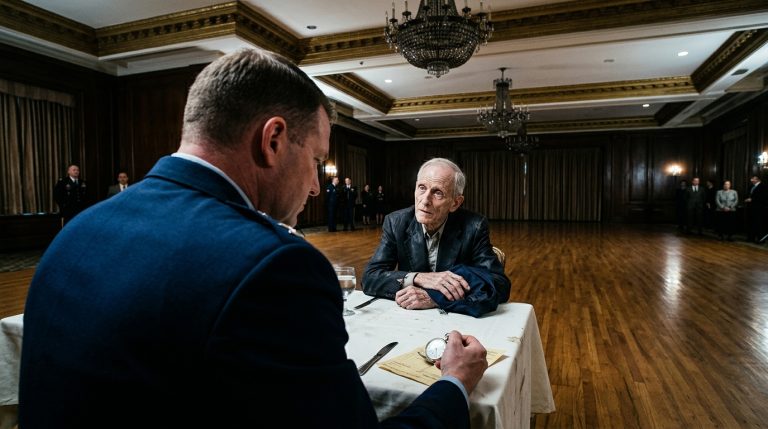
The air in the room was processed, sterile, and entirely devoid of the scent of earth or rain. It was the air of a tomb, or a court—whichever one decided to claim her first. Mara sat with her hands flat against the cold steel of the table, her palms absorbing the chill until the sensation migrated up her forearms. She didn’t fidget. Fidgeting was an admission of guilt, a vibration in the armor that Vance was desperate to locate.
She watched him. He was a man who measured his importance by the volume of his voice and the number of people who jumped when he tapped his pen. He was currently tapping that pen against her file—a collection of redacted pages that looked more like a censor’s practice sheet than a service record.
“Staff Sergeant,” Vance began, his voice a smooth, practiced baritone that didn’t quite reach his eyes. “We have gone through the motions of protocol. We have looked at the gaps in your history. We have noted the… peculiarities of your attachments.”
He leaned closer. The smell of his cologne—something sharp and synthetic—drifted across the table. It was the scent of an office-bound career. “I am going to ask you one more time. Who authorized the direct action in the Northern Arabian Sea? And why were you, specifically, the one tasked with the cleanup?”
Mara kept her gaze locked on the bolt in the center of the table. She could feel the stares of the other officers behind her, a pressure like static electricity building at the base of her neck. They were waiting for her to break. They wanted a story—a scandal, a heroic tale, or a cowardly excuse. They wanted something they could categorize, file, and eventually discard.
She took a breath. In for four, hold. Out for six.
“My duties were performed under standing orders, General,” she said. Her voice was steady, a flat plane of sound that offered no purchase for his mockery. “The details of those orders are restricted by the command that issued them.”
Vance’s smile didn’t widen, but it hardened, turning into a thin, brittle line. He looked around the room, making eye contact with the junior staff as if to ensure they were recording every ounce of her defiance.
“Restricted,” he repeated, savoring the word. “Convenient. It seems the higher one climbs in these shadow assignments, the less one remembers about the basic requirements of military service: accountability.”
He stood up, his chair scraping against the floor with a sound that seemed to vibrate through the walls. As he turned to address the panel, Mara’s peripheral vision caught a movement. A junior officer, positioned near the far wall, had reached for a water pitcher. He knocked it slightly—a small, sharp sound of glass hitting glass.
Mara’s eyes flicked to the table. Beside her, the paper cup of water she hadn’t touched remained perfectly still, its surface a mirror of the room’s oppressive fluorescent light. But then, she noticed the discrepancy. The condensation on the side of the cup hadn’t pooled at the base in a ring of moisture. It was dripping down from a single, distinct puncture mark near the rim—a mark she hadn’t seen when she sat down.
The room wasn’t just observing her; someone had been tampering with the table while she was focused on Vance. The realization didn’t cause her heart rate to spike, but it changed the texture of the room. It wasn’t just a hearing anymore. It was a setup.
Vance turned back to her, his gaze triumphant. “You seem distracted, Staff Sergeant. Is the truth becoming too heavy to hold?”
Mara looked up, meeting his eyes for the first time. The puncture mark on the cup was a message—a warning that her privacy was already compromised. She had to shift the momentum, not by answering him, but by making him question the ground he was standing on.
“General,” she said, her voice dropping into that dangerous, quiet register that made the room fall deathly still. “I am not distracted. I am just wondering if the people in this room know that your own logistics audit from the last quarter is missing three million dollars in unauthorized equipment transfers.”
The silence that followed was absolute. Vance froze. The pen in his hand went still. Every eye in the room pivoted from her to him, and for the first time, the weight of the room wasn’t on her shoulders. It was on his.
CHAPTER 2: THE SHIFTING FLOOR
The sound of the pen hitting the floor was the only thing moving in the room. It bounced once, a sharp, plastic clack that sounded like a gunshot in a library. General Vance’s face underwent a transformation that was as sudden as it was ugly. The smug, polished mask of institutional superiority didn’t just slip—it shattered. The red went out of his cheeks, leaving behind a sallow, drained complexion that made him look a decade older.
Mara didn’t blink. She kept her hands flat on the steel, her posture a rigid, unyielding pillar. She had not raised her voice; she hadn’t needed to. In the ecosystem of the Corps, the most dangerous predator is the one that knows where the bodies are buried—or, in this case, where the missing millions were redirected.
“That is a reckless fabrication, Staff Sergeant,” Vance said, his voice straining, losing its practiced baritone. He moved to pick up the pen, but his hand hovered uncertainly for a heartbeat before snapping down to retrieve it. It was a small hesitation, a tremor of doubt, but in that room, it was a neon sign of vulnerability.
“It’s an audit trail, General,” Mara replied, her voice maintaining that flat, lethal neutrality. “I’m sure you’re familiar with how those work. They have a tendency to resurface whenever someone starts asking the wrong questions.”
The room was no longer a hearing. It was a cage, and the bars were starting to bend. The junior officers, who had been leaning forward to watch her squirm, were now pulling back, their gazes darting between the General and the Marine who refused to act like a victim. The Navy legal officer, a man who had spent the last hour meticulously documenting her ‘failures,’ had stopped writing entirely. He was watching Vance, his expression shifting from judgmental to guarded.
Vance stood up straighter, his chest heaving. He was a man who had built his career on the assumption that he was the hammer and everyone else was the nail. He didn’t know how to handle the idea that he was being leveraged. “You are suggesting… what? That I have somehow mishandled funds?”
“I’m suggesting that you have a very narrow window to end this inquiry before the wrong people start looking at the same spreadsheets,” Mara said. She didn’t offer a smile. She offered nothing but the facts.
She could feel the cold edge of the table beneath her fingertips. The puncture mark on the paper cup—the one she’d noticed moments ago—was still there. It wasn’t just a sign of tampering; it was a sign of presence. Someone in this room, someone who wasn’t currently speaking, had been working against Vance long before she sat down. She didn’t know who, but she knew the pattern. It was the same rhythm she’d used in the field: identify the weakest point of resistance and apply pressure until the structure yields.
General Vance looked around the room, his eyes frantic for an ally, but he found none. The Colonel who had been leaning on his words earlier was now staring at his own boots. The room was calculating the cost of loyalty, and the price had just spiked.
“This hearing is recessed,” Vance declared, his voice cracking slightly on the last syllable. He didn’t wait for a motion from the board. He turned, his movements jerky and uncoordinated, and marched toward the door.
Mara remained seated. She didn’t stand. She didn’t salute. She simply watched him go, her gaze tracking his path with the mechanical precision of a thermal sight.
When the door slammed shut, the remaining officers didn’t leave immediately. They sat in the heavy, suffocating silence, looking at the empty space where the General had been. The air smelled of ozone and stale coffee.
Rear Admiral Keane, who had sat in the shadows of the room, finally shifted. The movement was slow, deliberate. He stood up and walked toward Mara’s table. His presence was not aggressive, but it was absolute. He stopped a few feet away, his hands clasped behind his back.
“You have a knack for finding the structural weakness, Staff Sergeant,” Keane said. His voice was low, devoid of the General’s performative edge.
Mara looked up, her eyes meeting his. She kept her expression neutral, the mask she had spent years refining firmly in place. “I only look at the data provided to me, sir.”
Keane’s eyes flickered, a momentary flash of something akin to respect—or perhaps just recognition. He leaned in, just enough so that his words wouldn’t carry to the others still lingering in the room. “The General won’t let this go. You’ve humiliated him in a public forum. He’ll come back with something heavier than a logistics audit.”
“I’m aware,” Mara replied.
“Good.” Keane tapped the table twice—a sound that echoed like a heartbeat. “Then you know what happens next. The protection you think you have—the political cover—it’s thin. And it’s not meant to keep you safe. It’s meant to keep you contained.”
He turned to leave, but stopped, his hand resting on the back of the chair Vance had just vacated. “Stay in the room, Staff Sergeant. Wait until the recording team packs up. And for God’s sake, don’t touch that water.”
He walked out, leaving Mara alone at the metal table.
She sat there for a long time, the silence returning to the room like a physical weight. The cameras in the corners were still, their red lights dark, but she knew better. In a room this cold, you never assumed you were truly unobserved. She looked back down at the punctured paper cup.
She hadn’t been fighting for her career. She had been fighting to stay invisible. But by using the logistics audit, she had forced them to look at her. She had stepped out of the shadow of the ‘blank page’ and into the harsh light of their scrutiny.
The door opened again. A junior technician entered, his eyes fixed on the floor as he headed toward the recording console. He was shaking. He didn’t look at her, but as he passed the table, he stopped, just for a second. His hand moved toward the cup, his fingers hovering over the rim.
Mara felt the shift in the room’s energy. This wasn’t a technician coming to do his job. This was an extraction.
She reached out, her hand moving with a fluidity that betrayed her stillness, and gripped the base of the paper cup just as he reached for it. The contact was electric, sharp, and immediate.
“You’re not supposed to be here,” she said, her voice a low hum that didn’t travel past the table.
The technician froze, his eyes finally meeting hers. They were filled with a raw, frantic fear that didn’t belong in a military hearing. “I have to clear the logs,” he whispered, his voice barely audible. “They’re going to wipe everything. They’re going to wipe you.”
Mara felt a cold spike of adrenaline, but she pushed it down, burying it under layers of tactical discipline. The decoy secret—the political protection—wasn’t the shield she thought it was. It was the bait. And someone was trying to pull her off the line before she could see who was holding the rod.
She let go of the cup, her fingers brushing the technician’s skin. He was freezing. “Which log?” she asked.
“All of them,” he stammered, his gaze darting toward the door. “The ones for the last twelve months. You’re not being investigated for your service, Sergeant. You’re being investigated for what you saw during the insertion.”
The room seemed to tilt. The insertion. The mission she wasn’t allowed to confirm. The one that had been scrubbed from every record. If they were wiping the logs now, it meant the threat wasn’t in the past. The threat was happening right now, in the very building they were standing in.
She stood up, her movements calm, calculated, and entirely devoid of the panic that threatened to overwhelm the technician. She walked toward the console, her boots silent on the linoleum.
“Show me,” she commanded.
He didn’t argue. He moved aside, his hands trembling as he typed a command into the console. The screen flickered, a cascade of green text scrolling past, and then, a file name appeared. Not a standard military designation, but a coordinate.
Mara felt the breath leave her lungs. She knew those coordinates. She had been there. And she had been told, by every superior officer she had ever trusted, that those coordinates were a ghost.
“That’s not a log,” she murmured, her voice tight. “That’s a kill-switch.”
The console beeped once, a high-pitched, mournful sound, and the screen went black. The room plunged into darkness, the only light coming from the faint, dying glow of the recording indicators.
The door clicked. It wasn’t the sound of someone leaving. It was the sound of a lock engaging from the outside.
Mara felt the weight of the room change. The air grew heavy, static, and charged with the unmistakable scent of a trap. She looked at the technician, but he was already gone, disappeared into the shadows near the back wall, leaving her alone in the dark.
She reached for her sidearm, but her holster was empty. She remembered, with a jolt of clinical realization, that she had been ordered to surrender it at the security checkpoint. She was unarmed, inside a locked room, in a building that had just decided she was a liability.
She stood in the center of the dark room, her ears straining for the sound of movement, her pulse steady despite the situation. She was a Marine, and she knew one thing above all else: if the room is locked, it means the hunt has begun. And she was no longer the prey.