The Iron Gate at Parris Island Proved That True Service Cannot Be Erased by Age Or Uniformed Arrogance
CHAPTER 1: The Gate Check
Ma’am, I’m going to need you to step over here.
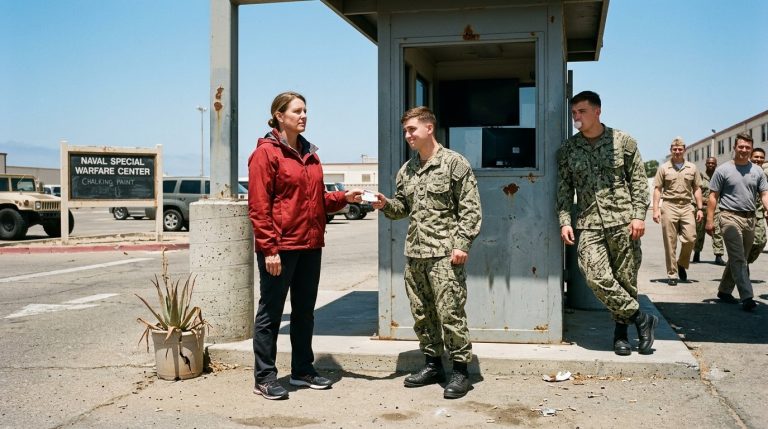
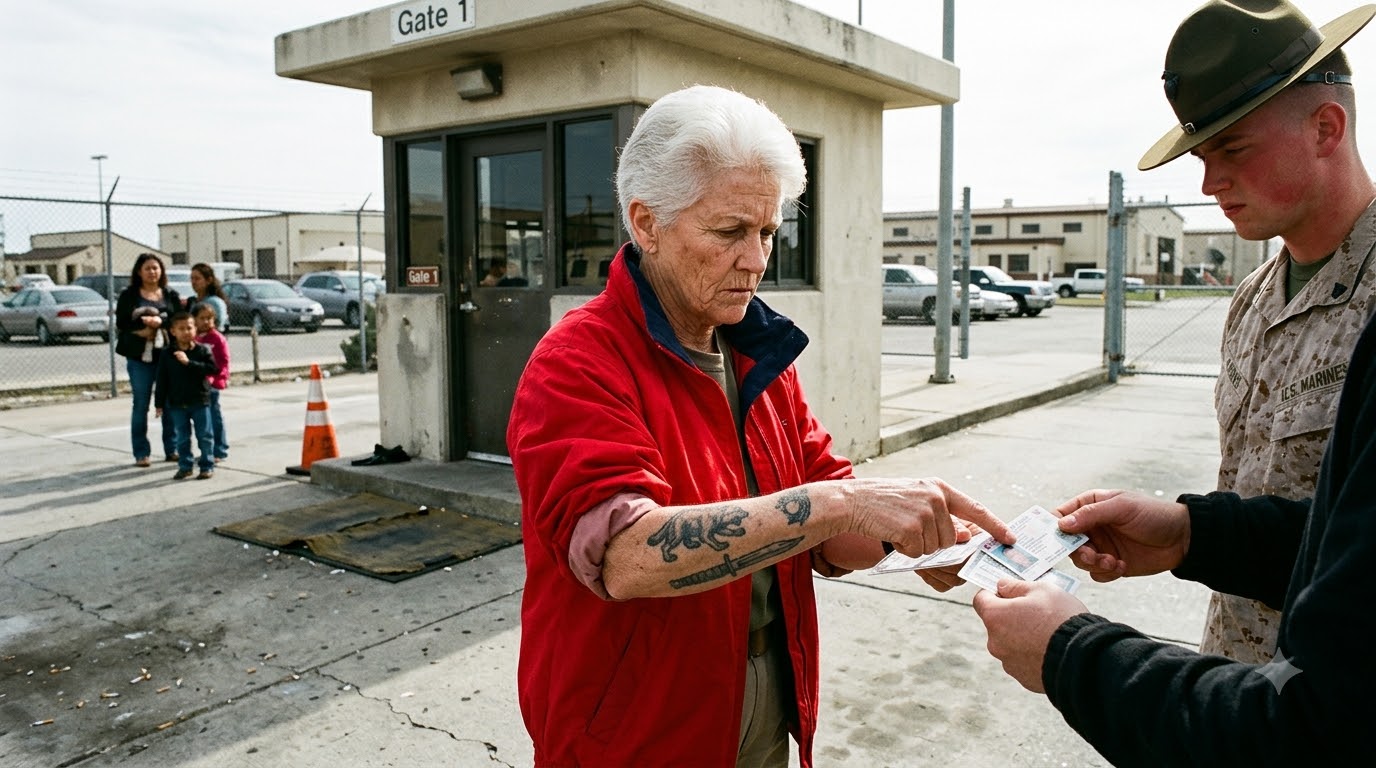
Gene Higgins did not blink. A young Marine, standing with the stiff posture of someone who had worn his starched camouflage for less than a year, stared down from the concrete step.
The corporal’s chevrons were immaculate. His gaze, however, slid right past her eyes to sweep over her bright red jacket and white hair with casual dismissal.
Is there a problem, Corporal? Gene asked. Her voice carried the steady, low resonance of decades spent shouting over diesel engines and range commands.
Just need to verify your access, he said, gesturing toward a side booth away from the family entrance. We are being extra careful today.
Gene held her ground for a fraction of a second before stepping aside. She reached into her leather handbag, her thumb catching the metal clasp, rolling it back and forth with a dry, metallic click.
She pulled out her visitor pass and state-issued identification, extending them flat across her palm.
The corporal took the plastic. His eyes barely grazed the printed name before dropping to her forearm, exposed where her sleeve was rolled.
There, faded into the weathered skin, sat a stark black ink mark: a snarling Wolverine over a downward-pointing K-bar knife, flanked by jump wings.
His professional mask cracked into a thin, condescending smirk. That’s an interesting tattoo, ma’am. Your husband served?
I am here for my grandson’s graduation, Gene said, ignoring the question entirely. Platoon 30041, India Company.
Right, the corporal said, tapping the plastic pass against his palm like a deck of cards. But you need an active sponsor to get past this checkpoint. Sometimes the grandparents get turned around. The welcome center is back down the road.
Gene did not turn around. Her shoulders squared automatically, an unconscious military reflex settling into her spine.
I am standing at the correct entrance for the Petros parade deck, is that not correct?
Yes, ma’am, it is, the corporal sighed, his patience thinning. But access is restricted. That pass needs verification. And frankly, that tattoo—he pointed his chin at her arm—it is an older design. People get fakes all the time to show support. Stolen valor is a serious issue around here.
The accusation hung heavy in the humid South Carolina air. A cluster of civilian families slowing down behind her whispered among themselves.
Gene felt the familiar, cold prickle of public scrutiny. She had navigated rough terrain and hostile airfields, yet here at the threshold of the very institution she helped build, she was treated like an intruder.
Corporal, Gene said, dropping her tone into a flat, absolute command. Scan the pass. Check the name. I am not asking twice.
CHAPTER 2: The Escalation
Ma’am, I am going to have to ask my supervisor to step over here, Corporal Davis said, his voice dropping into an official, defensive register.
He keyed the device on his lapel. This area is strictly for authorized personnel and vetted family members. Until I can confirm your credentials, you will need to stay right where you are.
Gene did not move an inch. Her heels remained locked to the weathered concrete of the checkpoint boundary.
More civilians streamed past the secondary gate, slowing their pace to watch the confrontation unfold. A mother pulling a wagon full of folding chairs threw a sympathetic glance toward Gene’s bright red jacket before hurriedly shuffling her children away.
The humiliation tactic was blatant. By stalling her in the open lane, the young guard was banking on her growing tired, losing her temper, or stepping out of line.
Gene felt the heat radiating off the blacktop bake through the soles of her shoes. Her shoulders remained pinned back, straight and rigid.
Call whoever you need, Corporal, Gene said, her voice dropping an octave, losing its conversational warmth and adopting the cold, unyielding flatness of a range safety officer. But check the identification numbers first. Do not make a fool of yourself twice.
Corporal Davis flushed a dull, stubborn red. He turned his back half an inch, muttering a quick call into his shoulder mic for a staff sergeant to report to gate one for a civilian access dispute.
A heavy, suffocating silence settled over the checkpoint. The air hung thick with humidity and the smell of exhaust fumes.
Gene reached back down into her leather handbag, her fingers finding the familiar cold metal of the clasp. She rolled it back and forth—click, click, click—keeping a steady, rhythmic beat that matched the pounding of blood in her temples.
A heavy pair of boots crunched against the gravel behind the checkpoint desk.
What is the hold-up, Davis? a voice barked, thick with morning annoyance.
A gunnery sergeant stepped out from the shade of the guardhouse, his campaign cover pulled low over eyes that scanned the line with immediate, cynical exhaustion.
Sir, this civilian’s pass is not registering on the quick-scan pad, Davis blurted out, turning quickly to regain control of the narrative. And she is displaying a non-regulation unit tattoo. It looks like a counterfeit design. I suspect she is trying to bypass security.
The gunnery sergeant sighed, a heavy expulsion of air that carried the clear weight of a man whose morning coffee had just been ruined. He turned his gaze toward Gene, looking right through her bright jacket and white hair without seeing a single year of her history.
Ma’am, let us not make a scene on graduation day, the gunny said, his tone dripping with patronizing calm. What is your name?
CHAPTER 3: The Stand
Ma’am, let us not make a scene on graduation day, the gunnery sergeant repeated, his voice dripping with synthetic patience. What is your name?
Gene Higgins, she said, her tone flat and completely stripped of compliance.
And who are you here to see?
My grandson. Recruit Michael Higgins, Platoon 30041.
The gunnery sergeant let out a sharp breath through his nose, snatching the visitor pass from Corporal Davis’s palm. He squinted down at the laminated plastic, then flicked his eyes back up to her face, searching for a sign of hesitation that never came.
Jean, you look like a nice lady, but this is a secure military installation, the gunny said, tapping the edge of the card against his knuckle. If your pass will not scan, we cannot just let you walk past this gate. Rules apply to everyone.
And that thing on your arm, he added, jutting his chin toward her exposed forearm with a dismissive squint. I have never seen a design like that. Looks like something drawn out of a cheap comic book. You really should not wear things like that here. It offends the real veterans who actually earned their place.
The insult landed with calculated weight.
Gene felt a hard, cold knot tighten instantly in the pit of her stomach. Forty years had passed since she last wore the green wool, but the indignity of being spoken down to by men who read history instead of writing it burned with the intensity of yesterday.
With all due respect, Gunnery Sergeant, Gene said, her voice dropping an entire register, locking onto him with absolute, unblinking authority. You hold my identification card right now. You possess my grandson’s full name, his platoon number, and every single digital flag required to verify my identity.
She took half a step forward, closing the distance until the heat radiating off her red jacket matched his starch.
I suggest you use it. Do not test me on paperwork I helped write.
The gunny’s jaw tightened. Her quiet, absolute command cut straight through his thick administrative arrogance, momentarily stalling his routine cadence.
He opened his mouth to bark another dismissal, but the sudden, rigid line of her posture made his eyes flicker with a flash of genuine uncertainty.
CHAPTER 4: The Bureaucratic Wall
This is a controlled access zone, civilian, the gunnery sergeant pressed back, digging his heels into the gravel while trying to salvage his fading authority. You cannot just flash an old card and expect us to bypass the digital logbooks. Procedures exist for a reason.
Gene did not blink. Her thumb rolled the metal handbag clasp—click, click—maintaining a steady mechanical rhythm that cut through his defensive bluster.
Then look at the manual you claim to protect, Gene said, her voice dropping into a razor-sharp cadence. The pass is linked to a federal database that predates your active duty service. Run the alpha-numeric code manually instead of relying on a broken scanner screen.
Corporal Davis shifted uncomfortably behind him, his fingers twitching near his belt line as the gathering crowd of families openly murmured behind the yellow boundary tape.
Sir, maybe we should just—the junior guard muttered, his voice cracking under the mounting weight of public attention.
Shut up, Davis, the gunnery sergeant snapped, refusing to yield an inch of ground to an aging woman in a bright red jacket. He glared back down at Gene, his expression locked in stubborn denial. We do not have time to manually override records during morning processing. Step back away from the gate or I will have military police escort you off the property.
Gene stood motionless, her shoulders braced against the heavy heat of the morning sun.
Try it, she said, her tone absolute and unyielding. Let them explain to the depot commander why an authorized family member with a valid veteran registry is sitting outside the gate because a pair of gate guards refused to read plain text.
The gunny’s face drained of its professional veneer, replaced by the dark, trapped fury of a man who realized he had pushed an immovable object too far.
CHAPTER 5: The Collapse of Authority
You are crossing a line, civilian, the gunnery sergeant hissed, his fingers gripping the plastic radio housing so tightly his knuckles turned white.
He keyed the device with a sharp, aggressive jab. Gate One security desk, report an uncooperative individual attempting forced perimeter access without valid clearance. Send a backup detail immediately.
Corporal Davis puffed out his chest, desperately trying to match his superior’s sudden escalation, pointing an accusing finger toward the side lane.
You heard him, the junior guard chimed in, his voice rising in panic as he tried to mask his own fading control. Step away from the gate right now or face formal detention.
Gene did not retreat a single millimeter. Her worn leather handbag stayed gripped in her left hand, her thumb applying steady, rhythmic pressure to the brass clasp.
Call whoever you want on that radio, Gene said, her voice cutting through the humid air like cold steel. Tell them Gunnery Sergeant Higgins is standing right here waiting for an adult to answer the phone.
The gunnery sergeant froze mid-motion, his hand hovering over the microphone clip.
What did you just call yourself?
You heard me, Gene said, her flint-gray eyes locking onto his without a flicker of doubt. Now type the service number on that terminal before I decide to report your entire squad for gross incompetence and dereliction of duty.
The sheer audacity of her unyielding posture shattered the remaining scaffolding of their administrative bluff.
The gunny’s mouth parted in silent fury, realizing too late that every aggressive threat he had made was now trapped inside an official logbook he could no longer delete.
CHAPTER 6: The Dusty Honor
The radio slipped another fraction of an inch, the weight of unverified threats turning into dead lead in the sergeant’s hand.
Gene watched him struggle with the gravity of his own mistake, her expression unyielding and entirely devoid of malice.
You can make that call, Gunnery Sergeant, or you can open the gate, she said, her voice dropping into a flat, level cadence that brooked no further argument. Either way, my grandson’s name is on the roster, and I am walking onto that parade deck.
Corporal Davis stared at his superior officer, waiting for an order that never came, his face pale and slick with the morning humidity.
The gunny swallowed hard, his throat tightening as the reality of the registry numbers finally anchored in his mind.
He didn’t speak. He simply stepped sideways, his boots scraping against the concrete, clearing the path through the checkpoint.
Gene adjusted the strap of her leather handbag, her thumb giving the brass clasp one final, quiet click.
She walked past them without looking back, her posture straight and her head held high in her bright red jacket.
The asphalt felt solid beneath her soles, each step carrying the weight of decades past and the uncompromised peace of a boundary held against the tide.