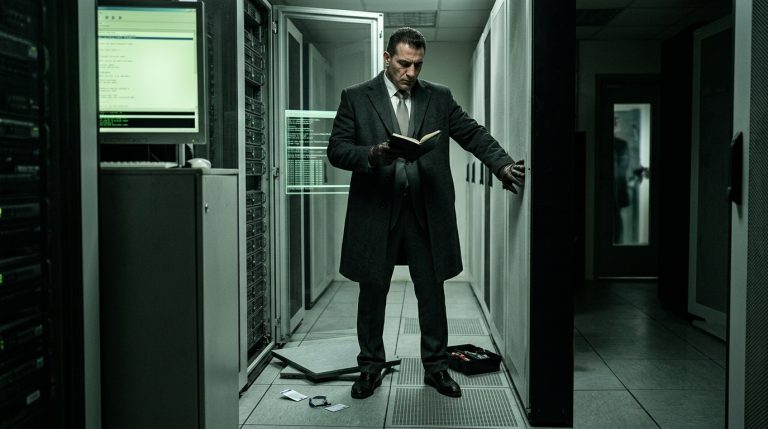
The Architect of Silence: A Father’s Descent into the Fractured Truth of a Stolen Legacy
CHAPTER 1: THE GEOMETRY OF BETRAYAL
The air in the penthouse felt different—thinner, charged with the static of a secret finally exposed. Michael stood in the threshold of his office, his palm pressed against the cool mahogany of the doorframe. The room was exactly as he had left it: the files on the desk, the low-light lamp casting long, jagged shadows across the carpet. But the silence wasn’t empty. It was waiting.
Grace stood by the window, her silhouette framed by the harsh, electric blue of the Manhattan skyline. She didn’t turn when he entered, but her shoulders were braced, a rigid line of tension that spoke of a prepared defense.
“You knew,” Michael said. The words didn’t come out as a shout; they were cold, surgical, stripped of the frantic energy of the night before.
Grace turned slowly. Her expression was a mask of calculated calm—the same mask he had been wearing for years as a CEO, the same one he now recognized as a weapon. “I knew what I was tasked to protect, Michael. I didn’t know how much you’d be able to handle.”
“Tasked by whom?” Michael stepped further into the room, his eyes scanning the desk. The folder Shaw had given him was gone. He felt the cold iron of his own resolve solidify. “Bailey? Was he the one who put you in my house, or were you already there, waiting for the right moment to trigger her?”
Grace’s gaze flickered to the door, checking for Emily, though the child was safely tucked away in the living room with the monitors on. “I was a contingency,” she replied, her voice dropping into that southern softness that now sounded like a jagged edge. “Bailey knew he wouldn’t survive the transition. He needed someone who understood the frequency. He didn’t trust you, Michael. Not because you were a bad man, but because you were the most visible target in the city.”
Michael gripped the edge of his desk. The wood felt hard, real, grounding him as his reality tilted. He realized then that the intimacy he had felt—the shared meals, the laughter, the subtle easing of his own grief—was all part of the calibration. “The humming. The lullaby. It wasn’t just comfort.”
“It’s the encryption key,” Grace said, and the bluntness of the admission landed like a physical blow. She walked toward the desk, her movements predatory in their grace. “Shaw is coming back, Michael. And he’s not coming for a conversation. He’s coming to extract the data.”
Michael reached into his drawer, his hand finding the grip of a compact security scanner he kept for physical sweeps. “Then you’re done here, Grace. Pack.”
“I can’t,” she whispered, her eyes locking onto his with a terrifying, desperate honesty. “If I leave, the frequency changes. She doesn’t just need the lullaby, Michael. She needs me to keep it steady. Without the anchor, the data in her head… it’ll tear her apart.”
Outside, a sudden, sharp crack echoed from the terrace—the sound of glass vibrating under the pressure of a localized sonic device. Emily’s humming in the next room cut off instantly, replaced by a silence so sudden it felt like a scream.
CHAPTER 2: THE ANATOMY OF A FREQUENCY
The silence that followed the vibration was not empty. It was pressurized, the kind of stillness that occurs right before a structure surrenders to a weight it was never built to support. Michael didn’t move. His hand remained on the doorframe, his knuckles white, his gaze locked on Grace. She hadn’t flinched when the glass vibrated, hadn’t looked toward the terrace. She had only watched him, her eyes tracking the shift in his pupils, the way he calculated the distance to the living room.
“That wasn’t wind,” Michael said. His voice was a flat, dead line. He didn’t wait for her to confirm it. He pivoted, his movements precise and stripped of all unnecessary energy, and vaulted toward the living room.
He didn’t run like a desperate man; he moved like a soldier navigating a kill zone. He reached the threshold of the living room just as Emily pulled her knees to her chest, the stuffed rabbit clutched so tightly against her sternum that the fabric looked translucent. She wasn’t rocking. She was rigid, her mouth open in a soundless, frozen inhalation.
“Grace,” Michael commanded without looking back. “Clear the room. Now.”
Grace appeared in his periphery, moving with that same liquid, predator-like efficiency he had underestimated for three weeks. She didn’t argue. She didn’t offer a platitude. She crossed the room, her voice dropping into a low, rhythmic cadence that bypassed the noise of the world and spoke directly to the wiring of the child’s brain. She began to hum—not the lullaby from before, but a new sequence, a minor-key variation that seemed to vibrate in the very teeth of the room.
Michael ignored them, his attention entirely consumed by the floor-to-ceiling glass of the terrace door. There was no shatter, no spray of debris, but there it was: a perfect, spider-web fracture blooming outward from the center of the pane, a geometric masterpiece of forced pressure. He stepped onto the terrace. The Manhattan wind hit him like a physical hand, cold and biting, smelling of river salt and industrial exhaust.
He looked down. Forty-three floors of sheer drop-off separated him from the street. There was no one on the ledge. There was no device. But on the floor of the terrace, near the metal railing, sat a small, blackened circular mark—the size of a coin, still radiating a faint, heat-hazed shimmer.
A phantom image flickered in his mind: Laura, in the hospital, her voice trembling as she talked about protection. He remembered the way she had looked at him, not with love, but with the hollow, terrifying exhaustion of a woman who had been carrying a bomb in her arms for years. He felt the cold iron of the railing under his hand. He wasn’t just a father anymore; he was the custodian of a biological relic.
He walked back into the living room. Grace was still humming, her hand hovering just inches from Emily’s shoulder, a conduit for whatever frequency was keeping the girl’s nervous system from liquefying. The child’s breathing was leveling out, but her eyes remained wide, fixed on a point only she could see.
“The device was directional,” Michael said, his voice hard enough to cut through the humming. He walked to the kitchen island, his eyes scanning the security monitors he had installed—the ones he now realized were likely compromised or, worse, ignored by whoever had planted the device. “They’re not just watching the building, Grace. They’re calibrating her.”
Grace stopped humming. The sudden lack of sound was deafening. She stood up, her face pale, her composure finally showing the strain of the night. “They didn’t just want to scare you, Michael. They wanted to see if she would break. If the data is still stored in her neural mapping, a high-frequency spike is the only way to force a diagnostic signal.”
Michael felt a sharp, burning need to dismantle every inch of the penthouse, to strip the walls until he found the hidden microphones, the sensors, the weight of the surveillance that had been living alongside them. He moved to the central control panel, his fingers dancing over the touch-screen interface. He hit the kill-switch for the external connectivity, severing the penthouse from the city grid. The lights flickered and died, leaving them in the dim, amber glow of the emergency path-lighting.
“We aren’t staying here,” Michael said. He looked at Grace, and for the first time, he saw her not as a plant, but as a fellow prisoner. “If they have the frequency, they have the perimeter. You’re going to get Emily’s bag. We leave through the service exit, the one that’s off the primary grid.”
“They’ll be waiting in the stairwell,” Grace countered, her voice sharp with pragmatism. “They know you’re going to run. That’s the entire point of the diagnostic spike—to force the target into a high-visibility extraction. They want us to run, Michael. They want to see where we go.”
“Then we don’t go where they think we’re going.” Michael looked down at the stuffed rabbit on the carpet. He reached into his pocket and pulled out the security scanner. He didn’t check for bugs; he checked for the signal emission coming from the house itself. The red light on the device flared to a blinding, continuous crimson.
The penthouse wasn’t just being watched. The penthouse was a broadcast tower.
“They haven’t been looking for the file,” Michael realized, the horror of it settling into his bones with the weight of a glacier. “They’ve been waiting for us to activate the system. By trying to secure the house, we just gave them the location of the key.”
He grabbed Emily’s hand, his grip firm but careful. She didn’t resist. She stood up, her eyes still clouded, and pressed her face against his coat. The smell of her—lavender and dust—hit him, a sharp contrast to the cold, clinical reality of the threat.
“Grace, move,” he ordered.
As they walked toward the service door, Michael stopped. He heard it then—not from the hallway, but from the walls. A faint, mechanical scratching, rhythmic and persistent, coming from the ventilation ducts behind the master suite. It wasn’t the sound of an intruder. It was the sound of a relay closing. The penthouse wasn’t just a home; it was a trap that was finally, after two years, snapping shut.
He pulled his phone, checked the signal one last time, and saw it drop to zero. They were in the dark now, and the only path forward was to navigate the geography of a betrayal he had spent three weeks calling a friendship.
CHAPTER 3: THE FORENSIC AUDIT
Michael didn’t reach for the wall again. He didn’t acknowledge the clicking, the rhythmic protest of wires being forced into a new configuration. He kept his gaze on the service door, his hand still clamped around Emily’s small, warm fingers. The adrenaline that had surged through him minutes ago was beginning to crystallize into a cold, hard focus. He could feel Grace watching him—not with the servile attention of a maid, but with the appraising focus of an operative who knew exactly how dangerous he was becoming.
“Move,” Michael repeated, his voice barely a breath.
They slipped into the service corridor. It was a utilitarian artery of concrete and brushed steel, a world away from the polished marble and art-filled galleries of the main residence. The air here was stale, heavy with the smell of floor wax and the distant, metallic tang of the building’s massive HVAC system. Michael didn’t head for the freight elevator; he knew better. That would be the first point of observation for whoever was holding the keys to the building’s security grid.
Instead, he guided them toward the emergency stairwell, his movements deliberate. He stopped at the heavy fire door, pressing his ear against the cold metal. Silence. Not the pressurized silence of the penthouse, but the dead, hollow silence of a vacuum.
“If they’re monitoring the internal sensors,” Grace whispered, her voice dropping into a professional rasp, “they already know we’re off the primary grid. They’ll expect us to hit the garage or the street. That’s where the SUV will be waiting.”
“I know,” Michael said. He reached into his coat and produced the security scanner again, but this time he didn’t point it at the walls. He pressed it against the seam of the fire door, watching the small digital readout. The numbers spiked, then settled into a steady, pulsing green. “They’re not using the internal grid to watch us. They’re using the building’s infrastructure to jam the external ones. We aren’t being followed. We’re being corralled.”
He nudged the door open just a fraction. A sliver of light from the stairwell fell across his face. It was empty. But on the landing below, he could see a discarded coffee cup—the same brand, the same dark-roast stain he had seen on the street earlier that day.
“They’re inside the building,” Michael realized. “They aren’t waiting for us to leave. They’re clearing the path.”
Grace moved past him, her eyes scanning the stairwell with a practiced, predatory ease. She reached into her bag and produced a small, unassuming black pouch. She didn’t look like a woman who had been cleaning marble three weeks ago; she looked like someone who had been rehearsing this exact extraction for years. She pressed a small, adhesive tab to the door hinge—a dampener.
“Michael,” she said, her tone suddenly devoid of all empathy, “if we go down, we lose our mobility. If we go up, we have access to the roof mechanicals. That’s where the high-gain transmission arrays are. If Bailey left a key, it isn’t buried in the penthouse. It’s buried in the broadcast signal.”
Michael looked at her, really looked at her. He saw the way she carried her weight, the way her breathing remained steady even under the threat of an imminent, armed confrontation. She was a plant, a contingency, a ghost of a life Bailey had built and he had been too blind to see. But she was also his only lead.
“You were his, weren’t you?” Michael asked, his hand tight on Emily’s shoulder. “From the beginning. You weren’t a cleaning crew. You were his handler.”
Grace didn’t blink. The confession wasn’t necessary; it was etched into the lines of her jaw. “I was his last resort. He told me that if he ever went dark, I was to find you. He knew you’d eventually look at the records. He just didn’t expect you to take this long.”
“He didn’t trust me,” Michael said, the realization stinging more than the threat of the men below.
“He feared you,” Grace corrected. “He feared you’d love her enough to get her killed before you understood what she actually was.”
Michael turned to the stairs and began to climb. He didn’t look back to see if she was following. He climbed with the heavy, rhythmic exhaustion of a man who was shedding his past with every floor. Every flight of stairs took them further away from the man who had been a billionaire tech mogul, and closer to the reality of a father who was nothing more than a temporary guardian for a living, breathing cipher.
As they reached the 45th floor, the mechanical hum of the building grew louder, a deep, bass-heavy thrumming that rattled the floorboards. Michael stopped. He could hear voices—not shouting, but the low, clipped professional dialogue of a tactical team. They were on the 46th floor.
He didn’t panic. He looked at Emily, who was watching him with a calm that bordered on the transcendent. She reached out, her small fingers touching the wall, her head tilted as if she were listening to the frequency of the building itself. Then, softly, she began to hum. It was the same minor-key sequence Grace had used, but it was richer, more complex.
The sound didn’t echo. Instead, the heavy hum of the building’s ventilation system suddenly shifted, the pitch dropping into an uncanny, rhythmic harmony with her voice. Michael watched the fire door at the top of the stairs unlatch itself, the magnetic seal breaking as if it had been given a command.
“She’s not just the key,” Michael whispered, the horror and the awe colliding in his chest. “She’s the interface.”
Grace looked at the door, then back at Michael. Her eyes were wet. “He didn’t just hide the file, Michael. He uploaded it to her synaptic memory. Every time she hums, she’s not just calming down. She’s decrypting the world around her.”
The door to the 46th floor swung open, and the shadow of a man in a dark coat stretched across the landing. Michael didn’t wait. He moved forward, his hand searching for the heavy metal railing, his mind no longer calculating profit margins, but the kinetic physics of the man who stood in their way.
CHAPTER 4: THE THRESHOLD OF THE UNSEEN
Michael moved before his brain had fully registered the man’s identity. It was reflex—the brutal, unthinking geometry of a man who had decided to stop being the target and start being the weapon. He shoved Emily toward Grace, his shoulder slamming into the fire door to maximize its arc, turning the heavy steel slab into a temporary shield.
The man in the dark coat—Daniel Shaw—didn’t flinch. He stood motionless in the narrow corridor of the 46th floor, his hands visible and empty. He wasn’t reaching for a weapon. He was waiting, his eyes tracking Michael with a disconcerting, clinical interest.
“The building’s security system just hard-crashed, Michael,” Shaw said, his voice level and devoid of any aggression. “I’d suggest you stop treating this like a physical breach. You’re not fighting me. You’re fighting the architecture.”
Michael didn’t stop. He closed the remaining distance, his fingers curled into the collar of Shaw’s coat, driving the man backward into the concrete wall. The impact was sickeningly dull, but Shaw didn’t gasp. He simply leaned into the pressure, his expression unchanged.
“Where is it?” Michael hissed, his voice a low, jagged sound. “Where is the override?”
“You’re looking at it,” Shaw replied, gesturing toward the stairwell railing.
The air pressure shift hit them then—a violent, localized atmospheric drop that made the hair on Michael’s arms stand on end. The lights in the stairwell began to strobe, a blinding, rhythmic pulse that perfectly matched the tempo of the lullaby Emily was still humming, though now it was softer, a mere vibration in the back of her throat.
“She’s harmonizing with the structural resonance,” Grace said, her voice tight. She was standing back, Emily pressed against her side, her eyes darting between Michael and the equipment mounted along the stairwell walls. “Michael, get away from him! He’s using you to ground the signal!”
Michael stepped back, but the realization was already sinking in. The black, circular marks he had seen on the terrace earlier—they weren’t incendiary burns. They were contact points. Shaw wasn’t just here to kidnap a child; he was here to synchronize a distributed network of signal amplifiers using the building’s steel skeleton as a tuning fork.
“You’re broadcasting through her,” Michael realized, his voice hollow. “You’re using her neural frequency to bypass the firewall on the files Bailey stole.”
Shaw adjusted his coat, his composure irritatingly intact. “It’s not just a file, Michael. It’s an architecture of state-level surveillance. Bailey didn’t just steal information; he stole the ability to watch anyone, anywhere, without detection. And the only way to tap into that stream is through a live, bio-encrypted key.”
Michael looked at Emily. She seemed smaller than ever, a tiny, fragile figure standing in the middle of a war between two men who both viewed her as a utility. The hum in the stairwell intensified, reaching a pitch that made Michael’s vision blur at the edges. The sound wasn’t coming from Emily anymore; it was coming from the walls, the pipes, the very concrete surrounding them.
“She’s breaking,” Grace warned, moving forward. Her professional mask was gone, replaced by a raw, frantic maternal instinct. “If the frequency hits that level of intensity, her brain will suffer a catastrophic cascade failure. She’ll burn out.”
“Then stop it,” Michael commanded, his eyes locked on Shaw. “Shut down the broadcast.”
“I can’t,” Shaw said, and for the first time, Michael heard a flicker of genuine uncertainty in the man’s voice. “Once the sequence starts, the signal feeds back into the source. If I cut it now, the surge will hit the child before the network can dissipate it. We’re locked in a feedback loop, Michael.”
Michael looked at the railing, then at the access panel embedded in the wall. The metal was glowing a dull, angry cherry-red from the sheer amount of energy flowing through it. He realized then that he couldn’t fight Shaw, and he couldn’t fight the network. He had to be the circuit breaker.
He reached out, not toward Shaw, but toward the panel. The heat was instantaneous, a searing bite against his palm, but he didn’t pull away. He jammed the edge of his compact security scanner into the junction, hoping the electronic override would force a localized short-circuit.
The effect was immediate and catastrophic.
The stairwell lights exploded in a shower of white sparks. A deafening, high-pitched screech tore through the air, and Michael felt a violent, invisible shove throw him back against the concrete stairs. His head struck the wall, and the world dissolved into a smear of black and grey.
When his vision began to clear, the silence had returned. But it was different now. It was heavy, laden with the smell of scorched ozone and burnt plastic. Grace was on her knees, clutching Emily to her chest. The little girl was limp, her eyes closed, her breathing shallow but steady.
Daniel Shaw was gone. The door to the 46th floor was standing wide open, leading into a darkened corridor that stretched away into the heart of the building.
Michael stood up, his hand dripping blood where the skin had been scorched by the panel. He didn’t check his wound. He checked Emily. She wasn’t humming anymore. She was silent, her head resting on Grace’s shoulder as if she were in a dreamless sleep.
“She’s alive,” Grace whispered, her eyes wide with shock as she looked up at Michael. “But the sequence… Michael, it didn’t stop. It just moved.”
She pointed to the wall where the junction had been. The metal was etched with a series of pulsing, glowing lines—a map, or a script, burning slowly into the concrete, glowing with a soft, bioluminescent blue that mirrored the exact shade of Emily’s eyes.
Michael realized then that he hadn’t broken the connection. He had simply migrated it from the child to the building itself. The penthouse was no longer a cage; it was the decrypted drive. And someone—or something—was already beginning to download.
CHAPTER 5: THE ARCHITECTURE OF RESIDUE
Michael stared at the wall. The glowing, web-like pattern wasn’t static; it shivered with the same rhythmic cadence Emily had maintained for weeks. It was a digital ghost, a manifestation of the humming sequence now hard-coded into the building’s steel and concrete. He reached out, his fingers hovering millimeters from the light, feeling the unmistakable hum of an active power grid vibrating beneath the cold surface of the panel.
“Don’t touch it,” Grace’s voice was brittle, a sharp contrast to the soft, rhythmic lullabies she had used to control the room. She was on her feet now, her eyes fixed on the wall with a mixture of professional recognition and profound grief. “It’s not just data, Michael. It’s a sensory feedback loop. If you break the circuit now, you don’t just kill the signal—you pull the remaining energy from whatever biological anchor is left in the room.”
Michael didn’t pull his hand away, but he didn’t close the distance either. He looked down at Emily. She remained slumped against Grace, her face pale, her features frozen in a mask of artificial serenity. She looked like a shell, a hollow vessel whose contents had been siphoned off into the infrastructure of the skyscraper.
“She’s the anchor,” Michael said, the realization settling in with the crushing weight of a falling vault. “You said she was the key. But she’s not just the key. She’s the battery.”
Grace didn’t answer. She didn’t have to. The silence in the stairwell was filled with the low-frequency thrum of the building—a sound that was becoming increasingly melodic, as if the skyscraper were learning to mimic the lullaby.
“We need to move,” Grace said, her gaze shifting toward the open fire door on the 46th floor. “The relay is localized here, but the stream is heading toward the broadcast array on the roof. If we don’t sever the link at the source, Shaw gets the decrypted package within the hour. Everything in that file—the tactical positions, the surveillance backdoors, the black-budget operations—it all gets dumped onto the open web.”
Michael grabbed his gear, his movements mechanical, his mind a whirlwind of tactical scenarios. He looked at the glowing wall one last time, noticing a peculiar discrepancy: near the center of the bioluminescent web, a small, dark segment of the concrete remained unlit, a jagged, star-shaped void where the light refused to propagate. It looked like a footprint—or perhaps, a signature.
He didn’t have time to analyze it. He hauled the fire door wider, his boots silent on the concrete as he stepped into the 46th floor. It was a floor under renovation, a labyrinth of exposed pipes, skeletal drywall, and stacks of insulation. The air was thick with the scent of fiberglass and dust, a sharp, suffocating texture that coated the back of his throat.
“Keep her close,” Michael ordered, his eyes tracking the movement of shadows between the scaffolding.
They moved with a calculated, rhythmic caution. Michael took point, his body hunched, his eyes reading the geometry of the room. He wasn’t looking for people anymore; he was looking for the signal. He saw it in the way the dust motes danced in the air—patterned, directed, moving in subtle, organized currents that suggested they were being pushed by an electromagnetic field.
“The air,” Michael whispered, stopping in his tracks. “The HVAC vents. Look at the flow.”
Grace glanced up, her eyes widening. The dust wasn’t settling; it was forming intricate, mathematical shapes—fractals that mirrored the glowing patterns on the wall below.
“They’re using the ventilation system as a signal amplifier,” Grace realized. “They’re broadcasting the data through the air, vibrating the dust particles. It’s a low-fidelity, high-security transmission method. It’s untraceable because it’s physical.”
Michael gripped the handle of a metal utility cart, pushing it into the path of a main vent. The metal grated against the concrete, a screeching, dissonant sound that seemed to temporarily disrupt the dust patterns. The signal shivered, the blue light in the vents flickering, but it didn’t collapse.
“It’s too sophisticated,” Michael muttered, his frustration mounting into a cold, focused rage. “Shaw is a broker, not an engineer. He doesn’t have the technical expertise to stabilize a bio-kinetic signal like this. He’s got help. Someone inside the firm, or someone inside the federal intelligence agencies, is running this for him.”
He turned to Grace, his voice dropping into a dangerous, low register. “Who, Grace? Who’s the engineer? Who knows the frequency?”
Grace hesitated. Her gaze drifted toward the darkened end of the hallway, where the skeleton of the building opened up into a massive, cavernous atrium. “There was a lead engineer on the Bailey case. A man who was officially declared dead two years ago during the same operation where Bailey disappeared.”
“What was his name?”
“Arthur Vance.”
The name struck a chord in Michael’s memory—a name from a cold-case file he had brushed past weeks ago while doing the initial search on Bailey. A shadow figure, an expert in signal intelligence who had allegedly been vaporized in a secure-facility blast.
“If Vance is alive,” Michael said, his eyes scanning the cavernous gloom of the atrium ahead, “then this isn’t just about a file. This is about rewriting the last two years of history.”
They stepped into the atrium. It was a massive, empty space designed for corporate prestige, now filled with the skeletal remains of construction. In the center, a makeshift console had been wired directly into the main support pillar of the building. A man sat there, his back to them, his fingers dancing over a series of haptic interfaces that were projecting the same bioluminescent blue light onto the surrounding pillars.
The man was humming. It was a precise, technical rendition of the lullaby, devoid of the human warmth Grace had brought to it. It was a machine-perfect tone.
Michael didn’t signal Grace. He didn’t wait for a plan. He moved with the weight of the last two years behind him, his focus on the console, his intent clear. He wasn’t going to negotiate with the ghost of a dead engineer. He was going to cut the source, even if it meant bringing the entire floor down with them.
As he reached the base of the console, the man turned. It wasn’t Arthur Vance.
It was a screen, a high-definition monitor displaying a live, real-time feed of a man’s face. The face of Arthur Vance, perfectly rendered, moving in sync with the humming.
“Automated,” Michael breathed, his hand locking onto the console’s main power supply. “It’s all automated.”
The feed on the screen flickered, and suddenly, the humming stopped. A voice, synthesized and cold, emerged from the console speakers, echoing through the atrium like a judgment.
“Mr. Carter,” the voice said, the cadence perfectly mimicking his own. “You’ve spent so much time looking for the truth that you forgot to check if you were even the one asking the questions.”
The console ignited, not with light, but with a sudden, violent surge of heat that forced Michael to stagger back, his lungs burning with the sudden, acrid smell of burning silicon. The trap wasn’t the building. The trap was the investigation itself.
CHAPTER 6: THE ECHO OF A DEAD ARCHITECT
Michael didn’t look at the screen. He looked at the floor, at the way the light from the haptic interface was bleeding into the dust, creating a map of the room that didn’t match the architecture he knew. His hand was a ruin of scorched skin, the smell of his own singed flesh clinging to him, but the pain was distant, secondary to the cold, encroaching realization that he had been playing a part in someone else’s script for three weeks.
“Grace!” he barked, his voice raw.
She was ten paces back, still clutching Emily, who remained in that eerie, trance-like state. Grace wasn’t looking at the screen. She was looking at the support pillars, her eyes darting between the structural beams and the rhythmic, pulsing blue light.
“Michael, get away from the pillar!” she screamed. “The console isn’t the source—it’s the relay for the entire structural load. If that console crashes, the weight of the broadcast won’t just vanish—it’ll redistribute into the building’s primary support struts. The tower isn’t just transmitting; it’s being held together by the frequency!”
Michael looked up. For a second, the cavernous space of the atrium seemed to groan, a deep, structural protest of steel against a force it wasn’t designed to contain. The hum that had been a gentle vibration was now a physical presence, a weight against his eardrums. He understood the trap now, the brutal elegance of it: Shaw and Vance hadn’t just created a broadcast—they had turned the penthouse into a weaponized structure. If Michael broke the signal, he triggered a structural failure. If he left it alone, the download continued until there was nothing left of the secrets Bailey had hidden.
“Vance!” Michael yelled at the monitor. “You’re not saving the data! You’re burning the house down to hide the evidence!”
The monitor flickered. The image of Arthur Vance—a man who had been dead for two years—tilted its head. “Evidence is a matter of perspective, Michael. You think you’re protecting a child. I’m protecting a legacy that spans three decades of state-level oversight. Bailey was a thief. And you? You’re just an inconvenience in an otherwise perfect system.”
The screen blinked, replaced by a live feed of the penthouse’s living room. It was empty, save for the blocks Emily had been stacking. Then, the feed switched to the building’s exterior. Dozens of black SUVs were pulling up to the curb. Shaw hadn’t just come to talk. He had come to clean up.
“They’re inside,” Grace said, her voice dropping to a whisper. She shifted Emily, her fingers brushing the child’s pulse point. “Michael, the signal is spiking. They’ve breached the main lobby. We have exactly four minutes before they reach this floor.”
Michael didn’t waste time on the console. He looked at the floor, at the star-shaped void in the bioluminescent map. He grabbed a heavy steel pipe from a pile of construction debris and drove it into the concrete at the center of the void.
The sound was like a thunderclap.
The floor didn’t crack. Instead, the concrete rippled. The bioluminescent light vanished instantly, plunging the atrium into a sudden, suffocating darkness. The humming stopped, replaced by the terrifying sound of the building’s massive, industrial-grade cooling fans spinning down to a dead halt.
“The structural integrity,” Grace gasped, her balance faltering as the floor beneath them vibrated violently. “You severed the dampener!”
“I severed the link,” Michael countered, hauling himself up. He grabbed Grace by the arm, his grip bruising. “The signal isn’t going to the array anymore. It’s trapped in the floorboards. We move, now!”
They sprinted toward the service lift, their footsteps echoing through the hollowed-out construction site like gunfire. Behind them, the sounds of tactical boots hitting the floorboards of the floor below signaled the arrival of Shaw’s cleanup crew. Michael didn’t look back. He shoved Grace and the limp body of Emily into the narrow, steel-walled service lift and hammered the button for the sub-basement.
The lift groaned, its cables straining, as it began to descend. Michael looked at his bleeding hand, then at Grace.
“Why you?” he asked, the question hanging between them as the elevator plummeted. “If you were his handler, why did you let me bring you into this? Why reveal yourself?”
Grace looked at the unconscious child. “Because he told me the truth, Michael. Bailey didn’t steal a file. He stole a person. Emily isn’t just the key—she’s the prototype. She’s the first of a generation of human-interfaced processors. She didn’t just inherit the data; she is the data. He didn’t want me to protect a secret. He wanted me to save a life before they could turn her into a permanent asset.”
The elevator jolted to a stop in the subterranean gloom of the garage. The darkness was absolute, save for the faint, flickering red glow of the emergency lights. Michael stepped out, the pipe still clutched in his hand. He heard the screech of tires above, the heavy thud of SUVs locking into formation, and the realization hit him with the force of a wrecking ball.
They weren’t just running from Shaw. They were running from a world that had spent two years redesigning itself to capture the very thing he was currently carrying in his arms. The game wasn’t about the file. The game was about ownership. And as the sound of boots on the concrete floor above began to descend toward them, Michael knew that the only way to win was to be the thing everyone else thought was already dead.
He looked at the dark exit, then back at the elevator. He didn’t head for the car. He headed for the sewage tunnels that connected the building to the city’s old, forgotten infrastructure. He was going to disappear, and he was taking the only piece of the future that mattered with him.
CHAPTER 7: THE GEOGRAPHY OF THE FORGOTTEN
Michael didn’t look for a light switch. He didn’t have to. The dim, greenish phosphorescence of moss clinging to the damp brickwork provided just enough illumination to see the treacherous path ahead. He moved with a brutal, knee-jarring pace, his arm locked tight around Emily, who remained a weightless, silent burden against his side. Grace was right behind him, her breathing shallow, her eyes constantly sweeping the darkness behind them.
“The tunnel leads to the East River discharge,” she whispered, her voice echoing in the confined space. “If we reach the overflow chamber, we can hit the service bypass. It’s an old manual shunt—pre-digital. They can’t track us there.”
Michael didn’t respond. He focused on the rhythm of his own boots against the slick, uneven ground. Every splash in the shallow, murky water felt like a siren call to the men descending the lift. The air down here was thick with the scent of stagnant water, rot, and the sharp, chemical sting of industrial runoff. It was a suffocating, visceral environment that stripped away the last veneer of his life as a billionaire. There was no prestige here. There was only the raw, physical reality of survival.
He felt the dampness soaking through his suit, the fabric clinging to his skin like a second layer of misery. He remembered the antiseptic smell of the hospital, the way the sterile air had made his throat ache when Laura was fading. It was the same sensation now—that same overwhelming, suffocating sense of being in a place where life was being systematically drained away. He wasn’t just protecting a key; he was dragging a piece of his own past through the filth of the present.
Suddenly, Grace grabbed his shoulder, yanking him into a recessed alcove just as a bright, sweeping beam of white light cut through the gloom of the tunnel behind them. They huddled in the darkness, the rough brick scraping against Michael’s back.
The light moved slowly, purposefully, dancing across the water and the walls. It was a high-intensity tactical floodlight, mounted on a drone. It wasn’t looking for them; it was mapping the tunnel.
“They aren’t just sending men,” Michael hissed. “They’re using the infrastructure again.”
“It’s not just Shaw,” Grace muttered, her voice trembling for the first time. “He doesn’t have the clearance for an autonomous drone deployment in a restricted municipal tunnel. Someone in the city administration is feeding him real-time access. We’re not just fighting a broker. We’re fighting the city itself.”
The drone hovered, its high-pitched whine vibrating in the stagnant air. It turned, its lens focusing on the alcove where they were hidden. Michael felt the instinct to bolt, but he forced himself to remain still. He knew the drone’s programming—it relied on movement detection and thermal tracking. If he moved, the drone would lock on.
He reached into his pocket and pulled out the security scanner he had used to override the panel in the penthouse. It was still hot, still buzzing with a residual charge. He looked at Grace, then at the drone, then at the dark, roiling water at their feet.
“I’m going to draw it,” Michael whispered. “When I move, you take Emily and run for the shunt. Don’t look back.”
“Michael, no—”
“Go!”
He threw the scanner into the water ten yards ahead. The device hit the surface with a splash and a shower of bright, blue sparks. The drone pivoted instantly, its floodlight blinding, and dived toward the disruption. Michael didn’t wait. He surged out of the alcove, his boots churning the water as he scrambled across the slippery floor toward the tunnel’s far bend.
The drone shrieked, its rotors spinning up to a deafening velocity as it registered his thermal signature, but the water spray from the scanner had created a localized fog of steam and mist, confusing the optical sensors. Michael pushed his body to the limit, his lungs screaming as he rounded the corner, his hand slamming into the cold, rusted surface of a heavy iron wheel—the manual shunt.
He grabbed the wheel, the metal biting into his palms, and threw his entire body weight into it. It was seized, rusted tight, refusing to budge. He roared in frustration, the sound swallowed by the cavernous dark, and slammed his shoulder against the iron.
It groaned, a high, metallic shriek that echoed through the tunnel.
“Grace!” he shouted, not looking back. “Get through!”
The drone was closing the distance, the light turning the tunnel into a blinding white void. He felt the heat of the rotors against his neck as it hovered just inches away. He didn’t turn. He swung the heavy metal pipe he had scavenged from the atrium, putting every ounce of his remaining strength into a blind, desperate arc.
The pipe connected with something—a sickening crunch of plastic and internal circuitry—and the drone spun out of control, slamming into the tunnel wall and exploding in a localized fireball that lit up the darkness for a split second.
The shockwave knocked Michael off his feet, his head slamming against the tunnel wall. He slid down, his vision flickering, his body broken and exhausted. But the shunt was open. The sound of rushing water, heavy and relentless, began to flood the tunnel as the bypass gate swung wide.
He didn’t have the strength to stand, but he saw Grace dragging Emily through the opening, her face etched with a desperate, frantic clarity. She reached the other side, the water swirling around her waist, and looked back at him.
“Michael!”
He tried to stand, but his legs were lead. He looked at the tunnel floor, seeing the way the water was swirling into the opening. He had done it. He had created the breach. But as the sound of tactical boots echoed again, closer this time, and the light from a second drone began to bleed into the tunnel entrance, he realized that for the first time in his life, he had run out of moves.
He gripped the pipe in his hand, a rusted weapon in a war he no longer understood, and waited for the light to find him.
CHAPTER 8: THE TACTICAL COLLAPSE
The tunnel shrieked—a long, agonizing metal-on-metal groan that signaled the structural failure of the entire bypass system. The drone didn’t wait. It banked, its rotors spinning into a blur of predatory intent, but the ceiling chose that exact second to surrender to the pressure. A slab of reinforced concrete, jagged and heavy with exposed rebar, peeled away from the tunnel’s spine, crashing down between Michael and the drone.
The impact was a seismic event. Dust, pulverized brick, and the acrid smoke of shattered stone filled the air in a blinding cloud. Michael didn’t wait for the debris to settle. He used the chaos as cover, scrambling through the rising grit, his lungs burning with every inhalation. The drone’s floodlight pulsed through the haze, turning the dust motes into tiny, suspended diamonds of light, but it was blind, its sensors overwhelmed by the particulate interference.
“Michael!”
Grace’s voice came from the other side of the collapse, muffled but insistent. She had made it through the shunt, but the tunnel collapse had effectively walled off their escape route.
“I’m here!” Michael coughed, the taste of dry mortar coating his mouth. He hammered his pipe against a section of the collapsed wall, testing the stability. It was immovable, a dead-end of jagged rock and twisted iron.
“The water pressure is building up on this side,” Grace shouted, her voice closer now, pressing against the barrier. “The shunt is flooding the chamber, but the main line is backing up because of the collapse. You have to get out of there, Michael! The tunnel is going to become a pressurized tank.”
Michael looked at the drone, which was now hovering erratically near the ceiling, its internal processors trying to compensate for the sudden change in the tunnel’s environment. He knew what she meant. The pressure from the river bypass was immense. He was in the kill zone.
He looked around, searching for a secondary relief valve—something, anything to dump the pressure before the walls exploded. His eyes fell on the underside of the pipe structure he had just demolished. There, hidden behind a layer of encrusted salt and mineral buildup, was a secondary control housing. It wasn’t electronic. It was a manual, mechanical relief gate designed for extreme emergency purging.
He lunged for it. The metal was cold, slippery with the rising water that was already swirling around his ankles. He grabbed the handle, his fingers locking into the grooves, and pulled.
It was locked by a biometric seal, a legacy security feature from the old municipal infrastructure. He stared at it, his mind racing. Biometric. The system was keyed to a specific frequency—not a human one.
“Emily!” he shouted, his voice echoing in the confined, damp space. “Grace, put her hand on the relief valve! Now!”
“She’s unconscious, Michael!”
“Do it!”
He felt a hand—small, cold, and limp—press against the gate. There was no hum, no lullaby, no conscious intent. But the moment Emily’s skin touched the rusted metal, a sharp, violent blue spark jumped from the valve. The lock disengaged with a clean, heavy thunk.
Michael threw the gate open.
The sound was apocalyptic—a roar of escaping water so powerful it literally ripped the remaining support beams from the tunnel walls. The pressure vanished, the water shooting out into the river discharge with the force of a hydraulic press, creating a vacuum that pulled everything in the immediate vicinity toward the opening.
The drone was sucked into the torrent, its rotors shattering against the iron gate as it was pulverized by the sheer volume of water. Michael felt the pull, his boots losing their purchase on the slick floor. He caught the edge of the relief gate, the current clawing at his legs like a living thing, trying to drag him into the dark, churning abyss.
He reached out, his hand grasping for anything, and felt a hand—Grace’s hand—catch his wrist.
She wasn’t just pulling him; she was anchoring herself to the ironwork, her face set in a mask of grim, absolute resolve. Behind her, Emily was safe, cradled against the wall of the shunt. Michael pulled, his muscles screaming, his boots scraping against the uneven floor until he tumbled through the opening, collapsing into the shallow, swirling overflow of the discharge chamber.
The tunnel behind them shuddered and finally gave way, the entire roof section dropping with a sound that shook the very ground they were standing on. The roar was silenced, replaced by the dripping of water and the distant, echoing siren of city emergency services now realizing the structural failure of the bypass.
They were in a small, concrete-lined chamber, safe for the moment, but the path was blocked. They were in the guts of the city, miles from the penthouse, and the silence that filled the chamber was worse than the noise had been.
Michael sat up, his body bruised, his clothes torn and soaked in sewage-tainted water. He looked at Emily, who was beginning to stir, her eyelids fluttering as if she were waking from a long, confusing fever.
“We’re not out,” Grace said, looking at the stone walls that hemmed them in. “This is the final containment node. There’s no way out but through the main server access, which is strictly monitored by the municipal grid.”
Michael looked at his hand—the burnt, scorched skin now beginning to throb with the dull, rhythmic ache of a nerve being exposed to the air. He realized that the “file” wasn’t just in Emily. It was being mirrored by the city’s own system, and every step they took toward freedom was just another data packet being uploaded to the grid.
He looked at the pipe he had carried—the rusted, simple piece of metal that had done more damage to the state-of-the-art surveillance equipment than any software update ever could. He realized then that the only way to win wasn’t to play the game better. It was to tear the board apart, piece by piece.
“We don’t need a way out,” Michael said, his voice quiet. He picked up the pipe. “We need a way to go dark. Permanently.”
CHAPTER 9: THE FREQUENCY OF FREEDOM
The water in the chamber was no longer rising; it was static, a dark mirror reflecting the jagged, rusted walls of the bypass. Michael stood in the center, his chest heaving, the heavy pipe still gripped in his right hand. Across from him, Grace sat on the wet concrete, Emily resting against her knees, the child’s breathing now deep and rhythmic. The roar of the city above—the distant, muffled sirens, the thrum of traffic—felt like a dream from another life.
“It’s stopped,” Grace whispered. She wasn’t looking at Michael. She was looking at the air in front of Emily.
Michael walked toward them, his boots dragging through the silt. He stopped and watched. A faint, shimmering haze was manifesting around the child—a delicate, geometric architecture of light that pulsed in time with her steady, sleeping heartbeat. It wasn’t code; it wasn’t a file. It was a projection of human cognition, a complex, layered map of memory and logic that Arthur Vance had attempted to digitize, but which Emily had internalized as part of her own consciousness.
“She’s not the lock,” Michael said, his voice dropping to a tremor. “She’s the correction.”
He realized then what Bailey had actually done. He hadn’t stolen data to sell. He had taken the prototype—a child born with the unique neurological capacity to harmonize with the very signal that was meant to enslave the global grid—and hidden her in plain sight, hoping that in a world of static and noise, the only thing that could save her was a father who finally understood that love was the only encryption they couldn’t hack.
Emily shifted. She opened her eyes, and for the first time, they weren’t just a soft, confused blue. They were sharp, focused, reflecting the architecture of the light surrounding her. She reached out, her fingers tracing the air, and the bioluminescence condensed into a single, palm-sized sphere of steady, warm white light.
“You have to let it go, Grace,” Michael said, his voice firm but devoid of the malice he had carried for weeks.
Grace looked at him, her eyes shining with unshed tears. “If I let it go, the system will know she’s off the grid. Shaw, Vance… they’ll never stop.”
“Let them come,” Michael said. He looked at his own hand—the scorched skin, the trembling muscles. He thought of the penthouse, the glass walls, the empty, sterile life he had led before this began. He picked up the pipe and placed it on the ground. It made a flat, final sound. “We aren’t hiding anymore. We’re going to use the broadcast. If they want this architecture, they can have it—but they’re going to have to watch us turn it into a mirror.”
He reached out and took Emily’s hand. The sphere of light in her palm pulsed once, a gentle, resonant chime that echoed through the tunnel, vibrating in the very soul of the city.
The payoff was immediate. Far above, the power grid flickered. The surveillance drones, the traffic cameras, the digital eyes of the city—they all stuttered. Michael didn’t see it, but he felt it in the way the air pressure suddenly neutralized. The “file” was being released, not as a dump of sensitive secrets, but as a broadcast of pure, unadulterated truth—the architectural blueprint of the surveillance state itself, projected in a frequency that every device in the city could receive.
Daniel Shaw, wherever he was, would be staring at a screen that was now showing exactly what he had done, broadcast by the very girl he had tried to weaponize. Poetic justice, etched in light.
The denouement was slow, a quiet settling of a life after the storm. They didn’t leave through the tunnel. They walked out into the cold, gray morning light of a riverfront park, the city waking up around them, oblivious to the fact that its digital chains had just been shattered.
Michael stood by the railing of the East River, the morning mist clinging to his clothes. He reached into his pocket and pulled out the stuffed rabbit—the one he had hugged for luck. It was stained, torn, and heavy with the silt of the tunnel, but he didn’t discard it. He knelt and tucked it into Emily’s arms. She looked at him, smiled a small, genuine smile, and leaned her head against his shoulder.
The symbolic closure was quiet. He didn’t need to rebuild the penthouse. He didn’t need the boardroom. He needed the silence, and for the first time in years, the city’s noise didn’t sound like a threat. It sounded like a conversation he was finally ready to join.
Grace stood a few paces away, watching the water. She was no longer a handler; she was a witness. Michael looked at her, then back at his daughter. The arc was complete. He had lost his legacy, his company, and his illusions, but in the process, he had finally become the father he had only pretended to be. He took a deep breath of the damp, river-scented air, and for the first time, he felt the weight of the world lift from his shoulders.
They began to walk, not toward a safehouse, but toward the horizon, two people and a child who was finally, truly, nobody’s property but her own.