A Legacy Carved in Soil: The Quiet Promise Between a Departed Mentor and a Young Heir
CHAPTER 1: THE WEIGHT OF THE GAVEL
The canvas of the tent sagged under the weight of the July heat, casting long, bruised shadows over the rows of folding chairs. Frank Druzell stood at the podium, his face glistening, the wood of the gavel held like a weapon. He was waiting for a number—a figure that would slice the Brenner farm into manageable, marketable pieces.
Matthew Brenner’s heart hammered against his ribs like a trapped bird. He looked at his mother; her hands were clasped so tightly in her lap that her knuckles had turned the color of bone. She wasn’t looking at the auctioneer. She was staring at the farmhouse in the distance, a white dot against the endless, shimmering green of the corn.
When Matthew stood, the movement felt impossibly slow, as if the air itself was resisting him. The scrape of his chair against the gravel sounded like a gunshot in the heavy silence.
“Son,” Frank said, his voice dropping, shedding its predatory, high-energy rhythm. “Do you need something?”
Matthew didn’t answer right away. He focused on the paper in his hands—a single, creased sheet that held the smell of his grandfather’s study: cedar, old paper, and machine oil. He felt the eyes of one hundred and forty people crawling over him, a collective pressure that made his knees tremble. He took a breath, the air tasting of dust and stale coffee.
“I need to say something,” Matthew said, his voice thin, cracking at the edges. “Before you sell it.”
He looked toward the front row. There, seated near the registration desk, was Laura Dietrich. She held a pen suspended over a ledger, her face an unreadable mask of professional indifference. But as their eyes met, her grip on the pen slackened, just for a heartbeat. It was a subtle, flickering disconnect in her armor, a detail that didn’t belong in a public auction.
Matthew gripped the paper tighter. He began to read. The words were a lifeline, pulled from the quiet evenings on the porch with Grandpa Joe, the sound of the tractor idling at dawn, the rhythm of a life lived in service to the soil.
“My name is Matthew Brenner,” he began, the words catching in his throat. He saw a man in the third row, a farmer with hands calloused into leather, wipe his eyes with a handkerchief that had seen better decades.
Behind him, the wind shifted, rippling the edge of the tent. Matthew felt a sudden, sharp draft, and a small, weathered envelope slipped from the folds of his grandfather’s letter, landing face-down in the dirt by his foot. He didn’t look down, but his peripheral vision caught the corner of a stamp—a dated, archaic seal that certainly hadn’t come from his grandfather’s estate. It was tucked away, hidden. A piece of the story that wasn’t on the page in his hands.
He kept reading, his voice gaining a sudden, terrifying clarity, unaware that the document at his feet was about to rewrite everything he thought he knew about the farm, his grandfather, and the man who was currently watching him from the back row with a look of desperate, calculated intent.
CHAPTER 2: THE NEGOTIATED QUIET
The silence under the tent was no longer just the absence of noise; it was a physical weight, thick with the smell of dry earth and the lingering, sharp scent of old paper. Matthew stood paralyzed, his eyes locked on the weathered envelope that lay at the toe of his shoe. It looked out of place against the beaten gravel, a relic of a different time, its edges frayed and softened by years of being tucked away.
He knew he shouldn’t touch it. He knew that if he reached down to claim it, he would be acknowledging that his grandfather’s life was not the simple, linear story he had read aloud. But the wind, shifting suddenly, tugged at the corner of the envelope, revealing a faded wax seal—the distinct, jagged crest of a family he had only ever seen in the corners of old photographs.
“Son,” Frank Druzell’s voice cut through the air, but it lacked its earlier edge. The auctioneer had moved back from the podium, his hand resting on the microphone as if he were hesitant to break the spell. “We’re going to take ten minutes. Everyone… let’s step outside for a bit.”
The movement began as a low murmur before swelling into the scrape of chairs and the shuffle of feet. Matthew’s mother leaned in, her hand firm on his shoulder. Her touch was a grounded, familiar presence, but he could feel the tremor in her fingers.
“Matthew,” she whispered, her voice low enough that only he could hear. “We need to go. We’ve said what needed to be said.”
“In a second,” he murmured, his focus entirely on the space at his feet.
As the crowd ebbed away, retreating toward the coffee station and the relative safety of the open air, a shadow fell over him. It was long, narrow, and cast by a figure that had remained seated in the front row. Laura Dietrich, the estate attorney, didn’t leave with the others. She stood slowly, smoothing the skirt of her dark suit, and began to walk toward him.
Matthew knelt, his fingers brushing the gravel. He snatched the envelope up, the paper feeling unnaturally heavy, a hidden architecture of secrets contained within a few square inches. As he rose, he came face-to-face with Laura.
“That’s a delicate thing to be carrying, Matthew,” she said. Her voice was professional, devoid of the emotion that had marked the room just moments ago, but her eyes—sharp and observant—tracked the envelope in his grip.
“I didn’t know it was there,” Matthew said, his voice steadier than it had been when he read his grandfather’s letter. He didn’t offer to show her. He felt the protective instinct flare—a instinct he hadn’t known he possessed.
“Your grandfather was a meticulous man,” Laura said, her gaze drifting toward the farmhouse visible through the side opening of the tent. “He understood that some things are too important to be left to chance. Or to the law.”
Before she could continue, a heavy boot crunched on the gravel behind them. Carl Ebert. He had been watching from the back row, his face a map of the same soil and struggle that Joseph Brenner had spent fifty-six years working. He didn’t look at Laura; he looked at Matthew.
“You did good in there,” Carl said, the words gruff but carrying an unexpected warmth. He didn’t acknowledge the envelope, but his eyes dropped for a fraction of a second, a silent, knowing look that told Matthew everything: Carl knew what was in there. Or, more accurately, Carl knew why it was there.
“Mr. Ebert,” Matthew’s mother said, stepping forward, her professional mask sliding back into place. “Thank you for what you said. We’re heading home now.”
“Wait,” Carl said. He reached out, his hand—thick, scarred, and stained with the residue of his labor—halting them. “The auction isn’t done. The land needs to go to someone who knows the cost of it. If you leave now, you’re letting the history be sold to the highest bidder, and we both know that’s not what Joe wanted.”
“We can’t bid, Carl,” his mother said, her voice strained. “You heard him. We don’t have the means.”
Carl looked at the farm, then back at the boy. “Sometimes the means isn’t just money. Sometimes it’s the willingness to be the one who stays.”
He stepped closer, his presence grounding the chaotic, swirling uncertainty of the last hour. “I’m going to buy this place. But not for the reasons everyone thinks.”
The wind gusted again, whipping the tent canvas into a frantic, rhythmic snapping. Matthew clutched the envelope against his chest. He realized then that the auction wasn’t a funeral for the farm; it was a transition. And the secret tucked in his pocket wasn’t just a letter—it was the map for a journey he hadn’t yet realized he had already begun.
He didn’t need to ask why. As he watched Carl turn toward the registration desk to prepare for the final, decisive bids, Matthew felt the weight of his grandfather’s legacy shift. It was no longer a ghost he was mourning; it was a responsibility he was inheriting, one piece of land at a time.
CHAPTER 3: THE FIRST HARVEST
The engine of the old John Deere coughed, a deep, rattling protest that shuddered through the frame of the machine before settling into a steady, rhythmic thrum. Matthew gripped the steering wheel, his palms damp despite the breeze. This was the first day he had been truly alone on the forty acres—the land that was, by some miracle of timing and stubborn intention, his.
He shifted the tractor into gear, the metal lever cold against his skin, and felt the machine lurch forward. The soil, a deep, rich brown that smelled of hidden minerals and ancient rot, crumbled away from the heavy steel discs of the plow. It was heavy, uncompromising work. Every foot he gained felt like a negotiation with the land itself.
His mother was back in Grand Island, working her shift at the clinic, but the weight of her absence felt magnified here. He had a water jug, a thermos of lukewarm coffee, and a notebook where he had scribbled the instructions Carl Ebert had given him the week prior. Don’t rush the row. Respect the moisture. Listen to the engine, not your ambition.
By midday, the heat was a physical barrier, a shimmering haze that danced above the horizon and blurred the edges of the distant tree line. Matthew stopped the tractor, jumping down into the dirt. The ground felt firm, yet resilient. He knelt, taking a handful of the soil and letting it sift through his fingers. It was good dirt. Joseph had been right about that.
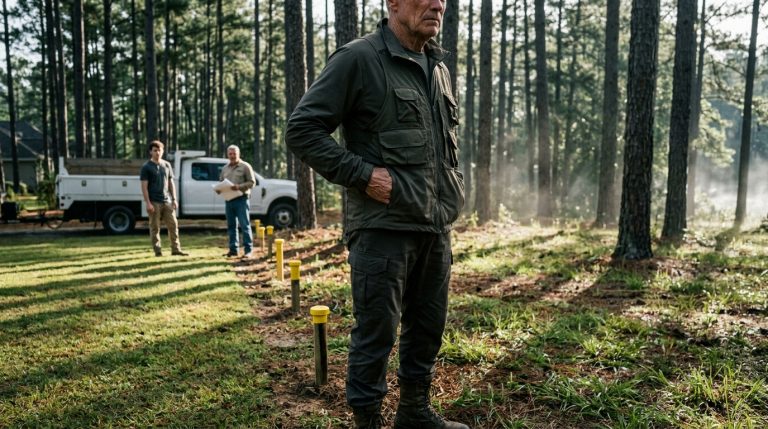
He leaned against the rear tire, wiping sweat from his forehead with the back of his hand. His gaze drifted toward the boundary line where his property ended and Carl Ebert’s land began. There, partially obscured by the tall, yellowed stalks of fencerow grass, stood a small wooden post. It was painted white, but the paint had long since peeled away, revealing the grey, weather-beaten wood beneath.
He walked over to it, his boots crunching in the silence. It wasn’t just a fence marker. There was something etched into the wood—not a brand, but a series of numbers and letters, faint and difficult to read. He squinted, scraping away a layer of lichen with his thumbnail. J.B. 1962.
It was a stake set by his grandfather, a small, stubborn declaration of ownership that had survived six decades of frost, drought, and harvest. He felt a sudden, sharp ache in his chest—a realization of how much had been required to keep this single, tiny piece of the earth connected to his family.
He climbed back onto the tractor, but as he reached for the ignition, he noticed something in the dirt near the post. It was a metal canister, no larger than a spool of wire, half-buried in the silt. He pried it loose with the toe of his boot. It was rusted shut, sealed with layers of oxidation that spoke of years spent undisturbed.
He didn’t open it. He didn’t even try to force the cap. He placed it carefully into his pocket, the sudden weight of it against his hip feeling like a compass needle pointing toward a direction he hadn’t yet defined.
The afternoon wore on, the sun dipping lower until the sky was a bruised purple and the air turned brittle with the onset of evening. He finished the final pass, his back aching and his limbs feeling like lead, but as he shut down the engine, the sudden quiet was transformative. He had finished the task. He had done the work.
As he walked back to his truck, the headlights swept over the dark fields. He caught a glimpse of a silhouette parked at the edge of the access road—a battered pickup truck, familiar and waiting. It was Carl.
Matthew slowed his pace. Carl stepped out of his truck, hands tucked into the pockets of his denim jacket. He didn’t offer a greeting, didn’t need to. He just watched the younger man approach, his expression unreadable, eyes narrowed against the fading light.
“The soil is turning well,” Carl said, his voice as rough as the gravel they stood on.
“I tried to keep it even,” Matthew replied, his breath hitching slightly.
“Even is for the garden,” Carl countered, a faint, rare smile creasing the corner of his mouth. “Farming is about balance. You have to be willing to let the land push back.”
He looked toward the horizon, where the lights of Aurora were just beginning to flicker to life. “Joe knew that. He spent his life learning how to hold that balance. And I think, looking at that row you just cut… you’re learning it, too.”
Matthew reached into his pocket and fingered the metal canister. He debated asking about it, about the stakes and the history buried in the silt, but something held him back. The silence between them was not uncomfortable; it was a pact.
“I’ll be back tomorrow,” Matthew said.
“See that you are,” Carl answered. He turned to leave, then paused, looking back over his shoulder. “Keep your eyes on the boundary, Matthew. Sometimes the truth isn’t in what you’re planting, but in what you’re protecting.”
He drove away, his taillights fading into the vast, darkening expanse of the Nebraska plains. Matthew stood alone, the weight of the canister in his pocket serving as a silent, heavy witness to the fact that the work had only just begun.
CHAPTER 4: THE HIDDEN LEDGER
The gravel crunched beneath the tires of Matthew’s pickup as he rolled to a stop, the truck tilting slightly into the ditch. He didn’t turn off the engine. The headlamps cut a stark, yellow path into the dark, illuminating the thicket of weeds that lined the edge of the Brenner property. He sat there for a long moment, the vibrations of the truck humming through his palms, until the tension became too much to bear.
He reached into his pocket and pulled out the metal canister. In the dim glow of the dashboard, it looked like nothing more than scrap metal, but the weight of it was deliberate. He pried it open. The seal gave way with a sickening, gritty screech of oxidized metal, releasing a faint scent of trapped air, stale and sharp—like old grain and ozone.
Inside wasn’t money or a map. It was a ledger, bound in thin, water-damaged leather, and a folded piece of stationery.
Matthew unfolded the paper, his hands shaking. It was a note, written in the same steady, utilitarian script he had seen on his grandfather’s equipment logs. For the one who finds this: The land is not the inheritance. The agreements are.
His heart hammered. He flipped open the ledger. The pages were filled with names, dates, and amounts—a history of co-signed loans, informal land trades, and verbal contracts spanning decades. Halfway down the third page, a name jumped out at him: Laura Dietrich.
He traced the ink. A payment, marked seven years prior, logged to the attorney’s firm, but it wasn’t a bill. It was a deposit, labeled ‘Placeholder-Estate_Contingency’.
He stared at the entry until the words blurred. The “spontaneous” auction, the legal hurdles, the attorney who had seemed surprised to be there—it all aligned with the cold, hard logic of a man who had planned his departure like he planned a harvest. His grandfather hadn’t just died; he had orchestrated the very auction that threatened to consume his life’s work, all to ensure that Carl Ebert—and eventually, Matthew—would be the ones to inherit the stewardship.
A sudden, jarring knock on his driver’s side window made him jump.
He looked up to see Carl Ebert standing in the dark, his face illuminated by the truck’s harsh light. Carl didn’t look angry; he looked exhausted. He gestured for Matthew to roll down the window. The cold air rushed in, smelling of rain and turned earth.
“You shouldn’t have dug that up, Matthew,” Carl said, his voice quiet, lacking its usual grit.
Matthew held the ledger up, the evidence of the contingency clear in the harsh light. “You knew. You and Laura. You were part of it.”
Carl sighed, leaning his arms on the door frame. The movement exposed the lines of fatigue etched into his neck. “Joe didn’t have anyone left who could take the farm. The developers were circling like vultures, and the law… the law doesn’t care about the history of a crop. It only cares about the final balance sheet.”
“So you staged an auction?” Matthew asked, his voice rising, the realization cutting through him like a blade. “You let people believe it was a fair fight, but you and the attorney already had the outcome written down?”
“We didn’t write the outcome,” Carl corrected, his tone sharpening. “We just provided the opportunity. If I hadn’t stepped in, that land would be a sub-division today. Joe didn’t leave you a farm, kid. He left you a debt of honor. He wanted you to learn that land isn’t just something you own—it’s something you maintain, even when the world tells you to let it go.”
Matthew looked down at the ledger, then back at Carl. The man wasn’t a hero, and he wasn’t a villain. He was a piece of the architecture, a living, breathing component of his grandfather’s final, desperate, and brilliant design.
“Is there more?” Matthew asked, the words feeling heavy in his throat.
Carl looked toward the farm, his expression softening into something uncomfortably close to grief. “There’s always more, Matthew. But now that you’ve got the ledger, you’re not just a student anymore. You’re an accomplice.”
He stepped back from the truck, gesturing toward the road. “Go home. Think about what you’re holding. Tomorrow, you’ll have to decide if you want to keep the cycle turning or if you want to be the one who finally breaks the seal.”
Matthew watched him walk back to his own truck, the taillights flickering in the dark like dying embers. He shifted the truck into gear, the metal biting into the transmission, and drove forward, the ledger heavy and terrifyingly real on the seat beside him. The farm was no longer just land; it was a cage of memories and obligations he was only just beginning to map.
CHAPTER 5: THE FIVEYEAR MARK
The kitchen was cold. It always felt colder than the rest of the farmhouse, a drafty, high-ceilinged room that had served as the heart of the Brenner family for generations. Matthew stood by the window, watching the moonlight crawl across the fallow fields. Five years. The term of the note had ticked away with the slow, inevitable rhythm of the seasons, each harvest a battle, each payment a deliberate choice to keep the connection alive.
He turned back to the table. The contract lay there, a stark white rectangle against the dark, worn oak. It was the final document: the transfer of the last portion of the land Carl had held in trust. If he signed it, the debt was gone. He would be the owner, not just in practice, but in the eyes of the law.
But his hand hovered over the signature line.
Earlier that afternoon, he had gone to visit Carl. The old man’s house was a smaller, humbler structure a mile down the road, filled with the silence of a man who had lived his life in service to his neighbors. Carl hadn’t been in the living room. He had been in the small, glassed-in porch, staring out at the Brenner farm with a pair of ancient binoculars.
“You’re early,” Carl had said without turning around.
“The payment is ready,” Matthew had replied, pulling the bank draft from his jacket. “Everything is settled.”
Carl had finally turned then. He looked frailer than the season before, the skin on his hands thin as parchment, his movements punctuated by a tremor he couldn’t quite hide. “Settled. That’s a word people like to use when they think the work is done.”
“It’s what we agreed to,” Matthew said, his voice firm, though it faltered when he saw the look in Carl’s eyes. It wasn’t the look of a mentor who was satisfied; it was the look of a man who had been holding a heavy stone and was finally, desperately tired of the weight.
“Joe never wanted you to own this place, Matthew,” Carl said, the confession dropping into the air between them like a lead weight.
The silence that followed was absolute. Matthew felt the blood drain from his face. “What are you talking about? Everything—the auction, the note, the way you helped me—it was all to keep it in the family.”
“To keep it alive,” Carl corrected. He stood up, his joints popping, and walked over to a stack of papers on his workbench. He shuffled through them and pulled out an envelope, yellowed and brittle—the same type of stationery Matthew had found in the canister. “Joe knew he couldn’t keep the land together by the rules. So he broke them. He built a system of favors, of hidden contingencies, and yes, of deception. He didn’t want you to be a landlord. He wanted you to be a witness.”
Carl pointed to the farmhouse in the distance. “He knew that if the land became a ‘possession,’ it would eventually be sold. If it remained a ‘responsibility’—a debt that could never fully be repaid—it would survive. He didn’t give you the land, Matthew. He gave you a chain. And tonight, when you sign that paper, you’re deciding whether you’re going to be the next link or the one who breaks it.”
Back in the kitchen, the memory of that conversation clawed at Matthew’s resolve. He looked at the ledger, the list of names and debts his grandfather had spent a lifetime collecting. It wasn’t just a ledger; it was a list of lives touched, of risks taken, of an intricate, invisible web of human connection that had sustained the community for half a century.
If he signed the contract, he was ending the artifice. He was turning the ‘responsibility’ back into ‘property.’
He grabbed the pen, the plastic body of it feeling alien in his calloused hand. The house groaned in the wind, a sound like a tired animal settling into sleep. He could see his grandfather’s ghost in the wood grain of the table, in the way the light hit the floorboards—not as a haunting, but as an expectation.
His phone buzzed on the counter. A text from his mother: Proud of you. Grandpa would be, too.
The sentiment felt hollow, a gentle lie that didn’t account for the heavy truth of the canister or the hollowed-out look in Carl’s eyes. He realized then that the decoy mystery—the auction, the legality of the land transfer—had been the easiest part. The real mystery was his own capacity to be the person his grandfather had gambled his entire legacy on.
He pressed the pen to the paper. The ink bloomed on the surface, a dark, permanent scar. He signed his name, but as the final letter curled, he didn’t feel the relief he had expected. He felt the sudden, terrifying vacuum of a man who had just taken full control of his own future, without a script or a mentor to guide his hand.
Outside, the first dusting of winter snow began to fall, muffling the world in a shroud of white. He had signed the paper, but as he stood in the quiet kitchen, the realization hit him: he hadn’t finished the work. He had only just defined the perimeter of the challenge he would spend the rest of his life answering.
CHAPTER 6: THE HORIZON
The silence in the farmhouse was no longer empty; it was heavy, filled with the resonance of the decision he had just made. Matthew placed the signed contract into a manila envelope and set it on the table. Outside, the blizzard had arrived in earnest, a swirling wall of white that erased the boundaries between the sky and the earth. The fields he had plowed, the fences he had mended, and the soil he had tended were hidden under a deep, insulating drift.
He didn’t stay in the kitchen. He walked through the hallway, his boots echoing on the hardwood, and entered the study that had belonged to Joseph Brenner. It was exactly as he remembered it—dust motes dancing in the sliver of moonlight, the smell of cedar and old machine oil, the desk cluttered with manuals and worn-out tools.
He sat in the chair, feeling the indentation of the man who had lived here, and opened the final drawer. Tucked into the back was a small, iron key—the heavy, primitive kind that opened padlocks from the 1960s. He knew where it fit.
He stepped out onto the porch, the biting wind whipping against his face, and walked to the small equipment shed near the barn. The door creaked open, and he stepped into the darkness. There, tucked under a canvas tarp, sat the old tractor Joseph had used for the better part of his life.
It wasn’t just metal. It was the centerpiece of the “contingency.”
As Matthew touched the cold, flaking paint, he heard a sound—the crunch of heavy boots on the snow. Carl Ebert emerged from the swirling white, his coat dusted with ice. He didn’t come inside; he stayed at the threshold, his breathing ragged in the frozen air.
“You signed it,” Carl said, the words not a question.
“I signed it,” Matthew replied. He turned to look at the older man. “You told me the truth about the contingency. You told me Joe wanted me to be a witness, not an owner. But you left out the most important part.”
Carl shifted, the ice on his coat tinkling. “Which part is that?”
“The reason he kept the farm alive,” Matthew said, his voice steady against the howling wind. “It wasn’t for me, and it wasn’t for the soil. He knew that if he let this place disappear, he would be admitting that his entire life’s work was disposable. He didn’t build a system of favors to keep a farm; he built it to prove that a man’s life could outlast his death if he cared for the right things.”
Carl leaned against the doorframe, his face softening. “He was a stubborn man, Joseph Brenner.”
“He was a architect,” Matthew corrected, a small, genuine smile touching his lips. “He designed this whole thing to force me to stay. To force me to understand that the ‘debt’ wasn’t something I owed him or you—it was something I owed myself.”
He held up the iron key. “He wanted me to finish the work he started. And he wanted me to do it because I chose to, not because I was bound to.”
The pay-off for the last five years hit him then—not in money, not in land, but in the realization that the invisible burden he had been carrying was actually his own agency. The antagonist of his life had never been the developers or the banks; it had been his own doubt.
“I’m keeping the farm,” Matthew said, his voice ringing with a newfound, quiet authority. “But not because of the note. I’m keeping it because I want to see what this soil can produce when the labor is fueled by choice instead of obligation.”
Carl nodded, a slow, deliberate movement that seemed to shed the weariness of the last decade. He pushed off the doorframe. “Then the debt is paid, Matthew. For both of us.”
The cool down settled over the scene—a sudden, immense peace that eclipsed the cold. Matthew turned back to the tractor. He set the iron key down on the workbench—not as a symbol of duty, but as a relic of the past. He wouldn’t need it for what came next.
He looked at his hands, calloused and mapped with the grit of the fields. He had repaired the fences, he had honored the memory, and he had finally stepped out of the shadow of his grandfather’s design. He looked out at the frozen fields, the white expanse no longer an erasure, but a blank canvas.
He had the land, he had the ledger, and for the first time, he had a future that was entirely his own. He walked back to the farmhouse, leaving the shed behind. He closed the door, the latch clicking into place with a definitive, satisfying sound. The storm continued to howl, but inside, the house felt warm, settled, and finally, unequivocally, like home.