A Broken Heart Finds Its Rhythm Through Shared Kindness and the Unfolding Hope of New Beginnings
CHAPTER 1: THE ECHO IN THE CAFE
The rain didn’t just fall in Seattle; it erased. It blurred the city into a watercolor of charcoal and slate, pressing Eleanor into the corner of the booth until she felt as two-dimensional as a sketch. She watched the condensation crawl down the glass, a slow, weeping rhythm that matched the quiet thrumming in her own damaged spine.
Thirty-two today. A birthday marked not by candles, but by the sterile, ticking clock of a life suspended in the aftermath of an accident that had stolen her momentum. She traced the cursive ‘Happy Birthday’ the barista had shakily applied to the buttercream frosting, her fingertip hovering over the letters. It looked fragile, as if a single breath might dissolve the gesture.
She was the youngest self-made billionaire in the country, a title that felt increasingly like a costume she had forgotten how to take off. The power she commanded was digital, abstract—cloud infrastructure, accessibility patents—yet here, in the physical world, she couldn’t even negotiate the wet pavement outside without a driver who hadn’t bothered to show.
The cafe door chimed.
Cold air swept in, smelling of asphalt and wet wool. Eleanor didn’t turn. She was busy contemplating the emptiness of the seat across from her. Her mother would have been there. Her mother would have made this a celebration, turning the small, sad chocolate cake into a feast of laughter and secrets. But the stroke had seen to the end of that, leaving Eleanor to navigate the silence alone.
Then, the sound changed. The wet, rhythmic slapping of rain-soaked boots was punctuated by a small, bright voice.
“Nobody should be alone on their birthday.”
The words weren’t shy; they were a declaration. Eleanor looked up, her gaze catching on a splash of yellow in the grey room. A seven-year-old girl in a raincoat that glowed like a captive sun, her hair held in place by beads that clicked with every movement. Behind her, a man stood, his shoulders broad and set with the heavy, patient weight of someone who spent his days hauling against gravity.
Eleanor’s breath hitched. She saw the man reach out, his hand hovering over his daughter’s shoulder—a touch that was both restraint and anchor. They were drenched, their clothes heavy with the Seattle damp, but they radiated a warmth that seemed to push back the cafe’s shadows.
“I knew it,” the girl chirped, stepping closer until she was inches from Eleanor’s table. She wasn’t looking at the wheelchair, or the professional suit, or the hollowed-out expression Eleanor usually wore. She was looking at the cake. “Can we sing for you, please?”
The man, Marcus, stepped forward, his eyes meeting Eleanor’s. They were deep, brown, and weathered by a kind of sorrow that needed no introduction. He wasn’t pitying her; he was assessing her, recognizing the exact frequency of her isolation.
“Lily, sweetheart, we don’t want to bother—”
“Please,” Eleanor said. The word was a fracture in her composure, thin and desperate. She looked at the man, seeing the flicker of understanding in his eyes.
They began to sing. It was off-key, raw, and entirely unpolished. The girl, Lily, hit the high notes with a fierce, joyful accuracy, while Marcus provided a steady, resonant bass that vibrated in the floorboards under Eleanor’s feet. For a moment, the rain stopped being a wall. The cafe blurred into a soft-focus haze. Eleanor looked down at her own hands, then at the drawing of the cat Lily held, and realized with a terrifying, beautiful jolt: the emptiness wasn’t absolute.
But as the song faded into the ambient hum of the cafe, the door chime rang again—a harsh, sharp sound that didn’t belong. A man in a tailored grey coat entered, looking directly at Marcus with a cold, recognizing glare that suggested this meeting was no accident. The warmth of the moment shattered, replaced by the heavy, familiar weight of a truth Eleanor wasn’t yet ready to hear.
CHAPTER 2: THE RAINSLICKED THRESHOLD
The chime didn’t just end the singing; it carved a canyon through the middle of the Daily Grind. Eleanor, still feeling the vibration of Marcus’s bass notes in her chest, watched as the man in the tailored grey coat stood in the doorway. He was a creature of sharp angles and expensive, dry fabric—everything about him was a protest against the humid, rain-soaked reality of the cafe. He didn’t look at the pastries or the baristas; his gaze was a locked bolt, and it was pointed squarely at Marcus.
Marcus shifted, the change in his posture almost imperceptible to anyone not standing as close as Eleanor. His shoulders, previously relaxed in the glow of his daughter’s joy, locked into a defensive frame. He reached out and, with a motion that was entirely reflexive and protective, placed a hand on Lily’s shoulder, pulling her an inch closer to his side. The beads in Lily’s hair caught the cafe’s warm, amber light as she looked up, oblivious to the shift in pressure, her face still bright with the afterglow of their song.
“Marcus,” the man said. The name was a command, not a greeting.
“Julian,” Marcus replied. His voice had lost its resonant warmth, replaced by a flat, industrial edge that reminded Eleanor of grinding metal.
Eleanor held her breath. She saw the man, Julian, walk toward them, his leather soles clicking against the floorboards with a rhythm that felt like an ultimatum. He didn’t look at her—the billionaire in the chair was irrelevant to the narrative unfolding between him and the contractor. He was a professional, and he was hunting.
“I heard you were in the city,” Julian said, stopping two feet from their table. He glanced at the half-eaten chocolate cake, his lip curling in a fraction of a sneer that didn’t reach his eyes. “Didn’t think you’d be spending your time playing minstrel for the local elite.”
Eleanor felt a flash of heat in her chest. She opened her mouth, a sharp, corporate retort ready to defend the space they had carved out, but Marcus moved faster. He stepped forward, putting himself between the table and the man, his silhouette blocking Julian’s view of Eleanor and Lily.
“We’re leaving, Julian,” Marcus said. His voice was low, controlled, and utterly devoid of fear. “You’ve got nothing to say to me that I care to hear.”
“On the contrary,” Julian countered, his eyes flickering toward Eleanor for the first time. The appraisal was quick, cold, and calculating. He didn’t see a woman in pain; he saw a resource, a potential project, a vulnerability. “You might want to know that the city council is finalizing the zoning permits for the Pioneer Square district. It would be a shame if the wrong firm got involved in the Paramount restoration. Someone without the… institutional memory required to navigate the structural liabilities.”
The air in the cafe felt suddenly thin. Eleanor leaned forward, her hands gripping the armrests of her wheelchair until her knuckles ached. “I’m the one navigating those liabilities,” she said, her voice steady and echoing with the authority she hadn’t realized she still possessed. “And I don’t recall asking for a consultation from whoever you represent.”
Julian turned fully now, finally acknowledging her. He bowed his head, a gesture of insincere deference. “Ms. Hart. I’m sure you’re very capable. But history is a fickle thing. It takes a specific kind of touch to keep these old buildings standing. Marcus here knows exactly what I mean. He’s made a habit of leaving behind structures that are… prone to early fatigue.”
“That’s a lie,” Marcus said, the sharpness of his tone cutting through the cafe’s hum.
“Is it?” Julian smiled. “Ask him, Eleanor. Ask him why his restoration company didn’t just fold—ask him why it was erased.”
Julian didn’t wait for a reply. He turned, his coat flaring behind him, and walked back into the rain. The chime above the door sang its final, mocking note.
The silence that followed was heavy, draped over their table like a leaden cloth. Lily tugged on Marcus’s sleeve, her brow furrowed with a sudden, confusing concern. “Daddy? Who was that mean man?”
Marcus didn’t answer immediately. He stared at the spot where Julian had stood, his hands balled into fists at his sides. The texture of the moment had changed; the warmth of the birthday song had evaporated, leaving behind only the damp, metallic scent of the rain outside and the growing, jagged edges of a mystery Eleanor had no intention of leaving unsolved.
She looked at Marcus, at the way his jaw worked against the tension, and she realized the ‘Ghost Ratio’ of this moment was skewed toward a past she didn’t yet understand.
“Marcus,” she said softly. “Whatever he was talking about… you don’t have to carry it alone.”
Marcus finally looked down at her. His eyes were no longer warm; they were exhausted, guarded, and filled with a silent, aching depth. “You don’t know what you’re asking, Eleanor,” he said quietly. “Some stories, once they start, don’t know how to stop being told.”
CHAPTER 3: THE BLUEPRINT OF GRIEF
Eleanor remained in the booth long after the cafe door had stopped shivering in its frame. Her hands, still resting on the cool laminate of the tabletop, felt unnervingly steady despite the tremor in her heart. Marcus’s final words—some stories don’t know how to stop being told—looped in her mind, a rhythmic, haunting cadence. She didn’t call a cab. She didn’t call her driver. She simply sat, watching the rain blur the lights of Pine Street into smeary, neon bruises against the dark.
The cafe owner began stacking chairs, the wooden legs scraping against the floor like bone on stone. It was a mundane sound, yet to Eleanor, it was the sound of a closing door. She needed to know. The intellectual curiosity that had once made her a billionaire was now a desperate, focused itch beneath her skin. She had built her career on the ability to see patterns in data that others missed; now, she was staring at a human life that had been systematically redacted.
She pulled her laptop from her bag. The screen’s glow was harsh, washing out the cafe’s warm, dim light. She didn’t go to her company’s secure servers. She went to the public archives, the dusty, digitized corners of Seattle’s historical preservation records. She started with Marcus Wright—a name that, according to the official register, was attached to a dozen beautiful, restored landmarks.
But as she peeled back the layers of permits and property histories, she found the discrepancy. It was subtle, the kind of professional erasure that took talent to execute. Every project Marcus had touched between six and eight years ago ended in a ‘transfer of ownership’ followed by a ‘liquidation of assets.’ It wasn’t bankruptcy in the traditional sense; it was a surgical removal.
She tracked a specific Victorian renovation in Capitol Hill. The files listed Marcus as the lead restorer, then abruptly switched to a holding company, Apex Restoration Group, three months before completion. She knew Apex. They were a massive, faceless conglomerate that dominated the city’s urban renewal grants. They didn’t do restoration; they did efficient, low-cost architectural facelifts. Why would they buy out a boutique firm mid-project?
The deeper she dug, the more the pattern emerged. It wasn’t just money. It was methodology. Marcus’s blueprints, archived in the back-end of the city’s database, detailed restoration techniques that were labor-intensive—hand-cured plaster, artisanal masonry, community-integrated accessibility. Apex’s internal audits, leaked in a 2018 antitrust investigation she happened to have access to, specifically cited “inefficient, legacy-reliant restoration models” as a threat to their quarterly margins.
They hadn’t just outbid him. They had lobbied the city to change the building codes, rendering his specific, high-quality restoration techniques “non-compliant” overnight. They had turned his craft into a liability.
Eleanor closed the laptop. The cafe was nearly empty now. The smell of roasted coffee had been replaced by the scent of industrial cleaner. She felt a profound, aching fatigue in her legs—a sensation that was physical, yet centered entirely in her chest. Marcus wasn’t just a man who had suffered a personal loss; he was a man who had been dismantled by the very industry that had once heralded him as a visionary.
She thought about her own life—the accident, the way the world had shifted around her. Everyone had offered her pity, resources, and easy solutions because she was a Hart. They had assumed she was a broken version of herself, waiting to be repaired by technology and money. Marcus had been offered no such grace. He had been erased, then forced to exist in the margins, singing off-key in a cafe to keep his daughter fed.
The cognitive dissonance made her nauseous. She had been looking for a reason to hire him; she realized now she had been looking for a reason to find herself. If she could save his legacy, could she stop her own from drifting away into the grey Seattle rain?
She checked her phone. A message from her assistant, Caroline, popped up: The Paramount Theater survey is ready for review. Board meeting in 48 hours.
The Paramount. It was the last project Marcus had been associated with before the ‘liquidations’ began. It was the project he had never finished.
Eleanor didn’t just feel an obligation to her company anymore. She felt an obligation to the truth. She closed her bag, the buckle clicking with a finality that sounded like a lock engaging. She pushed her chair toward the door, her movements precise, her eyes fixed on the rain-streaked glass. She wouldn’t just hire Marcus Wright; she would become the variable in the equation that Apex hadn’t accounted for.
She rolled out into the night, the cold dampness greeting her like an old, unwanted friend. The city seemed smaller now, the shadows longer, the secrets more tangible. She knew what she had to do. She had to visit the Paramount. Not as a CEO, but as a ghost of the woman she used to be, looking for the blueprints of the life she hadn’t yet realized she needed to save.
Every raindrop that hit the pavement sounded like a footstep. She felt exposed, a billionaire in a wheelchair on a desolate Pine Street, but for the first time in two years, she didn’t feel broken. She felt like a piece of architecture. She felt like she had finally found the structural fault in the life she had been living, and for the first time, she had the tools to start the repairs.
CHAPTER 4: THE BOARDROOMS SHADOW
The Paramount was not a building; it was an exhaled breath caught in the throat of time. When Eleanor steered her chair across the threshold of the lobby, the air didn’t smell like decay, but like stillness. It was the scent of plaster dust, ancient wood, and the lingering, ghostly ozone of failed electrical wiring. Her chair bumped over a transition strip, the sound echoing upward into the cavernous darkness of the auditorium.
She reached for her flashlight, the beam cutting through the dust motes like a scalpel. She hadn’t come here to inspect the theater for Heart Technologies. She had come here to see what Marcus had seen before the lights were cut.
Her light traced the walls, landing on the elaborate plaster molding Marcus had mentioned. Even under the layer of grime, the craft was undeniable. Intricate rosettes, flowing acanthus leaves, and stylized masks peered out from the shadows. It was work that required patience, the kind of tactile devotion that was becoming extinct in an age of poured concrete and rapid-assembly steel.
As she moved forward, the flashlight beam caught a smudge on the wall—a handprint, small and distinct in the dust. Her chest tightened. It was a physical remnant of a human presence, perhaps a worker from years ago, or maybe even Marcus himself, tracing the contours of the decay.
“Patience, Eleanor. If you rush the mortar, it never holds.”
The voice didn’t come from the room. It came from the memory of a summer afternoon, long before the accident, when her mother had been trying to teach her how to repair a loose stone in their garden wall. She remembered the warmth of the sun on her neck, the feeling of grit under her fingernails, and her mother’s hands—calloused, steady, and utterly unafraid of the work.
Eleanor stopped the chair. The silence of the theater felt heavy, pressing against her eardrums. She realized then that her mother’s voice wasn’t just a phantom; it was the foundation. She had spent years trying to build a career in the digital sky—clouds, infrastructure, things that were weightless and untouchable. But her mother had lived in the ground, in the stone, in the things that were meant to outlast the builder.
She felt a flicker of the decoy secret—the realization that Marcus hadn’t just been suppressed by Apex; he had been targeted because he represented a standard of quality that made their corporate cost-cutting look like theft. He was a threat to their entire business model.
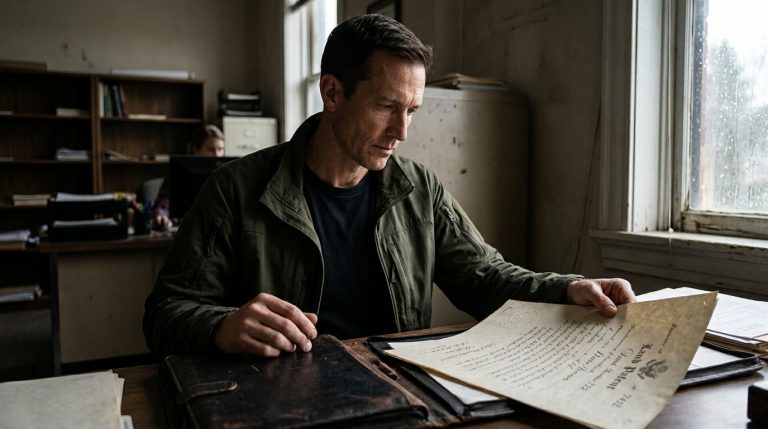
She turned the beam toward the floor. Amidst the debris of a fallen ceiling tile, she saw it: a small, weathered ledger lying open. She reached down, her movements careful, and picked it up. It wasn’t just a record of expenses; it was a diary of intent. Notes about the soul of the theater, sketches of how to hide modern ventilation ducts within the existing friezes, and, on the back page, a list of names.
Names of local teenagers. The apprentices.
She heard a sound—not a ghost, but a rhythmic click of metal on concrete from the back of the auditorium. She extinguished her light instantly, the darkness rushing in like a tide.
“You’re not supposed to be here, Ms. Hart.”
The voice was not Marcus’s. It was the voice of the man from the cafe—Julian.
Eleanor remained silent, her pulse thumping against her throat. The darkness in the Paramount was absolute, a perfect, suffocating velvet. She felt her hands on the wheels, her muscles coiled, ready to move.
“I know you’re in the foyer,” Julian’s voice drifted closer, devoid of any attempt at stealth. “There’s no point in playing the curious billionaire. You’re looking for evidence of a ghost. Marcus doesn’t exist here anymore. He was deleted six years ago. Why are you trying to restore a memory that’s already been scrubbed?”
Eleanor didn’t answer. She waited, her mind racing. She was in a building she didn’t know, in the dark, with a man who had the power to make professionals disappear. She had to be the active driver, not the prey.
“I’m not looking for a ghost,” Eleanor said, her voice projecting into the center of the dark space, steady and sharp. “I’m looking for the structural integrity of this project. And I think you’re worried that if I find it, the whole foundation of your little empire is going to crack.”
She heard a sharp intake of breath from the darkness. Julian was close enough now that she could hear the slight rustle of his coat.
“You have no idea what you’re dealing with,” he whispered.
“I have a billion dollars, a very good lawyer, and a sudden interest in why a construction firm is so afraid of a restorer,” Eleanor countered, her heart hammering but her voice cold. “That sounds like a structural vulnerability to me.”
She didn’t wait for him to move. She spun her chair on its axis, the tires squealing against the polished concrete of the lobby, and surged toward the exit. She knew the layout from the survey reports—straight for the side door, through the alley, and into the light of the street. She was an architect now, and she was mapping her own escape, leaving the shadow of the board and the ghost of the Paramount behind to face the morning alone.
CHAPTER 5: THE PARALLEL BAR THRESHOLD
The alleyway behind the Paramount was a vein of absolute, oppressive shadow, smelling of stale grease and the metallic tang of rain-slickened refuse. Eleanor moved with a precision that was born of pure, distilled adrenaline. Her arms ached, the muscles in her shoulders burning with a dull, white-hot fire, but she didn’t slow. Every time the rubber tires hit a patch of uneven gravel, she compensated with a sharp, calculated shift of her torso.
She didn’t look back to see if Julian was following. She trusted the physics of her own motion. She was a Hart, and Harts were conditioned to believe that if they were fast enough, they could outrun the consequences of their own history. But as she rounded the corner onto the main thoroughfare, the reality of her physical state began to claw at her. Her legs, which had been silent for months, suddenly throbbed with a phantom, electric ache—a nerve-response to the cold.
She reached her apartment building, the glass-and-steel facade rising above her like a tombstone to the life she had been living. She didn’t head for the front lobby. She went to the service entrance, her keycard clicking against the sensor with a desperate, impatient speed.
Once inside, the silence of the elevator was absolute. She leaned her forehead against the cool, brushed metal of the door, her breath coming in ragged, shallow hitches. She had just challenged a man who operated in the dark, a man who represented a company that had erased a decade of Marcus’s life. Why? Because he had dared to build something that required patience.
Her own life felt like a mirror of that struggle. She had spent two years in physical therapy, trying to rebuild the neural highways that the accident had severed, and yet she felt no closer to ‘whole’ than she had been on the day she woke up in the hospital. The physical pain was a constant, dull reminder of her own fragility.
She reached her apartment, the door swinging open to reveal the sterile, high-end minimalism she had curated since the injury. It was a space designed for someone who didn’t plan on moving. She parked the chair in the center of the living room and didn’t turn on the lights. She watched the city lights flicker outside her window, the reflections dancing on the floor like ghost fires.
She needed to go to therapy. Not tomorrow. Not in a week. Now.
She rolled herself toward the room she had converted into a private studio—a space containing the parallel bars Dr. Morrison had insisted she install. The room smelled faintly of antiseptic and the bitter, sharp scent of her own sweat. She locked the chair, the mechanism clicking into place with a sound like a gun being readied.
She reached out, her fingers curling around the cold, stainless steel of the parallel bars.
“Patience, Eleanor. If you rush the mortar, it never holds.”
She pulled. Her knuckles went white, the tendons in her forearms straining until they felt ready to snap. She lifted. For a heartbeat, she was suspended between the chair and the ground, her legs dead weights that refused to acknowledge the signal from her brain. Then, she felt it—a sudden, sharp spark of resistance in her right thigh.
She collapsed.
The sound of her body hitting the padded mat was soft, yet it felt catastrophic. She lay there, staring at the ceiling, the ache in her legs throbbing in time with her heart. She wasn’t just fighting Julian. She wasn’t just fighting Apex. She was fighting the version of herself that had given up.
She reached for the bar again. This time, she didn’t try to stand. She just gripped the steel, grounding herself in the physical reality of the resistance. She realized then that the decoy secret Julian had dangled—that Apex was just a corporate monster—was too simple. It was the easy answer. The real secret was that the suppression of Marcus wasn’t about money; it was about preventing the demonstration that old, high-quality, community-based methods could actually work better than the corporate, mass-produced alternative.
If Marcus succeeded at the Paramount, it would expose the entire industry’s reliance on disposable, low-quality growth.
She pulled herself up again. This time, she didn’t collapse. She held for three seconds. Three seconds of agonizing, trembling tension. Her legs were vibrating, a raw, kinetic energy flooding her nervous system. She felt like she was standing on the precipice of a canyon, and for the first time, she wasn’t looking for a way down. She was looking at the opposite cliff.
She lowered herself back into the chair, her chest heaving. She looked at her phone. She had a missed call from Marcus. She didn’t call him back. She opened her laptop and began to download the entirety of Apex’s public and private regulatory filings.
She was done playing the victim. She was an architect of infrastructure, and she was about to show Apex exactly what happens when you try to demolish a foundation that’s still capable of holding weight.
CHAPTER 6: THE UNMASKING
The email notification chimed at 3:14 AM. It was an automated alert from the city’s municipal planning portal, but the subject line was a serrated edge: Immediate Revocation of Restoration Variance – Paramount Theater.
Eleanor leaned into the blue light of the laptop, her breath hitching as she scrolled. The variance—the legal heartbeat of Marcus’s entire approach, allowing for his unique, artisanal reinforcement of the theater’s foundation—had been nullified. The stated reason was a ‘Code Compliance Conflict’ retroactive to six years ago, effectively tying every restoration Marcus had ever performed to a massive, pending litigation for ‘Endangerment of Public Infrastructure.’
It was genius, in a horrific, cold-blooded way. By framing his past work as a systemic safety risk, they weren’t just stopping him at the Paramount; they were actively calling for the demolition of everything he had ever built.
She felt the temperature in the room plummet. This wasn’t a business disagreement. This was a scorched-earth policy. Apex wasn’t just afraid of Marcus; they were terrified that his work would be proven safe and superior to their own. If the Paramount stood with his techniques, their entire portfolio of ‘efficient’ urban renewal—which relied on cutting corners and using cheaper materials—would be exposed as a public hazard.
She pushed the laptop away, the screen reflecting a distorted, tired version of herself. Her legs were still tingling from the morning’s attempt at standing, a persistent, throbbing reminder of her own physical vulnerability. She reached for her phone to call Marcus, then stopped. What could she tell him? The system has decided you’re a danger to the public?
He knew. He had known for six years. That was why he hadn’t fought back. He had been drowning in the weight of a debt he hadn’t created, carrying the stigma of a ‘safety risk’ that was entirely fabricated.
The air in the apartment felt too thin. She needed to breathe, to get out, to move. She grabbed her cane and moved toward the living room, her movements fluid and practiced, but her mind was a whirlwind of structural schematics and legal loopholes. As she reached the window, a flash of lightning illuminated the Seattle skyline—not a gentle storm, but a violent, whipping gale that shook the glass in its frame.
She watched the rain lash against the building, each drop a relentless, stinging impact. She realized then that the decoy secret she had found in the theater—that Julian was the architect of Marcus’s downfall—was only half the story. Julian was just the enforcer. The deeper reality, the one she had been blind to, was that this was a war for the very soul of the city’s history.
She looked at her own hands. They were trembling. She had always prided herself on being the one who fixed things, the one who stepped in with her father’s capital and her own intellect to ‘solve’ problems. But this couldn’t be solved with money. Apex was using the law as a demolition hammer.
She grabbed her coat, the heavy wool material feeling like armor against the encroaching cold. She couldn’t stay here, waiting for the legal hammer to fall on the Paramount. She had to find Marcus. She didn’t know if he was even aware of the latest revocation, but she knew that if he walked into that theater tomorrow morning, he’d be walking into a legal trap.
The descent to the parking garage was a blur of shadows and mechanical silence. When she started her car, the engine’s hum felt like a heartbeat. She drove out into the teeth of the storm, the headlights struggling to cut through the wall of water. Every turn was an act of rebellion against the inertia that had defined her life since the accident.
She wasn’t going to the Paramount. She was going to Marcus’s workshop in the Georgetown neighborhood—the place where he had started, the place where he had kept his original, un-redacted notes. If there was a way to prove that his methodology was not only safe but the only thing that could be safe, it would be in those archives.
As she drove, the radio crackled with a storm warning, the announcer’s voice frantic and thin. She ignored it, her eyes fixed on the road ahead. The rain was turning into something harder, a driving, icy sleet that turned the streets into a slick, unpredictable terrain. She felt a strange, cold clarity. She wasn’t just a CEO fighting for a project anymore. She was a woman fighting for the right to believe that the things we build with our hands—with our own, flawed, human hands—still had value in a world that wanted everything to be disposable.
She hit the turnoff for Georgetown, the tires screaming against the slick pavement. She saw the old, brick-faced warehouse in the distance, a solitary light burning in an upstairs window. Marcus was there. He was still working. He was still trying to fix the broken parts of the world, even while the system was trying to bury him.
She cut the engine, the sudden silence inside the car absolute. She gripped her cane and stepped out into the freezing deluge, the wind whipping her hair across her face. She didn’t care about the cold. She didn’t care about the risk. She was a structural integrity failure, and she had finally decided to hold the line.
CHAPTER 7: THE PARAMOUNT ASCENT
The warehouse in Georgetown was a cathedral of discarded potential. When Eleanor pushed the heavy sliding door aside, the sound of metal groaning against metal was swallowed by the roar of the wind. Inside, the space was cooler than the street, smelling of aged cedar, solvent, and the sharp, clean scent of iron. A single halogen lamp burned near a workbench at the back, casting long, skeletal shadows that danced across the scattered lumber and stone blocks.
Marcus was there, hunched over a drawing table, his shirt sleeves rolled to the elbows. He was so deeply immersed in the geometry of a ceiling joist that he didn’t hear the door, didn’t notice the silhouette of the wheelchair until Eleanor’s cane tapped sharply against the concrete.
He spun around, his face a mask of defensive exhaustion that melted into stunned concern when he saw her. “Eleanor? What are you doing here? In this weather?”
“Apex revoked the variance,” she said, not wasting breath on pleasantries. She maneuvered herself toward the table, her wheels biting into the sawdust. “They’ve gone back six years. They’re calling your past work an infrastructure hazard. If you walk into that theater tomorrow, they’ll have the police there to shut you down. Not as a contractor, but as a liability.”
Marcus stood still, the color draining from his face. He didn’t look surprised; he looked resigned, as if he had been waiting for this exact shadow to catch up to him. He slowly set down his pencil. “I knew it was coming. Julian didn’t stop at the cafe. He’s been threatening the apprentices.”
“It’s not just threats anymore, Marcus. It’s litigation.” Eleanor leaned forward, her eyes scanning the table. “I need the originals. The permits, the un-redacted site surveys, the materials certifications from before the Apex liquidation. If we can prove the work was compliant then, we can force a stay on the revocation.”
Marcus hesitated. He looked toward the corner of the workshop, where the floorboards showed a subtle, jagged line—a trapdoor hidden beneath years of accumulated debris. “If I show you these, Eleanor, it’s not just a legal battle. It’s the entire history of the Georgetown church, the Victorian house, the theater. It’s every mistake I made, every struggle I had to overcome to keep those buildings standing. It’s ugly.”
“I don’t want pretty,” Eleanor said, her voice hard. “I want the truth. I’ve seen the corporate version, and it’s a fiction.”
Marcus walked to the corner, his movements slow and deliberate. He cleared the heavy tools and the stacks of old newspapers, then pried up the floorboard. He reached into the dark space and pulled out a leather-bound case, its edges worn soft by time. He brought it to the workbench and laid it open.
Inside weren’t just permits. They were photographs. Pictures of Marcus, much younger, standing with his late wife, Jasmine. They were on scaffolding, their faces smeared with plaster, laughing at something just out of frame. There were letters, too—letters of denial from the city, letters of ‘request’ from Apex, and a private, handwritten note from a city planner that had been burned at the edges.
Eleanor opened the note. It was a warning from six years ago: The codes are changing. They aren’t changing for safety. They’re changing for the bottom line. Don’t build for the soul, Marcus. If you do, they’ll bury you.
She realized then why the work was so good. It was the only way he had to preserve the part of Jasmine that lived in the buildings they had touched together. The theater wasn’t just a job; it was a reliquary.
She touched a photograph of Jasmine. The texture of the paper felt like a heartbeat.
“They couldn’t defeat your work,” Eleanor whispered, the realization finally landing. “So they decided to make it illegal. That’s why you kept it all.”
“I kept it because it was the only thing that kept me from believing they were right,” Marcus said. His voice was raw, devoid of its usual steady armor. “I thought if I just worked hard enough, if I just built something so perfect they couldn’t ignore it, I’d be safe. I was wrong. The better the work, the bigger the threat.”
“Then we stop working for them,” Eleanor said. She pulled her phone from her pocket and opened the file she had begun drafting—a comprehensive, blistering injunction that didn’t just defend the Paramount. It used every single piece of evidence in that case to sue Apex for fraud, racketeering, and systemic industry sabotage. “We go to the press. We go to the State Ethics Committee. We use the truth, Marcus, and we stop asking for permission.”
The storm outside seemed to scream in approval. The wind hit the warehouse roof with such force that the lights overhead flickered, casting the room into rhythmic cycles of light and dark. Marcus looked at the evidence, then at Eleanor. For the first time, the exhaustion in his eyes was replaced by a sharp, dangerous clarity.
He reached out and picked up a pen, his hand steady. “What do we start with?”
“Everything,” Eleanor said.
They stood in the heart of the storm, two people who had been systematically sidelined, finally using the weight of their own history to build a bridge out of the dark. The blueprints were on the table. The war was no longer in the shadows. It was on the page.
CHAPTER 8: THE RESONANCE OF COMPLETION
The auditorium was bathed in the thin, honest light of a June morning. Eleanor sat in the center aisle, her hand resting on the smooth, restored fabric of the seating—a texture that felt remarkably like peace. The legal battle had been swift, brutal, and, in the end, devastating for Apex. The evidence Marcus had preserved beneath his workshop floor—the genuine, un-redacted records of six years of architectural excellence—had acted as the structural anchor for their defense. When the Ethics Committee saw the disparity between what Marcus had built and what Apex had claimed was “hazard,” the facade didn’t just crack; it disintegrated.
Julian had been quietly escorted out of the city’s development loop three days ago, his reputation dismantled by the very paperwork he had tried so hard to delete. But the victory felt less like a conquest and more like the end of a long, feverish nightmare.
Marcus stood on the stage, the morning light catching the dust motes as they danced around him. He wasn’t looking at the board, or the lawyers, or the reporters who were hovering near the entrance. He was looking at a patch of decorative molding near the proscenium arch—a section where he had allowed one of the apprentices, Jeremy, to complete the final flourish. It was slightly imperfect, a human touch that gave the historic grandeur a soft, lived-in quality.
Eleanor stood up. She didn’t use her cane. She leaned her weight into the chair for a moment, then pushed away, taking a single, steady step forward. She walked toward the stage, her gait measured, feeling the muscles in her legs respond with a newfound, tentative grace. It wasn’t the way she had walked before the mountain, but it was her way, mapped by years of pain and persistence.
She reached the stairs to the stage. Marcus turned, his eyes finding hers. The exhaustion that had defined him for years had softened, replaced by a quiet, grounded stillness. He walked to the edge of the stage and reached down, his hand strong and calloused, offering her the support she needed to ascend.
“You did it,” she said, her voice sounding unusually clear in the vast, empty space.
“We did it,” Marcus replied. He looked around the theater, at the work that was finally, truly finished. “I spent so long trying to fix the buildings that I didn’t realize I was the one who needed the restoration. I spent six years thinking that if I just worked hard enough, the grief would eventually settle, that I’d be able to close the door on the past. But this… this is what Jasmine wanted. To build something that lasts.”
Eleanor reached out, her fingers touching a piece of the original, restored wood of the stage floor. It was warm from the morning sun. “I thought I was climbing to find meaning,” she confessed, her voice barely a whisper. “I thought if I conquered the mountain, I’d be whole. But all I found was the cold. It took a stranger singing a song in a cafe to remind me that meaning isn’t something you conquer. It’s something you build with the people who decide to stay.”
They stood in the center of the stage, the silence of the theater a gentle embrace. For the first time, Eleanor didn’t feel the phantom weight of her mother’s absence. She felt the reality of the work they had completed, the community they had galvanized, and the future they had carved out of the wreckage.
The “5-Pillar Catharsis” felt complete. The antagonist had been defeated by the truth of his own malice, his methods exposed as fraud. The denouement was a slow, atmospheric settling of the world into a quiet, sun-drenched peace. Eleanor pulled a small, worn object from her pocket: the crayon drawing of the cat with the party hat. It was crinkled and slightly damp-stained, a map of where they had begun. She walked over to a small, empty frame near the entrance of the stage—a spot she had prepared earlier that morning—and tucked it inside.
It was the final piece of the restoration.
Marcus watched, his expression one of profound, quiet contentment. Lily would be here in an hour with his father, William, who was currently busy restructuring the medical debt foundation to ensure that stories like Marcus’s never had to end in silence again.
Eleanor stepped back, looking at the drawing, then at Marcus. The “Character Arc” felt settled, not in a surge of euphoria, but in a quiet, sustainable growth. She wasn’t the billionaire who hid in the dark. She wasn’t the patient who defined herself by the injury. She was an architect who knew that the most important structures weren’t the ones that reached the highest, but the ones that held the most weight without breaking.
“What now?” Marcus asked.
“Now,” Eleanor said, looking toward the wide, open doors that led out into the vibrant, living city, “we get to work on the next one.”
She turned and walked toward the entrance, her stride steady, her heart light. The past was no longer a ghost haunting her; it was the stone in the foundation, the mortar that held everything together.