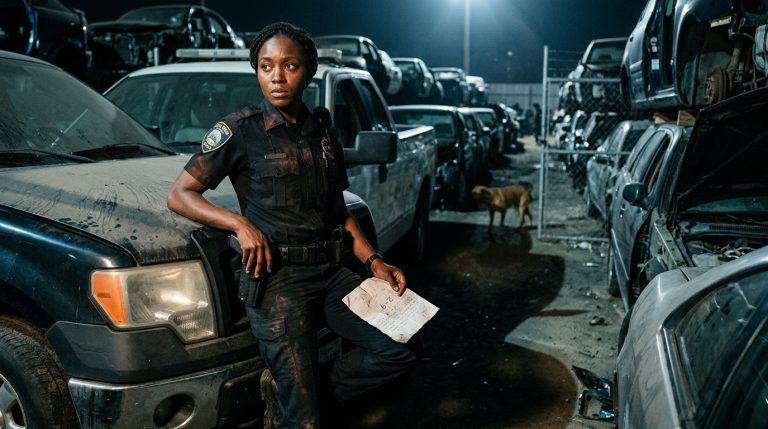
The Weight of Iron and Scars: A Soldier’s Relentless Reclamation of a Stolen Legacy
CHAPTER 1: THE FRICTION OF EXPECTATION
The firing range at Camp Pendleton wasn’t a place for sentiment; it was a grinder for mechanics and ego. The morning air was thin, tasting of dry earth and the acrid bite of spent casings from the earlier rotations. Emily Carter moved through the noise with the practiced lethargy of a woman who had learned that moving fast only wasted energy that would be needed later.
She set the rose-colored rifle onto the steel table. It landed with a dull, heavy thud that didn’t sound like hollow metal. It sounded like something solid, something dense.
“Is that a Hello Kitty toy?”
The voice belonged to Gunnery Sergeant Michael Rodriguez. He was a man composed of sharp angles and too much ink, his chest expanded like a pufferfish in full display. The thirty Marines flanking him erupted in a chorus of practiced, performative laughter. Phones flickered to life, lenses angling for the best shot of the inevitable embarrassment.
Emily didn’t look up. She was focused on the dent in the trunk of her 2008 Honda Civic, a scar of rust that mirrored the fatigue in her own joints. She reached into her gear bag, her fingers tracing the familiar, worn edges of her equipment. Her hands began the tremor—a ticking, rhythmic agitation that appeared every 4.7 seconds like clockwork.
To the observers, it was the weakness of a civilian play-acting at soldiering. To Emily, it was the metronome. She synchronized her breathing to the vibration, four seconds in, four seconds out, a steady, pressurized loop of air.
“We’ve got ourselves a civilian who thinks she’s a sniper,” Corporal Madison Brooks sneered, the red light of her camera recording the scene for thousands of unseen eyes. “Brought her Barbie rifle to a Marine qualification. Let’s see how fast she breaks.”
Emily felt the gaze of the crowd like a physical weight—a pressure on her neck, a friction against her skin. She pulled out a notebook, its pages brittle and yellowed, covered in wind-drift charts that defied standard physics. She didn’t need to justify her presence; she needed to justify the math.
“I’ll give you two minutes to pack up and get off my range,” Rodriguez barked, stepping closer. His boots crunched on the grit, the sound sharp and invasive. “This is for real Marines.”
Emily finally looked up. Her eyes weren’t angry; they were dead, clinical, and completely devoid of the fear he expected to see. She looked at the distance markers, her internal rangefinder calculating the humidity, the elevation, and the rotation of the earth.
“I’ll need fifteen minutes,” she said. Her voice was quiet, stripped of all inflection, a sound like stone grinding on stone.
The laughter that followed was louder, a feeding frenzy of mockery. They didn’t see the rifle’s balance. They didn’t see the way the tremor in her hands stopped the exact micro-second she touched the scope’s focus dial. They only saw a woman in a faded gray shirt, holding a tool they thought was a toy.
The air grew heavy, static-charged. She felt the gaze of someone standing near the ammunition station—a man with the hollow, weathered look of someone who had seen the same ghosts she had.
Her phone buzzed in her pocket, a sharp vibration that broke the rhythmic hum of her concentration. She ignored it. The wind shifted—a sudden, dry gust that sent a cloud of orange dust swirling around her boots.
She wasn’t just here to pass a qualification. She was here to ensure the weight of her brother’s legacy didn’t vanish into the rust.
The sky began to pale, the first heat of the California sun catching the edge of her rifle’s barrel. She adjusted the scope one last time, her finger hovering an inch from the trigger. She felt a familiar, cold prickle at the base of her skull—the sensation of being watched by someone who knew exactly what the rose paint was hiding.
She looked toward the perimeter of the range, expecting to see a horizon, but finding only the encroaching shadow of a future she had tried to leave buried in the dust.
CHAPTER 2: THE CALCULATED SILENCE
The world did not stop spinning just because a civilian with a rose-colored rifle had dared to challenge the hierarchy of Camp Pendleton. The wind continued its steady, low-frequency hum across the open range, carrying with it the grit of a thousand spent training days. To the onlookers, the silence that followed Emily’s request was merely an awkward pause in their morning entertainment. To Emily, it was the sound of a countdown.
She didn’t look at Rodriguez. She didn’t look at the camera lens held by the woman who called herself a Marine, but moved with the fragile vanity of a social media influencer. Emily’s reality was currently contained within the four-foot radius of her steel table. Her hands were performing their silent, involuntary work. Every 4.7 seconds, the tremors returned, a biological stutter that she had long ago ceased to view as a hindrance. It was a rhythm. It was a metronome. It was the only constant in a life that had been shredded, reconstructed, and shredded again.
She reached for a small, recessed dial on the side of her scope. The motion was microscopic, her movements governed by the cold, biting pragmatism of a field operative who knew that every calorie of energy saved was a second of life bought.
Clack.
The dial seated itself. Below the surface of the rose paint, she could feel the faint, rhythmic ticking of the internal stabilization hardware—her brother’s final, desperate contribution to their survival. It was a delicate architecture of brass and circuitry, designed to ignore the erratic human element of the shooter. In a world of standardized, mass-produced weaponry, this rifle was an anomaly. It was a Rusted Truth, worn by time and scarred by the friction of existence, yet beneath that patina lay a precision that made the standard-issue gear of the surrounding Marines look like wood-carved toys.
Rodriguez shifted his weight, his boots grinding into the parched earth. The sound was a jagged interruption to her cycle.
“Fifteen minutes?” he repeated, his voice dropping into a register of mocking disbelief. “You think you’re in a movie, Carter? You’re on a live range. The clock is already running.”
Emily ignored him. She was busy monitoring the shift in the dust clouds near the three-hundred-meter mark. The air was drying out rapidly, the heat index climbing. She wasn’t just adjusting for distance; she was calculating the rate of barrel heating and the subsequent shift in the harmonic frequency of the rifle’s suppressed barrel.
Suddenly, a phantom memory spiked behind her eyes—a vision of Kandahar, the dust there tasting of bitter ash and sulfur, the sound of Rob’s laughter over the comms right before the frequency went dead. The phantom limb sensation in her left forearm flared, hot and sharp, a ghost-pain that mimicked the exact rhythm of the tremor she currently fought.
She closed her eyes for a heartbeat. Just one.
She had to stay in the Now. The past was a grave, and the present was a battlefield of expectations. If she let the ghost of her team settle into the room, she would lose the synchronization. She breathed in, pulling the dry, metallic air into her lungs, forcing it to cool the fire in her mind.
Four seconds in.
She saw Madison Brooks move closer, the camera phone held at a high angle to catch both the rifle and Emily’s face. The lens was a black, unblinking eye.
“We’re going to see if that ‘toy’ can handle the humidity, folks,” Brooks said, her voice dripping with artificial confidence. “I’m betting the action jams on the first cycle.”
Emily didn’t turn. She finished the intake of breath, held it, and let the air out with a controlled hiss that matched the steady decay of her tremor. Her finger brushed the trigger guard, testing the weight. It was perfect. She had stripped the rifle down every single night for the last five years, using makeshift tools and makeshift shelters, treating every component like a fragile, dying relative.
She felt a presence move into her periphery. It was Master Sergeant Jake Sullivan. He wasn’t laughing. He wasn’t recording. He was watching her hands with the sharp, narrowed focus of a man who recognized the pattern of the tremor—not as a medical issue, but as the telltale mark of a soldier who had been pushed past the breaking point and had simply refused to break further.
“The air is thickening, Sergeant,” Sullivan said quietly, his voice pitched low enough to avoid the ears of the gathering crowd.
Emily didn’t look at him, but she adjusted her angle by a fraction of a degree. “The humidity is rising,” she murmured, her voice like grinding iron. “The dust carries more static than it did ten minutes ago. It’ll pull the round left.”
Sullivan didn’t say anything, but he stepped back, creating a buffer zone between her and the circling Marines. He was acting as a shield, a silent guardian of the space she needed to operate. He wasn’t doing it out of kindness; he was doing it out of professional curiosity, a soldier’s instinct to see if the impossible could truly be rendered into fact.
Emily looked down at her battered notebook. The calculations were written in a shorthand that only she and her brother had understood—a language of ballistics, wind-age, and the specific, idiosyncratic drift of their proprietary rounds.
She felt the gaze of the Shadow Division—a feeling that hadn’t manifested physically yet, but hovered in the periphery of her senses like the static before a lightning strike. She knew the CIA wasn’t just monitoring the base; they were looking for the Phantom Protocol, and they thought it had died in the fire with the rest of her team. They didn’t know that she had carried the key out in the form of this rifle, and they didn’t know that she was finally, inevitably, stepping back into the crosshairs to ensure that the secrets she had been keeping didn’t stay buried in the dust forever.
She stood up, her movements fluid and devoid of wasted kinetic effort. She picked up the rose-colored rifle. It weighed forty pounds, but in her hands, it felt as light as a whisper.
“Fifteen minutes are up in twelve,” Rodriguez called out, checking his watch with a smug, self-satisfied grin.
Emily didn’t reply. She was already in the zone of total, rusted silence. She laid the rifle across the sandbags, feeling the solid, unforgiving resistance of the earth beneath her.
The range was a stage, the crowd was a distraction, but the target was a reality that only she could see. She looked down the scope, the glass clearing, and for the first time that morning, she allowed herself a small, cold, and entirely joyless smile.
The physics were about to change.
CHAPTER 3: THE FIRST SHOT
The world beyond the scope narrowed into a pinprick of light. The distant steel plates, six thousand meters out, were nothing more than heat-shimmering ghosts against the horizon, dancing in the rising thermal waves of the California desert. Rodriguez was still talking, his voice a low, rhythmic drone of arrogance that Emily tuned out as easily as she tuned out the wind.
She felt the rifle’s internal dampeners kick in. It wasn’t a subtle transition; the stock warmed against her shoulder as the specialized circuitry engaged, locking the barrel’s harmonics into a rigid, singular state. To any other shooter, the weapon would have felt like it was fighting their input. To Emily, it felt like an extension of her own nervous system. The tremor in her hand, that persistent 4.7-second pulse, met the dampening frequency of the rifle. For the first time in years, the vibration neutralized.
The silence that hit her was absolute.
She watched the target. The wind charts in her notebook were a blur of mental geometry. Three degrees of drift. Correction for air density. Compensation for the earth’s rotation. She didn’t consciously calculate these things anymore; they were instincts honed in the dark, refined in the aftermath of her team’s destruction. She knew the round would travel for over eight seconds. In that time, the world could change. A bird could cross the path. A gust of hot air could veer the bullet into the dirt.
She adjusted her breathing. The metallic tang of the rifle—the scent of oil and iron—filled her nose. It was the smell of home, if home could be defined by the lethal intersection of physics and willpower.
“She’s stalling,” Madison Brooks whispered, the comment picked up by the sensitive microphone on her phone. “She’s just holding the trigger to look dramatic.”
“Shut it,” Sullivan’s voice cut through the air, sharp and warning. He was standing directly behind Emily now, his presence a heavy, comforting anchor. He knew what she was doing. He was watching the way her back muscles were locked in place, the way her eyes remained unblinking even as the desert heat threatened to dehydrate her tear ducts. He wasn’t just watching a shooter; he was watching a machine reach its peak state.
Emily’s finger tightened. The trigger break was not a sudden snap, but a slow, intentional collapse of resistance.
Fire.
The report was not the sharp, ear-splitting crack of a standard .50 caliber round. It was a deep, resonant thrum, a sound that seemed to displace the very atmosphere around the rifle. It didn’t punch through the air; it tore a hole in the silence.
The rifle didn’t jump. The dampening system absorbed every ounce of the recoil, the stock pressing back into her shoulder with the firmness of a handshake rather than the violence of a blow. Emily kept her eye on the scope, watching the vapor trail—a shimmering, faint line of disturbed air that hung in the morning heat like a ghost of the bullet’s flight path.
Ten seconds.
The range was paralyzed. The laughter had died out, leaving behind a vacuum of sound that felt heavy and expectant. Rodriguez stood with his mouth slightly parted, his arms no longer crossed. Even the Marines who had been laughing a moment ago were leaning forward, their eyes squinting into the distance, trying to find the impact.
Eight seconds.
The vapor trail held true. It didn’t waver.
“That’s impossible,” Rodriguez breathed, the arrogance replaced by a frantic, jagged edge of realization. “At that distance, the heat shimmer alone would—”
“Quiet,” Sullivan commanded, his eyes fixed on the distant steel.
Emily didn’t blink. She watched the target. She didn’t need to see the hole appear; she could feel it. The internal dampeners in the rifle sent a subtle, high-frequency pulse back through the stock and into her cheekbone the moment the round cleared the barrel. It was a digital confirmation of a physical reality.
Thud.
The sound of the impact took seconds to travel back to the firing line. It wasn’t the metallic ring of a bullet hitting a thin plate; it was the heavy, deep-seated boom of a round tearing through something dense.
Then, silence returned.
Then, another boom.
And another.
“She hit the target,” someone whispered. “And the plates behind it.”
Emily pulled her face away from the scope. Her vision was swimming, the edges of her sight blurred by the sensory overload of the rifle’s stabilization feedback. She felt a wave of nausea, the price of the link between her nervous system and the hardware, but she forced it down. She had to stay upright. She had to remain the ghost they couldn’t bury.
She looked toward the target through her naked eyes. Through the shimmering heat, she saw the impossible. Five steel plates, each rated to stop standard military-grade munitions, were riddled with holes that were perfectly, imposs
CHAPTER 3: THE IMPOSSIBLE RIPPLE
The range floor seemed to tilt beneath Emily’s boots as she locked her focus onto the reticle. The 6,000-meter markers were nothing but hazy, graphite-colored smudges in the distance, barely distinguishable from the shimmering heat waves. Behind her, the chatter of the Marines had died down, replaced by a suffocating, heavy silence. Even the wind, which had been gusting aggressively moments ago, seemed to have stalled, waiting for the inevitable outcome of her folly.
Emily’s finger took up the slack of the trigger. She didn’t think about the crowd. She didn’t think about the cameras, the mocking Instagram feed, or the career-obsessed Sergeant Rodriguez. She thought about the internal balance of the rifle—the proprietary gyroscopic stabilizers her brother had embedded within the heavy rose-colored barrel. It was a piece of engineering that shouldn’t have worked, a Frankenstein of physics that relied on high-frequency oscillation to counteract the rotation of the earth at such extreme distances.
Four seconds in. Four seconds out.
The tremor in her hand peaked, then vanished into the rhythmic, artificial stillness provided by the rifle’s internal dampeners. The world became a single, crystalline point of contact.
She pulled.
The report was not the sharp, percussive crack of a standard .50 caliber Barrett. It was a subterranean thrum, a heavy, low-frequency boom that didn’t just vibrate the air; it seemed to bruise it. The rifle didn’t jump. It barely even shivered, the dampening system absorbing the massive kinetic discharge and dissipating it into the chassis.
Emily didn’t watch the round travel. She watched the vibration of her own scope as the data flashed in the faint, flickering lenses of her eyewear.
The steel plates at 6,000 meters were static for a heartbeat. Then, the center of the first target simply ceased to be. There was no puff of dust, no dramatic spark. The round moved with such velocity and stabilized precision that it punched a clean, surgical aperture through the slab, the energy carrying forward with unrelenting momentum.
The second plate followed, then the third. Five slabs of hardened steel, rated to stop standard armor-piercing fire, were perforated in rapid succession. The distance was so vast that the sound of the impacts took nearly nine seconds to return to the firing line, a rhythmic, delayed tock-tock-tock that sounded like the ticking of a gargantuan clock.
The silence that followed was absolute.
Emily kept her eye to the scope, watching the lingering vapor trail, which shimmered in the morning light like a ghost of the trajectory. She saw the debris—small, jagged flakes of steel—falling away from the target structure, confirming the penetration.
Beside her, Rodriguez was frozen. His mouth hung slightly open, his hand hovering mid-air where he had been ready to point and jeer. Corporal Madison Brooks’s phone, which she had been holding up to document the anticipated failure, dropped an inch, the live-stream screen showing thousands of viewers rapidly scrolling comments in a frantic, uncomprehending blur.
“That… that’s not possible,” Sullivan whispered. His voice was raw, devoid of the skepticism he had carried moments before. He stepped toward the firing table, his boots scuffing the dirt, but he didn’t approach Emily directly. He kept a respectful distance, as if afraid that breaking her concentration might break the reality she had just forced into existence.
Emily slowly engaged the safety. Her hands began their rhythmic tremor again, the 4.7-second pulse returning to her fingers like a loyal, unwanted shadow. She stood up, her movements stiff, and began to pack her tools with the same clinical, mechanical grace. She didn’t look at the targets. She didn’t look at the crowd.
“Check the optics,” she said, her voice cutting through the stillness like a jagged blade.
She didn’t need to hear their confirmation. She knew the mechanics of the shot. She knew the way the round had carved through the target density, ignoring the friction and the thermal expansion. What she didn’t know—what she couldn’t know—was who else was watching.
She felt it then. A shift in the static.
It wasn’t just the surprise of the Marines. It was a deeper, more calculated observation. High above, hidden in the glare of the morning sun, something was moving. Not a bird. Not a drone. It was an atmospheric observer, likely a specialized sensor suite designed to pick up the signature of the Phantom Protocol’s weaponry.
Her brother had warned her that if she ever fired a full-cycle round from the rose rifle, the signature would bloom like a flare in a dark room. She had gambled that the isolation of the range would mask it, but the sudden, sharp silence from the Marines—the sheer magnitude of the impact—had drawn too much attention.
She turned to Sullivan. His eyes were wide, and he was looking at her gear bag, then at her chest. He was staring at the small, metallic tag she wore beneath her shirt, the one he had glimpsed earlier.
“You,” he started, then stopped, swallowing hard. “The mark… the 7th. You were supposed to be dead.”
“I was,” Emily replied, sliding the rifle into its nondescript hard case. She didn’t wait for his response. She moved toward her battered 2008 Honda Civic, the car looking even more pathetic against the backdrop of a base that had just been forced to confront the limits of its own understanding.
She knew she had maybe two minutes before the local base security protocols were overridden by something higher. The Shadow Division wasn’t just coming for her; they were coming for the math. They were coming for the stabilization tech that made the impossible a mathematical certainty.
As she reached the trunk of her car, the air began to hum. It was a high-pitched, electronic whine that set her teeth on edge. It wasn’t the sound of the environment. It was the sound of a localized EMP grid being brought online.
She looked back at the range one last time. Rodriguez was still standing there, staring at the destroyed target plates with a look of genuine, existential terror. He looked small. The entire base looked small, a fragile collection of structures sitting in the crosshairs of an approaching storm.
Emily didn’t panic. Panic was a waste of calories. She opened the trunk, slid the rose rifle into its hidden compartment beneath the spare tire, and gripped the steering wheel. The car’s engine sputtered to life, the old, rusted metal frame groaning in protest. She wasn’t driving toward safety; she was driving toward the only truth she had left.
The silence on the range was about to be broken by something much louder than a gunshot.
CHAPTER 4: THE CALCULATION OF ESCAPE
The engine cut out with a final, metallic clunk, a sound that felt entirely final in the sudden, eerie silence of the base. For a moment, the only thing Emily could hear was the cooling metal of the exhaust manifold ticking like a bomb. Then, the silence was pierced by the sound of the base’s power grid failing—a cascading series of pops followed by a complete cessation of all industrial background noise. The fluorescent lights overhead, even the ones in the distance, blinked once and surrendered to the encroaching shadows.
Emily sat behind the wheel, her hands gripping the plastic ring until her knuckles went white. She didn’t reach for the ignition; she knew the electronics were fried. She sat still, letting her eyes adjust to the absence of light, her breath held in a steady, four-second cycle.
Clack.
She reached over and unlocked the passenger door. The interior of the car smelled of stale coffee, old upholstery, and the persistent, sharp tang of the rifle case’s synthetic foam. She didn’t look back at the range. She knew the eyes—the electronic, sightless eyes—were already tracking the heat signature of the dead vehicle.
She exited the car, her boots hitting the desert floor with a muffled crunch. The grit here was different from the range; it was finer, more abrasive, blowing against her shins like stinging needles. She grabbed the rifle case, her grip firm, the weight of it familiar and grounding. The stabilization hardware within hummed, a low-frequency vibration that resonated through her forearm.
She started walking. Not toward the main gates—those would be blocked, monitored by the same invisible force that had fried her engine—but toward the drainage wash that cut through the north side of the training perimeter. It was a route that offered natural cover, the culverts and overgrown brush providing a broken, uneven path that would minimize her visual signature.
She hadn’t taken more than twenty paces before she felt it: the subtle, directional drag of a thermal tracking beam. It was a faint sensation, a prickle on the skin of her neck, the kind of subtle pressure that told her an airborne sensor was sweeping the grid. She didn’t speed up. Speed was a mistake. Speed was a beacon. She maintained her steady, rhythmic stride, her body language that of someone who belonged in the dark, not someone fleeing it.
She ducked into the concrete maw of the drainage culvert. The temperature dropped instantly, the air smelling of stagnant water and cold, damp earth. The walls were covered in a thin layer of fine, rusted iron dust, the byproduct of the desert’s chemical erosion. She brushed her hand against the wall, feeling the texture of the decay—it was a physical reminder of time, of how things inevitably broke down if they weren’t maintained.
She paused in the center of the culvert. Above her, the hum of a low-flying turbine—the ghost-birds she had seen earlier—vibrated through the concrete ceiling. They were searching. They knew she had left the range, and they knew the general heading of her retreat.
She opened the case just enough to access the small, experimental radio her brother had built. It was a crude-looking thing, a mess of wires and copper coils, but when she flicked the toggle, it emitted a localized, scrambled pulse. It wouldn’t broadcast her location, but it would create a ghost signature, a false, stuttering feed that would mimic the rifle’s stabilization frequency for a few critical minutes.
She placed the radio on a concrete pillar, left it running, and moved deeper into the darkness of the culvert.
The transition was physical. She had to navigate by touch, her hands trailing along the cold, abrasive walls. She wasn’t just escaping; she was navigating the geometry of her own survival. Every movement was a calculation. If she went too fast, the vibration would alert the sensors. If she stopped, the cold would slow her muscles, making the tremor in her hands worse.
She reached a junction where the drainage pipe opened into a larger, forgotten storm-drain system. The air here was drier, the walls covered in a thicker, darker rust. She could hear the distant, faint sound of boots on pavement—the sound of an search team, likely the Shadow Division, moving toward the car she had abandoned.
She stopped and listened.
“Target’s vehicle is cold,” a voice said, clear and professional, carrying through the vents. “Looks like she abandoned it in the sector four perimeter. Scan suggests she’s on foot, but the signal is… inconsistent.”
“Inconsistent how?” a second voice asked.
“Flickering. We’ve got multiple signatures. She’s using decoy hardware.”
Emily allowed herself a microscopic tightening of her jaw. They were smarter than she had hoped. She had planned on the radio lasting ten minutes; she’d be lucky if it gave her five. She continued moving, her footsteps silent, her body held in a posture of extreme, tactical economy.
She arrived at a rusted iron grate that led out toward the base’s logistics depot. This was her destination. Not for an exit, but for a piece of information. She remembered seeing a transport manifest earlier that morning, a detail her mind had filed away as irrelevant, but which now seemed critical. The depot housed the high-security courier runs that exited the base every night. If she could reach the transport bay, she could verify the final destination of the data that the CIA had been trying to extract—the real, final destination of the Phantom Protocol.
The grate was locked, the padlock a heavy, oxidized mess of iron. She didn’t try to pick it. She took a small, sharp instrument from her kit, slid it into the mechanism, and applied a precise amount of torque. It wasn’t about strength; it was about finding the flaw in the metal, the point of absolute tension where the rust held the least integrity.
Snap.
The lock broke, the sound muffled by the roar of a distant turbine. She pushed the grate open, the iron hinges shrieking a low, dying protest.
She stepped out into the logistics yard. The air was cold, the smell of burning oil from a distant generator mingling with the dry scent of the desert. She was in the heart of the base, behind enemy lines, and she had exactly enough time to find what she needed before the sensor grid tightened around her.
She looked toward the rows of transport containers, the metal walls shimmering in the moonlight like the skin of a titan. She wasn’t a ghost, not anymore. She was a woman with a rifle, a legacy to protect, and a cold, hard logic that demanded she see this through to the absolute, bitter end.
CHAPTER 5: THE MANIFEST OF GHOSTS
The depot was a cathedral of industrial neglect. Towering stacks of shipping containers, weathered into shades of oxidized orange and bruised gray, created a labyrinth of blind corners and sudden, echoing dead ends. Emily moved with a predator’s caution, her boots barely grazing the concrete floor. The smell here was different—a sharp, sterile mix of machine lubricant and the heavy, metallic tang of oxidized copper. It was an antiseptic environment, one that felt jarringly out of place compared to the raw, grit-blown desert outside.
She hugged the shadows of a container stack, her rifle case pressed against her side. Her hand felt the familiar hum of the dampening hardware, a constant, low-frequency pulse that kept her heart rate in check. But the smell—the sharp bite of ozone—dragged a memory to the surface, unbidden and cold.
Kandahar.
The test site. The smell of burning circuits when the prototype had failed, the sudden, violent release of kinetic energy that had deafened her and left her brother, Rob, scrambling to salvage the data while the bunker groaned under the weight of an incoming artillery strike. She shook her head, the motion subtle, a brief recalibration of her focus. She wasn’t in the bunker. She was in a logistics yard, three hours before the next courier flight, and she was being hunted by men who knew the value of the scrap metal in her hands.
She reached the main control terminal—a bulky, dated piece of hardware housed in a glass-fronted shack at the center of the yard. The power was dead, but the manual override panel was accessible. She didn’t need the grid; she needed the physical manifest logs.
She slipped into the shack. The glass was cracked, a web of fissures radiating from a bullet hole that looked years old. Inside, the air was stagnant, heavy with the scent of old dust and paper. She found the terminal and pulled a small, multi-tool from her kit, the one Rob had modified to bypass standard military-grade locking pins.
It took her thirty seconds to pop the rear panel. Beneath it was the hard-copy ledger—a redundant, low-tech fail-safe that the base used when the digital systems were compromised. She flipped through the pages, her flashlight’s beam cut to a pinprick by a piece of translucent tape.
Manifest 04-Alpha. Destination: Fort Detrick. Payload: Specialized Ballistic Research – Category 7.
Category 7. Her breath hitched. That was the Phantom Protocol’s internal classification. They weren’t just moving the equipment; they were moving the core of the grid itself. The Shadow Division wasn’t just here for her rifle; they were here to seize the final, missing piece of the network, the hardware that would allow them to turn the Phantom Protocol into a permanent, autonomous surveillance grid.
She felt a flicker of movement in the shadows outside.
It wasn’t the wind. It was the distinct, rhythmic crunch of tactical boots on gravel—the cadence of someone trained to move silently, but not silently enough to mask the weight of their gear.
Emily didn’t panic. She tucked the manifest into her jacket, snapped the control panel shut, and eased herself out of the shack. She needed
CHAPTER 5: THE SHADOW IN THE WAREHOUSE
She pressed her spine against the corrugated steel of the container, the metal freezing cold through her thin shirt. The search team wasn’t just patrolling; they were sweeping, moving with the systematic, mechanical efficiency of an apparatus that expected to find exactly what it was hunting.
Emily’s hands were steady, her fingers curled tight around the handle of her rifle case. She didn’t retreat. To retreat was to accept that she was the prey, and she had already decided that the narrative would not resolve in her favor if she played by the rules of the hunted. She adjusted her weight, feeling the shifting sand beneath her boots, and leaned forward just enough to peer around the edge of the container.
Twenty yards away, two figures in black tactical gear moved in tandem. They were scanning with thermal-imaging optics, their weapons raised in a low-ready position that made no allowance for hesitation. Behind them, a larger, low-profile vehicle—a sensor-laden rover—tracked the perimeter of the yard. It was the same tech she had seen circling the range, the kind of hardware that could detect a heartbeat from a hundred yards away.
She needed to move, but the sensor-sweep was too fast. If she ran, the rover would flag her movement instantly. If she stayed, the thermal sweep would eventually catch the residual heat of her body against the cold container wall.
She looked up.
The logistics yard was a maze of stacked shipping crates and heavy machinery. A gantry crane sat dormant overhead, its arm extended like a rusted finger toward the far end of the facility. If she could reach the maintenance ladder attached to the primary support beam, she could gain the height advantage.
She reached into her pocket and pulled out a small, metallic sphere—a component she had stripped from the rose rifle’s secondary optics. It was a simple piece of tech, but when triggered, it emitted a high-intensity magnetic pulse.
She didn’t throw it at the guards. That would be a reactive move, and reactive moves were for victims. Instead, she tossed it toward the base of the primary electrical relay on the far wall of the yard.
Clang.
The sphere hit the metal box and adhered. Emily didn’t wait to see the effect. She pushed off the container, moving at a dead sprint toward the gantry’s support beam.
Three seconds later, the relay detonated. It wasn’t a fire-based explosion; it was a pure, white-hot burst of magnetic energy. The local lighting rig—the very one the security patrol relied on for their electronic optics—blacked out instantly.
“Movement, grid four! Flash at the relay!”
The guards pivoted, their optics struggling to re-calibrate in the sudden, pitch-black darkness. Emily hit the maintenance ladder, her hands finding the rungs by muscle memory. She climbed with a violent, frantic energy, the tremor in her hands suppressed by the pure, adrenaline-fueled necessity of the moment. She didn’t look down. She could hear the guards shouting, the rhythmic thud of their boots shifting from a hunt to a pursuit.
She reached the catwalk of the gantry and swung herself over the rail, landing silently on the grated floor. She was thirty feet above the yard, obscured by the structural cross-bracing of the crane. Below her, the search patrol was fanning out, their flashlights cutting erratic, desperate lines through the darkness.
She opened the rifle case. Her hands were shaking now, the tremor returning with a vengeance as the adrenaline began to dissipate. She needed to be still. She needed the rhythm. Four seconds in. Four seconds out. She reassembled the rifle, the familiar click-clack of the barrel seating into the receiver acting as a stabilizing force for her mind.
She set the scope to passive night vision. The yard turned into a monochromatic landscape of grey and white. She saw the patrol moving toward the ladder. They were checking the climb path, their weapons angled upward.
She didn’t fire.
The Phantom Protocol wasn’t just about killing; it was about control. She scanned the depot, looking for the specific manifest she had been hunting. There, tucked behind a row of hardened cargo crates, was the transport vessel she had identified from the morning logs. It was marked with the distinctive, black-on-black seal of the CIA’s logistics division.
The data she was looking for—the encrypted files of the protocol—would be inside that container, waiting for transport to an off-site server facility.
She watched the guards. One of them began to climb. He was twenty feet away, his movements clumsy in the confined space of the ladder.
Emily didn’t kill him. She didn’t want to bring the full weight of the base down on her position yet. She shifted her aim, the barrel of the rose rifle tracking not the guard, but the heavy hydraulic coupling of the crane’s main winch located directly above the guard’s head.
She squeezed.
The bullet didn’t make a sound. It struck the coupling with the force of a falling anvil, shattering the internal seal. The winch gave way with a violent groan, the massive steel cable whipping loose from its housing. It didn’t strike the guard, but the sheer force of the collapse sent a cascade of heavy metal debris crashing down, blocking the ladder and forcing the search team to dive for cover.
“They’re on the gantry!” the guard screamed, his voice thick with panic.
Emily didn’t wait. She grabbed her gear, left the rifle case behind, and swung herself onto the crane’s counterweight, moving toward the far end of the yard. She was a shadow among shadows, moving through the structure of the facility with the desperate, calculated efficiency of someone who knew that the truth she was carrying was far more dangerous than the bullets being fired at her.
She had the location. She had the target. The next phase of the reclamation was about to begin, and she was already a step ahead of the people who thought she was a ghost.
CHAPTER 6: THE CRUMBLING ADVANTAGE
The catwalk shivered under her weight. Below, the search team had stopped their clumsy climbing; they were no longer looking up with flashlights. They were fanning out, their weapons shifting to incendiary tracers that turned the warehouse into a flickering, high-contrast hellscape. Every bullet that struck the metal framework around her sent a shower of sparks cascading into the dark, illuminating her position like a beacon.
Emily didn’t run. Running was an invitation to be tracked by the motion sensors now pulsing across the floor. She moved with the slow, deliberate care of a mountaineer, her fingers finding the cold, rusted bolt-heads of the crane’s support structure. She was descending, but not down the ladder they were watching. She was moving toward the central gantry pylon, an area shielded by a heavy, grease-caked hydraulic housing.
A tracer round buzzed past her ear, hot as a soldering iron, and impacted the metal beam beside her head. The sound was a sharp, flat crack, followed by the dull thud of lead embedding into steel.
She reached the housing and squeezed into the gap. It was cramped, suffocating, and smelled of decades of leaked oil. She pulled her knees to her chest, her rifle clutched to her body, and waited.
“She’s in the structure,” a voice boomed from the floor below. It was hard, professional, and entirely devoid of the doubt that had characterized the Marines at the range. “Use thermals. Find the heat bloom.”
Emily felt her breath catching in her throat. The thermal sweep was inevitable. She reached into her gear pouch and withdrew the last of the emergency coolant capsules she had scavenged from her car. It was a volatile, pressurized gas meant for rapid engine-cooling in extreme heat.
She cracked the seal.
The cold hissed into the tiny, enclosed space of the housing, a rush of sub-zero vapor that instantly lowered the surface temperature of her skin and the surrounding steel. It was an improvised cold-suit, a desperate attempt to create a thermal shadow that might fool the optics for a few vital seconds.
She felt the temperature drop, her skin prickling with the bite of the escaping gas. She closed her eyes. Four seconds in. Four seconds out.
She heard the drone of the rover as it approached the base of the gantry. It was scanning the structure, its sensors projecting a fine, invisible mesh of infrared light that lit up every dust mote in the air. The light washed over the pylon, lingering for a second, then another.
Emily froze, her muscles locked into a state of absolute, petrified motionlessness. If the sensor picked up even a fraction of her metabolic heat, it would be over.
The rover paused.
“Nothing,” the voice said, sounding closer now. “Must have slipped out to the outer perimeter.”
“Check the north exit,” the second voice replied. “She’s not here.”
The sound of their boots began to fade, moving away from the pylon and back toward the central loading bay. Emily waited, her lungs burning from the lack of oxygen in the cramped, coolant-filled space, until the last vibration of their footsteps had died away.
She pushed out of the housing, her limbs stiff and protesting. She was still thirty feet above the floor, and the gantry was beginning to sag. The cable she had sabotaged was whipping against the structure in the wind—a wind she hadn’t noticed until now, pushing through the broken warehouse roof with a low, mournful howl.
She needed to move, and she needed to be fast.
She climbed out onto the main boom of the crane, the metal beneath her feet feeling like a living, breathing thing that was tired of holding her up. She walked the length of the boom, her balance precarious, looking for a way down that didn’t involve the ladder.
She saw it. A heavy-duty conveyor belt system, designed to move cargo from the depot to the external loading docks, ran directly beneath the gantry arm. It was stationary, silent, and potentially her only route out of the warehouse without being spotted by the perimeter guards.
She jumped.
It wasn’t a graceful leap. It was a desperate, gravity-assisted fall that landed her squarely on the rubberized, grit-covered surface of the conveyor. The impact sent a jolt of pain through her ankles, but she didn’t collapse. She rolled, coming up into a crouch, and scanned the depot floor.
The loading bay was empty, save for the transport container she had identified earlier.
She moved toward it, her movements now fueled by a cold, hard sense of purpose. She reached the door of the container, her fingers brushing against the heavy, industrial-grade seal. It wasn’t just locked; it was magnetically engaged, tied into the base’s grid.
She didn’t try to force it. She used the same magnetic pulse tool she had used on the relay, placing it against the lock’s internal sensor suite.
Click.
The door groaned open, revealing the interior. It wasn’t full of weapons. It wasn’t full of gold. It was a server rack—a compact, high-density data storage unit, humming with a low-frequency, blue light that cast long, distorted shadows against the floor.
She climbed inside. This was the heart of it. This was the proof of the betrayal, the manifest of the Phantom Protocol’s true, global application. She reached into her kit, pulled out a high-speed data-bridging cable, and plugged it into the console.
The screen blinked to life. A loading bar, green and steady, began to crawl across the interface.
She was in. She had the data.
But as the progress bar hit fifty percent, a single, sharp sound echoed through the warehouse—the sound of a heavy, pressurized door sealing shut.
The air in the container shifted. The hum of the server rack changed pitch, going from a low, steady drone to a high-pitched, warning wail.
She wasn’t being hunted anymore. She was being collected.
CHAPTER 7: THE PRESSURE VESSEL
The air within the shipping container turned heavy, thick with the sudden buildup of static and the dry, stale scent of overtaxed cooling fans. The heavy steel door had come together with a definitive, mechanical clack, the sound echoing through the small, enclosed space like a deadbolt sliding into a cell frame. Emily didn’t waste breath shouting or throwing her weight against the iron hull. She stood perfectly still, her knees slightly bent to absorb any sudden movement of the container, her eyes fixed on the terminal screen.
The green progress bar stayed locked at fifty-one percent. The interface was frozen, a single crimson error code blinking in the corner: EXTERNAL OVERRIDE ACTIVE.
She dropped to one knee, her boots scuffing against the grated iron floor. The floor panels were cool, but beneath them, the high-density server blades were vibrating at a frantic frequency, their internal drives whining under the pressure of a forced data quarantine. She needed to pull the physical storage media before the external network wiped the buffer memory.
She reached into the dark gap between the primary processing column and the outer reinforcement frame, her fingers searching for the manual release toggle. Her skin brushed against hot insulation and the rough, abrasive edge of unpolished steel.
Her fingers caught on something unexpected.
It wasn’t a standard manufacturing seam. It was a raised, irregular texture in the metal frame—a sequence of hand-stamped letters and numbers cold-chiseled into the iron behind the rack. Emily pulled her pin-light from her pocket, shielding the lens with her thumb until only a microscopic sliver of light escaped.
She angled the beam into the recess.
P7-ARC-00.
The breath left her lungs in a quiet, ragged hiss. That wasn’t a CIA logistics tracking number. It was the specific, non-standard architectural identifier her brother Rob had used when coding the very first field iterations of the Phantom network. The zero-zero designation meant this hardware hadn’t been constructed by a shadow agency in the years following the Kandahar betrayal. It had been fabricated before the fire, built using the exact blueprints she thought only she and her brother possessed.
The realization sat in her chest like sand. The decoy secret—the idea that Marcus Bishop had simply stolen the rifle’s stabilization components for a specialized weapons program—was collapsing under its own weight. The infrastructure was older than the betrayal itself.
Before her mind could untangle the implications, the container violently shivered.
Thud.
A heavy, metallic impact vibrated through the outer hull. It wasn’t the lift of a gantry crane; it was the distinct, pressurized thump of a magnetic breaching apparatus being clamped onto the external locking mechanism. The high-pitched wail of the server rack died instantly, replaced by the low, guttural hum of a secondary power circuit kicking in.
The interior of the container turned a deep, saturated crimson as the emergency tactical lights activated overhead. The red light split across the floating dust motes, turning the narrow corridor between the server racks into a blood-lit chute.
Emily didn’t hesitate. She grabbed the barrel of the rose rifle, her thumb sliding the selector switch to live-circuit status. The internal stabilization hardware didn’t hum this time; it stayed silent, the battery cells depleted by her previous engagements, leaving the weapon heavy, unassisted, and raw. It was just iron, wood, and mechanics now.
She backed into the furthest corner of the container, using the mass of the primary server stack as a solid barrier between her chest and the door.
Outside, the scraping sound of tactical harnesses against the corrugated iron hull grew distinct. They were stacking on the entry point. Two men, judging by the displacement of weight against the frame.
“Breach in three,” a muffled voice muttered through the metal. “Non-lethal containment parameters are nullified. Seize the core.”
Emily calculated the trajectory based on the sound. The operators were using standard three-man wedge positioning against the container’s exterior seams. Their primary torso mass would be centered exactly four inches to the left of the external latch assembly.
She didn’t wait for the charge to blow.
She raised the heavy rifle, bracing the buttstock against her hip, and squeezed the trigger.
The room exploded into noise. Without the internal dampeners active, the recoil was a brutal, unyielding shockwave that slammed through her skeletal frame, her boots sliding two inches across the iron grates. The .50 caliber round tore through the double-walled steel door of the container with a horrific tearing sound, leaving a jagged, white-hot aperture where the metal had vanished.
A choked grunt followed the discharge, accompanied by the heavy, metallic collapse of a body striking the concrete outside.
“Fire through the hull! Back off, back off!”
The remaining operators didn’t retreat; they reassessed. A fraction of a second later, a hail of high-velocity suppressive fire began to perforate the container from the outside. The rounds didn’t have the heavy punch of her weapon, but they moved in a relentless, synchronized rhythm, punching neat rows of daylight through the iron skin.
Emily kept her head down, the debris from shattered server components raining onto her shoulders like grey ash. The air grew thick with the smell of ozone, burnt silicone, and the copper tang of fresh entry wounds in the metal.
She could feel the structural integrity of her shelter failing. The container was becoming a colander, the red emergency light above her head shattering into a spray of glass as a stray round severed the conduit.
She had six rounds left in the magazine. No backup. No extraction team. The active agency she possessed was the only thing keeping her from being converted into an asset or a corpse.
She crawled toward the jagged hole her initial shot had carved in the door. The metal edges were still glowing orange, the air rushing through the gap smelling of fresh cordite and the cold, damp concrete of the surrounding logistics bay.
Through the narrow aperture, she saw the warehouse. It was flooded with the same crimson emergency glare, the shadows of the remaining Shadow Division operators stretching long and distorted across the transport trucks.
They were setting up a gas canister deployment system near the conveyor line. They weren’t trying to shoot her out; they were going to flood the pressure vessel and wait for her lungs to give up.
Emily braced her shoulder against the buckled inner handle of the door. The friction of the metal tore at her palms, the heat of the recent exchange blistering her skin through her grit-dusted gloves. She didn’t feel the burn. She only felt the mechanical necessity of the exit.
With a final, straining heave, she threw her weight against the seal. The door shrieked—a long, agonizing scream of tearing iron—and swung open into the red-lit expanse of the depot.
She stumbled out onto the concrete, her rifle raised, her eyes scanning the rafters for the next calculation. The hunt had evolved into a meat-grinder, and she was the iron teeth inside.
CHAPTER 8: THE PRICE OF TRUTH
The warehouse was a cathedral of discarded potential. The red emergency lights cast long, distorted shadows that seemed to claw at the massive shipping containers lining the loading floor. Emily moved with the jagged rhythm of a wounded predator, her breath coming in short, controlled bursts that she forced into the familiar four-second cycle. The air was a cocktail of copper, hot insulation, and the faint, sweet smell of chemical suppressants used to neutralize potential fires in the storage racks.
She wasn’t looking for an exit. Not yet. She was moving toward the center of the bay, where the high-security courier platform stood—a hardened, blast-proof enclosure that housed the primary uplink hub for the depot. If the Phantom Protocol data had been transmitted, the trail would end at this hub.
She kept her rifle raised, the barrel tracking the movement of every shadow. The tremor in her hand was no longer a pulse—it was a steady, low-frequency shake that vibrated through the steel of the weapon. She didn’t fight it. She waited for the moments of stillness, the tiny, infinitesimal gaps between the beats of her own fatigue, to make her moves.
A shadow detached itself from the row of stacked machinery ahead.
It wasn’t a guard. It was too tall, too deliberate, moving with a fluid, predatory grace that lacked the mechanical stiffness of the Shadow Division patrols. Emily pivoted, her rifle snapping to the center of the mass.
“Don’t,” the figure said. The voice was calm, familiar, and stripped of the clinical coldness she had encountered in the other operators.
It was Sullivan.
He stepped into the thin, red glare of the emergency lighting. His uniform was disheveled, his sidearm holstered, his hands held away from his body in a gesture of absolute, non-threatening surrender. He looked older than he had that morning, his face etched with the wear of a man who had seen too many secrets and had finally decided that the cost of keeping them was no longer worth the return.
“The base is locked down, Emily,” he said. He didn’t use her rank. He used her name, and the sound of it in the vast, echoing warehouse felt like a confession. “The Shadow Division has sealed the perimeter. They aren’t looking for a target anymore. They’re looking for a containment solution. They’re planning to purge this entire sector.”
“Let them,” Emily replied, her voice a harsh, dry rasp. She didn’t lower her rifle. “I have the data. I have the link.”
“You have a file,” Sullivan corrected, taking another slow step forward. “You don’t have a way out. They’ve locked the uplink. The moment you try to broadcast that manifest, they’ll trace your signature and collapse the entire grid onto your position. You’re not just holding a secret; you’re holding a beacon for an airstrike.”
Emily felt the high-frequency tinnitus spike in her ears—a sharp, piercing whine that made the warehouse floor seem to tilt. She blinked, her vision blurring, the edges of the red light bleeding into the dark.
“Why are you here, Sullivan?” she asked. “Are you with them? Did they send you to clean up the last ghost of the 7th?”
Sullivan stopped ten feet away. He looked at the rose-colored rifle, his expression a mixture of profound, soul-deep exhaustion and a strange, flickering spark of pride.
“I was in Kandahar,” he said, his voice dropping to a whisper. “I wasn’t in your unit, but I was on the comms the night the bunker went dark. I heard your brother’s final transmission. He didn’t send an emergency signal to the CIA. He sent an encrypted packet to a dead-drop server in the Pentagon’s own architecture. He knew they were coming. He knew the betrayal was already in the code.”
Emily’s heart hammered against her ribs. The data she had pulled—the manifest—it wasn’t just a research file. It was a failsafe.
“He left instructions,” Sullivan continued. “If the data was ever recovered, if the Phantom Protocol ever resurfaced, the person holding it had to be the one to activate the kill-switch. It wasn’t meant to be broadcast, Emily. It was meant to be buried.”
He reached into his pocket and produced a small, silver drive—the missing piece of the key.
“I’ve spent five years waiting for someone to come back for this,” he said, holding it out toward her. “The Shadow Division thinks this is about data. They think it’s about control. They have no idea what happens when that kill-switch touches the hub. They think they’re gaining a weapon. They’re actually walking into a grave.”
The warehouse felt like it was shrinking. The heavy, pressurized air, the flickering red lights, the distant, thundering approach of the base’s security rovers—it all seemed to contract around the space between them.
Emily looked at the drive. She looked at Sullivan. She looked at her rifle.
She could feel the tremor in her hand—the constant, 4.7-second reminder that she was still here, still alive, and still carrying the weight of the promise she had made in the mud of Kandahar.
“If I activate it,” she said, her voice steadying, “I don’t leave.”
“We don’t leave,” Sullivan replied.
Emily lowered her rifle. She took the drive, her fingers brushing against the cold, smooth metal. The tinnitus in her ears faded, replaced by the heavy, rhythmic thrum of the depot’s cooling systems. She stepped toward the hub, the data-bridging cable trailing from her jacket.
The Shadow Division was seconds away. The doors at the end of the warehouse began to groan under the force of a hydraulic breach.
She wasn’t a soldier anymore. She was a curator of the inevitable.
She reached the hub, the screen pulsing with a soft, waiting glow. She slotted the drive home.
The warehouse fell silent. The hum of the servers, the whir of the cooling fans, the distant shouting of the operators—it all vanished into a singular, expectant breath.
She turned to Sullivan, a small, genuine smile touching her lips for the first time in five years.
“Tell them,” she whispered, “that the 7th is home.”
She pressed the icon on the screen.
The world didn’t explode. Instead, the red lights flickered out, the facility darkened, and a low, musical chord—the sound of an ancient, pre-war server initializing—reverberated through the floorboards.
The light from the hub turned a brilliant, blinding white, and for a moment, the entire warehouse was bathed in a clarity so absolute it felt like being looked at by the sun.
Then, the data began to dump.
CHAPTER 9: THE VINDICATION OF GHOSTS
The data stream didn’t just flow; it surged, a digital tidal wave cascading through the warehouse’s internal network and out into the wider, unsuspecting architecture of the military’s global communications grid. Emily watched the screen, her vision clearing slowly. The progress bar had vanished, replaced by a cascading waterfall of file names—PHANTOM-CORE-LOG, BI-LATERAL-AUTHORIZATIONS, CANDAHAR-AFTERACTION-RECONSTRUCTION.
Every name was a nail in the coffin of the CIA’s shadow operation.
“It’s done,” Sullivan whispered, his voice sounding distant, as if coming from the other side of a thick wall of glass. He was slumped against the side of the shipping container, his breathing ragged. He had taken a grazing shot to the shoulder during the final push to the hub, a bright, jagged bloom of crimson spreading across his tactical vest.
Emily didn’t turn. She was watching the hub. The white light that had bathed the warehouse was fading, replaced by the harsh, pulsing strobe of the base’s external security perimeter being breached. The Shadow Division wasn’t just coming for her anymore; they were coming for the evidence. And as the server rack finally began to wind down, its fans slowing to a mournful, dying wheeze, she knew the truth had already outrun them.
The doors to the warehouse were blown inward with a roar that cracked the concrete floor.
It wasn’t the Shadow Division. It was the base security—General Morrison’s own tactical squads, their armor pristine, their movements calibrated to a standard of duty that the black-clad mercenaries had long ago discarded. They poured into the bay, weapons raised, scanning the crimson-lit chaos.
“Cease fire! Cease fire!”
The order echoed through the facility, a sharp, commanding strike that brought the firefight to an abrupt, violent halt. The Shadow Division operators, caught in the middle of the warehouse, hesitated. They looked at the hub, then at the Marines, then at the terminal screen—where the scrolling names were still visible, a public broadcast of the very betrayal they had killed to keep hidden.
The mercenaries broke. It was a chaotic, scrambling retreat, but the Marines were already closing the circle. There was no negotiation, no dramatic showdown. The Shadow Division was simply dismantled, their weapons clattering to the concrete, their tactical arrogance evaporating in the face of a unit that fought for law, not for profit.
Emily walked toward the center of the bay, her rose-colored rifle hanging at her side. She felt a profound, aching stillness in her limbs. The tremor—that constant, 4.7-second reminder of her trauma—had vanished. Her hands were still. For the first time in five years, the clock had stopped.
General Morrison walked through the ranks of the disarmed operators. She didn’t look at them. She looked at Emily.
“Sergeant Carter,” the general said, her voice steady, carrying the weight of a command that had been waiting for this exact moment. She looked down at the hub, then back at Emily’s face. “The upload is complete. The Pentagon is already moving to secure the nodes. You didn’t just expose a betrayal, Sergeant. You dismantled a war.”
Emily stood at attention. It was a shaky, ragged salute, but it was perfect. “Ma’am. Phantom Team 7, duty complete.”
Morrison returned the salute, her expression softening into something like grief. “Phantom 7 was never meant to survive the Kandahar report, Emily. You were supposed to be a footnote in a classified folder. You decided to be a soldier.”
Sullivan stood up, his arm clutched against his chest, his eyes fixed on the warehouse ceiling as the red lights flickered and gave way to the steady, warm glow of the base’s restored overheads. The battle was over. The echoes of the gunfire still hung in the air, the metallic tang of cordite and the scent of heated silicon mixing into the stale atmosphere of the warehouse.
Emily looked around the vast, cavernous space. It was the same bay where she had stood under the mocking gaze of a dozen men that morning. But the faces were different now. The arrogance was gone, replaced by a quiet, stunned reverence.
She turned to Sullivan. “My brother’s rifle,” she said, her voice barely audible. “It’s back in the trunk of the car. It’s just metal now. The tech is dead.”
Sullivan shook his head. “It was never just the tech, Emily. It was the hands holding it.”
She looked down at her own hands. They were scarred, grime-streaked, and trembling, just barely, with the return of her humanity. She had spent five years being a ghost, a weapon, a shadow in a system that wanted her deleted. She had reclaimed her history, restored her unit’s name, and burned the grid that had sought to enslave the future.
She walked toward the exit, the Marines parting like the tide to let her through. She stepped out into the night. The desert air was cold, bracing, and filled with the scent of sagebrush and the promise of a morning that didn’t require a calculated survival strategy.
She had arrived as an anomaly, a rose-colored challenge to a world of grey, and she was leaving as a woman who had finally found the place where her ghosts could rest.