The Weight of the Bolt: A Marksman’s Return to the Cold Geometry of Absolute Redemption
CHAPTER 1: THE CALIBRATION OF SILENCE
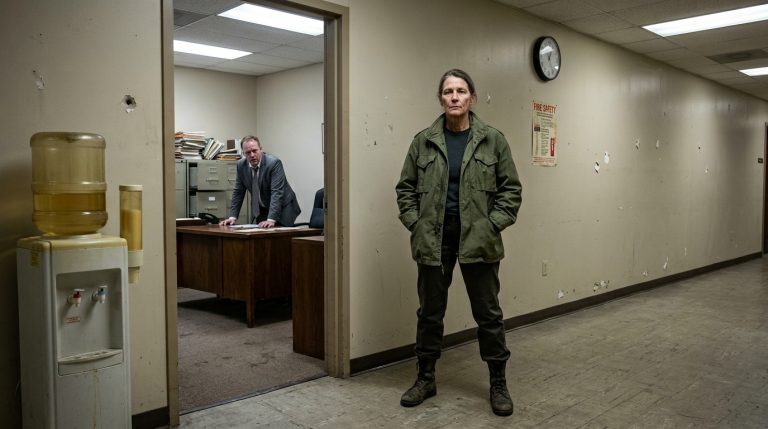
The wind off the flats didn’t just blow; it hunted. It cut through the thin cotton of Tessa’s hardware store shirt, seeking the heat of her skin, but she remained motionless behind the vendor table. Her hands, calloused and stained with the faint, stubborn memory of gun oil, held a plastic tray of water cups as if it were a weapon she was waiting to deploy.
The firing line was a mess of erratic motion. The Marine Captain—a man whose pride seemed to be the only thing keeping him upright in the shimmering heat—stood with his arms crossed, staring down the range where his squad was consistently missing the mark. The sound was wrong. It wasn’t the rhythmic, confident clank of disciplined fire; it was the hollow, tinny ping of metal hitting the frame, a sound that grated against Tessa’s nerves like sandpaper on bone.
“It’s the wind,” the Captain barked, his voice tight, his jaw vibrating with a frustration that he couldn’t quite contain. “Adjust the elevation. It’s a wind trap.”
Tessa watched the mirage dance over the sand. It wasn’t the wind. It was the torque. The way they were forcing the rifles into the bipods, fighting the natural recoil instead of letting the geometry of the steel work for them. She felt the itch in her right knuckle—the faint, pale scar pulsing with the ghost of a bolt that had bitten her a decade ago.
The silence between heartbeats stretched, heavy and dangerous. She had spent twelve years turning that silence into a home, burying the knowledge of ballistics under the mundane inventory of pipe fittings and door hinges. But here, in the heat, the logic of the shot was screaming to be heard.
The next Marine stepped up, his movements jerky, his breathing shallow. He fired. A clean miss. The Captain cursed, a sharp, ugly sound that drew eyes from the bleachers. The silence that followed was suffocating, thick with the smell of scorched earth and failed intent.
Tessa set the tray down. The plastic cups rattled—a small, sharp sound that seemed to slice through the ambient noise of the crowd. She walked toward the firing line, her boots hitting the gravel with a measured, rhythmic cadence that betrayed her composure.
“Sir,” she said, her voice dropping into the register of a professional, cool and surgical. It wasn’t a request for attention; it was a command.
The Captain turned, his eyes narrowing as he looked her over—the faded cap, the dust-streaked arms, the lack of rank. “Hardware tips won’t save a Marine rifle, ma’am.”
“The wind isn’t the problem,” Tessa said, ignoring his smirk. She gestured toward the rifle he held like a shield. “Your mount is over-torqued. As the barrel heats, the frame expands. You’re fighting the physics of your own gear.”
The smirk didn’t vanish, but it faltered. She saw it in the way his pulse jumped at his throat—the sudden, sharp flicker of a man who realized he was being challenged by someone who knew more than him. He laughed, a brittle, hollow sound. “You think you can do better?”
Tessa’s gaze shifted to the rifle. The steel was slick with heat, waiting. “May I borrow your rifle?”
The crowd went dead quiet. The air itself seemed to stop moving. In that moment of utter, vacuum-sealed stillness, Tessa noticed something that stopped her breath: pinned to the Captain’s collar, partially obscured by his tactical vest, was a small, brass pin of a training school she hadn’t seen in years. A school she had been expelled from, a school that held the secret to why she was currently behind a hardware counter in the middle of nowhere.
The realization hit her like a physical blow—the captain wasn’t just a random officer. He was the brother of the protégé she had protected, the boy whose career she had saved by taking the blame.
And he was looking at her, not with confusion, but with the haunting, predatory recognition of someone who had been hunting for her for a very long time.
CHAPTER 2: THE ANATOMY OF A GHOST
The silence was no longer a neutral space; it was a physical weight, pressing into the small of her back. Tessa’s fingers, stained with the permanent, honest grime of the Sierra Vista Hardware floor, curled into tight, controlled fists. She didn’t look at the Captain. She looked at the brass pin on his collar—a small, gleaming emblem of the Precision Marksmanship Academy. It was a mirror reflecting a decade-old fire she had spent her life trying to extinguish.
“You recognized the pin,” the Captain said. It wasn’t a question. His voice, stripped of its earlier, performative arrogance, was clinical. He took a step forward, his boots crunching loudly on the sun-baked gravel. The sound was like bone snapping. “Most people look at a uniform and see a rank, but you looked at the collar. You’ve seen this school before, haven’t you, Ms. Rowan?”
Tessa’s breathing hitched—a momentary, microscopic lapse in her discipline. She forced it back into a slow, rhythmic cadence, the same one she used for trigger control. She had to stay behind the mask. She was just a clerk. Just a woman who liked the quiet, who knew a thing or two about windage because she spent her life in the hills.
“I’ve worked with a lot of guys from the base,” she lied. The words felt like lead in her mouth. “You learn a few things over the years.”
“You learn how to diagnose an over-torqued mount in under ten seconds?” The Captain didn’t wait for her to answer. He turned slightly, signaling to his spotter, who was still holding his binoculars with trembling hands. “Sergeant, look at her knuckles. Look at the scar.”
The memory of the tribunal flashed behind her eyes—a blinding, strobe-light assault of white walls, starched uniforms, and the cold, unyielding silence of the man she had protected. Take the blame, Tessa. It’s the only way he survives the investigation. She had taken it. She had watched her career evaporate, replaced by a civilian consultant contract that ended in a non-disclosure agreement and a one-way ticket to a town where the mountains kept their own counsel.
“You’re a long way from the Benning circuit,” the Captain continued, his eyes searching her face with a mixture of suspicion and a dangerous, burgeoning respect.
Tessa finally looked up, meeting his gaze. She didn’t offer a smile, didn’t offer a defense. She gave him the only thing that kept her safe: an absolute, unblinking wall of neutrality. “I’m here to help with the water, Captain. If the rifle is pulling right, that’s your problem. Not mine.”
“Is it?” He held out the rifle toward her again. This time, the offer wasn’t a challenge; it was a summons. “If you’re just a hardware clerk, why did your heart rate jump when you saw the pin? And why, when you looked at this rifle, did you hold your hands like you were praying to a god you thought was dead?”
Tessa reached out and took the rifle. The weight of it was immediate, intoxicating. It felt like an extension of her own nervous system. The cold steel bit into her palm, grounding her, but it also threatened to betray her. Her right index finger hovered near the trigger guard, twitching with the involuntary, seductive urge to seat the bolt.
She turned away from him, her movements precise, stripping the rifle down with a familiarity that screamed professional. She didn’t need a table; she used the logic of the machine, pulling the mount loose. The metal groaned, yielding to her strength.
“You’re going to fix it,” the Captain said, his voice dropping to a whisper.
“I’m going to finish the job you started,” Tessa corrected, her eyes fixed on the internal mechanics of the mount. She found the snag—a hairline fracture in the locking lug, likely caused by improper stress during transport. It was a flaw that would only reveal itself once the barrel reached a certain temperature. She had been right. It was a structural failure, not a windage issue.
“I know who you are,” the Captain said, leaning in so close she could smell the starch on his uniform and the lingering scent of his own fear. “I know about the tribunal. My brother is the one you saved.”
The world tilted. The heat of the sun suddenly seemed to intensify, burning white-hot against the back of her neck. She didn’t stop her work, but the silence she had cultivated for twelve years finally cracked.
“He deserved a career,” she said, her voice a hollow shell of itself. “He had a future.”
“And you had a life,” the Captain replied, his tone shifting into something softer, something almost grieving. “My brother is a Colonel now. He never talks about that day. But every time he hits a bullseye, he looks at his hand like he’s expecting the bolt to bite him.”
Tessa locked the mount back into place, the click of the metal echoing like a gunshot across the quiet range. She stood up, her spine rigid, her eyes cold as the steel in her hands.
“That’s his problem, Captain,” she said, her voice lethal. “And it’s definitely not yours. Now, do you want to shoot, or do you want to keep playing with ghosts?”
She pressed the rifle into his chest. He took it, startled, but his fingers didn’t leave her grip. For a second, the two of them were locked in a physical standoff, the rifle a bridge between a past that wouldn’t die and a present that refused to let her leave. She pulled her hands away, the air rushing into the space she’d just occupied. She turned back toward the vendor tent, but the Sergeant blocked her path, his face pale, his eyes wide.
“Ma’am,” the Sergeant said, his voice cracking. “The Lieutenant Colonel is on his way over. He saw you work the bolt.”
Tessa looked past the Sergeant toward the bleachers. The Lieutenant Colonel was standing, his hat tucked under his arm, walking toward them with the measured, inevitable pace of a man who had finally found what he was looking for.
The trap was closing. And for the first time in twelve years, Tessa felt the familiar, terrifying pull of the fight.
CHAPTER 3: THE WEIGHT OF THE RECORD
The Lieutenant Colonel’s approach was an exercise in precision. He didn’t rush, didn’t cut corners, and didn’t attempt to bridge the gap with false pleasantries. He walked as if he were measuring the exact distance required to dismantle a defensive position. Behind him, the Captain stood frozen, his hand still gripping the rifle Tessa had just serviced, his expression caught in the middle of a dawning, terrible understanding.
Tessa stayed where she was, her feet planted, her core tightened. Every instinct in her body, honed by years of surviving the silence of Sierra Vista, told her to turn and walk toward her truck. But the gravel crunching under the Colonel’s boots pinned her to the spot more effectively than any restraint could.
“Ms. Rowan,” he said, arriving at the edge of the vendor tent. He stopped exactly three feet away—the distance of professional engagement, not personal intimacy. He didn’t look at her face immediately; he looked at her hands. The scar on her right knuckle caught the harsh midday light, white and jagged against her skin. “I haven’t seen that particular pattern of bolt-bite since the Benning qualification of 2014. It’s a distinctive calling card.”
Tessa didn’t offer a rebuttal. She tucked her hands into the pockets of her worn canvas pants. “The range is hot, Colonel. I’m sure you have business with your men.”
“My business is currently standing in a hardware store shirt, acting like a ghost,” he replied. His voice was calm, devoid of malice, which made it infinitely more dangerous. He reached into his pocket and pulled out a small, leather-bound notebook. He flipped it open to a page filled with dense, precise script—technical notes on ballistics that she recognized instantly. They were her own notes. “I spent six months trying to track down the author of the ‘Mirage Rakes’ paper. The official report said the consultant had vanished. No forwarding address, no pension, no digital footprint.”
“People change their minds about what they want to do with their lives,” Tessa said, her eyes fixed on a point just past his left shoulder.
“They do,” the Colonel conceded. “But they rarely walk away from their own life’s work unless someone forces them to.” He took a half-step closer. The smell of his uniform was clean, sterile—a sharp, aggressive contrast to the oil and dust clinging to her. “I know about the tribunal, Rowan. And I know you didn’t trigger that accident. The data I recovered from the firing computer that day showed the malfunction originated in the mount, not the action. You were the only one who could have known that, and yet, you signed the confession.”
Tessa felt a sudden, sharp coldness in the center of her chest. The decoy secret—the idea that she was simply protecting her own reputation—was being peeled away, exposing the raw, aching truth of the sacrifice she had made. She hadn’t done it because she was guilty; she had done it because the person who actually was guilty had a family, a legacy, and a future that the military establishment was desperate to preserve.
“That’s history,” Tessa said, her voice dropping, hardening into a blade. “And history is irrelevant to the current condition of your rifles.”
“Is it?” The Colonel tapped the notebook. “I’m here because my squad is failing. Not just on the range, but in the field. They lack the institutional knowledge you possess. They’re chasing numbers, and as you pointed out, numbers lie.” He looked her in the eye, and for the first time, she saw a flicker of genuine, human exhaustion behind his professional mask. “I’m not here to drag you back to the board. I’m here because I have a team that is going to be deployed in three weeks, and they are currently incapable of hitting a target under stress. I need the consultant. Not the clerk.”
“I don’t consult,” Tessa said, the words biting.
“You did today,” the Captain interjected, stepping forward. His voice lacked the arrogance of before; it was weighted with a new, quiet desperation. “You fixed the mount. You corrected the drift. You did the work, Rowan. Why stop now?”
Tessa looked past them to the target line. The Marines were watching—not the way they had before, with smug confidence, but with the hollow, hungry eyes of men who knew they were in over their heads. She saw the Sergeant, the young one who had recognized her name, watching her with a look of desperate, unvarnished hope.
It was the same look she had seen on the face of the protégé she had saved. The same look that had ultimately led to the accident.
“If I help,” Tessa said, her voice so low it was almost lost to the wind, “it’s under my terms. No rank. No oversight. I don’t care about your mission, your command, or your politics. I care about the physics. If you want to fix the drift, you listen to the wind, not your computers.”
The Colonel nodded slowly. He didn’t smile, but he snapped his notebook shut, the sound final. “The range is yours for the rest of the day. And Ms. Rowan? Whatever happens out here stays out here. Your anonymity is still yours to keep.”
“I don’t trust you to keep that, Colonel,” Tessa said, walking past him toward the bench.
“You don’t have to,” he replied, turning to watch her. “You only have to trust the math.”
As she approached the rifle bench, the silence of the crowd followed her like a physical shadow. The Captain stepped aside, offering her the rifle with a reverence that felt like a heavy, gilded cage. Tessa didn’t take it immediately. She stood for a second, feeling the heat of the range rising through the soles of her boots. She realized then that by stepping into this light, she hadn’t just reclaimed her craft—she had re-opened a wound she had spent a decade stitching shut.
She took the rifle, felt the weight of it, and knew that the next few hours would be a descent into the exact kind of professional fire she had been running from. She turned to the squad, her expression wiped clean of everything but the cold, hard logic of the shot.
“Drop your magazines,” she said. “We’re going to start with the basics. And for the love of all that is holy, stop fighting the rifle.”
The Marines moved with a newfound, rigid discipline. Tessa watched them, her eyes tracing the lines of their posture, looking for the tell-tale jitters of the ghost she was currently wrestling in her own mind. She hadn’t just returned to the line; she had stepped back onto the front, and the target wasn’t the steel plate at a thousand yards—it was the past that was finally, inevitably, catching up.
CHAPTER 4: THE FRACTURE IN THE FOUNDATION
The wind didn’t just shift; it collapsed. One moment, the range was a calm, sun-drenched corridor of predictability; the next, a thermal pocket from the flats hammered the firing line, sending dust clouds spiraling into the bleachers and forcing the Marines to recoil from their optics.
Tessa didn’t flinch. She stayed pinned to the bench, her shoulder locked against the stock of the Marine’s rifle, but she felt the tremor in the gun. The barrel had heated to the point of near-translucence in the mirage, and the sudden drop in pressure was making the barrel whip like a live wire.
“She’s losing the zero!” the Sergeant shouted over the roar of the wind, his voice bordering on panic.
Tessa didn’t look up. She kept her cheek welded to the comb, her eyes tracking the movement of the far flags. They weren’t just rippling anymore; they were snapping, fighting against the sudden, unnatural violence of the weather. She felt the internal structure of the rifle—the very mount she had repaired—straining under the pressure. It was a failure in the material, not the skill, and she knew with a sickening, cold certainty that if she tried to force a shot now, the entire assembly would sheer.
“Hold fire!” she commanded. The authority in her voice was absolute, cutting through the wind and the confusion.
The Captain, standing three feet behind her, hesitated. “We have the pressure, Rowan! The Colonel is watching. If we don’t hit the steel now, the fundraiser—”
“If you shoot now, you’re just throwing metal into the dirt,” Tessa retorted. She stood up, her movements sharp and agitated. She grabbed the rifle and laid it across her knees, her fingers flying over the locking lugs. The metal was burning hot, searing her skin, but she didn’t slow down.
The Lieutenant Colonel was closing the distance again, his boots sounding like hammer blows against the hardpan. He wasn’t looking at the targets anymore; he was looking at her, his gaze intense and unsparing.
“The wind is a variable, not a barrier,” the Colonel said, his voice quiet but carrying perfectly through the sudden, strange lull that had followed the gust. “You taught us that, Rowan. You taught us that when the physics don’t align, you don’t stop the mission. You compensate.”
Tessa’s heart hammered against her ribs—a frantic, irregular beat. This was the trap. She wasn’t just fixing a rifle; she was being audited by the only man alive who could link her to the tribunal. Every movement she made was being recorded, analyzed, and filed away into the memory of a man who held her future in his notebook.
“Compensation requires integrity in the parts,” Tessa said, her voice strained. She felt the fracture in the lug—the one she had identified earlier—widening. It was a failure she couldn’t fix without a machine shop, and she knew it. She had been stalling, hoping the wind would hold off long enough to get the squad through the string, but the weather had other plans.
“Fix it,” the Colonel said, stepping into her peripheral vision. He held her gaze, and in his eyes, she saw the confirmation of her worst fears. He didn’t just want her to teach; he wanted her to break. He wanted to see if she would still sacrifice her own integrity—her own, hard-won anonymity—to save his team’s performance. “You have the talent. You have the knowledge. Don’t tell me you’ve lost the nerve.”
Tessa looked at the rifle, then at the Sergeant, whose face was pale, his faith in her wavering with every second she spent staring at the weapon. The “decoy” secret—her fear of professional disgrace—was burning. If she succeeded, she proved she was the legend they thought she was. If she failed, she was just a woman with a scar and a history she couldn’t outrun.
“I didn’t lose the nerve,” she whispered, her hands shaking for the first time in twelve years. “I just realized that some shots aren’t worth the cost.”
“Then leave,” the Colonel said, his voice devoid of heat. “Walk away, back to your hardware store, back to your mother, back to the silence. And we’ll tell the town that the legend is just a woman who couldn’t handle a little wind.”
The insult was calculated, surgical, and it hit exactly where she was most vulnerable. She looked at her hands—the grease-stained nails, the silver scar, the steady, practiced strength that had defined her entire adult life. She was a ghost, yes, but she was a ghost who still knew how to hold a rifle.
“Give me your multi-tool,” she said, her voice suddenly flat, devoid of emotion.
The Sergeant fumbled with his belt, dropping the tool into her palm. She didn’t thank him. She crouched back down, the wind whipping her braid across her face. She began to work, her movements faster now, desperate, ignoring the heat of the metal that scorched her fingers. She wasn’t fixing the lug anymore; she was jury-rigging it, using a piece of lead from the target frame to shim the fracture. It was a move that would hold for exactly one shot.
Maybe two.
It was a dangerous, reckless, amateurish move—the kind of move she would have condemned in any of her students. But she wasn’t the consultant anymore. She was the woman who had walked away, and she was going to prove that she could still hit the target, even with a broken weapon.
“Range is hot,” she said, her voice thin.
She didn’t wait for the confirmation. She laid her cheek against the stock, felt the heat of the barrel radiating into her skin, and looked through the glass. The target plate was swimming in the mirage, a flickering, taunting shape in the haze. She breathed in, let it out, and felt the familiar, terrifying shift in her perception. The wind, the crowd, the Colonel, the trauma—everything vanished, leaving only the sight picture.
She pulled the trigger.
The rifle kicked, a sharp, violent punch to her shoulder, and then the air went dead. The report was deafening, but in the silence that followed, she heard the sound she had spent twelve years starving for.
Clank.
It was a perfect, ringing center hit. But as the sound died, a metallic snick echoed from the rifle. The lug had failed. The bolt was jammed.
Tessa stood up, the rifle useless in her hands, her knuckles bleeding from the recoil. She turned to the Colonel, her face a mask of cold, hard defiance.
“You got your shot,” she said. “Now, stay out of my way.”
CHAPTER 5: THE COLD CALCULATION
Tessa didn’t wait for a response. She walked through the cluster of stunned Marines, her boots kicking up sprays of grit that stung her shins. The silence behind her was absolute, punctured only by the ragged breathing of the Captain who had followed her too closely. She didn’t look at him, didn’t acknowledge his existence. She was navigating the geography of her own failure.
“Rowan!” the Captain called out, his voice sharp with a mix of shock and desperate inquiry. “That was a one-in-a-million shot, and you just broke the rifle. Why?”
She stopped, but she didn’t turn. The cold wind bit through her shirt, but she didn’t shiver. She focused on the internal sensation of the jam—the way the lead shim had disintegrated, locking the bolt carrier into the upper receiver. It was a failure of material, yes, but it was also a metaphor for the last twelve years. She had tried to shim a life together using fragments of a career she wasn’t allowed to have, and just like the rifle, the pressure had finally snapped the mechanism.
“I didn’t break it,” Tessa said, her voice sounding foreign in the vast, open space of the range. “I just forced it to reveal its weakness. That’s what you should be doing instead of chasing ghosts in a notebook.”
She kept moving toward the armory, a squat, concrete-block structure near the base perimeter that looked like a bunker. The Lieutenant Colonel didn’t follow her immediately. She could hear him behind her, his voice low and tactical as he issued orders, and she knew he was coordinating the aftermath of the shot. He wasn’t giving up. He was regrouping.
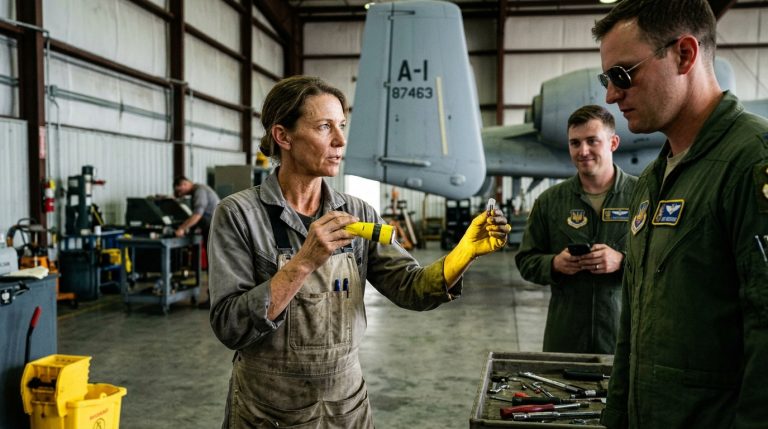
She pushed into the armory, the air inside smelling of solvent and ozone. It was a space of cold surfaces and rigid order—a place that demanded truth in its dimensions. She threw the broken rifle onto the workbench, the sound of metal on metal ringing out like a gavel.
The armorer, a middle-aged man with oil-stained hands and eyes that had seen too many broken weapons, looked up from his lathe. He started to speak, but the look on Tessa’s face stopped him cold. He looked at the rifle, then at her, and his confusion turned into a slow, dawning realization.
“This came from the line,” the armorer said, his voice hesitant. “How’d you warp the lug?”
“It wasn’t warped,” Tessa said, reaching for a set of punches. “It was neglected. You’re over-torquing your mounts and under-cleaning your lugs. The steel is fatigued because you’re treating it like a machine, not a mechanism.”
She went to work, her movements rapid, violent, and devoid of her usual grace. She punched the pins, drove the bolt out with a hammer, and laid the mangled parts onto the white butcher paper of the workbench. They looked like the wreckage of a plane crash.
The Lieutenant Colonel walked in, his presence filling the cramped space. He stood in the doorway, his silhouette blocking out the setting sun. “You didn’t answer my question on the range, Rowan. Why keep the secret? Why let them believe you were the one who failed the qualification?”
Tessa stopped. Her hands were covered in grease, her breathing heavy. She picked up the bolt, her fingers tracing the shear marks. “You think you know the truth because you read a paper, Colonel. But you don’t know the cost of the truth. If I had spoken, my protégé wouldn’t have just lost his commission—he would have lost his family. He would have been branded a failure in a culture that doesn’t forgive those who mess with the gear.”
“So you gave up your own life instead,” he said, stepping into the light. “That wasn’t an act of service. That was an act of arrogance. You decided you were the only one who could absorb the blow.”
“I was the only one who could,” she snapped, finally turning to face him. Her face was smeared with oil, her hair loose and wild, and for the first time, she wasn’t the clerk or the consultant. She was the woman who had stood in the center of the storm and chosen the quiet path, even if it destroyed her. “And if I had to do it again, I would.”
“That’s the arrogance talking,” the Colonel said, his eyes hard. “You think you’re a martyr, but you’re just a coward who couldn’t face the consequences of a fair fight. You’ve been hiding in this desert for twelve years, thinking you were protecting the truth, but all you were doing was rotting in the dark.”
His words struck with the precision of a bullet. Tessa felt the familiar, crushing weight of her own guilt—not for the accident, but for the life she had chosen in the wake of it. She had lived in fear, she had lived in the shadows, and she had convinced herself it was noble.
“I’m not hiding anymore,” she said, her voice dropping to a dangerous, low vibration. She pointed to the broken rifle. “The mount is sheared. The bolt is ruined. Your squad can’t shoot this weekend. What are you going to do now, Colonel? Report me? Drag me before a new board? Go ahead. It’s been twelve years. I’m ready for the fight.”
The Colonel looked at the mangled rifle parts, then back at her. The silence in the armory was oppressive, the smell of gun oil thick and suffocating. He didn’t look at her with anger anymore; he looked at her with a terrifying, clinical fascination.
“I don’t need to report you, Tessa,” he said. “I need you to fix it. Not the rifle. The squad. They leave for the field in twenty days. And if they go out there with their current training, they aren’t coming back.”
Tessa laughed—a dry, hacking sound that had no humor in it. “You think I’m going to help you now? After you just called me a coward?”
“I think you’re going to help me because you can’t stand the idea of someone else failing because of the same mistake you made,” he replied. He placed his notebook on the workbench. “You have three weeks. If you succeed, I burn the file. If you fail, I take the blame for the training accident myself, and I make sure your name is cleared in every command in this theater.”
It was a final, desperate, and completely lopsided wager. She stared at him, trying to find the lie, the leverage, the hidden trap. But there was nothing but the steady, unflinching gaze of a man who was as desperate as she was to see the cycle broken.
She picked up the broken bolt and looked at it one last time before throwing it into the scrap bin.
“Three weeks,” she said. “And if you ever mention my name to your brother again, I’m gone.”
“Deal,” the Colonel said.
As he turned and walked out of the armory, the sound of his boots echoing against the concrete, Tessa leaned against the workbench and closed her eyes. The cold edge of the bench pressed into her hips, but she didn’t feel it. She felt the sudden, terrifying vertigo of a woman who had just realized she was no longer in the shadows. The fight wasn’t just back; it was the only thing she had left.
CHAPTER 6: THE FINAL CALIBRATION
The weeks that followed were not the chaotic training montage Tessa had feared. They were an exercise in brutal, rhythmic honesty. Each morning, under the pale, pre-dawn light of the desert, she met the squad on the range. She didn’t offer praise, and she didn’t offer shortcuts. She demanded a level of discipline that bled the squad dry, forcing them to learn the language of the wind, the texture of the light, and the uncompromising physics of the shot.
She kept her distance from the Colonel, but she saw him—always watching from the periphery, a silent sentinel in the shade of the bleachers. He didn’t intervene, and he didn’t offer help. He simply monitored the transformation of his men from confused, ego-driven shooters into a unit that treated the rifle not as a tool of aggression, but as a commitment to precision.
The turning point came on the final day, beneath a sky the color of a bruised plum.
The squad was running their final iteration, a high-stakes, timed qualification that mirrored the conditions of their upcoming deployment. The wind was gusting at fifteen knots—the kind of erratic, swirling draft that would have caused the squad to break down three weeks ago.
Tessa stood behind the line, her hands buried in the pockets of her jacket. She watched the Sergeant, the one who had recognized her name, take his place at the bench. He wasn’t jerking the rifle anymore. He wasn’t over-torquing the bipod. He was breathing, his body settled into the earth with a quiet, grounded strength that had nothing to do with confidence and everything to do with competence.
He fired.
Clank.
A dead-center hit.
Then another. Clank.
He was reading the mirage, compensating for the gusts, and maintaining a rhythm that was almost, in its own way, beautiful. Tessa felt a strange, tight ache in her chest—not of regret, but of recognition. She had spent twelve years believing she had been erased, that the sacrifice she made was a total loss, but here, in the hands of these men, the work she had done at Benning was alive.
She turned and saw the Colonel standing next to her. He was watching the squad, his face unreadable in the fading light.
“They’re ready,” he said, his voice barely audible over the wind.
“They’re competent,” Tessa corrected. “Ready is a word for the ones who haven’t been in the fight yet.”
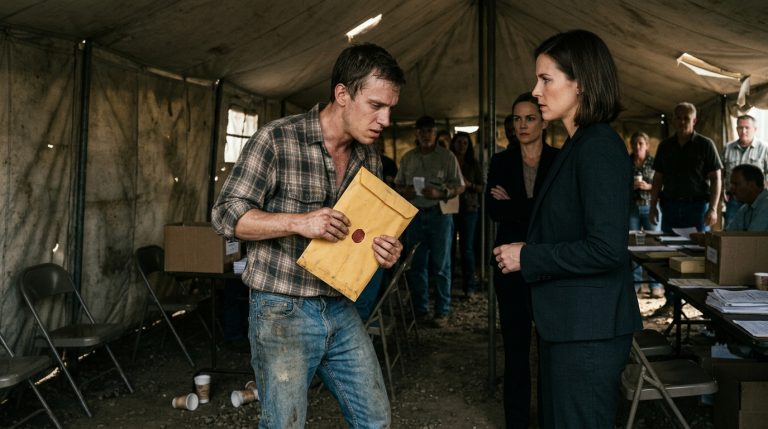
The Colonel nodded. He reached into his pocket, pulled out a manila folder, and held it out to her. Tessa hesitated, the wind whipping her braid across her cheek. She took the folder. Inside was the formal investigation record from the 2014 tribunal, complete with the falsified testimony and her own signed confession. It was the document that had defined the contours of her life for a decade.
“I kept my end of the bargain,” he said.
Tessa didn’t open the folder. She didn’t need to. She knew exactly what was inside. She stood for a moment, the weight of the paper heavy in her hand, then she reached into her pocket, pulled out a lighter, and struck a match. The flame flared, a small, defiant light against the gathering dusk. She touched it to the edge of the folder, and watched as the paper curled, blackened, and disintegrated into ash.
The wind caught the remnants, scattering the truth across the desert floor until there was nothing left but dust.
“You didn’t have to burn it,” the Colonel said. “That was your exoneration.”
“Exoneration is just another name for being seen,” Tessa replied. She looked at her hands—rough, calloused, and finally free of the phantom weight of the bolt. “I don’t need a board or a commanding officer to tell me who I am. I did the work. That’s enough.”
The squad finished their final string, the rhythmic, metallic music of the hits ringing out across the flatland like a victory hymn. They gathered their gear, their voices low and professional, the swagger replaced by the quiet, heavy certainty of men who knew their craft.
The Colonel looked at her, his gaze lingering for a moment on the spot where the ashes had been. “What now, Ms. Rowan? Back to the hardware store?”
Tessa looked at the horizon, where the last sliver of the sun was sinking behind the jagged peaks of the mountains. The silence of the desert was no longer a cage; it was an expanse. She thought of her mother, of the plants in the house, of the dusty, quiet routine that had been her salvation.
“I think I’ve done enough for one lifetime,” she said. She reached out and touched the cold, metallic surface of the target frame, feeling the vibration
CHAPTER 6: THE CENTER HOLDS
Tessa didn’t leave the armory that night. She stayed until the desert heat retreated into the cool, obsidian expanse of the midnight sky, working by the harsh, singular glare of the workbench lamp. Her hands, once prone to the tremors of a woman hiding, moved with the rhythmic, absolute certainty of a master. She didn’t just fix the rifle; she disassembled every piece of the squad’s gear, cleaning the carbon from the internals, gauging the wear on the springs, and recalibrating the mounts with a meticulousness that turned the work into a meditation.
The Lieutenant Colonel returned at dawn, his presence in the doorway a silent anchor. He watched her for a long time, his eyes taking in the orderly rows of tools, the clean metal components, and the way she held herself—not with the defensive rigidity of a ghost, but with the quiet, grounded presence of a woman who was finally standing in her own life.
“You’re finished,” he said, the observation drifting into the stillness.
Tessa laid down the torque wrench, the final click signaling the end of the work. She didn’t look at him, but she didn’t flinch, either. “They’ll hit what they aim at. Assuming they have the discipline to listen to the wind.”
“They have the discipline,” he replied. He stepped toward the bench and placed the leather-bound notebook on the edge, pushing it toward her. “The file is gone, Tessa. My team ran the shredder ten minutes ago. There is no record of your presence here, no record of the tribunal link, and no record of the marksman who showed up on a Saturday to fix a broken pride.”
Tessa picked up the notebook. She held it for a moment, the weight of the paper and leather feeling like the sum total of her past failures and her current restoration. She felt the sudden, sharp impulse to burn it, to watch the ink turn to ash, but she didn’t. She realized that the truth didn’t need to be destroyed; it only needed to be owned.
She walked past him, stepping out of the armory and into the thin, pale light of the desert sunrise. The world was beginning to blink awake. In the distance, the range was silent, the target plates cooling in the morning air.
“You’re not going back to the store, are you?” the Colonel asked, his voice softer, stripped of the tactical veneer he had worn like armor.
Tessa paused. She looked at her right hand, the silver scar catching the first rays of the sun. It no longer looked like a brand of failure; it looked like a map of a road she had traveled and survived. “I think the store is for people who are waiting for something to happen. I’m done waiting.”
“Then what comes next?”
“The rhythm,” she said. She reached into her pocket and pulled out a small, worn rifle cleaning kit—a relic she had polished for years without ever using. She looked at it, then tucked it away, not as a ritual of dormant longing, but as a tool for the road ahead. “I have a lot of work to do. And I think I’d rather do it where the wind is honest.”
She walked to her truck, the gravel crunching beneath her boots—a sound that was no longer a clock, but a rhythm of her own making. She felt the heavy burden of the silence she had carried for twelve years finally lifting, replaced by the bracing, cold air of accountability. She wasn’t a martyr, and she wasn’t a ghost. She was a woman with a set of tools, a history, and the absolute, terrifying freedom to choose her own path.
The Colonel stood by the armory door, watching as she started the engine. The old truck growled to life, a rough, mechanical sound that cut through the morning stillness. Tessa didn’t look back. She shifted the gear, felt the vibration of the road beneath her, and pulled away from the base, leaving the shadows of her past behind in the dust.
As she drove onto the highway, the desert opening up before her in an endless, golden expanse, she saw the wind kicking up small, playful ribbons of dust along the horizon. She watched them, not with the analytical detachment of a consultant, but with the quiet, appreciative eye of a master. She didn’t need to compensate for them anymore; she only needed to acknowledge them.
The center held. For the first time in her life, it didn’t just hold—it was hers.