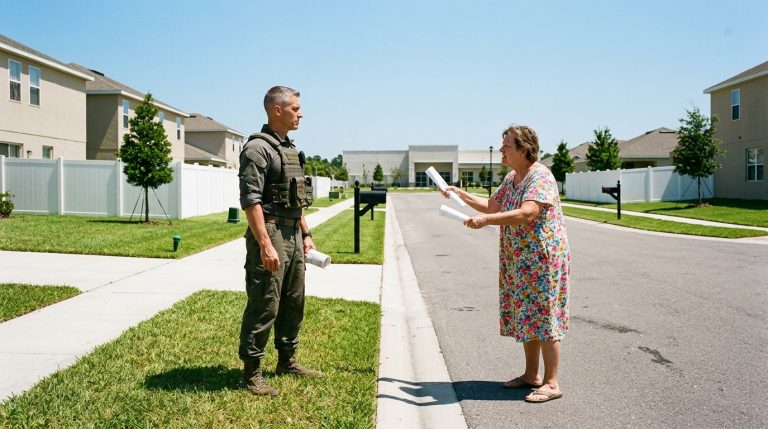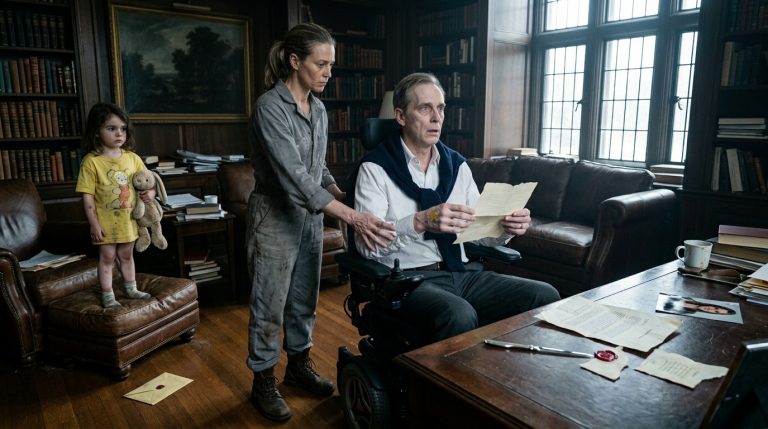
When Her Ungrateful Adult Children Expected An Inheritance, She Taught Them A Lesson They Would Never Forget
CHAPTER 1: THE COLD KITCHEN TABLE
The kitchen clock ticked like a countdown timer, but the silence sitting across from me was far louder.
I turned the silver-plated Parker pen between my knuckles, feeling the brass showing through the worn plating. Forty-three years Richard had owned this pen before handing it to me on his deathbed. My index finger traced the deep groove near the clip—the spot where his thumb used to sit while calculating the monthly mortgage.
Eleven months.
Eleven months since Daniel stood up from this table, his chair legs screeched against the oak floorboards, and called me selfish for keeping my own retirement savings.
I didn’t call Thomas. I didn’t reach for the phone directory to find a lawyer. I simply set the silver pen down beside a stack of unopened utility notices Daniel had forwarded to my address.
At the grocery store on Main Street two hours later, the fluorescent lights hummed overhead, casting a harsh glare across the canned soup aisle. I reached for a tin of tomato purée when a familiar voice carried over the metal shelving from aisle four.
“Daniel says we just need to wait her out,” Patricia’s voice rang clear, punctuated by the sharp click of her high heels against the linoleum. “She’s sixty-eight and living in an eight-hundred-thousand-dollar house alone. How long can she realistically stay there before her mind gives out?”
I froze, my hand suspended six inches from the shelf. My fingers tightened around the cool tin can until the aluminum dented slightly under my thumb.
“We already checked the property records online,” Patricia continued, her tone as casual as if she were discussing the weather. “The house goes straight to the three of them the second she passes. Why waste energy pretending to care when the property is the only real asset left?”
A quiet, icy calm settled into my chest, replacing the heavy ache that had lived there since Thanksgiving. I didn’t scream. I didn’t step around the corner to confront my daughter-in-law.
I placed the dented tin back on the shelf, walked out to the parking lot, and sat in my sedan with the engine idling. I pulled the silver Parker pen from my purse, clicked the top once, and wrote three words on the back of a grocery receipt: Sell it all.
CHAPTER 2: THE SECRET INVENTORY
The engine hummed in the sedan, my palms resting cold against the vinyl steering wheel while my eyes stayed fixed on the three words scrawled across the receipt.
I didn’t drive to Thomas’s office. I didn’t turn toward the city bank where Richard and I used to sit across mahogany desks.
I shifted into drive and headed straight back to the quiet house on Elm Street, my house, paid in full through forty-three years of Richard’s sweat and my frugal budgeting.
The front door clicked heavy into its frame behind me. I didn’t turn on the hallway lights.
Instead, I pulled the silver Parker pen from my purse, clicking it once in the dim entry hall before heading straight for the oak desk in the corner of the living room.
If I was going to sell this house on my own, without a lawyer, without an adviser taking a cut or asking cautious questions, I needed every leaf of paper.
The middle drawer stuck on its runner—a stubborn piece of brass fitting that always required a firm jerk. I tugged hard, the wood groaning before releasing with a sharp crack.
Bills, tax assessments, insurance policies from 2018. I stacked them methodically on the blotter, sorting the pile by date.
Near the bottom of the tax folder, my thumb brushed against something stiff and textured. Not standard copy paper.
It was a yellowed, folded postal receipt—a certified mail notice dated four months before Richard passed away.
I unfolded it under the single desk lamp. The signature on the delivery line wasn’t Richard’s slanting script, nor was it mine.
It was Daniel’s tight, aggressive cursive.
Beneath his signature was a tracking code tied to a commercial lender in downtown Chicago—a firm specializing in high-interest mezzanine loans for failing small businesses.
A cold trickle of sweat ran down the small of my back as I reached for the original property deed kept in the metal firebox beneath the desk.
I unlocked the box with the tiny key hidden inside my pen case and pulled out the county land records.
My fingers traced the lines of text on the second page, past the legal descriptions of the lot boundaries, down to the encumbrance filings.
There, stamped in faded blue ink six years ago, was a secondary lien application—signed with an attempt at Richard’s signature that was just slightly too upright, witnessed and submitted by Daniel.
Daniel hadn’t just asked for mortgage help four years ago when his business hit a slump.
He had tried to leverage my home as unauthorized collateral while his father lay dying in a hospice bed upstairs.
The paper rattled in my hands, but my chest didn’t heave. The panic had burned out in the grocery store parking lot.
I laid the yellow certified notice directly beside the deed on the dark oak surface, taking out the Parker pen to write down the county clerk’s recording number on a fresh index card.
They weren’t just waiting for me to die to take the house.
Daniel needed me to stay right here, oblivious and docile, until the lien matured or until my death cleared the title through probate, hiding what he’d done before anyone audited the deed.
A sudden, sharp knock echoed from the front porch, the heavy brass knocker striking the oak door three times.
CHAPTER 3: THE TRAPPERS DINNER
I stood frozen behind the oak desk, my right hand pressing the silver Parker pen firmly into the index card, my eyes locked on the heavy front door as the second round of knocks rattled the iron hinges.
I slid the yellow postal receipt and the deed into my cardigan pocket before walking across the living room.
When I pulled the door open, Jennifer stood on the porch in a beige trench coat, holding a glass casserole dish covered in foil.
“Mom,” she said, her expression softening into a wide, practiced smile that didn’t reach her eyes. “I know it’s late, but I was baking and thought… well, nine months is entirely too long.”
I looked down at the foil-wrapped dish, then back up at her face. “Nine months is two hundred and seventy days, Jennifer.”
She winced, a tiny twitch pulling at the corner of her left eye before she brushed past me into the foyer without waiting for an invitation.
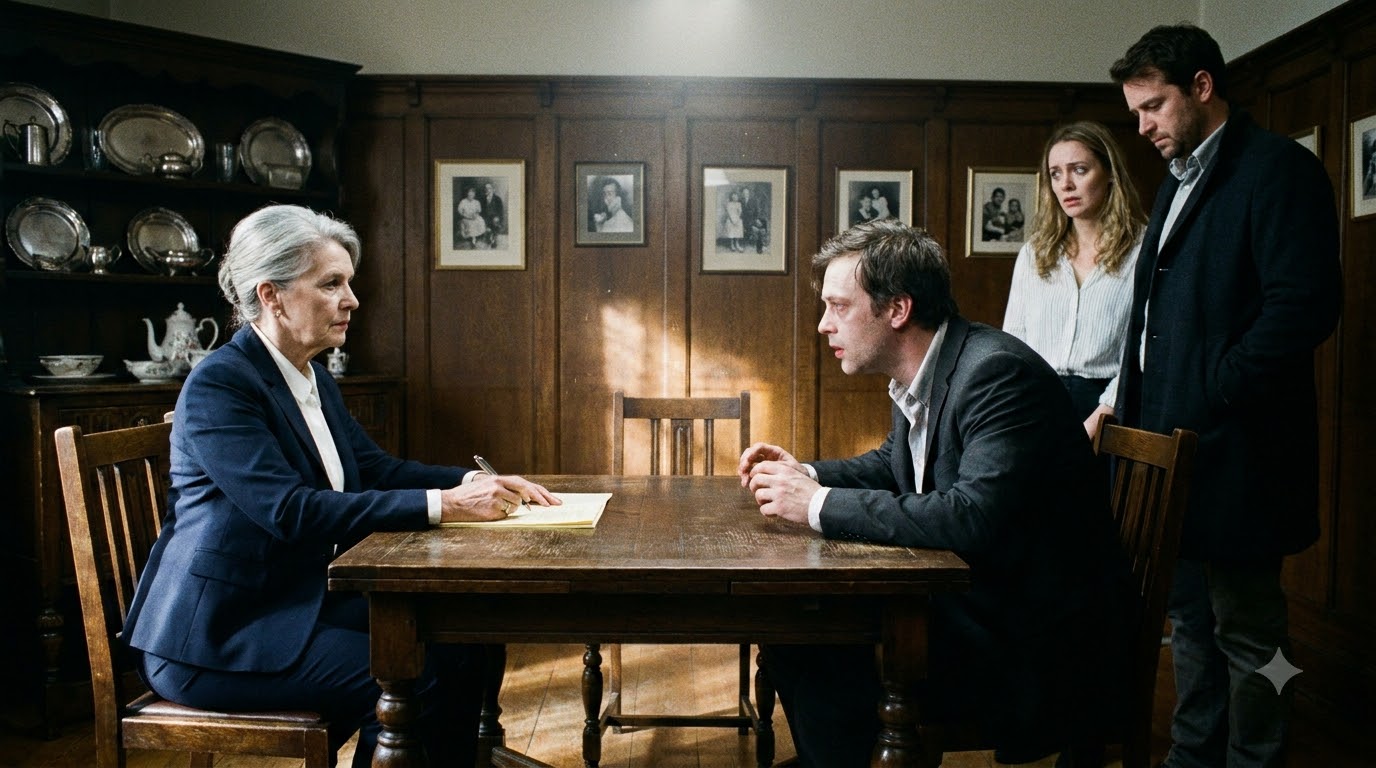
“Let’s not dwell on the past,” she said, setting the warm dish on the dining table. “Daniel and Michael are parking down the street. We wanted to talk. Just family.”
“Just family,” I repeated, walking over to the table and pulling out the head chair—Richard’s chair. “Like the Thanksgiving you spent at Daniel’s without me.”
Daniel walked in thirty seconds later, his leather dress shoes clicking heavily against the hardwood floor. Michael followed right behind him, keeping his hands jammed deep into his coat pockets and staring squarely at his boots.
“Look, Mom,” Daniel began, clearing his throat and unbuttoning his suit jacket. “Things got heated last summer. Words were said. But we need to make sure you’re doing okay here alone. The house looks… unmaintained.”
“The house is forty-two years old, Daniel. It has the same paint it had when your father died.” I tapped the silver Parker pen against the mahogany surface of the table. “What brings all three of my children to my dining table on a Thursday night?”
Jennifer leaned across the table, resting her manicured forearms near my plate. “We heard a rumor from the HOA board, Mom. Someone said a surveyor was measuring the lot lines on Tuesday.”
There it was. The real reason for the sudden burst of filial concern.
“Property values fluctuate,” I said mildly. “I was simply checking where my boundaries lie.”
“You don’t need to worry about boundaries or property values,” Daniel snapped, his calm veneer cracking as he took a step toward my chair. “In fact, Jennifer and I were talking to a estate manager. We think it’s time we put the title into a joint family trust. To protect you. To protect the asset.”
“To protect the house from being audited,” I said quietly.
The room went completely dead. Michael shifted his weight, his coat rustling loudly in the silence.
“What is that supposed to mean?” Daniel asked, his voice dropping an octave into a low, defensive growl.
I reached into my cardigan pocket, pulled out the yellowed postal notice, and smoothed it flat on the table right between Daniel’s elbows.
“It means I know about the mezzanine loan from six years ago, Daniel. The one you signed while your father was in hospice.”
Daniel’s face drained of color so fast his lips turned pale gray. Jennifer looked from the slip of paper to her brother, her eyes widening in genuine, panicked confusion.
“You… you pulled the title records?” Daniel stammered, his fingers twitching toward the paper before he yanked his hands back.
“I didn’t need a lawyer or an adviser to tell me my own house was encumbered,” I said, holding his glare without blinking. “I did the math myself.”
“Mom, listen to me—” Daniel started, leaning over the table, his knuckles turning white against the wood.
“No,” I cut him off, clicking the silver pen once. “You listen to me. Dinner is over.”
CHAPTER 4: THE UNILATERAL LIQUIDATION
I sat at the head of the dining table, my fingers resting steady over the silver Parker pen on the polished mahogany, looking Daniel dead in the eye as his white-knuckled grip on the table edge began to tremble.
Daniel opened his mouth, a red flush creeping up from his collar, but I didn’t give him the floor.
I slid the silver pen into my cardigan pocket, picked up the yellow postal notice, and stood up from the head of the table. “I told you to leave.”
“You can’t just throw us out after we came here to help!” Jennifer snapped, her hand slamming down beside her untouched casserole dish. “Daniel made a mistake six years ago, fine! But this house is family property. You can’t handle this alone, Mom. You’re getting paranoid.”
“I am completely lucid, Jennifer,” I said, walking past them toward the front hallway. “And my house is not family property. It is my property.”
Michael stepped into my path near the coat rack, his jaw set tight. “Mom, just listen for two minutes—”
“If you are not off my porch in thirty seconds,” I said, holding my thumb over the home security keypad on the wall, “I press the panic alarm. The siren on the roof is ninety decibels. The neighbors will be on the lawn before the police dispatch even answers.”
Daniel dragged his coat off the back of the dining chair, his jaw grinding as he marched past me toward the front door. “You’re making a massive mistake, Mom. Without us, you’re going to lose everything anyway.”
“I lost what mattered nine months ago,” I said, holding the door wide open. “Now I’m just clearing the ledger.”
The heavy oak door slammed shut behind them, the lock clicking into place under my palm.
I didn’t waste a single second staring at the empty hall.
Without a lawyer or a financial adviser to act as a middleman, I pulled my ledger from the hall drawer, sat down at the kitchen island, and opened the private buyer portal I had spent three weeks setting up directly with a local title holding firm.
The purchase agreement was already drafted—a direct, private cash transaction for eight hundred and seventy-five thousand dollars, no realtor commissions, no open house signs on the lawn to alert the neighborhood or my children.
My hand didn’t shake as I retrieved the silver Parker pen and signed my full legal name—Barbara Anne Vance—on the seller authorization line.
I scanned the document using the flatbed printer in the pantry and transmitted the file directly to the title officer’s secure server.
At seven-thirty the following morning, my cell phone buzzed on the counter.
An automated text notification from my credit union flashed across the screen: Pending wire transfer initiated. Amount: $862,400.00. Status: Clear for Escrow Finalization.
I looked out the kitchen window at the morning light hitting the backyard fence Richard had built thirty years ago.
The house was officially sold. The money was secured in a private, unlinked account in my name alone.
Then, a sudden heavy thump echoed from the side garage door—the sound of metal tools ratcheting against the exterior lock mechanism.
CHAPTER 5: THE FINAL BOUNDARY
I stood by the kitchen island holding my phone with the green wire transfer confirmation glowing on the screen, my eyes fixed on the side door leading to the garage as the heavy metal latch rattled again under brute force.
The deadbolt held, but the brass frame groaned as Daniel threw his shoulder against the exterior panel.
I didn’t run to the basement. I didn’t reach for the phone to dial emergency dispatch.
I walked straight down the hallway, pulled the door open, and stepped into the dim concrete floor of the garage, where Daniel stood breathing heavily, holding an iron crowbar he had pulled from my work bench.
Jennifer was right behind him, a blue manila folder clutched against her coat, her face pale in the overhead fluorescent tube light.
“Put the bar down, Daniel,” I said, my voice completely level.
“You’re not doing this, Mom!” Daniel yelled, his neck veins bulging against his collar as he stepped toward me, gesturing with the tool toward the kitchen doorway. “We spent the entire morning at the probate clerk’s office. Jennifer has an emergency petition for temporary conservatorship right here in this folder!”
Jennifer stepped forward, tapping the envelope with a manicured nail. “We have two notarized statements saying you’ve been showing signs of cognitive decline since Dad died. The court freezes all asset transfers the second this gets stamped at noon!”
I pulled the silver Parker pen from my cardigan pocket, clicking the top once with a deliberate sound that echoed off the bare garage walls.
“You’re four hours too late,” I said.
Daniel took another aggressive step forward, the iron bar heavy in his grip. “What are you talking about?”
“The sale didn’t go through an estate planner, Daniel. It didn’t go through a realtor with a sign on the grass.” I pulled the printed escrow closing receipt from my pocket and held it out between us. “The cash wire cleared fifteen minutes ago. The title has already been recorded at the county office.”
Jennifer’s hand dropped. The manila folder slipped two inches in her grip before she caught it against her waist. “You… you sold Dad’s house?”
“I sold my house,” I said, looking her straight in the eyes. “To a young couple who actually want to build a life here instead of waiting around for an old woman to die.”
“You selfish, ungrateful—” Daniel roared, raising his hands, his knuckles white around the cold iron tool. “That house was worth nine hundred thousand dollars! We covered your life for four years!”
“You drained three hundred thousand dollars from your father’s pension!” I barked back, my voice cutting through his outburst like a razor. “And you placed a fraudulent lien on this structure while Richard was dying in a bed upstairs!”
Daniel froze, the crowbar hovering in mid-air. His mouth opened, but no sound came out.
Jennifer turned her head sharply to look at him, her jaw dropping. “Daniel… what lien?”
“He didn’t tell you?” I asked, turning the silver pen slowly between my fingers. “The commercial lender in Chicago holds a note signed six years ago. Only now, there’s no real estate for them to collect against. The title is clear, and the proceeds are sitting in an unlinked account under a completely new trust.”
Daniel’s grip on the iron bar loosened, the heavy metal clattering loudly onto the concrete floor between his shoes.
“You can file your conservatorship papers,” I said, stepping over the crowbar until I was six inches from his face. “You can tell the judge whatever lie you want. But the house is gone, the money is moved, and you will never see a single dime of Richard’s work again.”
CHAPTER 6: THE QUIET HORIZON
I stood on the third-floor balcony of my new condo in Asheville, hands resting on the cool iron railing as the sun dipped behind the Blue Ridge Mountains, painting the sky in deep purples and quiet golds.
The mountain breeze carried the clean scent of pine and cool granite, completely washing away the stale air of the oak-paneled rooms on Elm Street.
My phone sat on the small outdoor table beside a steaming mug of black tea.
A single notification light blinked—a voicemail from a number I didn’t recognize, likely another desperate attempt by Daniel’s lender trying to trace assets that no longer belonged to his lineage.
I didn’t pick up the phone. I didn’t unlock the screen to check the preview.
Instead, I reached into my cardigan pocket and pulled out the silver-plated Parker pen.
I unclipped the top, unscrewed the barrel, and looked at the brass spring resting inside. For forty-three years, it had recorded mortgages, college tuition checks, medical bills, and bailouts for grown adults who treated my home like an open vault.
I set the pen down on the glass tabletop next to my tea.
My neighbor Margaret leaned over her side of the divider, holding a small pot of yellow chrysanthemums she had just pruned. “You look quiet tonight, Barbara.”
“I am,” I said, offering her a plain, genuine smile. “Just watching the light change.”
“It’s peaceful up here on the ridge,” she remarked, setting her shears down on the brick ledge. “No noise from the lower road.”
“No noise at all,” I agreed, taking a slow sip from my mug.
The tea was hot, bitter, and simple.
There were no financial papers sitting on my kitchen counter. No uninvited family members beating on the door frame with crowbars or carrying legal petitions stamped with bitter lies.
Layer by layer, the leverage had been dismantled. Daniel’s secret lien was exposed and rendered worthless against a property he no longer owned. Jennifer’s conservatorship threat had died the second the county clerk recorded the unencumbered cash deed.
They got the exact inheritance they earned over nine months of cold silence—nothing.
I reached out, took the silver Parker pen, and clicked the top once. The mechanical click was sharp, precise, and final.
I placed the pen inside my desk drawer indoors, shut wood against wood, and walked back out to the balcony to finish my tea in the fading mountain light.