The Price of Dignity: How a Disowned Daughter Unmasked Her Family’s Poisonous Lies
CHAPTER 1: THE KITCHEN DOOR EXILE
The brass key to my off-campus apartment was cold against my thumb. I pressed its notched edge into the meat of my palm, using the sharp bite of metal to keep my shoulders straight as the glass doors of the Skyline Terrace Ballroom slid shut behind me.
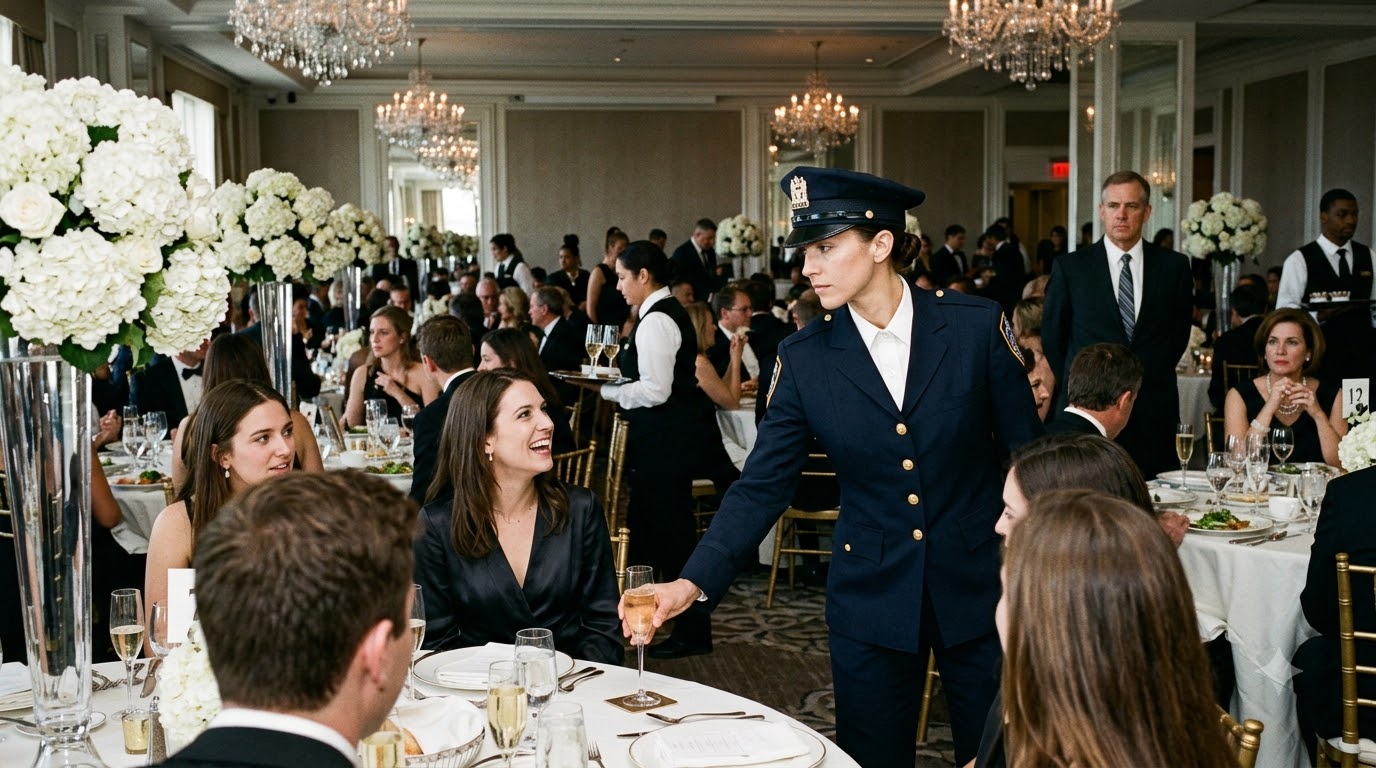
Ahead, three hundred guests mingled beneath crystal chandeliers, their laughter floating over white tablecloths and towering hydrangeas. At the center stage, the master of ceremonies adjusted his microphone, his voice booming through the speakers. He called my parents, Grady and Noella Kelm, to the riser first, praising their decades of civic leadership. Then he introduced my sister, Sirene, highlighting her vision and her untiring dedication to the family business.
When he finally turned toward me, he didn’t use my name. He simply announced “their youngest daughter, fresh from completing her studies,” while my parents stayed firmly in their plush chairs, offering three dry, polite claps.
I didn’t let my expression flicker. I walked toward Table Twelve—the one positioned directly beside the double swinging doors of the main kitchen. Every six seconds, a server kicked the doors open, sending a burst of heat, the smell of seared salmon, and the sharp clash of aluminum trays straight down the back of my neck.
Sirene drifted over before the first course arrived, her silk dress rustling against my chair. She set her wine glass down with a heavy click, leaning in until her perfume filled my space. “Enjoy the view from the back, Leech,” she whispered, her voice smooth and sweet enough for the surrounding tables to mistake it for affection. “It’s the last time you’ll sit in a room paid for by a Kelm.”
I turned the heavy room key in my hand, feeling the worn metal ridges. “The edge of the room is where you see the whole board, Sirene. You ought to try standing here sometime.”
Her smile tightened for a fraction of a second before she spun on her heel and glided back toward the head table. I watched her go, my eyes tracking her as she sat beside our father. Grady was leaning over a glossy magazine laid flat near his plate, pointing out a full-page diagram of a river cleanup filtration system.
It was my senior capstone project. Printed directly above the bold schematics was Sirene’s name.
A server pushed through the swinging doors, the rubber edge striking my shoulder. I didn’t flinch. In the inner pocket of Grady’s tailored suit jacket, a red edge of heavy paper caught the chandelier light—a certified mail envelope from the state licensing board, tucked out of sight, but out of place.
CHAPTER 2: THE WHISPERED CONSPIRACY
Hollis didn’t say a word. They just gave a slight, two-millimeter tilt of their head toward the service corridor behind the kitchen doors.
I turned my back on Table Twelve, leaving my untouched glass of iced water beside the rattling tray rack. The transition from the warm light of the ballroom to the dim, concrete-walled service hallway took three steps. Here, the hum of the jazz band lost its brass notes, reduced to a hollow, thumping bass that vibrated through the soles of my heels.
Ten feet down the corridor, a heavy metal fire door sat propped open on a wooden wedge. Through the narrow crack, Grady’s voice cut through the hum of the exhaust fans.
“It has to be tonight,” my father said. His tone wasn’t raised; it had the flat, clinical cadence he used when laying off line workers at the plant. “Veila has the timeline scheduled down to the minute. No public scenes, Noella. No yelling.”
“She’s been sitting there staring at the program for twenty minutes, Grady,” my mother replied, her voice tight, edged with the frantic sharpness of a woman watching her wallpaper peel. “If she starts asking the editor about the capstone attribution in front of the board members—”
“She won’t ask anyone anything,” Grady interrupted. A faint rustle of paper drifted through the gap—the crisp, heavy stock of an official document. “Veila is cueing the main toast after dessert. The glass will be set at her place. One drop of the sedative from Dr. Miller’s prescription. She’ll get dizzy, her speech will slur, and we carry her out through the loading dock.”
“And if someone asks?”
“We tell them she had too much champagne. A pathetic, embarrassing episode at her own celebration,” Grady said, cold and methodical. “By Monday morning, the temporary medical guardianship papers are filed. Sirene signs the municipal contract as sole patent holder for the filtration system, and Arlina gets six months in a quiet facility to ‘recuperate.'”
My thumb pressed so hard into the brass room key that the metal scraped against the bone.
They weren’t just trying to humiliate me. They were using my work to float a bankrupt company, and they were going to lock me in a room until the signatures dried.
Beside me, Hollis shifted their weight, their camera strap clicking against a coat button. I caught their eye, seeing the raw shock in their face. I didn’t shake. I didn’t rage. A strange, glacial clarity settled over my ribs, breathing room where panic used to be.
They didn’t know I knew about the red certified mail envelope in Grady’s pocket. They didn’t know Aunt Ranata was sitting at Table Four with an envelope of her own. And they certainly didn’t know that I had stopped playing defense the second I walked through the glass doors.
“They think I’m the target,” I whispered, my voice barely carrying over the kitchen fans as I turned back toward the ballroom doors. “Let’s go give them their audience.”
CHAPTER 3: THE SWAP AT TABLE SEVEN
Veila Strad’s voice cut over the house speakers, her sequined dress catching the overhead lights as she signaled the floor staff. “Ladies and gentlemen, please fill your glasses for the family toast.”
Servers moved between the round tables with silver trays, setting down pre-poured flutes of pale champagne. I walked straight toward Table Twelve, but I didn’t sit. I watched Grady step up behind my chair, his hand making a quick, low movement toward my place setting as if straightening a salad fork.
A tiny, almost imperceptible fizz rose to the surface of my glass, then vanished into the pale gold liquid.
I picked up the flute by its narrow stem, feeling the chill of the glass against my knuckles. Grady stood two paces back, his hands folded behind his suit jacket, his mouth set in a thin, expectant line. Noella was watching from three tables over, her fingers gripping her pearl necklace so tightly her knuckles showed white.
I walked right past my father, taking four slow steps toward Table Seven. Sirene was holding court among three junior associates, laughing at her own joke, her glass sitting half-empty beside her plate.
“Sirene,” I said, my voice bright enough to draw the eyes of the editor sitting next to her. “You took my glass when you stopped by earlier. This one is yours.”
Sirene blinked, her laughter cutting off mid-note. “What are you talking about? They’re all the same champagne.”
“Yours has slightly more effervescence,” I replied, setting my glass down on her coaster while picking up hers in a single, fluid motion. “And after everything you’ve accomplished tonight, you deserve the fresh pour.”
The editor chuckled, raising his own glass. “Sisterly consideration. You have to love it.”
Sirene’s jaw tightened, a micro-flicker of doubt crossing her eyes as she looked from the glass I set down to Grady across the room. Grady’s posture froze solid. He made half a step forward, his throat working as if to call out, but the editor was already raising his flute.
“To the Kelm family,” the editor announced, tapping his glass against Sirene’s. “And to the impressive innovation behind the river project.”
Sirene looked at Grady, then at the editor, trapped completely by the social politeness she had weaponized all evening. She couldn’t refuse without explaining why my glass was different. She lifted the flute, placed the rim against her lips, and swallowed two deep gulps.
I stood three feet away, holding her untouched, un-spiked glass, feeling the cool condensation run down my palm.
“Cheers,” I whispered, setting her glass down on the white linen before turning back toward Table Twelve.
CHAPTER 4: THE CRUMBLING MASK
Sirene’s laugh died in her throat midway through the editor’s next sentence. Her eyes widened, blinking rapidly as if trying to clear a thick fog. She braced both hands against the edge of Table Seven, her knuckles turning chalk-white against the linen.
She tried to push herself upward, but her knees buckled instantly.
Her elbow clipped a water glass as she stumbled sideways. The heavy crystal tumbled across the table, shattering against a bread basket and sending a wave of ice and water spilling into the editor’s lap. Silverware clattered onto the marble floor with a sharp, echoing ring that cut straight through the low hum of the jazz trio.
“Sirene!” Grady lunged forward from three tables away, dropping his plate. He caught her beneath the arms just as her legs gave out completely, his face pale and slick with sudden sweat. “She’s fine—she just stood up too quickly! Give her air!”
Noella rushed in from the right, her hands fluttering frantically over Sirene’s slumping shoulders. “Sweetheart, breathe. It’s just the champagne—she hasn’t eaten all day!”
The room fractured into sharp whispers. Guests at neighboring tables pushed their chairs back, several older relatives standing up to peer over the centerpieces.
Aunt Ranata didn’t stand up to gawk. She stepped smoothly out from behind Table Four, carrying a thick Manila folder under her arm, her heels striking the floor in a steady, unhurried cadence.
“She didn’t pass out from hunger, Noella,” Aunt Ranata said, her voice dropping into the silent space between the hushed murmurs. She opened the folder, pulling out a stack of stamped white pages. “And while we’re waiting for the paramedics, perhaps someone should ask Grady why he’s been filing for temporary conservatorship over his youngest daughter while claiming her university debt as his own.”
Grady’s head snapped up, his jaw working silently as he tried to hold Sirene upright with one arm while staring at the papers in Ranata’s hand. “Ranata, shut your mouth! This is a private family matter—”
“It stopped being private when you put my name on a fraud claim to cover your firm’s bank default,” Aunt Ranata replied smoothly, holding out a certified bank ledger for the editor to see. “Arlina paid her own tuition through state grants and three years of lab work. Every penny is documented right here.”
Noella made a desperate grab for the papers, her manicured nail tearing the edge of a page. “She’s lying! She’s always tried to ruin this family!”
I stood up slowly from Table Twelve, letting the heavy kitchen doors swing closed behind me one last time.
CHAPTER 5: THE TRAP SPRINGING
The editor turned page after page, his brow furrowing as he compared the stamped university grant receipts with the glossy draft spread on his table. “This is a direct paper trail, Grady. Her name is on every single department voucher.”
Grady’s posture didn’t collapse. He stepped over Sirene, who was groaning on the floor supported by two panicked servers, and squared his chest. His hand slipped into his suit pocket, his fingers tightening over the red certified mail envelope.
“Ranata is presenting forged, out-of-context scraps,” Grady barked, his voice ringing across the ballroom as two hotel security guards pushed through the crowd. “Arlina has been suffering from severe nervous exhaustion for months. Ask anyone here—she skipped seminars, she was nearly expelled, she’s been financially draining our family firm!”
Noella immediately caught the cue, wringing her hands as tears welled in her eyes for the watching guests. “She’s sick, officers! Look at her—she swapped the glasses on purpose to cause a scene! She poisoned her own sister out of jealousy!”
The room went dead silent. Guests shrank back, uncertain who to believe as the two uniformed officers reached the edge of Table Seven.
“You want to talk about medical conditions, Dad?” I walked directly up to Grady, my heels stepping right beside the broken crystal on the floor. I reached into my clutch, pulled out the heavy brass room key, and laid it flat on the white linen next to the editor’s plate. “This key fits the lock of a fifteen-hundred-dollar-a-month studio apartment near the river. I paid every month’s rent with money from my lab stipend.”
I pointed directly to the red paper peeking out of his pocket.
“And that envelope in your coat isn’t a medical report,” I said, my voice cutting through the hall with absolute, unyielding clarity. “It’s a final notice from the municipal water board rejecting your firm’s bid because you don’t hold the patent. You needed me incapacitated tonight so you could sign my capstone rights over under a forced power of attorney.”
Grady’s face flushed a deep, mottled purple. He lunged forward to grab my arm, his fingers clawing at my sleeve. “You ungrateful little—”
One of the uniformed officers slammed his hand down onto Grady’s shoulder, shoving him back against the chair. “Hands where we can see them, sir. Right now.”
Aunt Ranata stepped forward, handing the complete file of notarized bank records and department affidavits straight to the lead officer. “Check the timestamps on the patent filings, Officer. And check the prescription log for Dr. Miller’s office while you’re at it.”
Grady thrashed against the officer’s grip, his eyes wild as Noella began shrieking at the hotel manager, her carefully crafted image disintegrating into raw, ugly desperation right in front of the city’s entire business elite.
CHAPTER 6: THE FINAL SETTLEMENT
Grady sat four feet away, flanked by his legal counsel, his suit lacking the crisp press it had at the ballroom. His jaw twitched as he stared at the paper sliding across the mahogany table.
Noella sat beside him, her hands folded tight over her lap, her eyes fixed on the floorboards. The municipal contract was gone—awarded three days prior to an independent engineering firm that had hired me as lead project manager. The bank default notices had hit their desk on Monday, and the state board’s investigation into Dr. Miller’s prescription records had already shut down their family firm’s credit lines.
“You’re signing away every right to the family estate, Arlina,” Grady’s attorney said, his voice dry and clipped. “If you execute this waiver, you cannot claim a single asset, trust dividend, or property share from the Kelm estate.”
“I know,” I said.
Grady leaned forward, his hands pressing flat against the polished wood. “You think you’ve won something here? You’re cutting yourself off completely. You won’t have the family name to back you up when you try to bid on municipal work.”
I uncapped the pen, the black ink pooling smoothly against the paper.
“I built the river filtration system without your money, Dad,” I said, setting the point against the signature line. “And I don’t need your name to sign my own work.”
I dragged the black ink across the line in one smooth, uninterrupted motion.
I pushed the paper back across the table, picked up my clutch, and walked out of the conference room without waiting for them to gather their files. The glass elevator carried me down to the street level, the air sharp and clean as I stepped out onto the concrete pavement.
Back in my studio apartment near the river, the room smelled of fresh paint and damp oak. A single cardboard box sat on the kitchen counter, filled with my lab manuals, a small desk lamp, and a ring of spare keys.
I set the scratched brass room key down on the counter next to my sink. I turned on the tap, filled a glass with cold water, and took a slow drink while watching the river move steadily past my window, completely free.