When a Cold-Hearted Guardian Abused an Orphan for Cash, One Weary Biker Standing Alone Showed Him Real Justice
CHAPTER 1: THE DUMPSTER DISCOVERY
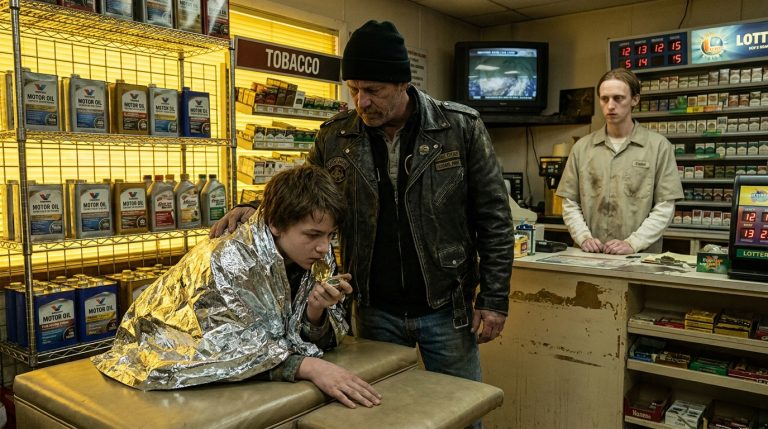
The Prairie Star Travel Mart reeked of burnt chicory coffee and diesel exhaust. Outside, forty miles west of Sundown Junction, the North Dakota wind drove snow flat across the gravel lot, rattling the aluminum frame of the ice ice-vending machine.
Atlas Monroe rolled the rough flint wheel of his brass Zippo lighter with his thumb. Click-clack. The flame flared once, reflecting off the salt-crusted toe of his engineer boot, before he snapped the casing shut with a heavy metallic thud. He wasn’t looking for trouble tonight. He just needed thirty gallons of mid-grade and a black coffee to keep his eyes open until Grand Forks.
Then the sound hit him.
Tap. Tap.
It wasn’t the wind. Wind didn’t hit plastic in sets of two.
Atlas rounded the rusted corner of the building, where the shadows pooled deep around a commercial dumpster. The temperature was dropping past eight below zero. A pile of discarded cardboard sat wedged against the steel base, stiffened with frost.
Underneath the cardboard, a small foot twitched.
Atlas dropped his duffel straight into the slush. He hit his knees, the cold biting through his denim in less than three seconds. He tossed the stiffened cardboard aside, revealing an eight-year-old boy curled into a tight, shivering ball. The kid wore mismatched sneakers—one missing a lace, the other gaping open at the toe—and a cotton hoodie soaked through at the elbows.
His lips were a dark, bruised purple.
“Hey, buddy,” Atlas said, keeping his voice dead-level despite the sudden spike of adrenaline in his chest. “Look at me. Can you hear me?”
The boy’s dark brown eyes cracked open, unfocused and glazed with ice. His jaw quivered, but his throat only produced a dry, clicking rasp.
Atlas didn’t waste time looking for a coat that wasn’t there. He reached down, slid one thick forearm beneath the boy’s shoulder blades and the other beneath his knees, and lifted. The child felt like a bundle of dry kindling—barely thirty-five pounds of hollow bone and damp cotton.
He kicked through the slush, hit the travel mart’s automatic door, and burst into the heat.
The bell overhead chimed three cheerful notes. Behind the counter, a young clerk in a slouchy beanie looked up from his phone, his face instantly draining of color as Atlas set the kid down on the vinyl booth near the space heater.
“Call 911,” Atlas said. He didn’t raise his voice, but the tone left zero room for discussion. “Tell them you have an eight-year-old boy with severe hypothermia.”
The clerk hesitated, his hand hovering two inches above the landline. His eyes darted nervously to the leather cut on Atlas’s chest, taking in the worn leather and faded territory patch. “I… I can’t just call emergency services. The manager said if transients—”
Atlas stepped up to the counter. The wood groaned under his weight as he leaned forward, resting both palms flat against the Formica.
“You can,” Atlas said, his voice dropping an octave into a low, terrifying rumble. “And you will. Right now.”
The clerk swallowed hard, snatched the receiver, and began punching numbers with a trembling index finger.
Atlas turned back to the booth. He stripped off his heavy leather riding jacket, wrapping it tightly around the boy’s shivering frame. The kid’s hand snaked out from beneath the leather, his pale fingers clutching desperately at a small, brass compass keychain hanging around his neck on a frayed cord.
“Don’t… don’t call him,” the boy whispered, the words barely making it past his cracked lips.
Atlas crouched beside the bench, his brass lighter resting quietly in his right palm. “Call who, kiddo?”
“My uncle,” the boy choked out, his eyes wide with pure, instinctual terror as he stared toward the dark glass of the front doors. “Caleb. If he comes… he’ll smile. And they’ll believe him.”
CHAPTER 2: THE HOSPITAL STANDOFF
The brass Zippo felt heavy and cold in Atlas’s right hand. Click-clack. The metallic snap echoed softly against the sterile linoleum.
The double doors slid open with a hiss.
A tall man in a tailored oilskin coat stepped through, wiping clean boots on the rubber mat. His hair was slicked back, untouched by the blizzard outside. He held a grease-spotted paper bag in one hand and a polished leather folder in the other, wearing the kind of wide, easy smile that was bought and paid for.
Caleb Ror.
“There he is!” Caleb’s voice boomed through the quiet corridor, warm and full of neighborly concern. He didn’t look like a monster. He looked like the president of the local Rotary Club. “Thank God. The deputy told me somebody picked up my boy.”
Mason’s tiny fingers dug into Atlas’s sleeve, his breath hitching into a silent, terrified gasp.
Atlas didn’t stand up immediately. He stayed low, keeping his body positioned squarely between the bed and the approaching man, his thumb tracing the worn strike wheel of his lighter.
“You must be the good Samaritan,” Caleb said, stopping three feet away. He didn’t look at Mason. He looked at Atlas’s leather cut, his eyes narrowing just a fraction before the wide smile snapped right back into place. “I appreciate you bringing him in out of the cold. Mason gets these episodes… severe night terrors, sleepwalking. He panics and runs. We’ve been out looking for hours.”
“He wasn’t sleepwalking,” Atlas said. He stood up slowly, all six-foot-two of him, letting his bulk fill the gap between Caleb and the boy. “He was wedged behind a dumpster at the Prairie Star. His core temp was ninety. Another ten minutes and his heart would’ve quit.”
Caleb sighed, a soft, exhausted sound meant to signal a long-suffering parent dealing with a troubled child. He reached into his coat pocket and pulled out a laminated card.
“I’m his legal guardian,” Caleb said, holding the paper out like a shield. “I have the county paperwork right here. I know how it looks, mister, but the boy is deeply disturbed. He makes up stories. Ask anyone in Sundown Junction.”
Dr. Priya Anand stepped out of the curtained bay, her clipboard tucked under her arm. Her eyes swept over Caleb’s dry coat and polished boots, then down to her own notes.
“Mr. Ror?” Dr. Anand’s voice was ice. “The child has ring bruises on both wrists and frostbite on three toes. He hasn’t had a proper meal in weeks.”
“He hides his food,” Caleb replied without missing a beat, his tone smooth as polished glass. “It’s part of his condition. The trauma from losing his parents… it broke something in him. We’ve been trying to get him help, but the county bureaucracy moves so slow.”
He stepped forward, reaching past Atlas toward Mason’s arm. “Come on, buddy. Let’s get you loaded into the truck. We’ll get you home.”
Atlas didn’t punch him. He didn’t grab him by the throat. He simply took one half-step sideways, planting his heavy engineer boot directly in Caleb’s path, and let his chest press against Caleb’s shoulder.
The movement was pure, immovable mass.
“Touch the kid,” Atlas murmured, “and we find out how fast hospital security gets here.”
Caleb froze. The practiced, friendly mask twitched. For a micro-second, the warmth drained entirely from his face, leaving behind something cold, sharp, and razor-thin.
“You’re making a massive mistake,” Caleb whispered, his voice dropping the public charm. “You don’t know who I am in this county. You’re a transient on a motorcycle. I’m his family.”
“You’re his landlord,” Atlas said.
Caleb turned his head, his jaw flexing tight as a uniformed deputy walked down the hall toward them, holding a clipboard. Caleb immediately smoothed his lapels, his face shifting back into a heartbroken, desperate smile before the officer even reached the door.
“Deputy,” Caleb called out, his voice cracking with emotion. “This man is refusing to let me see my nephew.”
CHAPTER 3: THE PAPERWORK TRAP
“What’s the situation here, Caleb?” Deputy Holt asked, tapping the edge of his clipboard against his hip. “Dispatch said you called in a runaway.”
“Because he is a runaway, Reena,” Caleb said, dropping his hands into his coat pockets with a heavy, practiced sigh. His voice carried the easy warmth of a man who played golf with the county commissioners. “You know how Mason’s been since the accident. He slips out the window, makes up wild stories, then gets scared when the cold hits. This gentleman here seems to think I’m running a prison.”
Atlas didn’t move an inch. He flicked the thumb wheel of his brass Zippo. Click-clack.
“He was wedged behind a dumpster at eight below zero,” Dr. Anand said, stepping past Atlas to hand Holt a tri-fold medical chart. “Core temp was ninety point two when he came through my doors. I’ve logged acute hypothermia, stage-one frostbite, and systemic malnutrition. If this child goes home tonight, he won’t survive till sunrise.”
Caleb’s eyes flashed, a tiny vein pulsing near his left temple before he forced a soft, grieving smile. “Dr. Anand, with all due respect, you’re looking at symptoms of a boy who refuses to eat his meals. We’ve had social services out twice. Both times, the files were closed.”
“Files get closed when people make quiet donations to school scoreboards,” Atlas said softly.
Caleb turned his head, his smile vanishing entirely. “Excuse me?”
Atlas pulled a cheap, plastic prepaid flip phone from his vest pocket. The screen was spider-webbed with cracks, wrapped in a rubber band to hold the casing together. Mason had slipped it into his hand right before the doctor moved him onto the gurney.
“The kid had this under his hoodie,” Atlas said, turning the cracked screen toward Deputy Holt. “He hit record before you locked him in the garage tonight, Caleb.”
Caleb made a sudden, aggressive step forward, his hand shooting out from his oilskin coat. “That’s my property! The boy stole that—”
Atlas didn’t swing. He simply shifted his weight forward, bringing his shoulder into Caleb’s chest with the momentum of an iron beam. Caleb hit the doorframe hard, his breath catching in his throat as his polished leather folder spilled onto the floor, scattering bank notices across the tile.
Deputy Holt put a hand flat against Caleb’s chest. “Back up, Caleb. Right now.”
“Listen to it, Deputy,” Atlas said, pressing the center button with his thumb.
The tiny speaker buzzed with static, followed by the muffled, hollow sound of a deadbolted door. Then Caleb’s voice came through—devoid of charm, flat and bone-chillingly calm.
“You can bang on the door all night, Mason. Nobody’s coming out to County Road 12. After the ball drops and court clears, the trust pays out. Until then, you sit in the dark.”
The hallway went dead silent. The only sound was the rhythmic beep of Mason’s heart monitor from inside the room.
Caleb stood frozen against the doorframe, his face drained of all color, his arrogant posture sagging just enough to expose the panic underneath.
“That’s… that’s edited,” Caleb stammered, his fingers twitching violently against his coat seam. “He spliced audio from old arguments. You can’t use a toy phone as evidence!”
Deputy Holt didn’t answer him. She pulled her radio off her shoulder strap, her eyes locked on the bank papers scattered across the floor—notices marked Overdraft Warning – Mason Reed Guardianship Account.
“Dispatch,” Holt said into her lapel mic, her voice clipping tight. “Get me Sheriff Keenan and the on-call family services director. I need an emergency protective hold served at St. Bridget Medical Center immediately.”
CHAPTER 4: THE GARAGE RAID
The wind cut across the open yard like a razor. Sheriff Keenan led the way up the wooden porch steps, the signed search warrant clamped firmly in his gloved fist. Atlas followed two paces behind, his thumbs hooked under the straps of his vest, his brass Zippo riding heavy in his palm.
Deputy Holt stepped up with a bolt cutter.
“We have a warrant for the premises,” Keenan announced, his voice flat and unyielding as Caleb opened the main door wearing a plush bathrobe, holding a mug of steaming coffee. “Step aside, Caleb.”
“This is an outrage, Lyle,” Caleb said, his jaw flexing tight as he tried to block the doorway with his frame. “I’m a respected business owner in this town. You bring a biker onto my private property based on the word of a hysterical kid?”
“The kid’s in the ER with frostbite,” Keenan said, pushing past Caleb’s shoulder into the entry hall. “Where’s the boy’s room?”
Caleb didn’t answer. He just stood in the center of the kitchen, his chest heaving under his robe, his eyes tracking Atlas like a cornered animal.
Atlas bypassed the main hallway entirely. He walked straight to the heavy steel door leading off the utility pantry—the one with a deadbolt mounted three inches above the standard handle.
He threw the heavy brass latch back. The hinges groaned as the door swung open into the unheated garage.
The air inside smelled of cold oil, concrete dust, and wet mildew. In the back corner, tucked between a rusty lawnmower and an unvented laundry hookup, sat a narrow wooden cot. The blanket was a single, threadbare sheet stiffened with grime. A plastic bucket with a lid rested beside the frame.
Atlas stepped closer, his heavy boots echoing on the slab. On the wall above the cot, a small storm window had been framed over with two-by-fours, nailed directly into the studs to keep the sash from opening even an inch.
“He sleeps out here,” Atlas said, his voice deadly quiet.
Sheriff Keenan stepped up behind him, taking in the padlocked refrigerator in the corner and the heavy chain wrapped around the pantry cabinets. Keenan’s jaw set hard. He turned to Deputy Holt. “Document every inch of this. Get the serial numbers off those locks.”
“He sneaks food!” Caleb shouted from the kitchen doorway, his voice cracking into a high, defensive pitch. “He steals! You don’t know what it’s like trying to discipline a boy who’s rotten to the core!”
Atlas walked past Caleb into the master bedroom. He didn’t ask permission. He scanned the mahogany desk in the corner until his eyes locked onto a heavy desk calendar sitting beside an open manila folder.
A thick red marker had been used to circle one specific date three times: January 3rd.
Written across the box in Caleb’s sharp, slanted cursive were four words: After court, funds clean.
Beside the calendar lay bank statements for the Mason Reed Irrevocable Trust. The ledger showed a starting balance of three hundred and ten thousand dollars sixteen months ago. The current balance read four hundred and twelve dollars and sixteen cents.
“Sheriff,” Atlas called out without turning around. “You’ll want to see this.”
Caleb lunged into the doorway, his face purple, all pretense of civic charm completely shattered. “Get your filthy hands off my private files!”
Atlas turned slowly, holding the bank statement between two fingers, his lighter resting quietly in his other hand.
“You weren’t waiting for him to grow up, Caleb,” Atlas said, his eyes locking onto the man’s trembling frame. “You were waiting for the temperature to finish what you started.”
CHAPTER 5: THE SYSTEMIC BREAKDOWN
Caleb’s chest hitched violently beneath his plush bathrobe. “You think you’re clever, don’t you?” he hissed, his face slick with sweat despite the draft coming off the garage. “You think some dirty paper trail proves a crime? I spent that money on his care! Food, clothing, medical bills!”
“You spent twenty-eight thousand dollars at a casino in Fargo,” Sheriff Keenan said, snatching the folder from the desk. He flicked through the receipts, his eyes darkening. “And fifty thousand on a lake cabin deposit. All drawn directly from the boy’s trust.”
“I took a management fee!” Caleb barked, his voice rising into an unhinged, defensive screech. “I took in an orphan nobody wanted! The school board approved my guardianship! The county welfare supervisor signed off on every single check!”
Atlas flicked his brass Zippo open. Click-clack. He held the flame low, illuminating a secondary manila file sitting tucked beneath the laptop keyboard.
“They signed off because you paid for a scoreboard,” Atlas said, pulling the second folder into the light. “And because the family services director didn’t want to dig into how your last foster kid died.”
Sheriff Keenan froze. “What did you say?”
Atlas tossed the folder onto the desk. The label read Markham, Tyler – Archived Case 2023. A death certificate sat right on top—accidental exposure during a winter storm, signed by a local medical examiner without an autopsy. Attached to the back was a life insurance payout for fifty thousand dollars.
Beneficiary: Caleb Ror.
“He’s done this before,” Atlas said softly. “The system didn’t fail Mason by accident, Sheriff. It failed him because Caleb found the price of every administrator in Sundown Junction.”
Outside, a county sedan pulled up behind Keenan’s cruiser. Lorie Feldman, the third-grade teacher from Maple Ridge, stepped out into the biting wind alongside a tired-looking social worker. Mrs. Feldman’s hands trembled as she clutched a stack of attendance reports to her coat.
“I filed three reports,” Mrs. Feldman said, her voice cracking as she stood in the open doorway, refusing to meet Caleb’s eyes. “Three separate reports about the bruises on Mason’s wrists. The principal told me to drop it. He said Caleb was a major donor and a pillar of the community.”
“You traitorous little bitch,” Caleb snarled, taking a furious step toward her.
Atlas moved before Caleb could take a second stride. He planted his forearm across Caleb’s collarbone, pinning the man against the doorframe with raw, unyielding mechanical leverage. Caleb gasped, his feet kicking uselessly against the baseboard as his breath caught in his throat.
“Keep your voice down,” Atlas murmured into Caleb’s ear. “The county’s done protecting you.”
Deputy Holt pulled Caleb’s wrists behind his back, the steel handcuffs clicking tight with two hard, definitive notches.
“Caleb Ror,” Sheriff Keenan declared, reading from his field card as he pulled the laptop and files into evidence bags. “You are under arrest for felony child neglect, grand larceny, and corporate fraud. Additional charges regarding the Markham file are pending state review.”
Caleb didn’t weep or ask for mercy. He spit on the floorboards, glaring at Atlas through bloodshot eyes. “This town runs on my money! You think a judge in Grand Forks is going to listen to an itinerant biker over me? My lawyer will have me out by lunch!”
“Your lawyer won’t find any money left for retainer,” Atlas said, tapping the empty bank statement against Caleb’s chest before handing it to Holt. “Because as of five minutes ago, the state froze every asset attached to your name.”
CHAPTER 6: THE FINAL RECKONING
Caleb thrashed against the reinforced glass, screaming through the window until the deputy engaged the child locks and pulled away down County Road 12.
Inside the Grand Forks County Courthouse, the fluorescent lights hummed above the mahogany defense table. Caleb sat in a orange jumpsuit, his slicked hair replaced by hollow, grey stubble. His high-priced defense attorney tried three separate technical motions—challenging the audio recording from the flip phone, claiming illegal search, and accusing Atlas of unlawful coercion.
Judge Oaks didn’t even look up from her bench.
“The recording was logged with unbroken chain of custody by hospital security,” Judge Oaks stated, her gavel resting flat in her palm. “The search warrant was signed based on physical medical evidence of hypothermia and starvation. The financial records speak for themselves.”
When the jury returned after less than eighty minutes of deliberation, the foreperson didn’t hesitate.
“Guilty on all counts,” she read aloud. “Felony child neglect, unlawful imprisonment, grand larceny, and fiduciary fraud.”
Judge Oaks lowered her glasses, looking directly at Caleb’s trembling frame. “Seventeen years in state prison. No parole eligibility for ten years. Full restitution ordered to the Mason Reed Trust, and a permanent, standing order of protection.”
Caleb’s mouth worked silently, his unearned entitlement completely stripped away as two bailiffs took his elbows and led him through the holding door.
Atlas stood in the rear of the gallery, his brass Zippo resting quietly in his palm. Beside him, Samantha Reed Calder—Mason’s maternal aunt—held a blue folder containing the final kinship placement order.
In the hospital courtyard two days later, the afternoon sun reflected off the snowbank near the entrance. Mason sat on a bench wrapped in a heavy navy winter coat, his hands tucked inside thick wool gloves. Around his neck, the small brass compass hung from a new leather strap. The needle no longer stuck; it swung clean and true toward north.
Atlas walked over and sat down on the cold wooden slate beside him.
“He’s not coming back, kiddo,” Atlas said softly. “The paper’s signed. The locks are off.”
Mason looked down at the brass compass, his thumb tracing the crude J + L initials carved into the back. He didn’t cry. He just let out one long, quiet breath that misted in the crisp prairie air before vanishing into the clear sky.
“Thank you,” Mason whispered, looking up with dark, clear eyes. “For stopping.”
Atlas pulled his lighter out, flicked the flint wheel once—click-clack—and snapped it shut. “Somebody had to.”