The Iron Skin of the Desert Warhorse Where Every Rivet Carried the Weight of a Vow
CHAPTER 1: THE WEIGHT OF BRASS
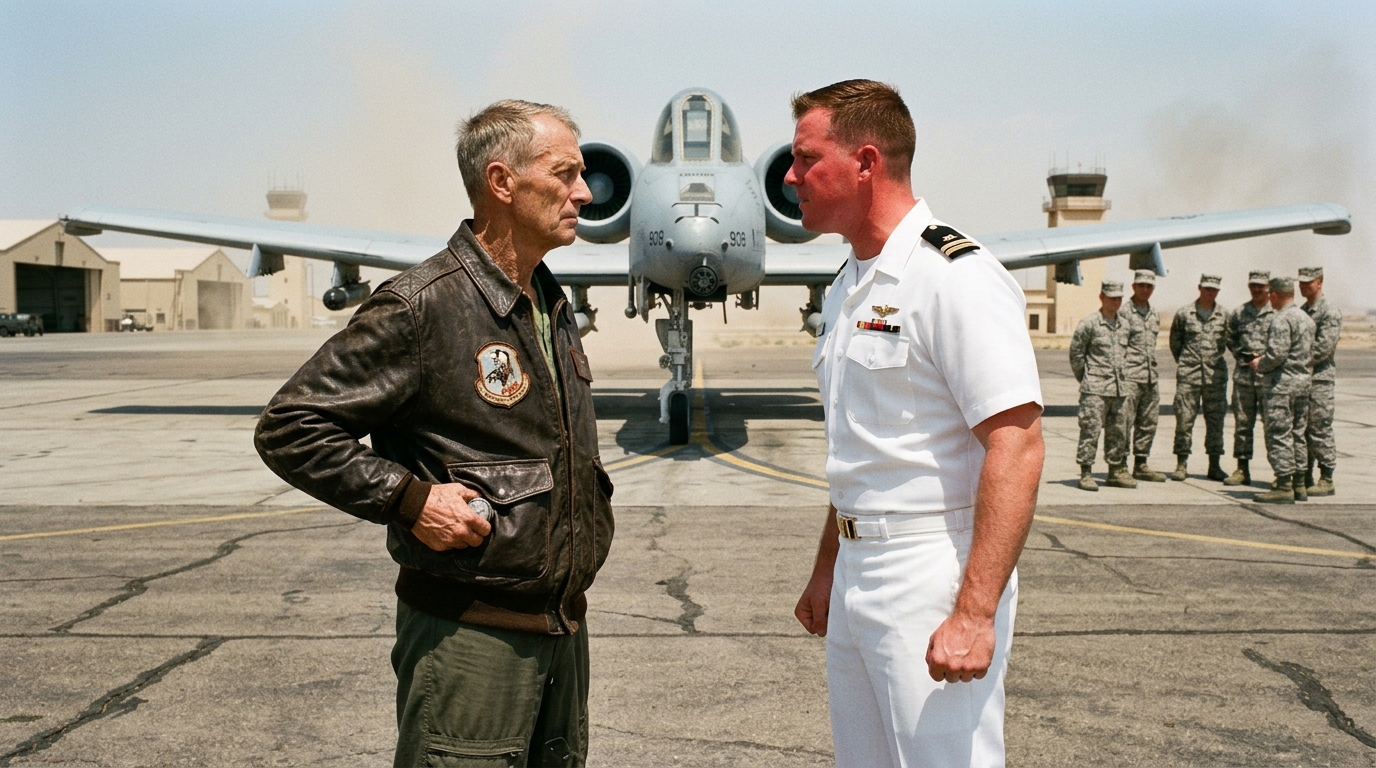
The sun beat down on the cracked asphalt of the flight line, turning the air into a shimmering wall of distorted light. Roger Bentley kept his right hand resting flat against the cool rubber of the A-10’s front landing gear tire. He didn’t blink against the glare. The leather of his jacket was stiff, smelling faintly of old sweat and machine oil, completely out of place amid the gleaming, starch-ironed perfection of the young flight line officers milling about for the base family day.
“Go on then. Start her up.” Captain Davis stepped closer, his boots clicking with crisp, deliberate authority against the pavement. He gestured toward the squat, pugnacious nose of the aircraft with a flick of his wrist. “Show us how it’s done. Old-timer.”
Roger didn’t turn his head. He watched the way the sunlight hit the rivets along the lower fuselage, catching the micro-fractures in the gray paint just beneath the cockpit bubble. His thumb brushed against the cold metal casing of the silver pocket watch hidden deep inside his breast pocket, clicking the clasp open and shut once in the heavy silence.
“You were telling my guys here all about the good old days,” Davis continued, his voice rising just enough to capture the attention of the small, uncomfortable circle of junior airmen drifting behind him. He flashed a practiced, teeth-baring smirk. “Surely you remember how to flip a few switches. Or is all that newfangled glass a bit too much for your generation?”
A junior airman near the back shifted his weight, staring down at the cracked concrete between his boots. The humidity was thick enough to taste, tasting of jet exhaust and parched dust, but the silence holding the group together was heavier. No one moved. No one corrected the captain.
Roger let out a slow, measured breath through his nose. He didn’t feel anger; he felt the familiar, dull ache in his lower back that always flared up when the barometric pressure dropped before a desert storm. To Davis, the aircraft was a museum piece, a prop for an afternoon photo op, and Roger was nothing more than an aging nuisance cluttering up a sterile military photo-op.
“The auxiliary power unit requires a ground check before any ignition sequence,” Roger said, his voice raspy and low, cutting through the hum of distant generators. “Hydraulic pressure needs to stay stable at three thousand pounds. You don’t just turn a key.”
Davis laughed, a sharp, dismissive bark that bounced off the thick aluminum wing above them. “Oh, we’ve got a technical expert. Look, sir, this is a restricted area. That bird is a static display. Step away from the asset.”
CHAPTER 2: THE COLD TARMAC
Captain Davis didn’t back down. He closed the remaining inches between them, his chest puffed out like a bantam rooster trying to dominate a seasoned hound. The smell of expensive cologne mixed sharply with the acrid stench of JP-8 jet fuel burning off in the distance.
“I asked you for a pass, old man,” Davis muttered, his voice dropping an octave to sound more menacing for the junior airmen watching behind him. “Not a lecture on fluid dynamics.”
Roger didn’t blink. He kept his weight balanced evenly on his heels, feeling the radiating heat of the concrete through the thick soles of his boots. His thumb paused its rhythm against the silver metal of the watch.
“You’re standing on live ground without a clue what holds this bird together,” Roger said, his voice flat, gravel-rough, and utterly unbothered by the rank pinned to the younger man’s shoulders.
A faint, heat-warped scorch mark on the starboard engine cowl caught Roger’s eye—a stubborn reminder of a long-ago morning when paint wouldn’t stick to metal that had cooked in a desert fire. Davis tracked Roger’s gaze, noticed the smudge of carbon, and let out a nervous, sharp breath through his teeth.
“That’s just deferred maintenance from the depot team,” Davis snapped, though a flicker of uncertainty crossed his polished features. He glanced back at the airmen to reclaim his audience. “We’ve got protocols here. This isn’t a museum for veterans to wander off the street and play pilot.”
“Protocols,” Roger repeated the word like a bad taste on his tongue. He let his hand drop entirely from the landing gear tire, the sudden loss of contact leaving a cool imprint on his palm.
The silence stretching between them wasn’t empty; it hummed with the collective anxiety of the young airmen who could smell a career-ending mistake unfolding in real-time. Senior Airman Garcia, standing near the edge of the crowd, shifted his weight and stared hard at the faded scorpion patch on Roger’s chest.
“You’re testing a machine you don’t respect, Captain,” Roger said quietly, stepping half an inch closer.
Davis stiffened, his fingers twitching instinctively toward his belt line where a sidearm holster sat empty for the static display detail. His face flushed a dark, angry crimson under the relentless noon sun.
“That’s it,” Davis barked, his voice cracking slightly with sudden panic. “You’re done playing games. I want security forces down here right now.”
CHAPTER 3: THE FRACTURED LINE
The two junior airmen flanking Davis didn’t move an inch toward the security perimeter. Senior Airman Garcia stepped half a pace out from the cluster of onlookers, his boots scraping dryly against the sun-baked asphalt.
“Captain,” Garcia started, his voice tightening with a sudden, sharp edge of warning. “That’s tail number 618. Look at the nose art under the canopy.”
Davis didn’t turn his head, keeping his eyes locked onto Roger with furious, unblinking intensity. “I don’t care if it’s painted with gold leaf, airman. Execute the order.”
“You might want to check who you’re talking to first, sir,” Garcia pressed forward, refusing to step back despite the rank disparity. “That bird has historical registry on this base. The man standing next to it isn’t a civilian wandering off the highway.”
Roger watched the subtle bead of sweat carve a clean path through the dust on Davis’s temple. The young officer’s jaw twitched, a tight spasm of professional panic colliding with bloated pride.
“I said security forces,” Davis shouted, his voice cracking slightly under the strain of being openly challenged in front of his subordinates. “Are you refusing a direct order, Garcia?”
The air heavy between them smelled of scorched rubber and ozone. Roger’s fingers curled inside his pocket, gripping the cold edge of his silver watch without clicking it open again.
“You’re making a very loud noise over a machine you only know how to wash,” Roger said quietly, his gravelly voice cutting through the captain’s shouting like a file on raw iron.
Davis spun back toward Roger, his face darkening to a bruised shade of red. “You keep your mouth shut, old man—you’re about three seconds away from spending the afternoon in a holding cell.”
CHAPTER 4: THE COMMAND APPROACH
The screen of Garcia’s phone flared blue against the harsh desert glare as his thumb punched digits into the glass. He didn’t look at Captain Davis, whose attention remained fixed on the old man like a hound tracking a cornered rabbit.
“You’re making a massive mistake, Captain,” Garcia muttered under his breath, stepping further into the shadow of the wingtip.
Davis flicked a hand dismissively without turning around. “Report to administrative punishment by sundown, airman—you’re done talking.”
Roger didn’t shift his stance. He let his gaze drift across the cracked asphalt toward the distant administrative blocks shimmering in the heat haze. He could hear the faint, low rumble of a heavy engine cutting through the lazy hum of the base generators.
“You think a uniform gives you weight,” Roger said, his voice a gravel-scraping rasp that refused to be drowned out by the rising tension. “It doesn’t. It just shows everyone else what you’re failing to carry.”
Davis stepped forward again, his fingers twitching toward his empty holster in sheer frustration. “One more word and I’ll have you physically dragged off this tarmac in handcuffs.”
The heavy drone of an approaching heavy vehicle rolled across the flight line, vibrating right through the soles of their boots. The tires crunched hard against the loose gravel near the edge of the secure zone, kicking up a dirty gray plume of dust.