Greased Hands And Tarnished Stethoscope: How An Old Sailor Brought A Billion-Dollar Warship Back To Life
CHAPTER 1: DEAD IRON IN THE PACIFIC
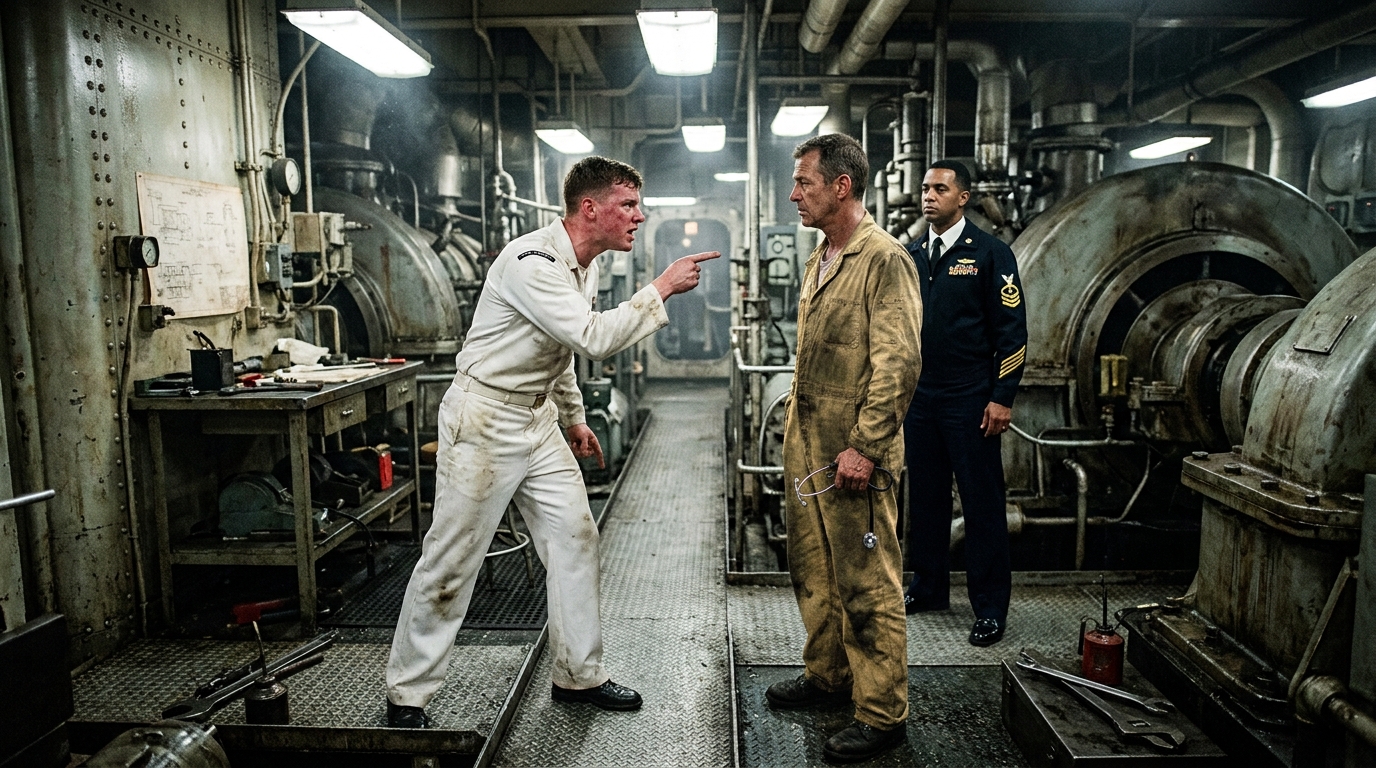
Lieutenant Commander Thorne jammed his boot heel against the metal grating. His pristine white uniform showed dark maps of sweat under the armpits.
The bank of monitors before him glowed with cold, useless green zeros. For forty-eight hours, the USS Vigilance had drifted like a ghost ship in the empty expanse of the Pacific.
He swung around, his jaw rigid, pointing a finger at the man standing by the main turbine. The intruder wore grease-stained dark blue overalls and smelled of old oil.
“I asked you a question,” Thorne snapped, his voice bouncing off the steel bulkheads. “Who the hell are you and what are you doing in my engine room?”
Jim Vance didn’t blink. He kept his calloused hands shoved deep into his pockets, staring straight past the frantic officer at the massive, lifeless machine.
Rear Admiral Pike stepped heavily through the hatchway, his uniform sharp but his eyes hollow with exhaustion. “He’s with me, Commander.”
Thorne straightened, his frustration twisting into sharp resentment. “Sir, this is a restricted area handling nuclear-powered systems. We have top-tier engineering teams. We don’t have time for local visitors.”
Pike’s gaze locked onto the younger officer with freezing precision. “The best teams in the fleet had two days, and the ship is still a barge. Master Chief Vance is here because I ordered him here.”
Thorne tasted ash on his tongue at the title. “An enlisted man? Sir, his records are ancient. He doesn’t know integrated digital control systems.”
“And yet,” Pike said softly, stepping closer, “your digital systems are dead.”
Jim finally moved his weight from one foot to the other. He reached out, his cracked fingernails brushing a thick steel conduit with the tentative touch of a blind man reading print.
CHAPTER 2: THE STETHOSCOPE AND THE NOISE
Jim held his breath, letting the low, discordant chatter of the turbine travel straight up through the cracked rubber tubing.
The silence around him was thick with the skepticism of a dozen young engineers who thought a computer screen was the voice of God.
Lieutenant Commander Thorne crossed his arms, his face hardening as he watched the old man play with scrap-heap medicine.
“If you’re quite finished with your parlor tricks,” Thorne muttered, stepping forward with his boots grinding sharply against the steel deck, “some of us have actual diagnostics to run.”
Jim didn’t look up from the auxiliary valve assembly tucked behind the main coolant line.
“Your screens are blind, Commander,” Jim said, his voice level and dry as sandpaper. “The brain’s looking at the gauges, but the blood’s pooling on the floor.”
Petty Officer Chen shifted her weight beside the primary console, her eyes darting from the old man’s weathered hands to the dead readouts overhead.
She reached down, her fingers grazing the auxiliary housing just as Jim lifted the bell away from the metal.
“Feel that?” Jim asked, handing the cold brass instrument straight into her palm.
Chen took it, pressing the metal against the valve housing while the heavy hum of the emergency diesel generator thrummed through the soles of her boots.
A tiny, frantic fluttering beat against her eardrums—a sharp, high-frequency stutter hidden completely beneath the smooth electronic drone of the automated logs.
“It’s skipping,” Chen whispered, her breath catching as the realization hit her ribs. “The valve isn’t seating.”
CHAPTER 3: RANK AND RUIN
“I’ve heard enough of this amateur hour,” Thorne shouted, his boots ringing hard against the iron floor as he thrust himself between the old mechanic and the primary console.
He locked his gaze onto Admiral Pike, his chest heaving with an arrogant fury that refused to see the trap closing around him.
“I am ordering this civilian removed from my department right now, or I will log every officer here for insubordination.”
Pike did not flinch, his eyes remaining as cold and unyielding as the bulkheads surrounding them.
“You are welcome to try, Commander,” Pike replied, his voice dropping into a dangerous, quiet register that cut through the engine room noise.
“I am the chief engineering officer of this vessel,” Thorne spat back, his face flushing a deep, mottled red as he signaled the two security guards standing near the hatch.
“Escort this man to the brig immediately.”
The two armed guards took half a step forward, their boots scuffing the steel, but they froze instantly as the overhead comms speaker hissed to life.
“This is Fleet Admiral Thorne,” the iron-clad voice boomed down from Coronado, echoing off every pipe and valve in the compartment. “Who is in command in that engine room?”
Thorne stiffened, his jaw going slack as all the color drained straight out of his face in a single heartbeat.
“Admiral Pike here, sir,” the rear admiral spoke up smoothly into the local pickup.
“Report,” the fleet admiral’s voice rasped across the line like cold sandpaper. “Why is Master Chief Vance being threatened with arrest?”
CHAPTER 4: THE HARMONIC FAULT
“You were not aware, Commander,” the fleet admiral’s voice crackled through the compartments, sharp as a drawn blade. “You let your pride and your faith in digital readouts blind you.”
Thorne’s knees gave a slight, involuntary twitch, his uniform collar suddenly feeling two sizes too tight against his throat.
“You are hereby relieved of your duties,” the speaker finished, the flat click of disconnection ringing like a falling guillotine.
Silence rushed back into the engine room, heavier and colder than before.
Jim Vance didn’t look at the disgraced officer stumbling back toward the hatchway.
Instead, he turned his calloused hands back to the steel manifold, gesturing quietly for Petty Officer Chen to step closer to the primary control board.
“Look at your bypass circuit,” Jim said, his fingers tapping firmly against the cold metal casing. “The automation thinks it’s sealing because the light is green.”
Chen swallowed hard, her palms slick against the edge of the console as she brought up the manual override diagnostics.
“It’s a shadow loop,” she murmured, her eyes tracking the tiny, irregular electrical draw that the main system diagnostics had filtered out as background noise. “The valve actuator registers closed, but the pressure differential keeps creeping.”
“Because the seating flange warped under thermal load three cycles ago,” Jim replied, pulling his weathered machinist stethoscope from his pocket. “The computer can’t feel heat fatigue. It only reads ones and zeros.”
CHAPTER 5: IRON AND BRUTE FORCE
“Put your weight into the handle,” Jim Vance said, his voice flat and steady against the roar of the emergency generator.
The two young engineers strained, their muscles locking up as the rusted seating of the auxiliary valve resisted every ounce of leverage.
“It’s seized solid,” one of them wheezed, sweat stinging his eyes as the heavy metal tool slipped a fraction of an inch against the bolt.
“It’s not seized,” Jim replied, stepping closer to guide their hands with a firm, calloused grip. “It’s choked on its own pressure. Ease off an eighth, then drive it home.”
Chen kept her ear pressed to the brass bell, tracking the high-frequency vibration as the metal groaned beneath the wrench.
The irregular stutter in the audio feed suddenly dropped into a deep, rhythmic thrum.
“The bypass pressure is leveling off,” Chen whispered, her eyes fixed on the manual gauge as the needle twitched out of the red zone.
“Now,” Jim commanded.
The engineers heaved together, the heavy wrench biting hard into the fitting as it turned a precise quarter-turn.
A sharp hiss of trapped steam echoed through the conduit, followed immediately by a heavy, satisfying mechanical click that shook the entire deck plate.
CHAPTER 6: THE ROSE AND THE QUIET
The turbine thrummed through the soles of everyone’s boots, a steady, living rhythm that filled the cavernous engine room with absolute authority.
On the main control panel, the digital displays flipped from stubborn amber straight to solid, glowing green.
The two-star admiral stepped through the hatchway flanked by a marine honor guard, coming to a halt directly before the old master chief.
He raised his hand in a sharp, immaculate salute, his voice booming over the sound of the revived machinery.
“Master Chief Vance, on behalf of the United States Navy, I am here to recognize your service,” the admiral stated, reading the citation for the Kensington reactor defense and the ongoing Vance Protocol.
Jim simply nodded, his calloused hands resting easily inside his pockets as he looked past the formal uniforms toward the humbled faces of the junior engineers.
“The machine just needed someone to listen to it,” Jim said quietly, his eyes lingering on Chen as she blinked back tears of profound realization.
A week later, down a quiet residential street in San Diego, former Lieutenant Commander Thorne stood outside a white picket fence, his hands trembling slightly as he stared at the garden inside.
Jim looked up from pruning a white rose bush, his expression entirely free of bitterness or malice.
“Master Chief,” Thorne stammered, the words catching dry in his throat. “I wanted to apologize. I was arrogant. I was wrong.”
Jim reached out, clipping a single, perfect white rose from the stem and holding it out over the wooden slats.
“The most complicated machines are still just a collection of simple parts,” Jim said softly, his voice calm and steady. “You just have to find the one that’s out of tune.”
Thorne reached across the fence and took the flower, the weight of its simple beauty sinking deep into his chest as he finally understood the true cost of pride.