The Faded Ink of Coronado: How an Unassuming Old Veteran Taught Unyielding Arrogance a Lesson in True Valor
CHAPTER 1: THE MORNING ROUTINE
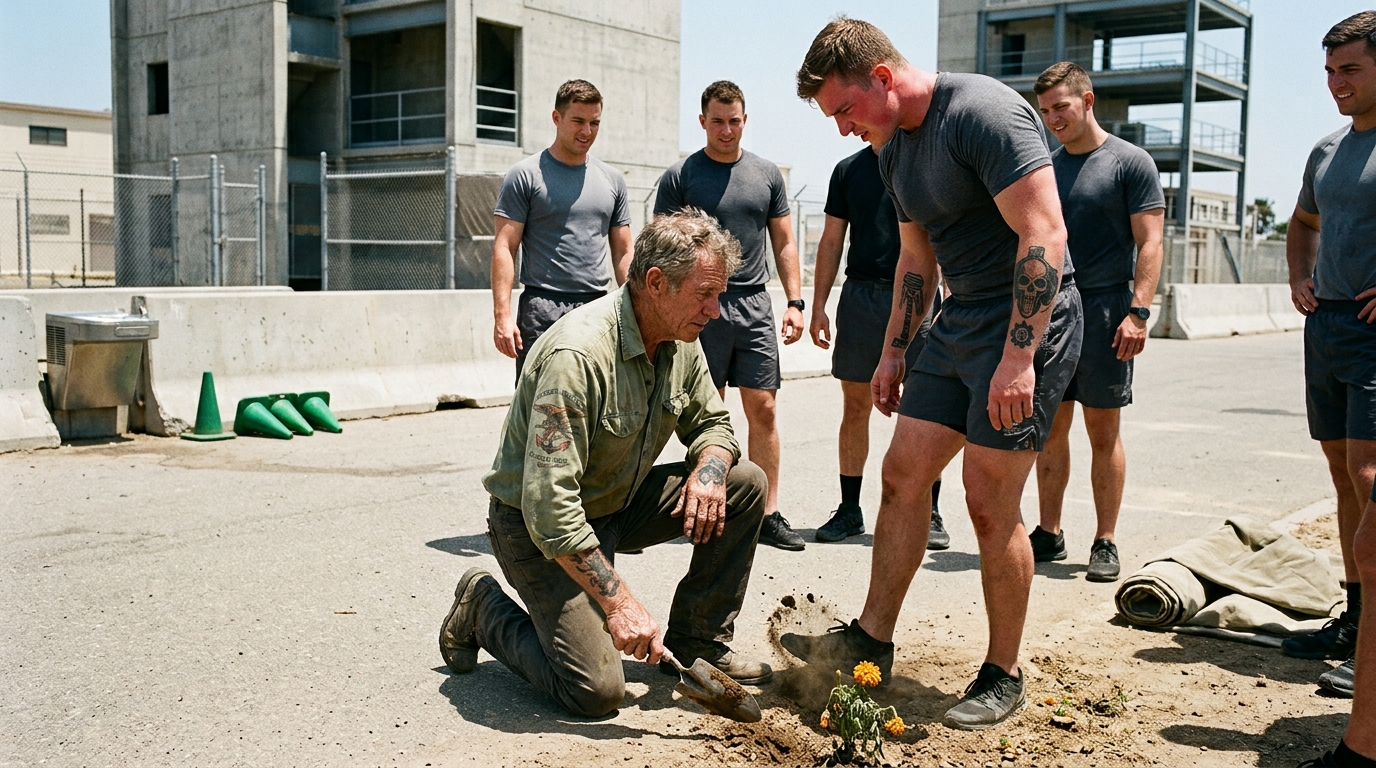
The soil of the Coronado flower bed was stubborn and dry beneath the midday California glare. Frank Nelson knelt in his faded work shirt, his gnarled hands gently patting earth around a fresh cluster of marigolds.
He didn’t look up when the sharp voice sliced through the placid air.
“You call that ink? I’ve seen better art on bathroom walls, Grandpa.”
The young man standing above him was built like a monument to physical perfection, sporting a fresh buzzcut and the unmistakable swagger of a SEAL candidate. His friends hovered close behind, their shadows cutting off the warmth of the sun.
Frank kept his breathing even. He reached down, picking up a small hand tool with slow, deliberate precision.
The taunts grew louder, bouncing off his silence like pebbles thrown against a stone wall.
“Is that a tadpole with a fork, pops?” the recruit demanded, stepping closer and leaning in. “What’s that supposed to be? Stamping boxes while the real men were out fighting?”
Frank finally raised his head. His pale, watery blue eyes met the young man’s gaze without a shred of anger or fear.
CHAPTER 2: UNPROVOKED INSULTS
The ring of young SEAL candidates tightened around the flower bed. Peterson leaned down further, his breath smelling faintly of coffee and youthful invincibility.
“Come on, Gramps,” Peterson scoffed, his voice carrying across the asphalt. “Is that a joke you bought at a surplus store, or did you just scratch that little doodle on your arm yourself?”
Frank did not flinch. He adjusted his grip on the thermos, feeling the faint chill of the liquid inside against his palm.
The other recruits joined in, laughing sharply as they cast long shadows over the marigolds. One of them pointed a thick finger directly at the faded ink on Frank’s forearm.
“Look at that thing,” the second recruit sneered. “A tadpole with a fork. What division were you in, the galley? Stamping shipping manifests while the real operators were out on missions?”
Frank kept his gaze steady and level. He knew the noisy bluster of a man who had never faced real silence.
“It’s just a mark, son,” Frank said, his voice a low, gravelly rasp that barely carried over the base wind.
Instead of backing down, Peterson took the quiet reply as an invitation to push harder. He reached out with a heavy hand, his thick fingers jabbing aggressively toward Frank’s shoulder to force an upward reaction.
“Don’t give me that old-timer routine,” Peterson snapped, his face flushing with irritation at the lack of submission. “This base is for men who actually earned their place. You don’t belong out here playing in the dirt.”
CHAPTER 3: THE WEIGHT OF MEMORY
The California sun vanished behind a sudden, suffocating wall of monsoon rain. The smell of sulfurous mangrove mud filled Frank’s lungs, thick and heavy like a wet blanket in the dark.
He felt the rough vibration of a riverboat engine thrumming through the floorboards beneath him.
“Keep your head down, Frankie,” a ghost from decades past muttered in the downpour.
Underneath a tattered poncho, three young men sat huddled together in the deep shadows of a forgotten riverbank. They weren’t marking themselves for glory or applause. They were carving a secret pact into their own skin using a needle sterilized in whiskey and soot from a rifle cleaning kit.
The sting of the needle was sharp, rhythmic, and absolute.
A crude frog holding a trident took shape on skin that had since withered into wrinkles and sun-spots. It was a promise made in blood and mud to bring every last man home when the world pretended they didn’t exist.
The sensory cascade shattered just as quickly as it had struck.
The tropical rain evaporated back into the blistering Coronado afternoon. Peterson’s hand was still clamped tight around Frank’s arm, shaking him slightly to demand an answer.
“I’m talking to you, old man,” Peterson sneered, his face close and flushed with unearned power. “What’s in the bag? You hiding stolen property?”
Frank blinked against the sudden glare, his gaze locking onto the young candidate’s sweating forehead.
CHAPTER 4: ESCALATION OF PRIDE
The crowd around the flower bed murmured, shifting from casual amusement to quiet discomfort.
Peterson held the thermos aloft like a trophy, his chest puffed out with the unearned validation of an audience.
“What’s in here, Grandpa? Prune juice?” Peterson sneered, shaking the container to hear the muffled slosh of liquid inside.
Frank did not lunge, and he did not call out for help. Without base command to lean on, the defense of his boundaries rested entirely on his own two hands and the immovable weight of his patience.
“Put that down, son,” Frank said, his voice dropping an octave into a cold, level register.
The warning was clear, but arrogance is deaf to quiet counsel. Peterson chuckled, mistaking the old man’s steady posture for hesitation.
“Make me,” Peterson challenged, taking another step forward and reaching down to grab Frank by the thin fabric of his sleeve, attempting to drag him upright.
The fingers dug hard into Frank’s bicep, crossing a line from verbal harassment into direct physical assault.
Frank’s breathing slowed to a measured rhythm. His fingers brushed the cool dirt of the marigold bed, calculating the precise angle of leverage required to stand without yielding an inch of dignity.
CHAPTER 5: THE QUIET LINE
Frank did not pull away. He let the young man’s fingers sink into his sleeve, anchoring himself to the earth with the heavy, unyielding patience of a stone breakwater.
“You’re making a mistake, son,” Frank said, his voice level and dry as dust.
Peterson scoffed, his face tightening with frustration at the complete lack of panic. He hauled upward, trying to force an 84-year-old man onto his feet for the amusement of the crowd.
“Get up, old man,” Peterson snapped, his voice cracking slightly under the strain of his own mounting anxiety. “You don’t get to sit here and ignore us.”
Frank allowed himself to be brought to his feet, his joints popping with audible stiffness. But as he stood upright, his pale blue eyes locked onto Peterson’s with a cold, terrifying clarity.
There was no anger in that gaze, only the crushing weight of a man who had looked down much longer barrels than the ones these boys were playing with.
Peterson’s thumb pressed hard against the faded tattoo on Frank’s forearm, trying to rub away the ink like dirt.
“It’s just a fake,” Peterson muttered, more to himself than to the crowd, sweating profusely under the piercing stillness of the old veteran’s stare.
“Is it?” Frank asked softly.
The question hung in the hot air like an anchor dropped from a great height, breaking the young candidate’s composure from the inside out.
CHAPTER 6: HARDEARNED UNDERSTANDING
Weeks later, the Coronado sun beat down with the same unrelenting glare upon the barracks quad.
Peterson stood near the edge of the flower beds, his shoulders slumped under a heavy work detail. His skin was caked in dirt, his boots scuffed, and the arrogant smirk that had once defined him was entirely gone.
He waited at a respectful distance until Frank Nelson paused with his hand tools.
“Mr. Nelson,” Peterson said, his voice raw and quiet in the warm afternoon air.
Frank looked up, his watery blue eyes meeting the young man’s tired gaze.
“I wanted to say I’m sorry,” Peterson murmured, looking down at his own calloused hands. “For the disrespect. For everything.”
Frank held the silence for a long moment, letting the heavy weight of the lesson settle into the earth between them.
He reached into his cooler, pulled out a cold bottle of water, and held it forward.
“I know, son,” Frank said, his voice a steady, gravelly hum. “A lesson learned matters more than the mistake made.”
Peterson took the water, his fingers brushing the old veteran’s hand in a silent, unbreakable bond of mutual understanding.
Frank turned back to the marigolds, kneeling down to tend the soil as the distant sound of training echoed across the base.