The Geometry of Retribution: How a Former Recon Surveyor Dismantled a Suburban Tyrant’s Empire of Paper
CHAPTER 1: THE RECONNAISSANCE OF SILENCE
The cheap pastel polo shirt strained against the humidity, the embroidered Lake View Estates logo distorting under the sheer force of its wearer’s self-importance. Karen Miller held her clipboard like a scepter, her face carved from the rigid mold of suburban entitlement.
“Not anymore,” she chirped, tapping the paper with a manicured nail.
A cold, familiar stillness settled through my veins. The ambient noise of the afternoon—the rustle of tall pines, the distant hum of traffic—receded into a vacuum. It was the same physiological drop in temperature I had learned to cultivate in dust-choked observation posts across three continents. When the perimeter is breached, you do not panic. You assess the terrain, identify the vector, and calculate the cost of neutralizing the threat.
I let the silence stretch, watching the superficial confidence on her face curdle at the edges.
“I’m sorry,” I said, my voice dropping an octave into a register that required no volume to command attention. “You have ten seconds to get off my property before I call the county sheriff.”
Her face flushed a blotchy, furious red, the skin tightening over her cheekbones. “You can’t do that! The HOA has a recreational easement. It’s right here in the covenants. You’ll be fined for impeding community access!” She shrieked, her voice pitching high enough to scatter a flock of bluejays from the lower oak branches.
With a theatrical huff that shook her wide-set hips, she spun on her orthopedic sandals and stomped back toward the asphalt, leaving behind the faint, stale scent of cheap coffee and institutional arrogance.
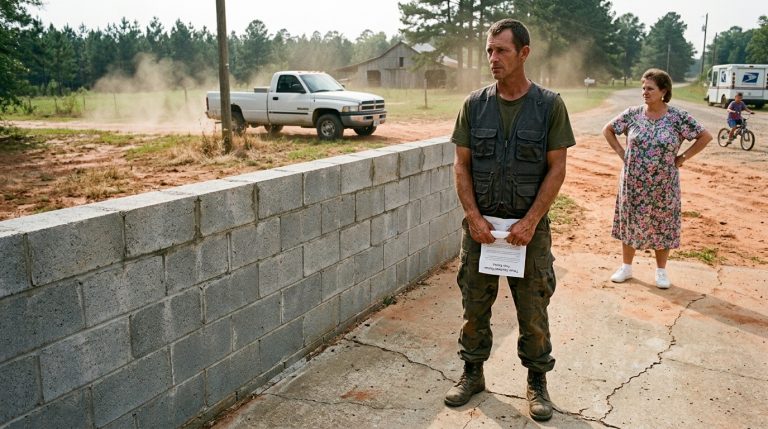
I let out a slow, controlled breath, my gaze dropping to the crumpled flyer she had forced into my palm. The cartoon sun and smiling fish mocked the 30 acres of pristine, spring-fed solitude I had spent two years securing for Sarah and myself. An easement. Covenants. Every line of every document had been scrutinized by my own eyes and verified by a title insurance policy thick enough to stop a low-caliber round. The 29 acres of unincorporated county land and the central lake sat safely inside Lot 17, a hundred yards beyond the reach of their administrative jurisdiction.
She hadn’t made a mistake. She had made a declaration of war.
I turned on my heel and walked back toward the converted barn serving as my home office. The rustic wood walls interiorly housed a different kind of sanctuary—one lined with state-of-the-art geodetic mapping tools, a high-grade drafting table, and a fireproof cabinet containing my DD214 and the ironclad deed.
Unrolling the massive closing plat beneath the cold, clean beam of my overhead lamp, I ran a finger along the bearings and distances of the metes and bounds description. Lot 17 was a fortress of legal fact. The blue oval of the lake rested untouched by their fictitious claims.
Yet, as my eyes scanned the margins of the developer’s original 1978 master plans stacked near the back of my desk, a microscopic discrepancy caught the beam of the lamp—a faint, pencil-noted revision date near the subdivision’s eastern border that did not match the county register.
CHAPTER 2: THE DRAFTING TABLE PERIMETER
The pencil mark was no thicker than a single hair, scratched into the margin of the 1978 master plat with a blunt graphite point that had long since faded to a ghost-gray. It sat adjacent to the eastern border of the Lake View Estates tract, precisely where the subdivision bled into the unincorporated county acreage.
I didn’t blink. I didn’t reach for a magnifying glass immediately. In the field, you let your eyes adjust to the low light before you flag an anomaly.
My thumb traced the edge of the heavy drafting paper. The date stamped on the formal approval block read October 14, 1978. But the faint annotation in the margin—scrawled by a draftsman who had likely retired or passed away decades ago—noted a “re-alignment of Tract A boundary secondary to utility easement shift.” A shift that, according to every official county record I had pulled during my initial title search, was never formally recorded in the public registry.
It was a phantom line. A ghost pencil stroke that hinted at an administrative sleight of hand.
I pushed back the heavy oak chair, the legs scraping against the wide-planked cedar floor with a sharp, dry protest that echoed off the rustic wood walls of the barn. The air inside my command center was cool, smelling faintly of gun oil, dry cedar, and the sharp chemical bite of fresh printer ink. Outside, the sun was sinking fast, dragging long, dark shadows from the pine line across the manicured turf toward the smooth, steel-gray surface of the lake.
Karen Miller was operating on the assumption that the world was governed by volume and intimidation—that if she screamed loud enough, pointed a manicured finger with enough conviction, and levied fines with enough bureaucratic letterhead, reality would bend to her utility. She didn’t understand the physics of surveying. You cannot talk a boundary line into moving three inches to the left. You cannot bully a benchmark.
My phone rested silently face down on the corner of the drafting table. Sarah would be back from her clinic soon. I had promised her a quiet evening, a simple dinner where we didn’t talk about property lines, deeds, or the suffocating micro-politics of suburban homeownership. But the pencil mark on the 1978 map refused to be un-seen.
I picked up a drafting triangle and laid it precisely along the north-south meridian of Lot 17, sliding it eastward toward the anomalous note. If that utility easement shift was real, and if the original developer had carved out a secondary access corridor before abandoning the project’s second phase, then the Lake View Estates HOA wasn’t just overreaching on my northern flank—they were sitting on an administrative landmine of their own making.
A sudden memory hooked into my cognitive periphery, sharp and unbidden: a forward operating base in the Helmand province, three days into a static perimeter watch where the local intelligence assets had fed us clean, orderly maps that omitted a single dry irrigation ditch—a ditch the opposition used to bypass our entire wire network. The map lied because the man drawing it wanted the sector to look secure.
Karen Miller wanted her sector to look secure. She wanted her 30 acres of pristine water for a community beach to validate her presidency, to cement her legacy in the monthly newsletter, and to keep the residents compliant through manufactured scarcity.
I reached for my field notebook, flipping past the clean, geometric calculations of yesterday’s boundary re-establishment. I needed more than a pencil mark. I needed the chain of custody for that 1978 revision.
The front gravel driveway crunched under the tires of Sarah’s compact sedan. The engine died, the headlights sweeping a bright arc across the barn’s exterior wood before clicking off into darkness. A car door shut with a muffled thud.
I didn’t move away from the desk immediately. I closed the historical plat slowly, letting the heavy paper settle into silence, and switched off the overhead halogen lamp. The room plunged into a cool, amber twilight.
The first counter-offensive was already mapped out. Tomorrow morning, before the landscaping trucks could rumble down the shoulder and before Karen could dispatch another wave of administrative paper bullets, I would be back at the county archives. I wasn’t just going to defend Lot 17. I was going to find out who drew that second line, and why they tried to erase it.
CHAPTER 3: THE PROBE AT FIRST LIGHT
The headlights of Sarah’s sedan had barely faded against the cedar siding of the barn when I stepped back out into the cool evening air. There was no hesitation between thought and execution. The gravel under my boots crunched with sharp, measured friction as I walked the perimeter of the converted barn, my hand sliding along the rough-hewn timber frame.
The morning would bring the heavy rattle of diesel engines and the whine of brush hogs from A1 Landscaping. Karen Miller was predictable. Tyrants relying on fabricated authority always used the same playbook: they struck early, banked on intimidation, and assumed the target would fold before noon.
I didn’t wait for morning to formulate the counter-move. By 5:00 a.m., the eastern horizon was a thin, bruised line of gray bleeding through the canopy of tall pines. I stood on the porch with a ceramic mug of black coffee, watching the mist lift off the surface of the lake. The water was a mirror of polished steel, completely undisturbed. It was a landscape that demanded peace, which made the impending administrative siege all the more grating.
At 8:15 a.m., exactly fifteen minutes ahead of yesterday’s schedule, the familiar mechanical groan of a beaten-up Ford Ranger hauling a utility trailer echoed down the gravel access road. The truck slowed, its transmission whining as it downshifted, and bumped onto the grassy shoulder right where Karen had planted her orthopedic sandals two days prior.
Two men climbed out. The older one, his face sun-beaten and mapped with deep fatigue, stepped down with a slow, deliberate heaviness that spoke of a man carrying someone else’s bad decisions.
I didn’t wait for them to unload the chainsaws. I stepped off the porch and walked across the damp turf, my approach calculated, slow, and entirely devoid of hostility.
“Morning,” I said, stopping twenty feet short of their bumper.
The older man froze, a rolled-up work order clutched in his calloused hand. He looked at me, then at the bright yellow survey caps gleaming along the property line I had driven into the earth earlier in the week. Those plastic caps were bright, aggressive guards standing in neat, unyielding geometry.
“Look, buddy,” the man sighed, rubbing the back of a weathered hand across his forehead. “The lady who runs the paper down at the estate office said the right-of-way was cleared. She said you were just making noise.”
“She lied,” I replied, my voice level, cutting through the idle purr of the Ford’s engine. “And your company’s insurance carrier is going to have a very long conversation with you about what happens when you cross a registered geodetic boundary with heavy machinery after being formally notified of trespass.”
The younger worker dropped his tailgate with a sharp metallic clatter, his eyes darting to my right hand, where my phone rested casually in my jacket pocket, ready to log the exact time and evidentiary exchange. The brand-new legal warning I had drafted with Ben Carter was already burning a hole in my digital files, but these men weren’t the enemy. They were instruments being wielded by a woman who hadn’t checked her own perimeter.
“This ain’t worth a five-hundred-dollar deductible,” the older man muttered, staring hard at the yellow boundary markers. He spat a dry stream of dust onto the grass, looked back at me, and made his decision. “Load it up. We’re done here.”
They didn’t argue. They packed their gear in silence, the heavy thud of metal tools sliding into the trailer bed serving as the only soundtrack to their retreat. As the Ford threw up a spray of gravel and headed back toward the paved subdivision roads, my phone buzzed against my palm.
The screen flashed a blocked caller ID.
I answered, keeping the line on speaker, letting the acoustic resonance of the barn office amplify the impending collision.
“Marcus,” Karen’s voice shrieked through the speaker, high and brittle, practically vibrating with uncontained fury. “You have crossed a line. You interfered with an authorized community project again. I am slapping you with a formal fine of five hundred dollars for obstruction, plus an escalating daily penalty—”
I let her talk. I let the manic speed of her indignation fill the quiet room, watching dust motes spin in the shaft of morning light cutting through the window. When the pitch of her voice finally cracked on a intake of breath, I spoke, dropping my tone into a slow, deliberate cadence.
“Karen,” I said quietly. “Thank you for confirming your instructions on a recorded line. A certified copy of this conversation, alongside the trespassing affidavits from A1 Landscaping, is currently being routed to my attorney. Any further attempts to dispatch contractors to Lot 17 will result in immediate criminal filings.”
Before she could form the next syllable of her tirade, I pressed the disconnect button. The sudden silence that flooded the room was heavy, dense, and absolute.
Phase one of the perimeter defense was holding. But the map on my drafting table—and the ghost pencil mark in the 1978 archive records—reminded me that the true vulnerability wasn’t on my lawn. It was buried in her office.
CHAPTER 4: THE ARCHIVE VAULT
The engine of my truck idled with a low, steady rumble as I pulled into the asphalt lot of the county courthouse. The building stood as a stoic, gray granite fortress of bureaucracy—its architecture heavy, unimaginative, and designed to outlast whatever petty administrative storms brewed in the subdivisions outside city limits.
I stepped down onto the sun-baked pavement, the heat radiating upward through the thick rubber soles of my boots. My hand instinctively brushed against the leather binder holding my certified plats and survey notes. Karen Miller could throw tantrums over the telephone lines, and her retained counsel could draft threatening letters filled with hollow bluster, but paperwork had a physical weight. And unlike a human adversary, paper left a trail that could be tracked, measured, and used as leverage.
Inside, the records room smelled distinct and unchanging: old wood pulp, chemical binding glue, and the fine, chalky dust of decades-old microfiche.
I checked in with the clerk at the central wooden counter, a middle-aged woman whose expression suggested she had spent thirty years watching people fight over twenty-foot strips of dirt. I didn’t ask for Lot 17 this time. I asked for the master development files of the Lake View Estates subdivision, specifically looking for the founding documents filed between January and October of 1978.
She slid a heavy, metal-reinforced cardboard storage box across the counter with a dull thud. “Sign here. No pens out of your holster, pencils only.”
I took the box to a corner oak table under the glare of an overhead fluorescent tube. The bulb hummed with a high-pitched, steady vibration that set a tense rhythm for the search. I untied the faded red cotton string wrapped around the primary folder and began to unfold the documents layer by layer.
The strategy was simple. If the eastern boundary revision noted on the master plat I had examined in my barn was legitimate, there had to be a corresponding resolution filed by the original board of directors—or an amendment signed by the county planning commission. If no such record existed, then the current board’s reliance on historical precedent was built on air.
For two hours, I worked through the financial ledgers, architectural covenants, and meeting minutes of the late seventies. The pages crackled under my fingertips like dry leaves. Every document was a snapshot of a different era, written by men and women who had long since moved on, leaving their property lines as an inheritance for people like Karen Miller to weaponize.
Then my fingers brushed against a thin, unindexed paper insert tucked deep inside a folder labeled Phase Two Infrastructure Adjustments.
It wasn’t a standard meeting minute. It was a carbon-copy memorandum dated November 12, 1982—four years after the initial development. The ink was a faded purple hue, typed on a mechanical typewriter with a slightly misaligned letter ‘e’.
I adjusted my posture, leaning closer to the page until my eyes could pick out the faint, cramped lines. The memo outlined a proposed realignment of the community access corridor to accommodate an expanding utility grid. But at the bottom, scrawled in thick, black fountain pen ink, was a handwritten marginal note signed by a former board treasurer: Access corridor rerouted per verbal agreement with commercial developer. Easement shifted off primary tract.
A cold, methodical clarity washed over the noise of the fluorescent light above me.
They hadn’t just made a mistake. Decades ago, a previous board had quietly traded away part of the subdivision’s legal access to a commercial entity, burying the transaction beneath layers of administrative notes to avoid a public vote. Karen Miller hadn’t discovered a hidden community right over my lake—she had inherited a cover-up, and in her arrogance, she was trying to execute a second land grab to make up for the historical deficit her predecessors had created.
I pulled out my phone, angled the camera carefully, and captured high-resolution frames of the memorandum, the signatures, and the surrounding index numbers.
As I repacked the archive box and slid it back across the counter, the friction of the cardboard felt entirely different in my hands. The game had shifted from defense to absolute structural dismantling. Karen thought she was fighting a neighbor over a view. She was about to find out she was standing on a fault line of her own board’s making.
CHAPTER 5: THE AMBUSH AT THE COMMUNITY CENTER
The air inside the Lake View Estates community center was thick, stale, and humming with an anxious, low-frequency current that could be felt through the soles of my boots. Every metal folding chair in the municipal inventory had been dragged out, forming concentric semi-circles that faced a long folding table up front.
I didn’t take a seat near the front. I stayed standing in the deep shadows by the rear double doors, my shoulders squared against the paneled wall. Ben Carter, my attorney, sat near the center aisle with his leather briefcase resting upright against his knee like a deployed toolkit. He looked bored, his gaze fixed on a blank notepad—the calm center of an impending meteorological disaster.
Up front sat Karen Miller.
She wore a crisp pastel blazer that commanded the center of the table, flanked by three nervous board members who kept shifting their weight. When Karen tapped the wireless microphone, the amplifier squealed a brief, jagged feedback note that made the front rows flinch.
“Thank you all for coming,” she began, her voice carrying a practiced, resonant authority designed to fill the room before anyone else could establish a baseline. “For too long, access to our community’s greatest natural asset—our lake—has been selfishly choked off by a recalcitrant individual who believes his personal property lines supersede the collective good.”
Every head in the room jerked backward, scanning the rows until a dozen pairs of eyes locked onto me standing by the exit. I met their gazes with an expressionless, flat stare.
“Tonight,” Karen continued, her pitch rising with manufactured passion, “we are asking for your approval on a modest, one-time special assessment of two hundred dollars per household. A dedicated legal fund to dismantle this obstruction once and for all and secure Lake View Commons for our children.”
A sparse, nervous clatter of applause drifted from the front three rows—loyalists and close associates. The rest of the room sat frozen, staring at their hands or at the color-coded information packets Arthur Henderson and his neighbors had quietly distributed across doorsteps forty-eight hours prior.
Ben stood up. He didn’t rush. He simply adjusted his jacket button, let his tall frame straighten, and let the quiet weight of his presence bleed into the atmosphere until Karen’s final applause died an unnatural death.
“Madame President,” Ben said, his voice cutting through the heavy air like a razor through canvas. “Before this community votes to allocate thirty thousand dollars of private capital toward a losing venture, I believe they are entitled to inspect the foundational evidence. Could you please display the recorded public easement granting this association legal access to my client’s lake?”
Karen’s jaw tightened, the skin around her mouth whitening. “Our legal counsel has confirmed our broad fiduciary rights under the governing documents—”
“That wasn’t my question,” Ben interrupted smoothly, taking two steps into the aisle. “I asked for a specific, recorded instrument. Because my client, a licensed geodetic surveyor, has reviewed every inch of the county registry. The map you have been circulating is a fabrication. The lake sits entirely within Lot 17, one hundred yards outside your jurisdiction.”
Ben reached down, flipped open his briefcase, and plugged a portable projector into the aisle floor socket. Instantly, a massive digital projection splashed across the pull-down screen behind the stage: on the left, the clean, mathematically unassailable lines of my county-certified survey plat; on the right, Karen’s cartoonish, hand-drawn flyer.
The collective gasp that rippled through the room was physical—a sharp intake of breath from a hundred lungs that instantly sucked the oxygen out of the space.
“Furthermore,” Ben’s voice rang out, steady and relentless, “when my client issued a formal demand for documentation thirty-five days ago under your own bylaws, the board failed to produce a single valid page. Instead, you attempted to push an illegal special assessment to cover up the fact that you possess no legal standing whatsoever.”
A man in the third row stood up abruptly, his chair legs screeching against the linoleum. “Is that true, Karen? Where’s the easement?”
Karen slammed her hand down on the metal table, her composure fracturing into a thin, brittle shriek. “It’s a complex administrative oversight! Our lawyers are handling—”
“You’re running a shakedown,” Arthur Henderson shouted from the fifth row, his voice shaking with the hard-earned friction of twenty years in the neighborhood. He stood to his full height, pointing a scarred finger directly at the head table. “She fined me last year because my tomato cages didn’t match her aesthetic color palette! She’s not protecting the community; she’s bleeding us!”
The floodgates gave way. Across the room, voices erupted simultaneously. The Garcias stood up together, speaking of arbitrary fines levied against children’s playsets and threats of property liens. The structured veneer of the HOA meeting disintegrated into an open insurrection. The board members at the table shrank back, their eyes darting toward the exits as the fury of their own constituents closed in around them like rising water.
The vote was called not by Karen, but by a roar from the floor. Out of more than a hundred households present, only four hands went up in favor of the assessment—Karen and her three loyalists. It was a public, absolute repudiation of her entire reign.
Karen stumbled back from the microphone, her face drained of color, her eyes locking onto mine across the chaotic room.
I didn’t smile. I didn’t move. I simply watched the structural collapse of her paper empire with the cold, measured detachment of a man observing a perimeter wall finally giving way under its own accumulated weight.
CHAPTER 6: THE STEEL BOUNDARY AND FINAL SILENCE
The air on the morning of the final installation was crisp, carrying the dry, metallic scent of fresh galvanized steel and mixed concrete. I stood thirty feet from the edge of the access path, holding a heavy-gauge steel post upright while the wet cement in the ground anchor settled around its base.
The legal war had collapsed into an unconditional surrender three days prior. Faced with mounting exposure from personal liability lawsuits and the explosive discovery of the 1982 archive memo regarding the subdivision’s true, illegally sold access corridor, the insurance carriers had forced the interim board into a complete capitulation. Karen Miller was no longer a name mentioned with fear in the cul-de-sacs; she was a ghost facing foreclosure, forced to list her home to cover the wreckage of her own administrative overreach.
Arthur Henderson walked over from the property line, carrying two plastic cups of iced tea, his boots kicking up light tufts of clover. He handed me one, his blue eyes crinkling against the morning sun as he looked down the immaculate, straight line of posts stretching toward the pine line.
” Interim board just voted to approve the legal petition to claw back the original easement from the commercial developer,” Arthur said, taking a slow sip. “Turns out the paperwork error was watertight. They’re going to get Henderson’s Landing back.”
I accepted the cup, the cold condensation slick against my palm. “It was never about the paperwork, Arthur. It was about whether a boundary means anything.”
“It means everything,” he replied, nodding toward the lake, which shimmered like a polished mirror under the rising sun.
With the final bolt tightened on the last section of heavy black mesh fencing, the perimeter was complete. It was not a hostile barrier, but a statement written in heavy-gauge wire and absolute law: This is the line. It is a fact.
Later that evening, Sarah and I sat on the wooden dock I had built with my own hands. The surface of the water was completely calm, reflecting the deep orange and purple bruise of a fading summer sunset. A small envelope had arrived earlier that day from the Garcia family—a crayon-drawn picture from their young son depicting a straight black fence beside a blue lake under a smiling sun, accompanied by a simple scrawl: Thank you for keeping us safe.
Sarah leaned her head against my shoulder, her breathing slow and even. The tension that had coiled in her chest for months melted away into the surrounding quiet.
“It’s quiet,” she whispered.
” Yes,” I said, watching the last sliver of the sun dip below the jagged silhouette of the pines. “It’s finally quiet.”
Some lines are drawn in dirt, and some are drawn in paper, but the truest ones are defended with a quiet, unyielding resolve. Justice had settled over the land, heavy, permanent, and absolute.