The Architect of Silence: A Billionaire’s Journey from a Polished Life to Radical Human Connection
CHAPTER 1: THE FOYER ENCOUNTER
John Harlo stopped mid-stride, his carry-on bag jolting to a halt against the pristine marble. He had been calculating the Mercer deal in his head, the numbers cascading like liquid, but the math shattered when a small, round-eyed toddler in a pink shirt stood directly in his path. She held a stuffed elephant by the trunk, its gray fabric worn nearly white at the edges.
John looked past her, expecting to see a nanny or a parent, but the foyer was empty save for the late afternoon sun cutting across the floor in long, amber slats. He blinked, the sharpness of his focus suddenly turning dull. He was a man who lived in high-definition—contracts, glass, steel, the relentless ticking of a clock that ran four minutes behind—but this child was blurry, out of place, an anomaly in his curated environment.
“You going somewhere?” the girl asked. Her voice was not small; it was distinct, carrying an authority that made the expensive hum of the air conditioning seem suddenly intrusive.
“Yes,” John said, the word feeling stiff in his throat. He looked down, his knuckles white against the handle of his bag. “Chicago.”
“Is that far?”
She scrunched her nose. It was a gesture of pure, unfiltered curiosity, devoid of the transactional energy he was accustomed to. She looked at his suitcase, then back at his face, and the silence stretched, heavy and expectant. A stray dust mote danced in the light between them, caught in the stagnant air of the penthouse.
“Pretty far,” he managed, crouching down. The movement was alien to him, a descent into a world he had long since outgrown.
Then, she stepped forward. The elephant in her hand drooped, the button eye glinting in the afternoon light. She looked at him with an intensity that defied her age, a gravity that felt older than the building itself.
“Don’t get on that plane,” she said.
John felt the floor tilt beneath him. It wasn’t the words themselves, but the absolute, crushing lack of malice in them. There was no social maneuvering here, no boardroom bluffing, no hidden agenda of status or gain. It was a fragment of raw truth, dropped into the sterile lobby of his life like a stone into a still pond.
Behind him, his assistant Marcus shifted, the rustle of his suit fabric sounding like static. John didn’t turn. He couldn’t. He was locked in the orbit of those enormous, brown eyes.
“Why not?” he whispered, his own voice sounding thin, a whisper of a man he hadn’t spoken to in years.
The elevator dinged again, a sharp, metallic interruption, but neither of them flinched. The child’s expression remained fixed, a mirror held up to his own fractured reflection. She stared, her small fingers tightening around the elephant’s trunk, and he knew, with a sudden, sinking dread, that she was about to tell him exactly what she saw.
CHAPTER 2: THE ECHO IN THE MARBLE
John remained crouched, his knees pressing into the unforgiving cold of the foyer’s marble floor. The child, Isabelle, didn’t move. She simply watched him, her small hand loosening its grip on the stuffed elephant’s worn ear. The air in the penthouse, usually filtered and climate-controlled to a sterile perfection, suddenly felt thin, as if the oxygen had been vacuumed out by the sheer weight of her gaze.
“Mr. John?”
The voice belonged to Rosa. It was soft, hesitant, but it cut through the haze of John’s internal static. She was standing a few feet away, clutching a microfiber cloth, her knuckles white. She looked terrified, not for her job, but for the breach of order that had just occurred.
John stood up, the movement slow and deliberate, as if his joints were stiff from a long winter. He looked at Rosa, then back at the girl. He wanted to offer a polite, dismissive comment—something about toddlers and their imaginative play—but the words wouldn’t form. The silence of the foyer was too absolute.
“I’m sorry, Mr. John,” Rosa said, stepping forward to retrieve her daughter. “She doesn’t—she doesn’t understand. She’s just tired.”
John looked at the child one last time. Isabelle didn’t look tired. She looked profoundly awake, her eyes tracking the movement of his tie as if she were measuring the distance between his heart and the fabric. He reached out, a fleeting impulse to touch her shoulder, but stopped mid-air. Instead, he reached into his jacket pocket and pulled out his keys, the metal biting into his palm.
“It’s fine,” he said, his voice sounding hollow to his own ears. He turned to Marcus, who was standing by the elevator, his phone pressed to his ear, his face a mask of professional neutrality. “Marcus, let’s go.”
The elevator doors slid shut, sealing them in the mirrored box. As they descended, the reflected image of John Harlo—polished, tailored, successful—seemed like a stranger. He watched the numbers drop on the digital display, each floor a rhythmic thud against his chest. He thought about the framed photo on his nightstand, the one he habitually turned face down.
Suddenly, a memory bloomed, unbidden and sharp: Vermont, three years ago. The smell of rain-soaked pine, the sound of Sabella’s genuine, unpracticed laughter—a sound that had vanished somewhere between the engagement gala and the acquisition of the Manhattan penthouse. He remembered the feeling of the grass under his boots, the texture of her damp hair against his neck. It was a phantom limb of a life he had once inhabited, a version of himself that hadn’t been filtered through stock projections and charity schedules.
The elevator opened to the lobby. The chaos of Manhattan spilled in, a cacophony of sirens, rain, and hurried footsteps. He stepped out, the cool evening air hitting his face, but it didn’t refresh him; it only made him feel more exposed.
“Car’s waiting, sir,” Marcus said, motioning toward the black sedan idling at the curb.
John walked toward the vehicle, his suitcase rolling behind him with a low, rhythmic hum. He felt a sudden, sharp ache in his chest, a physical manifestation of the crack that Isabelle’s four words had initiated. He climbed into the backseat, the leather upholstery cold and smelling of expensive polish.
“Airport?” Marcus asked, climbing into the passenger seat.
John looked out the window. The city lights were blurring in the rain, a smear of gold and neon against the dark. He thought of the child’s stuffed elephant, the way it had drooped in her hand. He thought of his own schedule, an endless grid of appointments that promised everything and delivered nothing.
“Wait,” John said.
Marcus turned around. “Sir?”
John didn’t answer immediately. He reached out and touched the window, the condensation cold against his fingertip. The logic of his life had always been Therefore / But: Therefore, he worked; But, he gained status. Therefore, he gained status; But, he lost time. The cycle was airtight, a closed system. But the child’s warning—the sheer, irrational weight of it—had jammed the gears.
He imagined the plane taking off. He imagined the altitude, the pressurized cabin, the familiar, suffocating safety of the first-class seat. He felt an intense, overwhelming urge to simply not go. To turn around, to go back up to the penthouse, and to sit on the floor of the hallway until the meaning of the world changed back to something he could recognize.
“John?” Marcus prompted, his voice laced with a subtle, professional concern. “The flight schedule is tight.”
“I know,” John replied, pulling his hand away from the glass. He stared at his own reflection in the window, searching for a trace of the man who had been laughing in the Vermont rain. He found only the ghost of a billionaire, a man who had everything he wanted and no idea who he was. “Just… give me a minute.”
He closed his eyes, the roar of the city outside fading into a dull, rhythmic thrum. He had to decide if he was a man who lived by the clock, or a man who lived by the truth. And for the first time in his adult life, the clock felt like the enemy.
CHAPTER 3: THE CHICAGO FRACTURE
The city of Chicago outside the window was a blurred, watercolor smear of gray and slate. Rain hammered the roof of the sedan, a relentless, rhythmic percussion that seemed to sync with the tightening in John’s chest. He looked at the back of Marcus’s head, at the rigid line of his shoulders, and realized how much of his own life was governed by the comfort of someone else’s certainty.
“Mr. Harlo?” Marcus’s voice was measured, tuned to the frequency of a man who managed crises as a matter of course. “The traffic on the I-90 is thickening. If we’re going to make the gate, we need to move within the next four minutes.”
John stared at his own hands. They were steady—they had always been steady—but he noticed for the first time the fine tremor in his fingertips. Was it fatigue? Or was it the residual shock of the foyer, the way a three-year-old child had reached past the expensive suits and the board-certified authority to poke a finger directly into the wound he’d spent two decades cauterizing?
He thought of the photo on his nightstand. He imagined it now, face up in the dark, the image of Sabella laughing in the rain mocking him with its authenticity. He felt a sudden, sharp spike of vertigo. What if the life he was running toward in Chicago—the Mercer deal, the legal teams, the endless, grinding pursuit of growth—wasn’t the solution, but the very mechanism that had hollowed him out?
“Marcus,” John said, his voice coming out lower than he intended.
“Yes, sir?”
“Do you ever feel like you’re playing a role? Not just at work, but in your own house? Like you’re waiting for a director to yell ‘cut’ so you can finally stop saying the right things and just… be?”
Marcus didn’t turn around, but his posture shifted, the slight tilt of his head indicating that he was, for the first time in six years, listening to the person rather than the client. “I think, Mr. Harlo, that most people are just trying to keep the set from collapsing.”
“And if the set is already falling down?”
“Then you find out what’s underneath,” Marcus replied quietly.
John looked back at the rain. The windshield wipers were struggling, creating a repetitive, screeching friction against the glass. He felt a phantom sensation, an intrusive memory of his father’s departure—not the scene itself, but the feeling of the house after he was gone. The way the air had changed. The way he had learned, at ten years old, that if you made no noise and asked for nothing, the world would eventually provide you with a fortress. He had spent his entire life building that fortress, brick by brick, acquisition by acquisition.
And now, a toddler in a pink shirt had climbed over the wall and asked why he was crying.
The absurdity of it was nearly suffocating. He should be worried about the Chicago conference room. He should be worried about the legal team, the leverage, the optics. Instead, he was obsessing over the texture of a stuffed elephant and the weight of a gaze.
“Cancel the dinner,” John said. His voice was firm now, stripped of the hesitation that had plagued him for hours.
Marcus turned around, his expression unreadable. “Sir, the Mercer team is already on-site. Mr. Mercer himself—”
“Cancel it,” John repeated. He reached forward and tapped the glass partition. “I’m not going to Chicago. Take me back to the office.”
“The office? At this hour?”
“I need to look at the books,” John said, though he didn’t mean the ledgers of his company. He meant the record of his own existence—the emails, the schedules, the endless trail of appointments he had curated to ensure he never had a moment of stillness. “I need to see exactly where I went missing.”
Marcus nodded once, a sharp, professional jerk of the head, and spoke into his radio. The sedan pulled away from the curb, merging into the sluggish, rain-drenched flow of the city. John watched the streetlights pass, the golden glow washing over his face and leaving him in shadow.
He leaned back, the leather cool against his neck. The fear was still there—a cold, steady thrumming in his gut—but beneath it, for the first time in years, was curiosity. He was about to return to the place where he exerted his greatest control, and he was going to dismantle it. He was going to sit in his library, in the silence that he had filled with tasks for so long, and wait to see what lived in the gaps.
As the car wove through the dark, congested streets, he realized that the feeling of sadness he had been suppressing wasn’t just a reaction to his crumbling marriage. It was a grief for the boy he had abandoned, the one who had watched his father walk out the door and decided that happiness was a luxury he couldn’t afford to keep.
He looked at his reflection again. The glass was dark, mirroring the interior of the car. For a second, he thought he saw the face of the child, the way she had looked at him in the foyer—open, searching, unburdened. He shivered, the cold from the window penetrating his expensive wool coat. He was finally looking, and the view was far more terrifying than he had ever imagined.
CHAPTER 4: THE ARCHIVE OF ABSENCE
The lobby of Harlo Tech was a cathedral of brushed steel and glass, currently muffled by the late hour. John exited the sedan and walked toward the entrance, his boots clicking with a hollow, rhythmic finality against the pavement. He didn’t wait for the security guard to finish his nod of recognition; he simply moved, his mind tracing the trajectory of his own career like a surveyor mapping a wasteland.
The elevator ride to the executive floor felt different than it had that morning. He was still the same man, still wearing the same tailored suit, yet the air in the car seemed thinner, as if he were climbing toward a summit that no longer offered a view. When the doors slid open, the silence of the suite hit him like a physical blow. It was the silence of a tomb, yet it was filled with the meticulously organized detritus of his ambition.
He walked past the workstations, past the sleek, minimalist desks of his assistants, and into his personal office. It was a space designed to intimidate—wide, expansive, dominated by a desk of black walnut and an uninterrupted view of the skyline. He sat in his chair, the leather creaking under his weight, and for a long moment, he simply stared at the blank surface of his monitor.
He needed to see the record. Not the public earnings, not the projections for the shareholders, but the quiet, administrative pulse of his own calendar. He opened his encrypted terminal and began to navigate the files he had delegated to Marcus to curate for years.
It was a systematic unfolding of absence.
He found logs of missed anniversaries categorized as “prioritized engagements.” He found dinner reservations canceled with robotic efficiency, the reasons often cited as “unforeseen volatility.” There were long threads of communication with Sabella, not of intimacy, but of logistics: Meeting times. Charity logistics. Public appearances. The choice of catering.
He clicked into a folder dated from six months ago. It was a draft for a speech he was supposed to give at a gala. He had written it, or rather, his office had written it for him, emphasizing “the strength of partnership.” He remembered the night of the gala. He had been distracted, checking his phone under the table, worrying about a merger in Singapore. Sabella had looked radiant, her dress a cascade of silver light, and she had leaned in to whisper something to him. He had missed it. He had apologized and shifted the conversation to the catering budget.
He felt a cold, sharp ache in his throat. He had been an architect of emptiness, a man who had treated his own existence like a project to be optimized, stripping away anything that couldn’t be quantified.
He stood up and walked to the wall of filing cabinets. He pulled open the drawer labeled Personal—a drawer he hadn’t touched since he bought the building. He rummaged through the folders, his hands shaking slightly. There, tucked behind a thick stack of insurance papers, he found a small, unmarked envelope.
He pulled it out. It contained a single, faded receipt from a florist in Vermont, dated three years ago. There was a note scrawled on the back in his own handwriting: For the rainy walk.
He stared at the ink. He didn’t remember the walk, but he remembered the feeling of that day—the lightness, the sense of having arrived at a place where the work didn’t matter. He had kept the receipt, a tiny, paper anchor to a version of himself that hadn’t been afraid of being ordinary.
A sudden, sharp sound made him jerk his head up. The soft beep of the elevator announcing a arrival.
He didn’t move. He stood in the middle of his office, the receipt clutched in his hand, feeling like a ghost haunting his own kingdom. The office door opened, and Marcus stepped in, his expression uncharacteristically strained.
“Mr. Harlo,” Marcus said, his eyes tracking the files scattered across the desk. “I saw your access log. I wasn’t sure if you were still in the building.”
John didn’t look at him. He kept his eyes on the Vermont receipt. “I’ve spent three years building a monument to my own success, Marcus. Look at this.” He gestured toward the open files, the meticulously documented history of a man who had prioritized everything except the actual experience of living. “It’s all here. Everything I’ve done. And yet, I can’t find a single moment in these files where I was actually present.”
Marcus walked closer, his gaze softening as he looked at the open drawer, the scattered, empty evidence of a life lived by proxy. “Sir, it’s not too late to start a new file.”
“Is it?” John asked, his voice brittle. He walked toward the window, looking down at the city, the rain turning the lights below into a sea of fractured glass. “I don’t think you can just edit a life, Marcus. I think you have to tear it down and see what’s left in the foundation.”
He felt the cold seep through the glass. He realized then that the decoy of his marriage, the belief that it was Sabella’s infidelity that had broken them, was a lie he had clung to because it was easier than admitting the truth: that they had both been sleepwalking through a life they had designed to be perfect, only to find that perfection was just another word for hollow.
He turned back to Marcus, the receipt still in his hand. “I’m not going to Chicago. I’m not going to the meeting. I’m going to go home. And I’m going to stop playing the part.”
CHAPTER 5: THE MIRROR BREAKS
John moved through the hallway of the office suite with a gait that felt unmoored. The decision to stop playing the part had left him feeling lighter, yet strangely vulnerable, as if the armor he had worn for years had been stripped away in a single breath. Marcus followed a respectful distance behind, his footsteps the only sound in the dead-air of the floor.
“I’ll have the driver meet us at the service entrance, sir,” Marcus said, his voice clipped. “It’s raining harder. The main exit is likely congested.”
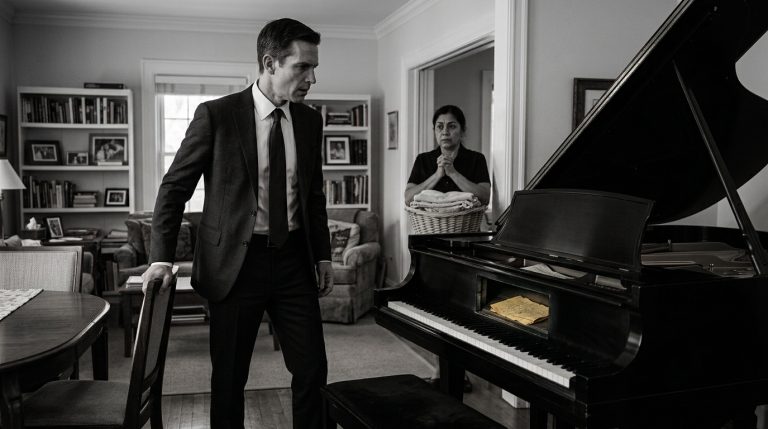
John didn’t answer. He turned a corner and found himself facing the entrance to the music room—a room he had designated as a storage space for equipment he never used. He stopped. The door was slightly ajar, a sliver of darkness peering out. He pushed it open. The space was cavernous, smelling of stale air and the faint, metallic tang of cold brass. In the center sat the grand piano, draped in a heavy, dust-covered sheet.
He walked toward it, his hand trembling as he reached out to pull the cloth away. As the fabric hit the floor, a cloud of dust billowed up in the moonlight, a ghostly, silent explosion. The keys looked like a row of yellowing teeth. He pressed a single note—a low C—and the sound was flat, out of tune, yet it resonated through the room with a hollow, mournful purity.
He recoiled. The sound triggered a memory so vivid it felt like a physical blow: his father, sitting at a similar piano, the room filled with the same suffocating silence, the way his father would play only when he thought John was asleep, his hands moving with a desperate, frantic precision. He realized then that his father’s silence hadn’t been about discipline; it had been about fear. Fear of being heard. Fear of being known.
John stepped back, the piano suddenly feeling like a confessional he wasn’t ready to enter. “I don’t think I can do this tonight, Marcus.”
“Do what, sir?”
“Go home. Sit in that apartment. Look at those walls.” He turned to face his assistant, his expression raw. “Everything there is a prop. Every chair, every lamp, every piece of art—it was all selected to project an image of a life I never lived. If I go back, I’m just walking back into the staging area.”
Marcus looked at the piano, then at John. “Then where do you want to go?”
“I need to talk to her,” John said. “Rosa.”
Marcus blinked, surprised. “The housekeeper? Sir, it’s past eleven. She’s likely already—”
“She’s the only one who didn’t look at me like I was a spreadsheet,” John interrupted. He walked out of the music room, his pace accelerating, a sudden, frantic need to be somewhere where the truth didn’t need to be negotiated.
They left the building, the rain now a relentless deluge that transformed the city into a series of distorted, glowing shapes. John sat in the back of the car, watching the windshield wipers cut frantic paths through the water. He was breaking the architecture of his life, and the cost was becoming clear: he was going to be alone in the rubble.
When they arrived at his penthouse, the lobby was desolate. He didn’t wait for Marcus to call ahead. He took the private elevator up, his heart hammering against his ribs like a trapped bird.
He stepped into the penthouse. The lights were dimmed, the vast, expensive space cast in long, haunting shadows. He walked toward the kitchen, his footsteps sounding like gunshots on the marble. He found Rosa in the auxiliary staff quarters area, sitting at a small table, a cup of tea in her hand, her expression one of quiet, tired resilience.
She jumped when she saw him, her hand going to her chest. “Mr. John? Is something wrong?”
John leaned against the doorframe, the adrenaline of the last hour draining away, leaving him exhausted. “I need to know something, Rosa. And I need you to be honest, not as an employee, but as a person.”
Rosa set her tea down, her gaze steady. She didn’t look at his suit, or his hair, or the expensive watch on his wrist. She looked at his face. “I am always honest, Mr. John.”
“You said earlier that you know me,” he began, his voice shaky. “That you know my rhythms. My silences.” He walked into the kitchen, the space feeling suddenly small and intimate. “Tell me the truth. Have you ever actually seen me? Or have you just been watching a projection of a man who didn’t exist?”
Rosa remained silent for a long moment. She picked up a small, worn photograph that had been lying on the table—a picture of Isabelle. “I have seen a man who was terrified of being seen,” she said softly. “I have seen a man who spent his entire life building a wall because he thought if anyone caught a glimpse of what was inside, they would find it empty.”
“And what did you find?”
Rosa looked at him, her eyes clear and unsparing. “I found a man who was trying so hard to be perfect that he forgot he was allowed to be broken.”
The words hit John with the force of a physical impact. He leaned his head against the cool granite of the kitchen island, the cold seeping through his skin. He had come here for a validation of his new trajectory, but instead, he had received the most brutal, necessary assessment of his entire life. The decoy—the idea that his marriage was the primary issue—was disintegrating before his eyes. The issue wasn’t Sabella. It was the fact that he had never invited anyone in, not even himself.
“What do I do now?” he whispered.
“You stop building,” Rosa said. She stood up, her movements calm, deliberate. “You stop trying to fix the architecture, and you start living in the space you actually occupy.”
She walked to the counter, took a clean mug, and poured him a cup of tea. She held it out to him, her fingers steady. It was a small, mundane gesture, yet it carried the weight of a monumental shift. For the first time in his life, John Harlo felt like he wasn’t playing a role; he was just a man, standing in a kitchen, holding a cup of tea, waiting for the rain to stop.
CHAPTER 6: THE SABELLA EXIT
The steam curled upward from the white ceramic, a pale, twisting ribbon that dissolved into the heavy shadow of the kitchen ceiling. John held the mug with both hands, using its simple, physical heat to anchor himself against the cold clarity of Rosa’s words. She remained standing near the counter, her posture a masterclass in quiet dignity. She did not look away, nor did she offer the soft, protective cushions of corporate reassurance that John had paid for his entire adult life. She simply let the truth exist between them.
“You speak about me like an autopsy, Rosa,” John said, his voice dropping into the lower register he usually reserved for failing negotiations. But there was no calculation in it now; it was merely tired.
“I have swept the floor around your feet for twenty-four months, Mr. John,” Rosa replied, her tone matching the calm rhythm of the rain outside. “A person learns the weight of a stride when they have to clean the marks it leaves behind.”
John took a slow sip, the bitter herbal liquid warming his throat but doing nothing to ease the tightness behind his ribs. He turned his head slightly toward the dark hallway that led to the master suite. The stillness there was different from the kitchen. It was brittle.
His eyes tracked across the pristine, quartz surface of the kitchen island, and then he froze. A small, square tray of hammered brass sat near the built-in espresso machine. It was a secondary detail—an object he had looked at a thousand times without seeing. On it sat a small velvet box containing a pair of diamond cufflinks he had supposedly lost three weeks ago during a trip to Boston. They were arranged neatly, perfectly parallel to the edge of the metal tray.
John stepped toward the tray, his boots making a faint, rubbery stick against the damp stone floor. He reached out and touched the velvet. It was dry, but the dust around the tray had been disturbed in a very specific, linear pattern. Someone hadn’t just cleaned here; someone had placed these back with an absolute, mathematical precision that didn’t belong to Rosa’s routine. Rosa always grouped small personal items in the ceramic bowl by the main foyer.
He looked up at Rosa, a question forming in his eyes, but a soft, rhythmic click from the main corridor cut the air.
Sabella stood in the archway.
She wore her silk robe, the dark emerald fabric catching the dim morning light filtering through the high glass windows. Her dark hair was pinned back, precise, not a single strand out of place despite the hour. But her face lacked its usual clinical sheen. The skin beneath her eyes was pale, almost translucent, showing the faint purple tint of exhaustion that no premium cream could mask.
“You didn’t go to Chicago,” she said. Her voice didn’t rise; it was flat, a transaction that had already been settled before the papers were signed.
John set his mug down on the quartz island, the ceramic clicking softly against the stone. “No. I turned the car around.”
“Marcus called the house line,” she said, stepping into the kitchen. She didn’t look at Rosa, and Rosa, true to her training, stepped back into the shadows of the utility pantry, invisible once more. “He said you canceled the Mercer dinner. He sounded… confused, John. Marcus is never confused.”
“I needed to see the archive,” John said. He didn’t move toward her. The distance between them felt structural, like a structural failure in a foundation that had finally given way. “I spent the night looking at the calendar. Every anniversary. Every dinner.”
Sabella let out a short, dry breath that wasn’t quite a laugh. She walked over to the brass tray, her manicured fingers brushing the velvet box containing the cufflinks. “And what did you find? A ledger of your absences?”
“I found that we both built exactly what we asked for,” John said quietly. He watched her hand. She wasn’t surprised to see the cufflinks there. “We wanted a presentation. We wanted something that looked unassailable from a distance so no one would look close enough to see that there was nothing inside the rooms.”
Sabella’s jaw tightened, a microscopic shift that John only noticed because he was finally looking. Her eyes, usually so sharp and calculated, flickered with a sudden, raw flash of vulnerability before the mask slid back into place.
“You think you’re the only one who noticed the silence, John?” she whispered, her voice cracking slightly at the edge. “I’ve been living in a museum for three years. Every piece of furniture was vetted by a designer. Every flower was selected to match the tone of the charity committees. I didn’t re-enter Marcus Hail’s orbit because I wanted a scandal. I did it because he actually remembers what my voice sounds like when I’m not giving a speech.”
The admission hung in the air, a heavy, suffocating truth that shattered the last remnant of the Layer 1 decoy. John had spent hours believing her infidelity was the rot, the single point of failure that had ruined his perfect trajectory. But as he looked at her now—at the lines of frustration etched around her mouth, at the structural rigidity of her posture—he realized the rot was older. It was the performative nature of their entire union. They had been business partners in a firm called A Content Life, and the dividends had run out.
“He was the one who left the cufflinks,” John said, his voice devoid of anger, filled only with a profound, diagnostic clarity.
Sabella didn’t look down. She kept her eyes on his face. “He brought them back from the Boston hotel. He thought you should have them. He has more respect for your house than you do, John. You didn’t even know they were missing.”
John let the accusation land. It was accurate. He hadn’t known. He had been too busy tracking the stock prices to notice the inventory of his own home.
“I think we should end this well,” John said, repeating the resolve that had begun to form in the backseat of the sedan. “Not with lawyers and war. Just honestly.”
Sabella stared at him for a long, agonizing minute. The wall clock ticked behind her, a steady, mechanical reminder of the time they had wasted. Then, she reached up and smoothed the lapel of her silk robe, her hands steadying as she reclaimed her armor.
“I’ll call my attorney this afternoon,” she said, her voice dropping back into its clinical, high-society register. “Let’s be adult about it.”
She turned and walked out of the kitchen, her heels making no sound on the runner rug as she disappeared back into the master suite.
The room exhaled. John stood by the counter, the coldness of the stone pressing through his slacks. He looked toward the shadow where Rosa stood, her outline barely visible against the dark cabinetry. He had broken the facade, but the emptiness left behind was vast, a cavernous space that he had no idea how to fill.
CHAPTER 7: THE PIANOS RESONANCE
The darkness was not absolute; it was a deep, bruised purple, bled through with the jagged, intermittent pulses of lightning outside. The hum of the penthouse—that constant, invisible vibration of climate control and high-speed data—died, leaving behind a silence so profound it felt heavy, pressing against John’s eardrums. He stood motionless in the kitchen, the cup of tea still warm in his hands, his knuckles aching from the strain of his grip.
He took a slow breath, the air already turning crisp and sharp as the building’s systems struggled and failed. He moved toward the main corridor, his movements guided not by the light, but by the familiar, learned geometry of the space he had curated for years. Each step felt like a trespass. He had owned these rooms, but he had never truly lived in them; he had simply occupied them, like an exhibit in a museum dedicated to a version of success that was now dissolving in the wake of the storm.
He reached the music room. The emergency lighting flickered to life—a low-voltage, sickly yellow glow that cast long, distorted shadows across the grand piano. The instrument looked ancient here, an island of wood and wire in a sea of sterile marble. He set his tea down on a small side table and walked toward it, his hand resting on the smooth, polished wood.
The cold was biting now. He pulled his suit jacket tighter, but it offered little protection against the chill that had settled into the very bones of the building. He realized with a jolt of clarity that the house was reacting to his own internal collapse. He had spent years ensuring that nothing in this apartment was out of place, nothing was unmanaged, yet tonight, the elements were reclaiming it.
He sat on the bench. The wood was ice-cold. He hesitated, his fingers hovering over the keys. For the first time in eight months, he was alone with the music—not the music he had learned to impress guests, but the music that lived in the gaps.
He played a single chord. It was a dissonant, haunting sound that shivered in the hollow space of the room. It was wrong, yet it was the most honest thing he had done in years. He played again, his left hand finding a low, melancholic bass line, his right hand tracing a tentative, searching melody.
He wasn’t thinking about the Mercer deal. He wasn’t thinking about the board of directors, or the optics of the separation, or the life he had built to ensure he was never questioned. He was thinking about his father, the way he would sit at the piano, his shoulders hunched, trying to hide his own heartbeat behind the rhythm. John understood now: the silence wasn’t a choice; it was a defense mechanism. And he had been using it with the precision of an expert.
A sudden, sharp thunderclap rattled the windows. The emergency lights surged, flared bright, and then died completely.
He was plunged into total darkness. He didn’t stop playing. He leaned into the rhythm, the music becoming a frantic, cascading dialogue between the man he had been and the man he was currently discovering in the wreckage. He felt the tension in his forearms, the physical exhaustion of muscles that had spent a lifetime holding a posture of control. He let it go. He played until his fingers were numb, until the melody shifted from a scream to a lullaby, until the music reflected the quiet, shaking resolution of someone who had decided to stop fighting the storm.
He heard a soft sound—a rustle of fabric—near the doorway. He stopped, his hands frozen in mid-air.
“Isabelle?” he asked, his voice barely a whisper in the gloom.
“It’s dark,” a small, muffled voice replied. It was Rosa. She moved into the room, her silhouette appearing against the faint gray of the rain-washed window. She held a candle, its flame dancing, casting a warm, flickering light that touched the piano and the walls, softening the harsh edges of the room.
“I thought I heard you,” she said, approaching the bench. She set the candle on the piano. The light illuminated the dust motes dancing in the air, creating a golden, fragile halo around them.
“I was just…” John trailed off, looking at his hands. They were trembling, not with fear, but with the raw, spent energy of the performance. “I was trying to find the key.”
“You found it,” Rosa said, her gaze resting on the keys, then on his face. She didn’t offer a platitude. She didn’t tell him it was all going to be fine. She just stood there, a witness to the dismantling. “The storm is passing, Mr. John. The power will come back on, and the building will hum again, but you aren’t the same man who walked in here at midnight.”
“I don’t think I am,” he admitted. He stood up, his legs stiff. He looked at the candle, the way it struggled against the drafts of the room. “What happens in the morning?”
“In the morning,” Rosa said, her voice gentle, “you have to decide what to do with the space you’ve made.”
John nodded. He looked at the piano, the dark, polished surface reflecting the flickering candlelight. For the first time, he didn’t see an asset or a status symbol. He saw a tool. A way to process the chaos. He turned toward the door, leaving the instrument behind, feeling the weight of the night finally beginning to lift, leaving him with the quiet, terrifying responsibility of beginning again.