The Echo of Resilience: A Story of Unseen Valor and the Radiance of Human Connection
CHAPTER 1: The Neon Threshold
The air inside May’s Diner was a physical weight, a mixture of stale coffee grounds, floor wax, and the damp, cool scent of a dying storm outside. Isabella moved through the silence with the economy of motion she had mastered over years of forced stillness. Her right hand, the one that sometimes ghosted with phantom pain when the pressure dropped, glided over the counter, leaving a streak of clean wood in its wake.
She flipped the griddle switch. A soft orange glow bloomed beneath the unit, followed by the tentative hiss of heating metal. It was 5:02 a.m. The world outside was still a bruising purple, the horizon refusing to give up the sun.
Isabella smoothed her apron, the fabric thin and softened by a thousand wash cycles. She didn’t have to look to know that the sugar pourer was perfectly centered or that the salt shakers were aligned with the edge of the booth seats. Her movements were not just a job; they were a liturgy. She was the anchor in a sea of roadside transient traffic, a fixed point in a town that moved too fast to notice the details.
A sudden, sharp metallic ping echoed from the kitchen—a dropped spoon. Isabella didn’t jump. Her heart didn’t accelerate. She simply turned her head, her eyes scanning the room, assessing the sound as if it were a tactical report. The diner was empty, save for the hum of the refrigerator.
She reached into her apron pocket and pulled out a small, bent photograph, its edges soft and white from handling. She didn’t look at it—she didn’t need to. She felt the texture of the cardstock, the way the corner had been crimped by heat years ago. It was a bridge to a version of herself that existed in a land of sand and iron, a version of herself that could handle the arterial spray of a dying man without a tremor.
The door jingled again. This time, it wasn’t the wind. A shadow detached itself from the gloom of the parking lot, stretching long and thin across the linoleum floor. Isabella tucked the photo away, her face settling into the familiar mask of the quiet waitress.
“We’re open,” she said, her voice steady, barely above the sound of the percolating coffee.
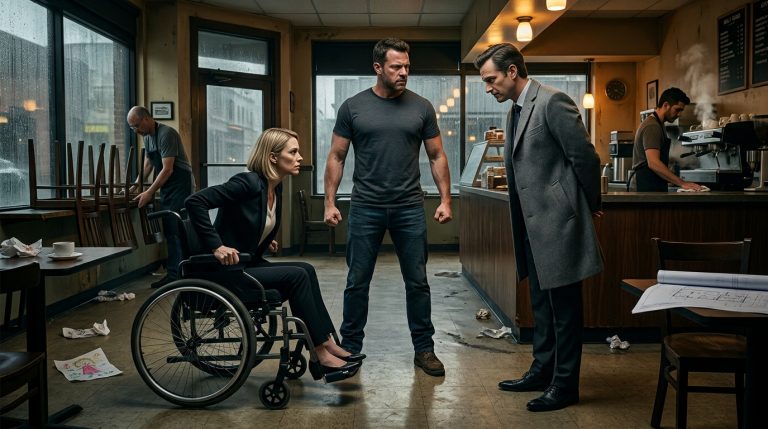
The man who entered was tall, his coat dripping with the remnants of the mist. He stopped, his gaze immediately landing on the faint, raised ridges of white scar tissue that traced the line of her neck. He didn’t look at her eyes. He didn’t look at the menu. He looked at the history written on her skin.
Isabella felt the familiar, cold prickle of judgment—the silent questioning of her place in this world—but she didn’t look away. Instead, she picked up a porcelain mug, the ceramic warm and chipped at the rim, and set it down with a deliberate, soft click.
“Coffee?” she asked.
The man stared, his expression a tight, narrow thing. “You don’t get many out-of-towners this early, do you?”
“I get exactly who the road sends,” Isabella replied, turning her back to him to face the rising steam of the urn. She felt the weight of the air change, a sudden, sharp shift that felt like the moment before a mortar strike, heavy with an incoming truth she wasn’t ready to hear.
CHAPTER 2: The Fracture
The man’s eyes flickered—a brief, involuntary stutter of pupils against the harsh overhead fluorescent lights. He had expected a cower, a flush of embarrassment, or perhaps a defensive stammer. Instead, he met a stillness that felt deeper than the room itself. Isabella remained motionless, her hand still resting on the ceramic handle of the mug. She didn’t press the offer of coffee again; she simply let the silence expand, allowing the man to fill it with his own discomfort.
The smell of his cologne—sharp, citrus-heavy, and aggressively expensive—clashed with the diner’s grounding aroma of burnt coffee and floor wax. It was a scent that didn’t belong in Highway 12, a sensory phantom that suddenly pulled Isabella back to a morning in 2010. She could almost feel the dry, grit-laden heat of a desert sunrise, the way the sand used to coat the back of her throat before the mortars began their daily ritual. The comparison was involuntary, a flash of memory that she filed away with a practiced mental click. She wasn’t a medic in the sand anymore; she was Izzy, the waitress who knew how to balance a tray through a crowd.
“I asked a question,” the man said, his voice regaining its edge as he tried to reclaim the narrative. He gestured vaguely at the scar tissue on her neck, a gesture that was dismissive and territorial. “Don’t they teach you to answer customers in this place?”
Isabella’s gaze drifted to the diner door. The morning mist was thinning, revealing the dull, gray asphalt of the highway. She knew the rhythm of this place. If she answered with aggression, she would be just another waitress having a bad day. If she answered with softness, she would be a target. She chose the middle path: the professional void.
“We prioritize service, not interrogation,” she said quietly. She finally poured the coffee, the liquid dark and steaming, creating a small, swirling eddy in the center of the cup. She set the pot down and began to wipe the counter with a cloth, her movements rhythmic, methodical, and purposefully oblivious to his agitation.
The man’s two companions shifted in the booth behind him. They were watching, their expressions a mixture of curiosity and a strange, budding resentment. One of them, a younger man with eyes that hadn’t yet learned to hide his lack of conviction, tapped his credit card on the laminate table. It made a high, staccato sound—tack, tack, tack—a deliberate irritation.
“You look like you’ve seen things, sweetheart,” the leader said, his smirk returning, though it looked brittle now. “Maybe even things that would make a place like this feel like a retirement home. We’re in town for a development project. The city is expanding. We’re looking for people who can manage high-stress environments. A woman with… that history… might be a waste of talent behind a griddle.”
Isabella stopped wiping. She looked at him then, really looked at him, for the first time. She didn’t see a businessman; she saw a man who used power to fill a vacuum where his own curiosity should have been.
“I’m exactly where I need to be,” Isabella said. Her voice didn’t waver.
“Are you?” He leaned in, his voice dropping to a conspiratorial, almost mocking pitch. “We represent a firm that cleans up ‘neglected’ assets. We fix what’s broken. We could offer you a role that actually demands that level of grit. A consultant, maybe. Someone who knows how to keep a cool head when the pressure gets real.”
He was dangling a carrot, but the bait tasted like sulfur. He wasn’t offering her a job; he was attempting to purchase her silence, to sanitize the discomfort he felt looking at her skin. He wanted to own the mystery of her, to fold it into his portfolio so he didn’t have to wonder about the woman behind the scar.
The bell over the door jingled again, a welcome intrusion. Margaret Benson stepped out from the kitchen, wiping her hands on her apron. She sensed the tension before she saw it—the air in the diner had turned static, like the charge before a lightning strike. She moved toward the booth, her presence a soft, warm texture in the room.
“Everything alright over here?” Margaret asked, her tone light but watchful.
The businessman turned, his mask of authority sliding back into place. “Just discussing business, ma’am. Your waitress has a unique… resume.”
Isabella didn’t wait for Margaret to intervene. She stepped forward, her hand moving to the donation jar by the register. It was a heavy, glass thing, filled with loose change and a few stray bills. She didn’t look at the businessman. She looked at the jar, the way the light caught the scratched glass.
“I think your coffee is getting cold,” she said, her tone final.
She turned away, leaving the man with the cooling cup and the unresolved offer. But as she walked toward the kitchen, she felt the man’s eyes trailing her, a lingering weight that made the space between her shoulder blades itch. She had successfully deflected the interrogation, but the ripple had started. The “job offer” was a tremor, a warning sign that the world outside was beginning to notice the quiet woman who didn’t fit the mold.
Behind her, she heard the younger man murmur something, followed by a low, sharp reprimand from the leader. Isabella reached the kitchen doorway and paused, catching her reflection in the stainless steel backsplash. She looked the same—the apron, the scars, the quiet posture—but the internal landscape had shifted. She was no longer just the waitress; she was the axis upon which their unease turned. She realized then that the peace she had built at May’s was not an impenetrable wall, but a glass house. And the wind was beginning to pick up.
She took a long, slow breath, letting the smell of bleach and coffee settle her heart. She wasn’t going to let them in. She would serve their food, take their money, and remain the ghost in the machine until they moved on to the next town. But as she looked at her hands—the hands that had held dying men and now held nothing more than a wet cloth—she knew that wasn’t going to be enough. They weren’t going to move on until they understood why she didn’t break.
And in that realization, she felt a flicker of something she hadn’t felt since the convoy: the cold, bracing necessity of a defense.
CHAPTER 3: The Ripple Effect
Isabella kept her back to the dining area, her fingers gripping the edge of the stainless steel counter until her knuckles turned a stark, bloodless white. The silence from the front of the diner was not empty; it was pressurized. She could hear the rhythmic clinking of the businessmen’s silverware—too precise, too loud—as if they were intentionally punctuating the stillness.
She turned the tap, and cold water splashed into the deep basin, the sound a welcome distraction from the weight of the scrutiny pressing against her spine. She wasn’t just washing dishes; she was scrubbing away the lingering residue of that “consultant” proposal. It was a preposterous offer, wrapped in the glossy veneer of corporate advancement, but beneath it lay a predatory curiosity. They weren’t interested in her skills; they were interested in the story behind her skin.
“Izzy,” Margaret called softly from the entrance of the kitchen. Her voice held a note of genuine concern, the kind that frayed at the edges. “They’re gone. They left a tip—too much of one, if you ask me.”
Isabella turned off the water and dried her hands on her apron. She didn’t look at the counter where the men had been sitting. She focused on the faded texture of Margaret’s uniform, the way the fabric had thinned over years of service. “It doesn’t matter what they left, Margaret. They aren’t going to be the last ones.”
She walked past the older woman and stepped back into the dining room. The shift in the atmosphere was immediate. The regulars—the retired school principal, the construction workers—were not looking at their newspapers or their lunches. They were looking at Isabella. It was a subtle, almost imperceptible change, but it was there: a new awareness, a speculative glint in their eyes that hadn’t existed yesterday.
Isabella navigated the floor with her usual practiced grace, refilling a coffee mug here, dropping off a check there. But she felt like a specimen under a microscope. Every movement was observed. Every flash of the scar tissue on her arm as she reached for a sugar caddy elicited a glance from the corner booth.
She retreated to the register to tally up the receipts, her mind running through the logistics of the afternoon. She had to restock the supply room, prep the evening menu, and deal with the fluctuating inventory that the diner’s local supplier seemed unable to keep consistent. It was the same routine she had followed for years, a rhythmic heartbeat that had kept her sane. Today, however, the rhythm felt off-sync.
She glanced at the phone mounted on the wall. It sat there, a silent piece of plastic that had only ever been used for mundane orders. But the air around it felt charged. She had a sudden, irrational fear that it would ring, and on the other end would be one of those men, or someone else representing that “firm,” asking questions she had spent a decade making sure no one could answer.
She pulled out a notebook from under the register—a simple, lined pad where she kept track of shift hours and minor expenses. She began to write, the tip of her pen scratching against the paper, a dry, rasping sound that mirrored the tension in her chest. She needed to focus on the tangible. The tangible was safe. The tangible didn’t ask about Fallujah.
She realized then that her “invisibility” had been her greatest asset, and she had allowed it to be stripped away in a single morning. The businessman’s arrogance had acted as a catalyst, and now, like an ink drop in a glass of clear water, the knowledge of who she was—or rather, the mystery of who she was—was diffusing through the town.
She looked up and caught the eye of the man in the corner booth—a regular, someone she had served coffee to every Tuesday for four years. He looked away quickly, his face flushing a dull red. The realization hit her with the force of a physical blow: the town wasn’t just observing her; they were starting to pity her, or worse, they were starting to mythologize her. They were trying to piece together the fragments of her life without ever asking her for the truth.
She felt the urge to stand on a table and tell them to stop, to tell them she was just Izzy, but she stayed rooted behind the register. To speak would be to acknowledge the narrative they were creating. Instead, she chose the silence of the strategist. She would let them whisper. She would let them speculate. She would go about her work with a precision that bordered on the clinical, and she would hold her peace.
The afternoon sun hit the front window, turning the dust motes in the air into a shimmering haze of gold. It was a beautiful sight, the kind that usually brought a sense of quiet contentment, but today it just made her feel exposed. She was a fixed point in a changing landscape, and she could feel the edges of her sanctuary fraying.
She reached into her pocket, her fingers grazing the edge of the bent photograph she always carried. She didn’t pull it out. She just held it there, a hidden anchor. She had survived far worse than small-town speculation. She had survived the fire, the shrapnel, and the long, slow, agonizing crawl through the recovery ward. If this was the new battlefield—this quiet, prying curiosity—then she would hold this ground, too.
But as the afternoon wore on, and the line of customers slowed to a trickle, she noticed something that stopped her cold. On the bulletin board near the exit, where locals pinned flyers for lost dogs and estate sales, there was a new piece of paper. It was a printout, a screenshot of a social media post, featuring a blurry photo taken from the street. It was of her, taken through the diner window, mid-pour, her arm partially obscured by the sleeve of her apron. The caption, handwritten in thick marker, simply read: The Quiet One. 5 a.m.
Isabella stood before it for a long, quiet minute. The world had started to map her, and she was only just beginning to understand the territory.
CHAPTER 4: The Gathering
The storm arrived with little warning, a bruising wall of slate-colored clouds rolling over Highway 12 that turned the midday light into a dim, pre-evening gloom. The temperature plummeted, and the wind began to howl against the diner’s aging frame, rattling the windowpanes in their frames. Isabella stood behind the counter, her hand still hovering near the bulletin board where the screenshot had been pinned. The air inside felt thin, charged with the static of the approaching front.
She wasn’t looking at the photo anymore. She was watching the road.
Through the rain-streaked glass, she saw them. They didn’t arrive in a convoy or with sirens. They appeared out of the mist like specters, one by one, each stepping from a different vehicle—a battered pickup, a sedan with faded bumper stickers, a motorcycle with a rusted exhaust. They didn’t park in a neat line; they scattered, a loose formation of figures moving against the wind with the familiar, squared-shouldered gait of people who had spent their lives learning how to endure.
Isabella felt a sudden, sharp constriction in her throat. She recognized the posture. She knew the way they shielded their faces from the wind. They were Marines, men and women who had carried the weight of the same ghosts that haunted her own quiet mornings.
The bell over the door gave a sharp, frantic jingle as the first of them entered. He was a man with graying hair and a heavy, waterproof jacket. He didn’t look around the room; he walked straight to the counter, his eyes locking onto Isabella’s with an intensity that made the surrounding space feel suddenly small. He reached into his pocket and placed a small, cloth-wrapped object on the laminate counter. It landed with a dull, weighted sound.
“We heard,” he said, his voice raspy from the cold. “They shouldn’t have put your face on a wall, Izzy.”
Behind him, more flooded in. The diner, usually a sanctuary of empty booths and quiet contemplation, was transformed into a space of tight, kinetic energy. The regulars huddled in the back, silent and wary, watching as these strangers took over the room. Isabella looked at the cloth-wrapped object. It was a unit patch, the edges frayed and discolored by years of sun and dust.
She felt the familiar, dangerous urge to retreat, to go back into the kitchen and close the door until the world went away. But as she looked at the patch—the mark of Echo 12—the impulse was replaced by something else. A hot, grounding sense of clarity. The “job offer” from the businessmen had been a shallow, predatory ripple, but this… this was a tide.
“I didn’t ask for this,” Isabella said, her voice sounding unnervingly clear over the roar of the wind outside.
“Nobody ever does,” the man replied. He nodded toward the back of the room, toward the businessmen’s old booth, which was now occupied by a woman in a trench coat, her eyes scanning the diner with the same tactical assessment Isabella had used just hours before.
The escalations continued. More veterans arrived, shaking off their wet coats, filling the diner with the scent of damp wool and the quiet, metallic click of unit coins being placed on the counter. The “physical clues” she had spent years hiding in the cracks of her life were being laid out in the open, a sprawling mosaic of shared sacrifice.
Isabella moved behind the counter, the machine of her day-to-day life breaking down under the sheer volume of history filling the room. She began to pour coffee, the urn hiss sounding like gunfire in the heightened silence. She didn’t have to ask for their orders; she simply served. And with every cup, she felt another layer of her “quiet” life being peeled away.
She looked toward the kitchen door. Margaret was standing there, her face a mixture of fear and awe. She reached out, catching Isabella’s sleeve as she passed. “Izzy, what’s happening? Who are these people?”
“They’re the people I saved,” Isabella whispered, the truth feeling heavy and sharp as it left her lips. “And the people who saved me.”
She pulled away, her movements becoming faster, more urgent. She saw a young man standing near the entrance, holding a photo from the field hospital—the one she had tried to burn a decade ago. The sight of it felt like a punch to the stomach. The decoy secret—the idea that she was a failure trying to hide—was utterly shattered, replaced by the crushing weight of their gratitude.
The wind outside intensified, a sudden gust slamming against the diner and blowing the front door wide open. Rain sprayed across the threshold, soaking the floor. Isabella didn’t look at the mess. She looked at the man in the doorway—the one who had first sneered at her scars, the businessman. He stood there, drenched, his expensive coat ruined, his face drained of every ounce of arrogance.
He looked at the sea of veterans, at the wall of faces that had come to see the woman he had tried to belittle. He looked at Isabella, and for a moment, the distance between them vanished. The power dynamic that he had built his entire career on was gone, dismantled by the sheer, unyielding reality of the people in the room.
He didn’t speak. He couldn’t. He just took a step backward into the rain, his world shrinking to the size of a failure he had never anticipated. Isabella watched him go, her hands steady, her heart hammering a rhythm that wasn’t fear, but the pulse of a long-delayed truth. She was no longer just the waitress. She was the epicenter, and the storm had only just begun to peak.
CHAPTER 5: The Mirror
The rain didn’t wash the tension away; it only trapped it inside the diner. The businessman stood just beyond the threshold, a silhouette against the gray curtain of the storm, his shoulders hunched, his posture failing. He looked less like an architect of urban expansion and more like a man who had realized the foundation he was standing on was made of glass. Isabella stood behind the counter, her gaze locked onto him. She noticed the frayed, torn seam of his coat pocket—a tiny, jagged rip that suggested a frantic, careless movement. It was a sign of a man whose internal order was rapidly dismantling.
She didn’t let him go. She picked up a clean, dry cloth and began to polish the surface of the donation jar—the jar that had become the unexpected centerpiece of this entire, unforeseen collision. The veterans in the room didn’t move. They were a wall of silent, protective resonance, their presence a physical barrier between Isabella and the world that had tried to dismiss her.
“Come inside,” Isabella said. Her voice was not loud, but in the cavernous silence of the diner, it carried with the force of a command. “The rain is ruining your suit.”
The man hesitated. For a heartbeat, the pride that had driven him to mock her earlier warred with the crushing realization that he was an outsider here, an interloper in a community of people who spoke a language of endurance he couldn’t possibly understand. Slowly, he stepped back across the threshold. He stood in the entryway, shivering, his expensive leather shoes leaving dark, watery prints on the linoleum.
The veterans watched him, their expressions unreadable, but their eyes tracking his every move with the calculated patience of predators. The businessman looked at the donation jar, then at the wall of faces, and finally, his gaze settled on Isabella. His arrogance was gone, replaced by a raw, naked confusion.
“I didn’t know,” he whispered, the words sounding thin, lacking the sharp, sneering edge of his previous interactions. “I thought this was just a stop on the road. A place to be bypassed.”
“You weren’t looking at the place,” Isabella replied, her tone devoid of malice, yet undeniably cold. “You were looking at a mirror you didn’t want to see.”
She walked around the counter, her steps deliberate. The distance between them was only a few feet, but it felt like a gulf of a decade. She stopped, meeting his gaze. She didn’t look at his torn pocket or his soaked hair; she looked at the man who had been terrified by the mere sight of her scars. She saw the fear there—the fear of someone who had never had to fight for anything, someone who had built their identity on the fragility of social standing.
“You wanted to offer me a job,” she said, her voice dropping into a quiet, conversational rhythm that felt more dangerous than a shout. “You thought you could buy the perspective I earned. You thought you could commodify the survival that you spent your whole life ignoring.”
He opened his mouth to speak, perhaps to apologize, perhaps to defend himself, but no sound came out. The weight of the room, the collective silence of the people who had survived what he couldn’t even fathom, pressed against him. He reached into his coat—a nervous, jerky motion—and withdrew his wallet. He didn’t count the money. He just pulled out a thick stack of bills and placed them on the counter. His hand was shaking.
Isabella didn’t take the money. She nodded toward the jar.
He moved forward, his movements stiff, and pushed the money through the slot. The sound of the bills hitting the bottom of the glass jar was loud—a crisp, final finality.
“I’m leaving,” he said, his voice barely audible. “I… I have nothing to say.”
“There’s nothing to say,” Isabella agreed. She turned her back on him, walking back to her station. She heard the bell chime as he left, the sound of the rain rushing back in for a split second before the door clicked shut.
The diner remained silent. Isabella picked up a fresh pot of coffee, her hands steady, but her mind was racing. The “decoy” of this situation—the idea that she was being “rescued” by these men—felt brittle. They hadn’t rescued her. They had simply forced the world to finally acknowledge the ground she stood on. She looked at the regulars, at the Marines who were slowly beginning to talk among themselves, their voices low and steady, as if they were discussing a long-overdue reunion.
The conflict was resolving, but the emotional exhaustion was beginning to set in. She had stood for the duration of the storm, and now, as the rain outside began to soften into a dull, rhythmic drizzle, she felt the phantom pain in her arm pulse—a rhythmic, dull ache that reminded her of everything she had pushed down to keep this place running.
She wasn’t a hero, and she wasn’t a victim. She was Isabella Cruz, and she was tired. But as she watched the light begin to shift in the window, she realized the town wouldn’t be the same tomorrow. The “Quiet One” was a story now, a map, a reference point. She would have to decide how to inhabit that space.
She walked over to the window and looked out at the highway. The mist was clearing, and for the first time in ten years, the road didn’t look like a place to hide. It looked like a path.
CHAPTER 6: The Final Light
The VFW hall was three blocks away, a modest brick structure that seemed to hold its breath in the cool evening air. Isabella walked the distance, her boots clicking rhythmically against the rain-slicked pavement. She wore the black dress she had pulled from the back of her closet, the fabric simple and unadorned. She didn’t try to cover the scars on her neck or the raised, uneven skin on her right arm. For the first time in a decade, she moved through the town not as a waitress, not as a woman trying to blend into the scenery, but as a person whose history was finally a part of her present.
Inside the hall, the atmosphere was thick with a warmth that defied the chill of the storm. When Isabella pushed open the heavy wooden doors, the hum of two hundred voices ceased. The room was a sea of dress blues, civilian jackets pinned with unit patches, and families standing in unified silence. They weren’t looking at the waitress; they were looking at the medic who had held the line when the fire roared.
Major Carter Brooks stood at the podium, his presence commanding yet softened by the lines of time. He didn’t speak with the booming authority of an officer; he spoke with the quiet, measured cadence of a man who had been searching for an answer for seven years. “We wondered if she had survived the aftermath,” he said, his gaze finding Isabella’s. “We wondered if the world had taken the best of her. But tonight, we see that she didn’t just survive. She carried the light forward, and in doing so, she became the reason we are all standing here.”
Isabella walked down the center aisle, her heartbeat steady, her hands at her sides. She felt the weight of every gaze, but for the first time, it didn’t feel like judgment—it felt like recognition. She reached the podium, and the cool metal surface beneath her fingers was the most grounding thing she had touched in years.
“I didn’t think this day would come,” Isabella began, her voice gaining strength with every word. She looked out at the faces—the young Marine holding his infant son, the woman who had become a nurse, the families who had found their own ways to heal. “I spent years thinking my scars were proof that I had failed to move on, that they were the jagged edges of a version of me that was better left behind in the dust of Fallujah. But they aren’t proof of failure. They are the map of where I had to go to get back to myself.”
She paused, looking at her right hand, the one that had once trembled at the mere memory of heat. It was still now. “I wasn’t hiding in that diner. I was finishing the job. I was stitching my own life back together, one shift at a time, one cup of coffee at a time. I was waiting to be ready to carry the weight of everything I had done, not as a burden, but as a testament.”
As she spoke, Major Brooks presented her with the shadow box. Inside, the Purple Heart gleamed, resting against the fabric of her old, long-folded uniform. It wasn’t a relic of trauma; it was a badge of continuity.
The applause that followed was not the frantic, loud sound of a crowd looking for a hero. It was slow, rhythmic, and deeply resonant. It was the sound of people who understood exactly what it cost to stay whole.
When the ceremony finally drew to a close and the lights in the hall began to dim, Isabella didn’t rush to leave. She stood by the podium for a long time, letting the weight of the moment settle. She remembered the chipped ceramic mug at the diner—the one she had mended with mismatched glue. She realized then that her life was like that mug; the cracks were still there, the mending was imperfect, but the vessel held. And that was enough.
She walked back to the diner late that night. The storm had passed, leaving the air crisp and clean. She entered the quiet space, the scent of bleach and stale coffee welcoming her home. She went to the kitchen and found the chipped mug sitting on the counter. She picked it up, running her thumb over the seam where she had glued it back together. It wasn’t a broken thing anymore. It was a repaired thing.
Margaret Benson appeared in the kitchen doorway, a soft, tired smile on her face. “You did good, Izzy. They’re proud of you.”
“I’m proud of us,” Isabella said, her voice soft.
She moved to the window, the same one where she had watched the businessmen arrive that morning. She looked out at the highway, at the dark ribbon of asphalt that led away into the distance. It wasn’t a path to escape anymore. It was simply the road.
She turned off the lights, the diner sinking into a peaceful, velvet darkness. She left the donation jar on the counter, full and heavy with the kindness of strangers and the gratitude of friends. She walked to the back, to the small, quiet room where she lived, and for the first time in ten years, she didn’t need to lock the door against her past. She had walked through the fire, and she had come out on the other side, not as someone who had forgotten, but as someone who had finally learned how to stand in the light.
The silence of the night was no longer the silence of the void. It was the silence of a life finally, completely, hers.