The Weight of Salt and Iron: The Unrecorded Reclamation of Mark Douglas
CHAPTER 1: THE FRICTION OF YOUTH
The wood under Mark’s palms was oil-soaked and split down the grain, the kind of cheap pine that absorbed forty years of spilled lager and sour sweat until it became something harder than rock. He didn’t look at the lieutenant. To look at him was to acknowledge the specific, blinding shine of the gold trident pinned to the boy’s crisp white linen—a clean piece of metal that hadn’t yet been scrubbed with salt water or dragged through the black mud of a delta bank.
“I said, are you deaf?”
Lieutenant Jax Miller leaned lower. His shadow swallowed the amber pool inside Mark’s shot glass, cutting off the low, buzzing neon reflection from the Miller Lite sign behind the bar. Miller smelled of expensive bay rum, fresh laundry, and the high-altitude oxygen from a pressurized cabin. He was twenty-four, maybe twenty-five, his skin tight and unblemished except for the slight pink flush of imported premium beer along his jawline. Behind him, four other boys from the squad shifted their weight, their grins wide, transactional, and hungry for a performance.
Mark didn’t move his boots. His old red flannel shirt was thin at the elbows, the canvas of his jacket smelling faintly of the wood smoke from his morning stove and the slow, damp rot of the cedar grove behind his porch. His right hand remained flat against the counter, the skin there a topography of liver spots, white gray scars, and thick, rigid knuckles that didn’t quite close into a proper fist anymore. But they weren’t shaking.
“VFW is down the street, Grandpa,” one of the boys in the back drawled. Sledge, they called him. A thick-necked creature built for breaching doors. “We need the space. Active duty only tonight.”
Mark lifted the glass. The movement was slow, deliberate, the friction of his sleeve against the polyurethane table making a dry, scratching sound like a beetle in the wall. The cheap whiskey hit his tongue—sharp, chemical, burning with the chemical heat of something distilled in a plastic tub—but he held it there before swallowing. He let the heat clear the stale taste of the room from his throat.
When he looked up, his eyes were the color of wet river slate, clouded by the yellowing film of seventy-two years but perfectly level.
“I am fine right here, son,” Mark said. His voice didn’t carry. It stayed low, vibrating in the old timber of the booth, rough as a shovel blade hitting gravel.
Miller chuckled, a short, dry bark that he threw over his shoulder to his audience. The boys grinned on cue. Miller turned back, his face tightening as he planted his palm directly onto the table, his knuckles inches from Mark’s glass. “You don’t get the hierarchy here, old man. We just finished an extraction. We’re the tip of the spear. You’re taking up the only clean leather in the joint. So unless you’ve got a trident tucked under that rags-and-bones coat, grab your cane and shuffle.”
Sully stopped wiping the glass behind the bar. The heavy cotton rag froze in his hand, his eyes dropping to the space where Mark’s sleeve had slipped back exactly one inch.
Beneath the frayed cuff of the red flannel, the skin of Mark’s inner wrist didn’t carry the blue ink of an old anchor or the standard eagle of the regular fleet. It was a smooth, hairless indentation—a perfectly circular brand, white as tallow, puckered at the edges where the iron had cooked the fat right out of the flesh forty years ago.
Mark didn’t hide it. He simply reached into his pocket, his fingers closing on a crumpled ten-dollar bill. The motion was small, but Miller’s shoulder twitched, his right hand dropping three inches toward his waistband in a reflexive, defensive jerk before he caught himself. The boy’s face turned the color of raw liver. He had flinched. He had flinched for a geriatric civilian.
“For the drink,” Mark said softly to the space between them, sliding the bill onto the grease-filmed wood. He began to turn his hips to clear the vinyl bench, his old knees popping with a sound like dry kindling.
But Miller stepped hard to the left, his polished boot locking against the leg of the table, barring the exit. “Not so fast. You don’t walk away while I’m talking to you.”
Mark stopped. The annoyance didn’t hit his eyes; it stayed down in his jaw, a slight hardening of the muscle under the gray stubble. “Get out of my way, son.”
“Or what?” Miller leaned down until Mark could smell the alcohol on his breath. “You going to hit me with your pension? In the teams, we have call signs. Names earned in the mud. I’m Viper. He’s Sledge. What was yours, paper-pusher? Private Pile?”
The hum of the neon sign seemed to drop an octave. Mark looked at the lieutenant’s teeth—straight, white, expensive. Then the grimy pine of the table began to smell less like stale beer and more like rotting ferns after a three-day downpour.
CHAPTER 2: THE JUNGLE FLOOR
The white, sterile glare of the lieutenant’s teeth didn’t just stand out against the dim, amber-soaked wood of the Rusty Anchor; it became a focal point that pulled the old air right out of Mark’s chest. The smell of sour yeast and floor wax didn’t fade—it twisted, curdling into the thick, heavy stench of black river silt and decaying vegetation after a three-day tropical downpour. The heat didn’t rise from a radiator; it slithered up from the floorboards, greasy and wet, sticking the thin cotton of his red flannel shirt directly to the dry leather of his shoulder blades.
Mark didn’t blink. His left boot remained anchored against the grit of the sawdust floor, the rubber sole worn flat by years of gravel paths and quiet kitchen tile. He looked at the boy’s throat. Right below the crisp white line of the dress collar, a small pulse hammered against the tan skin—fast, shallow, the rhythm of a juvenile predator that hadn’t yet learned that a cornered thing doesn’t always run.
“I asked you a question, old man,” Miller muttered. His voice had lost its theatrical volume, dropping into a sharp, localized hiss meant only for the three inches between his nose and Mark’s gray stubble. “What’s the call sign? Or did you leave your spine in the supply depot?”
Behind Miller, the big one—Sledge—shifted his boots, his heavy shadow blocking the exit to the alley. The air between them was tight, dry, charged with the friction of five young men who believed the world was an anvil and they were the only hammers in the room.
Mark felt the small manual brass pocket watch in his trousers press against his hip bone. The steady, mechanical click-click-click of its balance wheel was a tiny, metallic heartbeat against his thigh, losing its four minutes a day, dragging him backward even as the room held its breath. His right hand, still resting near the crumpled ten-dollar bill on the oil-stained pine, tightened until the old, circular brand on his inner wrist burned like a fresh ember.
The scar wasn’t a military record. It was an omission.
“You’re loud, kid,” Mark said. The words didn’t come from his throat; they came from deep in the salt of his lungs, dry and heavy as iron ore being dragged across a concrete floor. “Loud men die early in the high grass. They give away the numbers before the mortar even drops.”
Miller’s jaw didn’t just set; the skin around his eyes twitched, a tiny flinch of pure, unadulterated confusion. He wasn’t used to the weight of an old man’s stare looking through him rather than at him. To Miller, age was a deficit, a slowing of the clock, a softening of the bone. He didn’t recognize the iron underneath the gray moss.
“Don’t talk to me about the grass,” Miller whispered, his hand rising, fingers hooked like talons as he reached for the collar of Mark’s canvas jacket. The movement was calculated for humiliation, a quick, physical eviction to re-establish the boundaries of the room. “You don’t know the first thing about what we—”
The transition didn’t take an hour; it took a microsecond.
Mark didn’t strike. He simply adjusted his center of gravity by two inches, his weight dropping into his heels as his left forearm came up in a short, brutal arc that caught Miller’s wrist from the inside out. It wasn’t an attack; it was a structural correction. The bone of Mark’s arm met the boy’s tendons with a dull, wet thud that sent a vibration clear through the leg of the table.
Miller didn’t yell, but his breath caught, his fingers instantly uncurling as his arm was forced upward and away from the canvas fabric. His boots slid an inch through the sawdust, the grease on the floor offering no purchase against the sudden, solid resistance of a man who moved like an old oak stump.
“Davis,” Miller hissed, his eyes widening as he stumbled back a half-step into the chest of his own squad mate. “Grab him.”
The four SEALs behind him didn’t hesitate. They didn’t pull weapons—this was a bar, a base town, a public space under the loose jurisdiction of the local shoreline patrol—but they moved with the synchronized, fluid mass of a boarding party. Sledge came from the left, his broad shoulders dropping to pin Mark against the high back of the vinyl booth, while the other three closed the gap in front of the counter.
Mark didn’t look for help. Behind the bar, Sully’s shadow had already vanished through the narrow, unpainted door that led to the back office where the safe sat. The heavy timber of that door didn’t slam; it clicked shut with a small, brass finality that meant the line was already open.
Mark’s spine pressed against the cracked vinyl. The material gave way with a dry groan, the foam padding underneath brittle from decades of heat and neglect. He could feel the cold iron of the table’s pedestal through his trousers, a solid anchor in a world that was suddenly spinning into tactical increments. One second to the left elbow. Two seconds to clear the small gap between the booth and the cigarette machine. Three seconds before the big one’s weight buried him.
He didn’t have his rifle. He didn’t have the long blade he’d carried through the triple-canopy forest of the Meong in ’69. He had two thumbs, an un-jointed hip, and seventy-two years of salt in his blood.
“Stand down, son,” Mark said, his gray eyes locking onto Sledge’s throat as the big man’s fingers reached for his shoulder. “You haven’t seen the bill for this table yet.”
The boy didn’t answer. He just leaned in, his bulk blocking the last bit of the neon beer light, his skin smelling of premium hops and the cold grease of the harbor.
CHAPTER 3: THE COLD LINE
The leather of Sledge’s boot scraped the floorboards, a dry, grating sound that vibrated right through the iron legs of the booth and into the marrow of Mark’s shins. The big man’s fingers were wide, thick-jointed, and cold from the harbor damp as they reached down to clamp onto the worn canvas of Mark’s shoulder. There was no hesitation in the movement; it was the practiced weight of a technician handling an inert piece of machinery that simply needed to be cleared from the floor.
Mark didn’t pull away. He let his ribcage expand against the cracked vinyl backing, his breath dropping low into his diaphragm until his center felt as heavy as a sunken anchor. His shoulder didn’t drop; it tilted back by less than a quarter-inch, just enough to let Sledge’s momentum push the big man’s palm directly into the rigid ridge of Mark’s collarbone. The canvas fabric bunched, the old metal snaps of his jacket clicking against each other with a small, sharp sound like a firing pin dropping on an empty chamber.
Behind the bar, the unpainted door to the back office didn’t shake, but the faint, mechanical click of its latch setting into the frame echoed through the small gap between the wood and the copper floor strip.
Inside that back room, forty feet away from the glare of the neon signs, the air was cold. It smelled of old ledger paper, dry rot, and the grease used to lubricate the heavy dials of the iron floor safe. Sully didn’t drop the glass-wiping rag until his boots cleared the threshold. His heart hammered a jagged rhythm against his ribs, a frantic, hollow thudding that felt entirely too loud in the windowless smallness of the office.
His large, scarred fingers didn’t shake as he reached for the combination dial, but the skin around his knuckles was gray under the raw bulb hanging from the ceiling. He didn’t need to look at the card inside his wallet; the digits had been burned into his memory since the day the old admiral had handed over the deed to the Rusty Anchor.
Three turns to the left. Two to the right.
The heavy iron mechanism inside the safe door gave a low, metallic groan as the tumblers dropped into their slots—a dry, rusted sound that felt like teeth grinding together in the dark. Sully reached past the stacks of rolled quarters and the extra boxes of receipt tape until his palm brushed the cold, hard plastic of the bakelite receiver. It wasn’t a standard base line. The wire didn’t run out to the pole on the main road; it dropped straight through a hole bored through the concrete foundation, down into the salt-rimmed dark of the cellar.
As he lifted the receiver to his ear, his sleeve caught on the edge of the low wooden desk panel, pulling it back just enough to expose the gray junction box behind it.
Sully froze. His breath caught in his throat, a cold knot forming right behind his teeth.
The unlisted line wasn’t standard. Attached to the terminal block was a heavy, military-grade mechanical splitter—a dual-routing relay with a dull olive-drab casing that hadn’t been factory-installed by the telephone company. The copper contacts were bright, scraped clean of dust, showing that current had been running through both leads for a long time. One wire went down into the floorboards toward the basement; the second split disappeared through the back wall, running straight into the conduits that fed the municipal junction box across the street.
The line didn’t ring. It didn’t have a dial tone. The moment the receiver cleared the cradle, the line hummed with the high, clear whistle of a secured encryption bridge.
“Identify,” a voice said. It didn’t come through a speaker; it sounded like it had been dropped into a well of dry ice—flat, clipped, and completely devoid of the static that usually accompanied an analog connection.
“This is Sully,” the bartender whispered, his forearm pressing against the rusted edge of the safe door to steady his weight. His eyes stayed locked on the olive-drab splitter behind the desk. “At the Anchor. He’s here.”
“Specify target.”
“The old man. The one with the circle on his wrist. Douglas.” Sully’s voice cracked slightly, the moisture in his mouth completely gone. “We’ve got a squad of active frogs from the base pushing him. Miller’s kid. They’re fixing to drag him out. It’s about to break wide open.”
The silence that followed on the other end of the line was so heavy that Sully could hear the faint, sixty-cycle hum of the transformer inside his own desk lamp. There was no clicking of a tape machine, no intake of breath. Just a cold, empty void that suggested the person on the other end wasn’t sitting in an office, but standing in a room where the light never changed.
“Do not intervene,” the voice returned. The command wasn’t loud, but it had the weight of an iron door dropping into a groove. “Do not let anyone leave the building before the vehicle arrives. Three minutes.”
“Listen,” Sully stammered, his fingers tightening on the black bakelite until the plastic creaked. “Miller’s boy doesn’t know. He thinks he’s just rolling a civilian. If Douglas takes him apart—”
“The line is clear,” the voice interrupted, and then the line didn’t click—it simply died, the high hum vanishing into an absolute blackness that left Sully’s ear ringing.
He stood there for two seconds, the dead receiver still pressed against his cheek, his gaze fixed on the bright copper wire of the hidden splitter. The metal was too clean. The solder joints were fresh, silver against the grease-filmed dust of the baseboard. Someone had been maintaining that tap. Someone had been waiting for this specific call to go through from this specific room.
Outside, through the thick pine paneling of the partition wall, came the heavy, muffled sound of a chair leg splintering against the floorboards.
Sully dropped the receiver into the cradle with a sharp clack. He didn’t look back at the safe. He forced his heavy frame back through the narrow door, his boots hitting the sawdust of the main room just as Sledge’s shoulder leaned into Mark’s chest, the big man’s bulk blotting out the last yellow sliver of the bar’s western window.
Mark didn’t look at Sully as the bartender emerged. His eyes remained fixed on the lower edge of Miller’s jaw, watching the way the young lieutenant’s skin grew white around the corners of his mouth. The world inside the Rusty Anchor had stopped moving forward; it was spinning on a rusted pin, waiting for the first drop of oil to clear the gear.
CHAPTER 4: THE SOUND OF RED RIBBON
The mass of Sledge’s shoulder didn’t just block the light from the street; it compressed the air between their chests until the smell of the harbor damp became a solid thing in Mark’s throat. The big man’s fingers remained fixed on the worn canvas of Mark’s coat, the fabric straining against the old copper rivets. Mark didn’t shift his weight back. He kept his heels locked into the floorboards, his gaze steady on the small pulse jumping under Lieutenant Miller’s jawline. The boy was waiting for the snap. He was waiting for the old bone to give way under the weight of five active tridents.
Then the front door of the Rusty Anchor didn’t simply swing; it met the interior plaster with a rhythmic, explosive crack that sounded like a low-caliber round clearing a muzzle.
The heavy oak panel shuddered against the iron stop, the vibration traveling down the main structural beam of the ceiling and causing the tin shades of the low-hanging lamps to dance. The sudden backdraft blew a gust of cold, rain-rimmed air across the floorboards, scattering the dry sawdust into fine white eddies around Sledge’s boots. The big man’s fingers didn’t just loosen; they froze, his entire frame locking into an unmoving mass as his head turned toward the threshold.
In the doorway stood a single man.
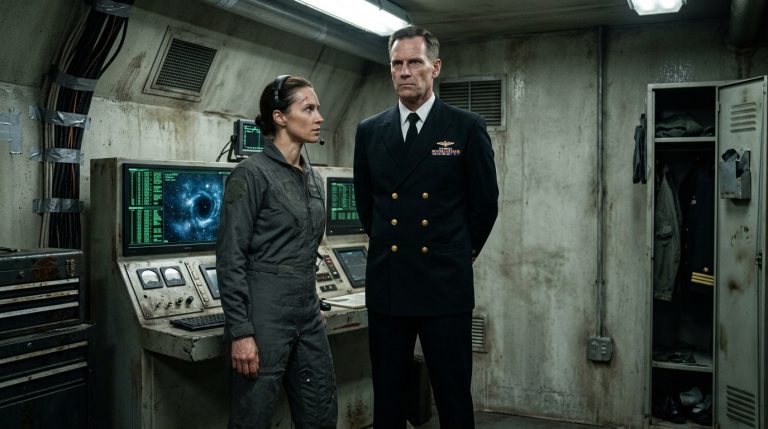
He didn’t wear a canvas jacket or the grease-stained denim of the shipyard workers. His dress blue uniform was immaculate, the wool so dark it looked black under the yellowing neon of the bar’s interior signs. The gold braid along his cuffs was thick, bright, and free of tarnish, catching the light with a cold, metallic precision. Across his left breast, rows of ribbons were stacked six deep, the small enamel bars forming a dense block of color that reached almost to his collarbone. On his shoulders, the silver stars of an admiral gleamed like fresh zinc.
Behind him, two younger men in dark, un-badged wool coats occupied the shadow of the awning, their hands hidden inside their pockets, their eyes moving across the room in short, three-degree sweeps. They didn’t look at the beer bottles or the pool tables; they looked at the exits, the corners, and the hands of every man sitting within ten feet of the booth.
Admiral Vance stepped forward. His low-quarter shoes didn’t slide through the sawdust; they struck the pine with a heavy, metronomic cadence that seemed to silence the sixty-cycle hum of the neon signs by sheer weight.
“Lieutenant,” Vance said. The voice didn’t rise above a conversational level, but it had the specific, dry coldness of an iron hatch latching in winter.
Miller snapped around so fast his heels left a dark crescent mark in the grease-filmed floor. His arms dropped to his sides, his thumbs locking against the seams of his trousers with a physical violence that made his white linen uniform rustle. “Admiral on deck,” he barked, his voice jumping an octave, thin and reedy against the sudden hollowness of the room.
The other four SEALs scrambled into alignment behind him, their heavy frames jerking into a rigid, unnatural symmetry. Sledge’s head was up, his eyes fixed on the water stain on the ceiling, his breathing shallow and loud. The bottles of premium beer they had been clutching remained on the scarred wood of the adjacent table, forgotten, the foam dying down into flat gray rims.
Vance didn’t look at Miller. He didn’t look at Sledge. He walked directly past them, his shoulder brushing the gold braid of Miller’s sleeve with enough force to turn the boy three degrees off his anchor line. The admiral stopped exactly three feet from the edge of the booth, his polished shoes resting in the grease ring where Mark’s wet glass had leaked earlier in the evening.
The old man didn’t stand up. Mark remained on the vinyl bench, his hands resting flat on the oil-soaked pine, his gray shirt thin at the throat. He looked at Vance’s face—the deep lines around the mouth, the white hair cropped close to the skull, the small red scar where a piece of mortar tin had taken the lobe off his left ear in the Delta.
For three seconds, neither man spoke. The only sound in the Rusty Anchor was the steady, dry tick of the brass watch inside Mark’s pocket, losing its four minutes in the dark.
Then Vance’s right arm came up. The movement was slow, deliberate, a straight line from his hip to his brow, the gold on his cuff catching the raw glare of the bulb above the counter. It wasn’t the perfunctory salute given to an officer on a pier; it was the stiff, high-elevation salute reserved for the arrival of a command flag or a box wrapped in wool. He held it there, his hand rock-steady, his eyes locked onto Mark’s clouded pupils.
Mark looked down at the crumpled ten-dollar bill between his palms. He let his breath out through his nose, a slow, dry rasp. Then, with the lazy, circular muscle memory of a man who had spent twenty years ignoring the book, his right hand rose three inches from the table, his fingers flat, his thumb tucked against the palm as he returned the gesture with a brief, unhurried tilt of his wrist.
“At ease, David,” Mark said. His gravel voice didn’t carry past the first row of tables, but Miller’s shoulders dropped another half-inch as if the words had physical weight.
Vance lowered his hand. The stone mask of his jaw didn’t break, but the small muscles around his eyes tightened, a fine network of wrinkles deepening in the sallow skin. “We thought you stayed down after ’89, Master Chief,” the admiral said softly. “The registry had you listed under the harbor logs in Galveston.”
“Galveston was too wet,” Mark said, his fingers tapping the edge of the ten-dollar bill. “I like the dry dirt better. It doesn’t rot the boots.”
Vance nodded once, a short, tight motion. Then he turned his head by forty-five degrees, his gaze finally dropping onto Lieutenant Miller like a rusted iron plate. The purple flush on the boy’s neck had faded, replaced by a gray, chalky paleness that reached all the way to his earlobes.
CHAPTER 5: THE VELVET AND THE TEARING
The gray, chalky paleness on the lieutenant’s chin didn’t twitch, but a thin, clear bead of sweat broke away from the hairline near his temple and cut a dark line through the salt-film on his cheek. His chest remained expanded, his shoulder blades pinned so hard against each other that the heavy white linen of his tunic strained over his collarbones. He stayed anchored to the grease-stained floorboards, his gaze frozen on the second brass button of Admiral Vance’s dress uniform.
Vance didn’t speak for five long seconds. He let the absolute silence of the room press down on the five boys until the only movement was the lazy, gray curl of smoke from a biker’s cigarette forty feet away near the pool tables.
“Lieutenant,” Vance said, his voice dropping into a register that was low, dry, and flat as a rusted sheet of tin. “You have a high opinion of that piece of metal on your coat.”
“Sir,” Miller squeaked, the sound catch-locked in his dry throat before he forced it clear. “The booth was—”
“The master chief was pulling a trigger before your father had a draft card, son,” Vance interrupted. His arm didn’t swing; his hand simply reached out, his thumb and forefinger closing on the edge of the embroidered unit patch pinned to Miller’s left sleeve.
The sound of the hook-and-loop backing separating was loud—a sharp, violent rip that sounded like heavy canvas tearing under a boot heel. The small black rectangle with the red hawk insignia came away clean in Vance’s palm, leaving behind a bare, dark gray rectangle on the sleeve.
Mark looked at that exposed space. Beneath the gray wool where the patch had sat for months, the uniform fabric wasn’t the standard Issue white or navy blue. It was a dense, un-weathered black synthetic weave—a heavy ballistic nylon that didn’t match any standard procurement uniform for a fleet lieutenant. The thread lines where the loop strip had been sewn down were double-stitched with thick, silver-gray monofilament, the kind used for heavy parachute rigging or high-load tie-downs. It was a specialized, non-standard modification, done by an un-badged rigger in a closed house.
Miller didn’t look down at his sleeve, but his left eye flared, the pupil shrinking to a pinhead under the glare of the raw bulb. He knew what the backing showed. He knew the specific weight of the thread.
“You’re confined to quarters, Lieutenant,” Vance said, his fingers rolling the red hawk patch into a small, crushed cylinder before dropping it into his pocket. “Effective three minutes ago. You and your squad will report to the base rigger’s office at 0600 tomorrow. If your boots are three seconds late hitting the gravel, I’ll have the shoreline detachment drag you there by your belts.”
The four men behind Miller didn’t look at each other. Sledge’s fingers were still half-hooked from where he had been holding Mark’s canvas jacket, his knuckles white against his own dark trousers. He dropped his chin by two degrees, his heavy boots shifting back through the sawdust until his heels hit the structural support of the next booth.
“Move,” Vance said.
They didn’t salute. They didn’t have the rank left to clear their wrists. Miller turned on his heel, his movements rigid, mechanical, and stiff with the tactical humiliation of an officer stripped in front of a shipyard crowd. The four SEALs followed him in a tight, defensive wedge, their heavy frames cutting through the dimness of the room until they hit the oak door. They didn’t look back at the pool tables or the bar counter; they pushed into the cool night air, the heavy oak panel swinging shut behind them with a low, wet thud that let the silence settle back into the wood.
Mark didn’t move from his vinyl bench. His hand remained wrapped around his shot glass, his thumb rubbing the small rusted chip on its base.
“They’re young, David,” Mark said into the hollow space left by the boys’ departure. His voice was rough, dry, like two stones grinding together in an empty bucket. “They think the world has a steering wheel. They haven’t found out about the ice yet.”
Vance didn’t look at the door. He kept his eyes fixed on the small, crumpled ten-dollar bill that sat between Mark’s old knuckles. “The standards aren’t just slipping, Mark. Someone’s turning the screws from the bottom. The rigger’s log shouldn’t have that black weave on a standard tunic.”
Mark didn’t answer. He let his thumb drop from the glass, his fingers sliding down to the raw edge of the pine table where the grease was thickest. He knew the rigger. He knew the specific shop where that silver-gray monofilament was spun. It didn’t come from the base depot; it came from the crates they used to drop over the ridge in ’72, before the records were turned into ash.
“Sully,” Vance said without turning his head toward the counter. “Leave the table clear tonight. The master chief has a long walk back to the line.”
The bartender didn’t look up from his cotton rag. He just nodded once, his large shoulders hunched over the sink, his eyes fixed on the wet copper drain where the cheap lager was dripping out of the tap. He knew about the line. He knew about the mechanical splitter hidden behind his own desk panel, its fresh solder joints still warm under the floorboards.
Mark slid his legs out from under the pine table. His joints made a sharp, dry pop that felt entirely too loud in the empty room. He didn’t use a cane; he planted his palms on the edge of the booth and lifted his seventy-two years into the yellow light, his canvas jacket hanging loose around his ribs like an old sail on a dead mast.
CHAPTER 6: THE RESIDUE OF TEN DOLLARS
The weight of the canvas jacket settled heavy across Mark’s shoulder blades as his boots cleared the vinyl edge of the bench. He didn’t look back at the table where the crumpled ten-dollar bill remained flat against the grease-ringed pine, its green corner lifting slightly in the cold draft coming from the door. His left hip gave another dull, dry click as he stabilized his stance in the sawdust, his slate-gray eyes fixed purely on the brass seam of Admiral Vance’s dress uniform.
Vance didn’t offer a hand. He stood like an iron post planted in the harbor silt, his fingers remaining straight along the trousers of his dress blues. “The car is out back, Mark,” the admiral said, his voice dropping below the low rattle of the refrigeration lines behind the counter. “The highway is still clear as far as the bypass.”
“I have my own boots, David,” Mark said. His gravel voice didn’t rise, but it had the specific, grinding finality of a spade hitting a buried stone. “And the road doesn’t get any wider just because there’s a flag on the bumper.”
Before Vance could clear his teeth to answer, the insectile hum of the neon sign behind the bar didn’t just flicker—it died with a sharp, metallic pop that smelled instantly of scorched copper and hot plastic.
The yellow glare from the raw bulb above the counter vanished as the shipyard grid down the avenue took a sudden, massive draw, pulling the voltage straight out of the Rusty Anchor’s ancient circuitry. The entire room dropped into an absolute, suffocating dark, the kind of thick blackness that usually belonged forty feet down in a mangrove swamp where the silver sliver of the moon couldn’t pierce the triple canopy.
Nobody screamed. In a harbor dive, men don’t yell when the lights fail; they keep their palms flat on the wood and wait for the weight of the steel to shift.
In the sudden black, Mark didn’t reach for his waistband. His ears locked onto the micro-movements of the three feet of space immediately in front of his chest. He heard the crisp, dense rustle of Vance’s unyielding wool tunic as the admiral took a half-step backward—not a defensive retreat, but the deliberate clearing of a lane. He heard the soft, leather-and-oil creak of the two un-badged coats in the doorway as the security detail adjusted their grip on their pockets, their breathing short, timed, and entirely silent through the nose.
“Sully,” Vance’s voice came out of the dark, perfectly level, located six inches to the left of where he had been standing. “Keep the door secured until the master chief clears the gravel.”
“The latch is down, Admiral,” the bartender’s shadow rumbled from behind the copper taps. The dry scratch of a wooden match followed, a small, sulfurous flare of orange light illuminating Sully’s thick beard for three seconds before he dropped it into a wet glass. “He knows the path.”
Mark didn’t wait for a second match. He didn’t need the glare of the neon to find the center aisle. His boots moved through the dark by memory alone, feeling the slight dip in the floorboards where the old joists had settled near the cigarette machine, his canvas jacket brushing the rough pine paneling of the wall with a faint, scraping hiss.
As his hand found the brass handle of the front door, the shadows of the patrons along the wall didn’t move. They sat like rusted machinery left out in the rain—bikers, local pipefitters, old boiler tenders from the dry docks—their faces completely obscured by the blackness, but their silence carrying the specific, dense weight of a collective formation. They didn’t speak a name. They didn’t offer a toast. They simply held their breath in the dark, letting the old man pass between them like a ghost clearing a trench.
He pushed the oak door open.
The cool night air hit him across the throat, wet and sharp with the smell of low-tide salt, creosote from the piers, and the heavy diesel exhaust of the transport trucks idling down on Route 4. The sky above the harbor was the color of a bruised plum, the high overcast holding the gray glare of the naval base searchlights two miles to the south.
Mark stepped onto the gravel lot, the crushed limestone crunching under his soles with a loud, dry friction that seemed to echo off the corrugated tin walls of the surrounding bait shops. Behind him, the heavy oak door didn’t slam; it set into its frame with a dull, iron clack as the security detail pulled it closed from the inside, cutting off the last smell of sour lager and burnt wire.
He didn’t turn toward the black sedan that sat three spaces down, its engine running with a low, silent vibration that didn’t shake the frame but left a fine white cloud of water vapor curling around the exhaust pipe. He didn’t look at the small tinted window of the rear door where a second dual-routing communications wire ran straight up into a high-gain antenna on the trunk.
Mark turned his collar up against the salt mist. He fixed his gray eyes on the broken asphalt of the pedestrian lane that ran parallel to the fence, his long legs settling into a slow, rhythmic stride that began the two-mile journey toward the unlit cedar grove on the edge of the town line.
CHAPTER 7: THE GRAVEL PATH
The vibration of the low-tide diesel engines down on Route 4 stayed down in the soles of Mark’s boots as he kept his stride even, his eyes fixed on the white line where the broken asphalt met the base perimeter fence. The iron chain-link was old, its galvanized zinc coating long since chewed away by the salt air until the wire was nothing but a red, bleeding weave of rust that left dark stains on the overgrown weeds beneath it. Every thirty paces, the dull reflection of a base security light would cut through the rolling maritime fog, turning the gray mist into a solid, yellow wall for three seconds before dropping him back into the unlit dark.
He didn’t turn his skull to verify the low, rhythmic hum behind him. The black sedan hadn’t pulled out of the Rusty Anchor’s gravel lot with a spray of stone; it had rolled forward by thirty yards at a time, its headlights dead, its tires hugging the soft shoulder where the grass muffled the tread.
Mark counted the intervals. Three hundred yards behind him. Then two hundred and fifty. The driver wasn’t using the gas pedal to close the gap; they were letting the automatic transmission idle the weight of the steel forward, tracking the swing of his canvas jacket by the faint orange tip of the industrial searchlights reflecting off his shoulders.
When he reached the intersection of the secondary shipyard lane, two blocks from the bar’s neon shadow, Mark stopped. He didn’t drop his chin or search for a weapon. He simply reached into his pocket and pulled out the brass watch, his thumb pressing the latch until the casing cracked open by a quarter-inch.
The mechanical ticking was loud in the wet dark—a clean, iron click-click-click that felt completely disconnected from the heavy mist settling in his gray stubble. The face showed twelve minutes past ten. The watch was still losing its four minutes a day, dragging the gears behind the municipal clock tower down the road, but Mark didn’t wind the crown. He used the polished interior mirror of the lid to catch the reflection of the street lamp behind his left shoulder.
Two hundred yards back, parked nose-in against the rusted frame of a defunct transformer station, the sedan had settled into the shadows.
Mark’s slate-gray eyes narrowed as he focused on the reflection of the lower bumper. The vehicle carried a standard, gray-rimmed commercial plate typical of the port authority vehicles that moved between the dry docks. But from this angle, beneath the direct glare of the unshielded mercury vapor bulb above the gate, the white enamel was wrong.
The third digit—a five—had an unnatural, hard edge along its upper curve. Someone had taken a fine, oil-based black marker to the metal, extending the top line to mimic a civilian registration from twenty paces away. Beneath that hand-painted ink, the faint, raised stamp of a government-exempt prefix was still visible—a specific, deep-set lettering that didn’t belong to the local state pool. It was a domestic surveillance tag, scrubbed for field routing, maintained by a workshop that didn’t file reports with the state DMV.
The line wasn’t just active; it was local.
Mark closed the watch with a soft, metallic snap that stayed inside his palm. He didn’t quicken his pace. He let his left knee take the weight of his stride, the dry pop of the joint a familiar counter-rhythm to the crunch of the fine limestone grit beneath his soles.
He knew the car wasn’t Vance’s personal detail. The men in the bar had been dressed for a quick extraction, their wool coats stiff from storage, their ears tuned to a secure encryption bridge that routed straight through Sully’s desk panel. The sedan tracking him now moved with a different kind of patience—the slow, heavy drift of an operator who had been sitting on the perimeter for three months, logging the hours he spent on the porch, counting the sacks of dry cedar he stacked against his wall.
The road grew narrower as the chain-link fence gave way to the dense, black silhouettes of the cedar grove. The smell of creosote and old oil died out, replaced by the sour, cold rot of wet pine needles and the damp earth of the flats. The town line was less than a mile ahead, marked only by a dead-end signs and a rusted drainage culvert that whistled whenever the harbor tide changed.
“You’re getting clumsy, David,” Mark whispered into the wet canvas of his collar. His gravel voice didn’t make a sound in the brush, but his right hand remained loose inside his jacket pocket, his knuckles resting against the smooth, cold steel of the heavy iron padlock he’d taken from his wood-shed latch three days ago.
The sedan behind him didn’t accelerate, but the hum of its alternator shifted, a small rise in pitch that meant the electronic components inside the dash were pulling more current from the block. The wire on the trunk was up, its tip cutting a fine, dark line through the maritime fog as it cleared the shadow of the transformer station and followed him into the unlit gray of the trees.
The circle wasn’t closing from the outside; it was tightening from the center, and the first turn of the screw had already stripped the thread.
CHAPTER 8: THE MORNING GRIND
The low, electronic drone of the sedan’s alternator didn’t follow Mark all the way up the rise. As his boots transitioned from the broken asphalt of the shipyard lane to the packed, un-kerbed dirt of his own road, the hum drifted back into the cold wet of the cedar grove, settling into an idling whisper two hundred yards deep in the timber. Mark didn’t break his stride. He kept his heels dropping with the same heavy, rhythmic precision, his right hand still loose around the cold iron padlock in his pocket until his soles cleared the three flat limestone slabs that served as his front steps.
The night didn’t leave the porch cleanly; it lingered under the rafters, thick with the sour smell of damp cedar shake and the gray residue of the maritime fog. Mark didn’t strike a match or turn the brass key in his front door latch. He sat on the unpainted wicker bench near the wood-box, his canvas jacket drawing the damp straight out of the air while the silver searchlights of the naval base two miles away continued their lazy, three-minute sweeps across the western sky. He watched the horizon until the purple edge of the clouds began to fray, turning the color of wet slag before the first blue light of 0530 hit the gravel.
When the light cleared the tops of the trees, Mark stood up. His left hip gave its dry, structural click against the wood of the bench, but his hands were steady as he reached for the galvanized iron bucket near the pump.
The handle was rusted, the cold metal pitting into the skin of his palm as he pressed the lever down three times to clear the silt from the valve. The well water came out gray and freezing, hitting the zinc bottom with a loud, hollow rattle that brought the scent of iron and wet stone up into the morning mist. He carried the bucket to the small tin stove on the edge of the porch, his fingers moving through the routine without the aid of a lamp. He shaved three splinters of dry pitch-pine with his pocketknife, the cedar flesh curling away from the blade like old skin, before dropping them into the firebox beneath the copper kettle.
He didn’t look toward the road while the water came to a boil, but his slate-gray eyes kept the perimeter locked in their lower register.
Two hundred yards out, where the lane narrowed between the ancient drainage culvert and the first thick stand of pine, the black sedan remained nose-in against the brush. The morning light didn’t catch the reflection of the glass; the driver had wiped the windshield clean of the fog-film from the inside, leaving only a dark, grease-stained crescent where their forearm had brushed the glass. The high-gain wire antenna on the trunk was down, tucked parallel to the chrome strip of the bumper to lower the vehicle’s silhouette against the gray wood of the fence line.
Mark poured the boiling water over the iron-stained tin of coffee grounds. The steam hit his face—sharp, bitter, smelling of chicory and old warehouse cloth—but it didn’t clear the taste of the Rusty Anchor’s sour lager from the back of his throat. He took the mug to the edge of the porch rail, his boots tracking a fine line of wet charcoal dust across the white pine boards.
He knew the man in the front seat wasn’t waiting for a deployment order. The surveillance configuration was passive, built for logging the frequency of his trips to the harbor, checking the weight of the supply sacks he dragged from the local co-op. They were building a ledger of his decay. Every time his knee popped, every morning his stove took three extra matches to catch, the ink in the logbook grew thicker. They were waiting for the grease to dry out of the old machine so they could file the final omission report without clearing the desk.
“You’re tracking the wrong clock, son,” Mark muttered against the rim of the tin mug. His gravel voice stayed inside the porch rail, flat and unhurried as the slow rise of the white smoke from his chimney.
He reached into his shirt pocket and pulled out the manual brass watch. The latch gave its small, metallic ping, exposing the face under the scratched crystal. It was 0558. The watch had lost another forty seconds since he crossed the town line, the balance wheel dragging through its rotation like an iron wheel through river mud.
Mark didn’t turn the crown to correct the sweep. He watched the small second hand tick past the twelve, its movement mechanical, unconcerned with the fact that two blocks away, Lieutenant Miller’s squad was currently standing in the rigger’s shop under the yellow glare of the depot lamps, their tunics bare of the red hawk insignia, their careers being turned into ash by an admiral who carried the same circular brand on his own ledger.
The circle wasn’t just spinning; it was throwing off its balance weights, and the iron at the center was beginning to feel the heat of the friction. Mark set the mug down on the weathered rail, his old fingers tracking the deep split in the timber where the frost had cracked the grain three winters ago, his eyes never leaving the grease-rimmed crescent on the sedan’s windshield.
CHAPTER 9: THE OPENED SAFE
The morning light didn’t hit the back office of the Rusty Anchor cleanly; it filtered through the high, dirt-crusted transom window in thin gray bars that highlighted the floating sawdust and the sharp smell of burnt insulation from the night before. Sully stood with his boots flat against the floorboards, his heavy shoulders hunched over the low oak desk. His knuckles were dry and gray from the cold basin water he’d used to scrub the counter before the dock shift began, but his fingers remained steady as he hauled the flat iron crowbar out of the lower drawer.
The package hadn’t been dropped by a standard postal van. A dark gray logistics truck with un-marked panels had idled at the curb at 0615, its driver leaving the heavy cedar crate on the gravel step without requesting an ink signature or an identification voucher.
Sully set the edge of the iron tool beneath the crate’s lid, the rusted steel grinding against the heavy copper staples with a short, brutal screech that sounded like teeth scraping on a pan. The cedar wood split down the grain, throwing off three sharp, bone-dry splinters that smelled instantly of aged pitch and old packing grease. Beneath the wood wool padding sat a single bottle of forty-year-old single malt, the dark amber liquid heavy behind the thick, hand-blown glass. The label carried no commercial barcode, just a stamped ink serial number that matched the registry codes inside the old admiral’s safe.
But Sully didn’t lift the glass by the neck. His large thumb brushed the inner corrugated lining of the box, feeling a structural stiffness that didn’t match regular distillery crates.
He slid the crowbar deeper, tearing away the false canvas backing that kept the internal partition stable. The paper didn’t come away in clean strips; it was a dense, three-ply rag stock—the heavy, blue-rimmed manifest sheets used by the naval base procurement rigger before the automation transition of ’94.
At the upper header of the torn sheet, beneath the faded watermark of the logistics command, three lines of un-redacted text remained visible in the sharp morning glare. It wasn’t a standard shipping order. The listing contained four horizontal entry rows: Douglas, M. / Operator 01-Circle / Status: Monitored-Passive. Directly below that line was a fresh ink notation, dated less than seventy-two hours ago, specifying the routing frequencies for a mechanical dual-line relay splitter identical to the olive-drab box currently wired into Sully’s desk panel.
The second routing line wasn’t an intelligence tap. The destination column was stamped with a specific, five-digit routing flag that belonged directly to the office of the Base Commander—Admiral Vance’s private desk.
Sully dropped the iron tool onto the desk, the heavy metal hitting the oak with a dull, hollow thud that caused the tin lamp shade to vibrate. His breathing stayed short, timed through his nose, his eyes never leaving the blue border of the manifest. The admiral hadn’t broken the SEAL squad’s tridents to protect an old operator’s dignity; he had broken them because their clumsy intervention had threatened to expose the domestic tracking loop that had been active since Mark cleared the logs in Galveston. The safe wasn’t a repository for a veteran’s legacy; it was a tracking terminal.
Outside, in the main bar room, the heavy oak door didn’t swing, but the floorboards near the front counter gave a slow, rhythmic groan as a pair of low-quarter dress shoes took the weight of a stride.
Sully didn’t look back toward the office door. He reached under the desk panel, his scarred fingers finding the copper contacts of the mechanical splitter, his palm gripping the casing until the fresh silver solder bit into his skin. He didn’t rip the wire—he knew the voice on the other end of the encrypted bridge would know within three seconds if the current dropped—but he memorized the serial number on the blue paper, folding the rag stock into a tight, sharp square that he slid deep beneath the leather lining of his boot.
The whiskey bottle remained in the center of the split cedar box, its amber surface catching the gray light from the transom, perfectly still behind the glass while the sixty-cycle hum of the rebuilt junction box across the street began to rattle the windowpanes.
CHAPTER 10: THE HORIZON WATCH
The split in the weathered cedar rail was rough under Mark’s palms, the gray wood fiber dry as bone where the winter frost had forced the grain apart. He didn’t look down at the cold tin mug of coffee settling into absolute stillness beside his wrist. His grey eyes remained locked across the two hundred yards of packed dirt road, tracking the exact point where the dark, grease-stained crescent on the black sedan’s windshield caught the rising horizontal glare of the morning sun.
The door of the sedan didn’t slam. It opened with a muted, heavy click—the precision click of a double-sealed government frame—and a single figure stepped out onto the soft shoulder of the road.
It wasn’t a young operator with a tactical earpiece or a rigger from the base depot. It was David Vance. The admiral had stripped the immaculate dress blue tunic from his torso, wearing only a plain, un-badged gray wool shirt that hung stiffly against his ribs. He didn’t carry a sidearm in his belt; his hands were loose at his sides, his leather low-quarters sinking slightly into the wet pine needles as he began the unhurried walk up the rise toward the porch.
Mark didn’t reach inside his jacket for the padlock. He reached into his pocket, his fingers finding the smooth, scratched casing of the brass pocket watch. He pressed the latch, letting the lid click open by less than a quarter-inch. The mechanical balance wheel was still dragging, losing its four minutes, ticking with a heavy, rhythmic friction that seemed to match the slow, metronomic crunch of Vance’s soles on the limestone grit of the path.
Vance stopped at the lowest limestone slab. He didn’t raise his hand to his brow this time. He looked at the galvanized bucket near the pump, then up at the thin, gray curl of smoke coming from the chimney pipe.
“The rigger’s log is locked, Mark,” Vance said. His voice was lower than it had been in the bar, rough around the edges, dry as the dust under the steps. “The boys from the squad are on a transport plane heading north. They won’t be coming back to the line.”
Mark took a slow breath through his nose, the scent of the chicory coffee blending with the cold damp of the cedar shake rafters above his head. “You didn’t fly that plane to clear the rigger’s ledger, David. You flew it because the black weave on the backing had your own signature on the procurement receipt.”
The admiral’s stone jaw didn’t break, but his shoulders dropped by an inch, the gray wool of his shirt bunching over his collarbones. He didn’t look back at the sedan in the trees. He looked at the circular brand on Mark’s inner wrist—the Puckered, white-tallow mark that showed clearly where the canvas sleeve had slipped back.
“The surveillance loop was active before Galveston, Mark,” Vance said softly, his eyes level with the rusted rail. “It was active when we cleared the logs in ’89. It routes straight to my desk because if the Circle ledger drops into the municipal files, the whole chain comes down. The command didn’t leave you behind in the swamp because you were compromised. They left you because the operational order for the Panama sector had my name at the bottom of the routing flag. I signed the abandonment paper, Mark. I signed it three hours before the last helicopter cleared the ridge.”
The silence that settled over the porch wasn’t the silence of an empty room; it was the heavy, suffocating silence of an un-exploded shell buried five feet deep in the river mud.
Mark didn’t stand up. He looked down at the brass watch in his palm, watching the second hand drag its way past the six. He had known about the signature since the third night behind the canal wall in ’89, when the encryption key on the radio had changed without a terminal warning. He hadn’t come to the edge of the town line to hide from the ledger; he had come to let the iron gears grind themselves down to a stop in the dark.
“I know, David,” Mark said. His gravel voice didn’t carry past the well pump. “The paper was white when it went into the rigger’s crate, but it turns red if you leave it in the sun too long.”
Vance didn’t offer an excuse. He didn’t monologue about the necessity of the service or the weight of the flag. He reached into his trousers, pulled out a small, heavy steel key—the master override key for the mechanical dual-line relay splitter hidden behind Sully’s desk panel—and dropped it into the gray water inside the galvanized bucket. It hit the zinc bottom with a sharp, metallic clink that died out instantly in the cold silt.
“The line is dead, Master Chief,” Vance whispered. “The tracking unit outside the fence is logging nothing but an empty porch from this morning on.”
Mark nodded once, a slow, tight tilt of his chin. He reached down to the weathered rail, his large, spotted fingers closing around the iron crown of his pocket watch. For the first time in thirty years, his thumb didn’t just feel the grit of the metal; he twisted the crown three full turns to the right. The internal springs didn’t snap; they took the tension with a heavy, clean click-click-click that brought the hands forward by exactly four minutes, locking the balance wheel into perfect calibration with the municipal clock tower down the avenue.
The admiral turned on his heel, his gray wool shirt a dull shadow against the limestone slabs as he walked back down the dirt path toward the waiting car. He didn’t look back at the cedar grove or the unlit windows of the house. He pushed the sedan’s heavy door open, his frame disappearing into the dark interior before the vehicle rolled backward into the maritime fog, its engine a silent vibration that faded into the low roar of the harbor trucks on Route 4.
Mark picked up his tin mug. The chicory was cold, bitter, and thick with the gray residue of the stove dust, but he drank it down to the iron rim. He stood up, his left hip giving no sound as his boots took the weight of his seventy-two years, his eyes fixed on the empty gravel where the black sedan had sat for three months. The road was clear all the way to the bypass. The silence that remained wasn’t an omission; it was the solid, unyielding texture of a piece of dry cedar left alone to face the sun.