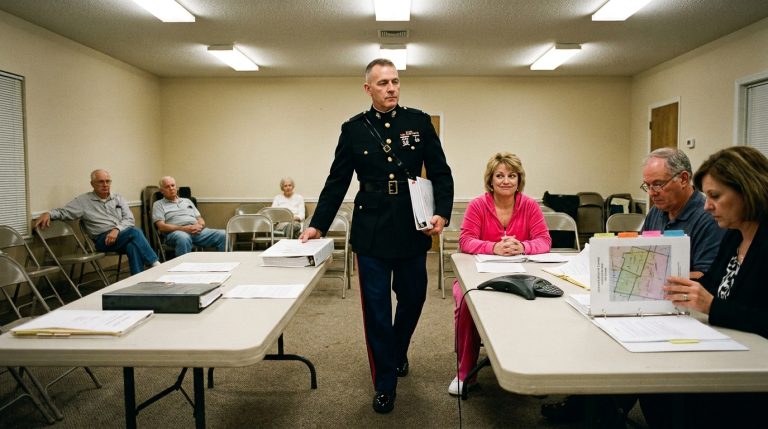
A Portrait of Resilience: How the Quiet Labor of a Father Built a New National Legacy
CHAPTER 1: The Weight of the Idle
The heat in the cabin of the beat-up Ford was a physical presence, a thick, dusty blanket that smelled of stale coffee and the lingering scent of Logan’s grape juice. Ben wiped a smear of black grease across his forehead, his knuckles throbbing in time with the distant, rhythmic ticking of the cooling engine. He didn’t look at the man standing by the open hood. He looked at the modification.
It was subtle—a bypass valve wired with a precision that didn’t belong in a rust-bucket of this vintage. It was clean. Too clean.
“You’re running lean,” Ben said, his voice raspy from a long day of hauling. He kept his eyes on the terminal, his fingers tracing the frayed insulation, searching for the source of the short. “If you try to push this past forty, the whole intake is going to starve.”
The older man didn’t move. He stood on the shoulder of the road, his hands tucked deep into the pockets of his stained jacket. He was watching the horizon, not the engine. The wind picked up, swirling the dry Georgia clay around their boots, but the man didn’t flinch.
“I’ve been further than forty miles,” the man said. His voice was like grinding gravel, low and steady. “And the engine has never failed me. Not once.”
Ben paused. He felt the weight of the man’s gaze on the side of his face. It wasn’t the look of a stranded traveler; it was the look of a scout assessing terrain. Ben tightened the final bolt, the metal biting into the grip of his wrench. He stood up, the movement fluid despite the exhaustion pulling at his shoulders.
“Well,” Ben said, wiping his hands on a rag that had long ago lost its original color. “It’s fixed. But if you keep running it like that, you’re going to blow the seal on the block.”
He stepped back, intending to return to the truck, to Logan, to the quiet hum of his son’s humming in the backseat. He caught a glimpse of his own reflection in the side mirror—the tired eyes, the faint lines around his mouth, the stubborn set of his jaw. He looked exactly like what he was: a man who had survived, but just barely.
As he reached for his door handle, the older man spoke again, his tone shifting, becoming sharper, more transactional.
“You didn’t ask how I knew the seal would hold, Ben.”
Ben froze. He hadn’t introduced himself. He glanced back at the Ford. The man was still staring at the horizon, but now, there was a faint, knowing tilt to his head.
“I didn’t ask a lot of things,” Ben replied, his voice cooling. “I just wanted to get you moving again.”
“And that,” the man said, turning to face him, his eyes clear and terrifyingly focused, “is precisely why you’re the only one I could have chosen.”
The air in the clearing suddenly felt colder. Ben’s hand lingered on the door handle. Inside, Logan laughed at something he saw in a book, a sound so bright and innocent it felt like it came from another world entirely. Ben turned back to the man, his pulse a steady, warning rhythm against his ribs.
“Chosen for what?”
The man didn’t answer. He simply climbed into his truck, the engine turning over with a perfectly synchronized, hauntingly smooth roar. As he pulled away, leaving Ben standing in the settling dust, Ben noticed something sitting on the gravel where the man’s tire had been—a small, silver service pin, tarnished by time but unmistakable.
It was a crest from a division that supposedly hadn’t existed for twenty years.
CHAPTER 2: The Weight of the Promise
Ben stood in the middle of the gravel shoulder, the silence of the back highway stretching out around him like an unspooled wire. The silver pin felt cold against his calloused skin, its edges biting into his palm with an almost clinical precision. He looked at it, then toward the darkening horizon where the dust cloud of the stranger’s truck had long since vanished.
Logan shifted in the backseat, a small, sleepy movement that broke the trance. “Dad?”
Ben didn’t turn around immediately. He pocketed the pin, the motion practiced and instinctual. His hand lingered on the fabric of his pocket, feeling the slight weight of it—a fragment of a world he had stepped away from three years ago. “Yeah, buddy. Just checking the tire pressure. Everything’s fine.”
He climbed back into the driver’s seat, the springs of the old bench seat groaning in protest. As he pulled back onto the asphalt, his mind wasn’t on the road, but on the engine he had just repaired. He had touched every component of that truck; he knew the feel of the valves, the wear on the belts. The machine was a masterpiece of maintenance, a level of craft that far exceeded the needs of a roadside traveler. It was a vehicle that had been built—and maintained—to never break down.
“He was nice, wasn’t he?” Logan asked, his voice thick with the contentment of a child who saw the world through a lens of unburdened simplicity.
“He was,” Ben replied, his eyes scanning the periphery of the headlights as they cut through the encroaching gloom. He felt a sudden, sharp prick of unease. The detour hadn’t been an accident. The truck hadn’t “broken down” in the way a machine breaks down—it had been positioned. He realized with a jolt of clarity that the man hadn’t been waiting for help; he had been waiting for him.
The realization didn’t make him pull over or panic. Instead, it triggered a tactical calculation, a cold, familiar habit from his time in the motorpool. If the breakdown was a performance, then the interaction was a test. And if it was a test, he had passed. But at what cost?
He focused on the road, the rhythmic hum of the tires against the pavement grounding him. He wouldn’t let the thought spiral. He had a duty to get Logan home, to get the cereal out, to get the story read, and to maintain the fragile, steady life they had built within the walls of their peeling-paint house.
When they pulled into the driveway, the house looked small and weary in the fading twilight. The porch light flickered, a stuttering yellow glow that cast long, distorted shadows across the overgrown yard. Ben watched the light. It was a failure of the electrical, a simple, manageable thing. He felt a wave of relief. He could fix the light. He couldn’t fix whatever was currently rattling around in his pocket, but he could fix the light.
He helped Logan out, the boy stumbling sleepily against his side. As they reached the steps, Ben stopped.
There was a car parked three houses down. It hadn’t been there that morning. It was a dark sedan, its silhouette blending into the shadows of the overhanging oak trees. It wasn’t moving, and its headlights were off.
Ben’s pulse quickened, not with fear, but with a sharp, analytical awareness. He turned his gaze away, focusing instead on his son’s face, ensuring he was shielded from the line of sight toward the street. He unlocked the front door, the key sliding into the rusted lock with a familiar, abrasive friction.
“Go on in, Logan. Get your pajamas on,” Ben said, his voice steady.
“Aren’t you coming, Dad?”
“Just need to grab the toolbox from the truck. Be right there.”
He waited until the door clicked shut. Then, he didn’t reach for the toolbox. He stood on the porch, his back to the house, his posture relaxed but his senses dialed into the ambient noise of the neighborhood. The rustle of dry leaves, the distant bark of a dog, the low-frequency hum of the distant highway. And underneath it all, the absolute stillness of the sedan down the road.
He reached into his pocket and touched the pin again. The “butterfly” of the afternoon—the decision to stop for a stranger—had spiraled into a storm. He wasn’t just a mechanic in Thomas, Georgia, anymore. He was a variable in an equation he didn’t yet understand, and the people holding the pen were watching him from the dark.
He didn’t go to the truck. He walked to the edge of the porch, leaned against the weathered railing, and stared into the dark street. He wasn’t hiding. If they were watching, he would give them a look that told them exactly who they were dealing with. He was a man who knew how to fix broken things, and he had a very low tolerance for being toyed with.
The light on the porch flickered one last time and died, plunging the entrance into total darkness. Ben didn’t blink. He stood in the cool air, listening to the silence, waiting to see if the sedan would move.
The silence held.
He turned, the wood of the porch groaning under his weight, and stepped inside. He had a dinner to make. He had a child to protect. And tomorrow, he had a house to fix, both the physical structure and the sudden, creeping encroachment of whatever had followed him home from the highway.
CHAPTER 3: The Price of the Kitchen Table
The morning air in the house was stagnant, thick with the smell of scorched coffee and the damp, earthy scent of the Georgia humidity pressing against the window panes. Ben stood in the threshold of his kitchen, his hand resting on the frame, his knuckles white. The sunrise was a pale, anaemic yellow, filtering through the cracked blinds to illuminate the layer of dust dancing in the air.
He didn’t move toward the coffee pot. He didn’t move toward the bills stacked by the toaster. His ears were locked onto the sound of gravel—the distinct, heavy crunch of tires that didn’t belong to a neighbor’s pickup or the mail carrier’s tired van. Three vehicles. He counted the doors slamming shut, a synchronized, metallic rhythm that vibrated through the floorboards.
“Dad?” Logan’s voice was small, emerging from the hallway. The boy was rubbing his eyes, clutching the frayed edge of his blanket.
Ben shifted his gaze, his face softening instantly. He moved away from the door, placing himself between the kitchen window and his son. “Hey, buddy. You go on and get your shoes on. Don’t worry about the cereal yet.”
“Who’s here?”
“Just some people who got lost,” Ben said, his voice level, practiced. “I need to talk to them for a second. You stay in your room, okay? Just like we talked about.”
Logan hesitated, sensing the shift in the air—the way his father’s shoulders were squared, the way the silence in the house felt heavy, like a held breath. He nodded and retreated, his small footsteps fading.
Ben turned back to the door. He didn’t check his reflection. He didn’t smooth his hair. He walked onto the porch, the steps groaning under his weight, and stepped out into the morning light. The three black SUVs were lined up along the curb like predatory animals, their surfaces so clean they reflected the surrounding woods with an unsettling, distorted clarity.
The front door of the lead vehicle opened, and a man emerged. Silver-haired, tall, his movements fluid and efficient—the same man from the roadside. He wasn’t wearing the stained jacket today. He was in a pressed blazer, the fabric dark and expensive, and his boots were polished to a mirror shine.
He didn’t reach for a weapon. He didn’t shout. He simply adjusted his coat and walked up the driveway, his gaze fixed on Ben. The two other men remained by the SUVs, standing in positions that allowed them to monitor the entire perimeter of the property. Professionalism, Ben noted. Calculated, tactical, and completely out of place in a neighborhood where the biggest issue was usually a neighbor’s loose dog.
“Mr. Carter,” the man said when he reached the base of the steps. His voice was stronger than it had been on the highway, carrying the weight of command. “I’m Lieutenant Colonel Samuel Whitaker. I believe you met General Caldwell yesterday.”
Ben didn’t step down. He kept his hands at his sides, his fingers brushing the silver pin still tucked deep in his pocket. “I don’t recall asking for a follow-up, Colonel.”
Whitaker smiled, a thin, humorless expression. “The General doesn’t make requests, Mr. Carter. He makes observations. And he observed something yesterday that he felt compelled to verify.”
“Verification usually happens in a lab, not on my porch.”
“When the subject is character, it happens exactly here.” Whitaker gestured to the house—the peeling paint, the sagging roof, the rusted gutters. “We’re not here to harass you. We’re here to offer you an alternative to all of this.”
He reached into his inner pocket and produced a leather-bound folder. He didn’t hand it over; he simply held it, an invitation framed as a demand.
Ben looked at the folder, then at the sedan parked three houses down. The vehicle was still there, a darker shadow in the morning light. He realized then that the “test” hadn’t ended on the highway. He was being monitored, assessed, and perhaps, curated. The realization sparked a cold, sharp anger in his chest, but he suppressed it. If they wanted a character study, he would give them one.
“I’m a mechanic,” Ben said, his voice dropping into a low, steady cadence. “I fix things. I don’t sign contracts with people who stalk my neighborhood.”
Whitaker’s expression didn’t waver. “We aren’t stalking you, Ben. We’re securing a future. A future that requires a specific kind of integrity—the kind that isn’t for sale, even when the roof is leaking.”
He took a step forward, his boots clicking on the concrete. “The General is inside. He’s waited for someone with your specific history for a long time. Will you let us in, or are you going to force us to have this conversation in front of your neighbors?”
Ben looked toward the sedan. The engine turned over, a soft, muted growl. He didn’t know what was in the folder, or what the “classified” incident the General knew about actually was, but he knew one thing: if he turned them away, the pressure would only increase.
He stepped aside, gesturing toward the front door. “Ten minutes. Then you leave.”
As they crossed the threshold, Ben looked back at the street one last time. The sedan was gone, but the feeling of being watched remained, clinging to the skin like static. He led them into the kitchen, the small space suddenly feeling crowded, the smell of the old, chipped ceramic bowl on the table catching the morning light.
He sat down, his chair scraping against the linoleum. He didn’t look at the General, who was now seated across from him. He looked at the bills. He looked at the life he had fought so hard to keep simple.
“Talk,” Ben said.
CHAPTER 4: The Language of Mechanics
The air in the kitchen tightened, the sound of the old ceiling fan overhead becoming a rhythmic, intrusive pulse. General Caldwell didn’t flinch at the abruptness of Ben’s command. He merely folded his hands on the table, his posture as immovable as a stone monument. Beside him, Colonel Whitaker remained standing, his eyes scanning the corners of the kitchen with an unsettling, clinical detachment.
“You want the truth, Ben?” Caldwell said, his voice dropping an octave, losing the polished tone of a recruiter. “The truth is that our infrastructure is failing. Not because of age, or rust, or lack of funding. It’s failing because we have lost the ability to diagnose the source of the rot. We’re treating symptoms with digital patches, and the foundation is crumbling beneath us.”
Ben watched him, his mind working through the statement. It sounded like a speech—a well-rehearsed, high-level briefing—but the General’s eyes were too steady, too tired, for it to be hollow.
“That’s a systemic problem,” Ben countered, his voice low. “That’s a budget issue. That’s not why you’re sitting in my house at six in the morning.”
Caldwell leaned forward. The movement was slow, deliberate. “You’re right. We’re here because of the ‘why.’ You remember the 2012 motorpool incident in Kandahar? The failure of the primary line? You were the sergeant who defied the override code to strip the assembly down by hand.”
Ben felt a sudden, sharp chill prickle along his skin. He hadn’t thought about that day in years—the smell of hot oil, the frantic urgency of the repair, the feeling of the metal giving way under his touch. He had been reprimanded for that, told he had compromised the integrity of the diagnostic protocols. It had been a black mark on his file, one he’d assumed had been buried deep in the archives.
“That wasn’t a repair,” Ben said, his voice barely audible. “That was a necessity.”
“That was an act of intuition,” Caldwell corrected. “You saw the flaw in the logic of the system, and you broke the protocol to save the machine. That is exactly what we need now.”
Whitaker stepped forward, sliding the leather folder an inch closer to Ben. As the light caught the edge of the material, Ben noticed a slight, unnatural thickness in the spine—a ridge that suggested a micro-transmitter or a sensor plate was embedded within the binding. He looked at it, then back at the General. They weren’t just here to recruit him; they were here to monitor his reaction to the solicitation.
“You’re talking about an entire nation’s grid,” Ben said, his eyes flicking to the folder’s edge. “You’re talking about a level of control that requires more than intuition.”
“We require a man who doesn’t trust the screens,” Caldwell said, his voice dropping to a near-whisper. “We require a man who knows how to listen to the friction in the metal. The program is currently being strangled by those who think efficiency is the same thing as quality. They’re running the systems into the ground, hiding the decay behind a wall of software. We need a team, led by someone who can strip the rot back to the foundation, regardless of the ‘official’ diagnostic results.”
Ben sat back, the chair leg scraping against the linoleum. The offer was larger than he had imagined, and the stakes were far higher than fixing farm equipment. But the weight of it—the responsibility—it felt like a lead blanket. He thought of Logan in the next room, the quiet life they had built in the dust and the struggle. If he accepted this, if he allowed himself to become a tool for the General, he wouldn’t just be fixing grids. He would be stepping back into the shadow of a hierarchy that had once discarded him the moment his wife passed.
“Why should I trust you?” Ben asked. “You talk about rot, but you’re using the same protocol as the people you’re claiming to fight. You staged a roadside breakdown. You put me under surveillance.”
Caldwell looked at Whitaker, then back to Ben. “Trust is a luxury we don’t have, Ben. We have a target. And we have a deadline. If you don’t take this, the system will eventually fail, and the people who depend on it—the farmers, the families, the people like you—will be the ones left in the dark.”
Ben stood up, his movements stiff. He walked to the window, peering out at the morning sun. The street was quiet now. No sedan. No movement. Just the enduring, heavy silence of a small town that had no idea of the power struggle unfolding in its midst.
He felt the silver pin in his pocket again. It was a reminder of a past he couldn’t outrun, a past that had clearly marked him as a target for people like Caldwell. If he refused, he would always be looking over his shoulder. If he accepted, he would be fighting a war he wasn’t sure he could win.
“I have a son,” Ben said, not turning around. “If I take this, he’s the priority. No deployments. No secret missions. No ‘diagnostic’ hazards that put him at risk.”
“You’ll be based in Atlanta,” Caldwell said. “You’ll have your own home, your own security, and the authority to build your own team. You won’t be a soldier, Ben. You’ll be the person who determines what gets fixed and what gets scrapped.”
Ben turned around. He looked at the folder, the device hidden in the spine, the General’s tired, desperate eyes. He didn’t see an opportunity. He saw a trap. But as he looked at the chipped bowl on the table, the small, mundane reality of his life, he realized the trap had already closed the moment he stopped for the stranger on the road.
“I need 24 hours,” Ben said.
Caldwell stood, his expression unreadable. “You have until tomorrow morning. We’ll be at the diner on 4th. Don’t let us wait, Ben. The decay doesn’t wait.”
As they left, the kitchen felt colder than before. Ben watched them drive away, the SUVs vanishing into the distance like a waking dream. He sat back down at the table and opened the folder, not to read the offer, but to feel the hidden device. He had been recruited. But more importantly, he had been compromised.
CHAPTER 5: The Glass Threshold
The training facility in Atlanta was a sprawling expanse of reinforced concrete and glass, a place that felt less like an educational center and more like a bunker disguised as an industrial park. Ben stood in the lobby, his boots clicking rhythmically against the polished terrazzo floor. He carried his own toolbox—a battered, heavy thing that looked like an artifact of a bygone era compared to the sleek, digital tablets carried by the other recruits.
He felt the eyes of the other veterans on him. They were a diverse group—some lean and scarred, others older, moving with the measured caution of men who had seen too much—but all of them carried the same restless, kinetic energy. They weren’t here for a job; they were here for a purpose.
Ben walked toward the intake desk, his gaze moving past the reception area to the high-security doors at the end of the hall. He could hear the faint, high-frequency whine of power inverters and the rhythmic, deep-bass thrum of heavy equipment testing. It was the sound of a system that was being pushed to its limits, the sound of a grid fighting to maintain its own stability.
He arrived at the security checkpoint. The guard behind the glass was a young man with a crisp uniform and an expression of unwavering, bureaucratic boredom.
“Name, Carter,” the guard said, not looking up from his monitor.
“Ben Carter.”
The guard scanned his badge. A small, red light blinked on the console, then turned green. “Proceed to Station 4. Your gear will be inspected.”
Ben moved forward, but as he stepped through the scanner, the machine let out a sharp, discordant chirp. A yellow light pulsed rapidly. The guard frowned, finally looking up. “Step back, please.”
Ben complied, his hand instinctively moving to the side pocket of his jacket where he had tucked the folder. He realized then that the device hidden in the binding wasn’t just a sensor; it was a broadcast unit. It was pinging the security system.
“Sir, you have a restricted electronic signal on your person,” the guard said, reaching for his sidearm.
“It’s an authorized courier packet,” Ben said, his voice remaining calm, though his mind was already mapping the room, the exit, and the speed of the guard’s reaction. “You can call Colonel Whitaker’s office. He’s expecting it.”
“I don’t care who’s expecting it,” the guard said, stepping around the desk. “Protocol dictates that all unauthorized electronics are confiscated. Empty your pockets.”
Ben knew that if he handed the folder over, the “decoy” secret—the high-level military tracking data—would be exposed, or worse, the device would be deactivated, cutting off the General’s ability to monitor his “success.” He needed to move, but he needed to move without creating a scene that would end his career before it began.
He took a slow step back, his foot finding the edge of a heavy, industrial-grade floor buffer parked in the corner. He shifted his weight, and with a calculated, subtle movement, his boot caught the power cord of the buffer.
The cord snapped taut, jerking the heavy machine forward. It careened into the wall with a thunderous, metallic crash, showering the lobby in a spray of sparks and triggering a facility-wide power flicker. The lights cut out, replaced instantly by the dim, red glow of emergency strobes.
Chaos ensued. The guard stumbled back, his attention pulled toward the sparking mess of wires. In that split second of darkness and confusion, Ben didn’t run. He walked. He moved with the precision of a man who knew the physics of a room. He bypassed the guard, ducked through the closing security doors, and slipped into the maze of the testing floor.
He was in. The alarms began to wail, a low, pulsing siren that echoed off the high, steel ceilings. He was inside the heart of the system now, far away from the intake desk, standing in the middle of a massive, echoing laboratory filled with rows of exposed power conduits.
He opened the folder, his fingers trembling slightly. He looked at the device again. It wasn’t just a transmitter. It was a master key—an interface that, when plugged into the facility’s control board, would allow him to bypass the software throttles that were causing the rot in the national grid.
He hadn’t been brought here to train. He had been brought here to be a surgical tool.
He moved toward the nearest terminal, his heart hammering against his ribs. He heard the heavy thud of security boots entering the wing. He had seconds to decide: hide, or finish the job he’d been brought here to do. He looked at the conduits, then at his own scarred, oil-stained hands.
He began to work, not with the digital precision of a technician, but with the brutal, effective intuition of a mechanic. He wasn’t just fixing a machine; he was rewriting the rules of the entire system. And as he felt the conduit vibrate under his touch, he knew that there was no going back to the porch in Georgia.
CHAPTER 6: The Friction of Truth
The screen of the terminal flickered, a cascade of amber data scrolling past at a speed that made Ben’s eyes ache. He wasn’t a coder; he was a mechanic. He didn’t care for the elegant, sweeping logic of the software. He cared about the output—the physical response of the hardware. And right now, the output was screaming.
He knelt in the narrow aisle between the conduit arrays, the heavy, metallic stench of ozone filling his lungs. Behind him, the sound of boots on concrete was getting louder, sharper—a rhythmic, predatory march. He had minutes, maybe less.
His fingers moved over the terminal interface, pulling back the software “curtains” the General’s team had installed. He saw it then—a hidden sub-routine, a ghost process buried deep within the diagnostic layer. It was designed to slowly, methodically throttle the grid’s efficiency, creating artificial localized failures. It wasn’t a decay; it was a manufacture.
His stomach turned. The General hadn’t brought him here to save the system from rot. He had brought him here to provide a “fix” that would validate the very control software that was causing the failure in the first place. He was the scapegoat, the credible mechanic whose manual override would provide the justification for an even tighter, more centralized control.
“Carter!” A voice boomed from the end of the aisle. Whitaker. “Step away from the board!”
Ben didn’t look up. His mind was a blur of tactical calculation. He could run, but the facility was a trap. He could fight, but he was one man against a security detail. Or, he could turn the trap on itself.
He pulled a small, multi-tool from his belt—a rugged, worn piece of kit he’d carried since his time in the motorpool. It didn’t belong in a high-tech lab, but its weight was familiar, steadying. He wedged it into the side of the terminal’s hardware bridge, creating a physical bypass. It was the “Kandahar fix”—a raw, unrefined intervention that the software couldn’t account for.
The console let out a high-pitched, protesting shriek. Sparks showered the floor. The amber data stream halted, replaced by a jagged, red warning light.
“I said move!” Whitaker’s footsteps were right behind him.
Ben didn’t move. He shoved the tool deeper, shorting the bridge. The entire laboratory went dark for a heartbeat, then illuminated in a blinding, strobing wash of white emergency lights. The sound was deafening—the combined roar of every power inverter in the wing resetting at once.
He lunged to the side just as Whitaker lunged for him, the two men colliding in the narrow space between the racks. Whitaker was trained, fast, but he was playing by the rules of the facility. Ben was playing by the physics of the machine. He used the momentum of the reset—the vibration of the floor, the sudden, violent shifts in the equipment—to throw Whitaker off balance, sweeping his legs with a mechanical, brutal efficiency.
Whitaker hit the deck hard. Ben was already moving, his boots pounding against the steel plating as he scrambled toward the maintenance crawlspace he’d spotted during the intake.
He didn’t run like a man fleeing; he moved like a man who knew exactly where the weak points were. He squeezed into the crawlspace, the tight, claustrophobic walls brushing against his shoulders. He could hear the security team regrouping, their voices sharp with confusion, their digital equipment clearly struggling with the massive spike he’d induced.
He stopped, his breath coming in ragged gasps. He wiped the sweat from his eyes, his hands shaking—not from fear, but from the adrenaline of the override. He had shattered the decoy. He had exposed the “fix” for what it was.
He pulled the silver pin from his pocket, the one the General had left for him, and looked at it in the dim, strobing light. It wasn’t a symbol of service. It was a brand.
He wasn’t going to fix the grid for the General. He was going to take the system apart, piece by piece, until there was nothing left to control. He didn’t have a plan, not a tactical one, but he had something better: he knew where the fault line was. And he was standing right on top of it.
He crawled further into the dark, the metallic taste of dust in his mouth, the weight of the pin in his hand. He was no longer the mechanic being recruited. He was the saboteur the system had never accounted for.
CHAPTER 7: The Architecture of Deception
Ben moved with the agonizing, slow precision of a man threading a needle in the dark. The ventilation duct was narrow, barely wide enough for his shoulders, and the metal walls bit into his skin with every shift of his weight. Below him, he could hear the muffled, agitated voices of the security team. They were tearing the laboratory apart, their flashlights cutting through the gloom like sterile, searching eyes.
He didn’t dare breathe too loudly. He focused on the friction—the way the screws bit into the steel, the subtle, rhythmic vibration of the facility’s ventilation fans. He was moving toward the heart of the system, the main server array that powered the regional grid. He didn’t need to know the code to break it; he needed to understand the mechanics of the pressure.
Every yard he covered was a calculation. He reached a junction, the air thick with the smell of scorched insulation. He paused, pressing his ear against the grating. He could hear the low, resonant thrum of the massive cooling turbines. That was it—the center of the machine.
He used his multi-tool to pry back the grating. It groaned, a sharp, screeching sound that felt like a gunshot in the silence. He froze. Down on the floor, the voices stopped. A light beam swept the ceiling, coming to rest a few feet from his position. He didn’t wait. He dropped, landing with a soft thud on a gantry walkway, his boots barely making a sound on the metal grating.
He was in the server room. It was a cathedral of blinking lights, humming servers, and tangled, high-density fiber optics. It was a monument to the very system he had been sent to “save.”
He walked to the primary control console. He didn’t look at the screens. He opened his toolbox, pulling out the rugged, heavy-duty lead he had prepared from the conduits back in the lab. He wasn’t going to hack the software. He was going to bypass the hardware gate, creating a feedback loop that would force the system to display its true operational data—stripping away the “rot” simulation and revealing the real-time load of the grid.
He connected the lead. The console shrieked. A massive, jagged line of data erupted across the main monitor, a stark, undeniable graph of artificial systemic failure. He saw the spikes—not random, but scheduled, calibrated, and deliberate. The system was being held hostage from the inside.
“I knew you’d come for the heart of it.”
The voice was cool, precise, and came from the doorway. Ben didn’t turn around. He didn’t have to. He knew the gait, the posture, the absolute, unshakable authority of the man standing there.
General Caldwell stood in the doorway, his silhouette framed by the harsh, overhead lights of the corridor. He wasn’t holding a weapon. He was watching the screen, his face an unreadable mask of controlled, strategic calculation.
“You weren’t sent to fix it,” Ben said, his voice steady, his hands still working the connection. “You were sent to find the one person who could bypass the throttle so you could justify the complete consolidation of the grid. You needed a martyr for the maintenance.”
“I needed a mechanic, Ben,” Caldwell said, walking toward him. “Someone who understood that a system—any system—is only as good as its weakest point. You proved that you are the strongest point we have. Now, are you going to finish the bypass, or are you going to keep playing the part of the moral agent?”
Ben looked at the screen, then at the General. He felt the weight of the silver pin in his pocket. It wasn’t a brand; it was a target.
“I’m not finishing your bypass, General,” Ben said. “I’m going to pull the plug.”
He reached for the main breaker. Caldwell’s calm finally fractured, a slight, involuntary tension in his shoulders. “If you do that, the whole sector goes dark. Millions of people, Ben. Hospitals, schools, emergency services. You’ll be responsible for the chaos.”
“No,” Ben said, his hand hovering over the heavy, black lever. “You’ll be responsible for it. Because you’re the one who turned the lights off in the first place.”
He didn’t wait for a reply. He gripped the lever, the cold, heavy metal biting into his palm. He looked at the General—not with anger, but with the flat, dead-eyed clarity of a man who had finally seen the machine for what it was. He pulled.
The sound of the breaker tripping was a singular, thunderous crack that vibrated through the floorboards. The entire room went silent. The hum of the servers died. The lights went out.
For the first time in three years, the world was truly, violently quiet. Ben turned to face the General in the sudden, total darkness, his breathing slow and rhythmic. He didn’t know what would happen when the emergency power kicked in, or if he would make it out of the facility alive. But he knew one thing: he had stopped the machine.
He was just a mechanic. But today, that was enough.
CHAPTER 8: The Quiet After the Storm
The silence following the breaker trip wasn’t empty; it was pressurized. Ben stood in the heart of the darkened server room, his hand still clamped over the cold, unyielding metal of the lever. Across from him, the silhouette of General Caldwell was a motionless void against the faint, shimmering ambient light of the corridor.
For a heartbeat, the only sound was the heavy, rhythmic thud of Ben’s own heart and the distant, fading whine of the cooling fans coming to a complete stop. Then, the facility groaned.
Emergency systems kicked in with a dull, subterranean roar. The floor vibrated as the backup generators engaged, but the main console remained dark. The artificial load, the simulated rot, the entire engineered decay—it had been severed at the source.
“You’ve cost us everything,” Caldwell said. His voice was devoid of the commanding, strategic edge it had held minutes ago. It was hollow, the sound of a man who had built his legacy on a foundation of sand.
“No,” Ben replied, his voice calm, cutting through the low hum of the emergency lights. “I just stopped you from building on it. You were never trying to fix the grid, General. You were trying to own the failure. You needed the breakdown to justify the control, and you were willing to sacrifice the stability of the entire region to get it.”
Caldwell stepped into the room, the dim light catching the sharp, tired lines of his face. He didn’t look like a master strategist anymore. He looked like a man who had been playing a game with pieces that had finally decided not to move. “You think you’re a hero, Ben? You’ve just plunged an entire state into chaos. The repercussions for this… the law, the military, the oversight committees… they won’t see it as a moral victory.”
“They’ll see the truth,” Ben said. He pulled the digital storage drive from the console—the one he’d managed to secure during his intervention. “Every spike, every artificial throttle, every decision you made to manufacture the crisis. It’s all here. When the systems come back online, they won’t be under your throttle anymore. They’ll be under audit.”
Caldwell stared at the drive. For a moment, the cornered beast logic took hold; he glanced toward the door, where the sound of approaching security teams was a rising, frantic tide. He could have tried to take the drive. He could have escalated it into a physical confrontation. But he stopped. He looked at Ben’s hands—calloused, stained with oil, steady as a rock—and he saw the absolute refusal to fold.
The General sighed, a long, weary exhalation that seemed to deflate his entire presence. “You were never supposed to be the variable, Sergeant.”
“I was never the variable,” Ben said, stepping away from the console as the security team burst into the room. “I was the baseline.”
He didn’t resist as they moved in. He kept his hands raised, his eyes locked on the General until the very last moment, when they were pushed to the floor and the cold metal of the handcuffs bit into his wrists. He felt no fear. He felt the weight of the silver pin in his pocket, and for the first time in three years, the weight of his own conscience felt light.
The denouement came in the slow, agonizing days that followed. The audit was swift, brutal, and public. The evidence Ben provided wasn’t just proof of the General’s deception; it was the map that allowed independent crews to dismantle the artificial throttles across the regional grid. The “rot” disappeared, not because of a new software patch, but because the system was finally allowed to operate as it was designed to.
Caldwell vanished into the machinery of military tribunals, his career, his legacy, and his authority evaporated. The program was dismantled, and the management of the regional infrastructure was returned to the local, boots-on-the-ground teams—the ones who knew how to listen to the machines.
Months later, the Georgia sun hung low and golden over the horizon, casting the same warm, heavy light across the porch of Ben’s house. He sat on the edge of the steps, his hands resting on his knees. The house was quiet, the roof repaired, the yard clear of the debris that had once cluttered it.
Logan sat beside him, his small, warm hand resting on Ben’s arm. They were working on an old, salvaged radio, a piece of junk they had pulled from a scrap heap. Ben held the soldering iron, his movements slow, deliberate, and gentle. He soldered a connection, the tip of the iron hissing as it bonded the metal.
“Will it work, Dad?” Logan asked.
“It will,” Ben said. “It just needs a bit of care. Sometimes you have to take the whole thing apart to figure out how to put it back together right.”
He handed the iron to Logan, letting the boy guide the final, delicate placement of the wire. They weren’t fighting systems or grids anymore. They were just two people, fixing something small, something real, something that belonged to them.
The struggle had left its marks—the memory of the server room, the weight of the handcuffs, the exhaustion of the climb—but the landscape had settled. He had returned to the dust, but it was his dust now. He was a father, a mechanic, and a man who had done the right thing when the world was watching, and even when it wasn’t. The legacy wasn’t in the speeches or the headlines; it was in the steady, rhythmic hum of the radio as it finally, perfectly, came to life.