The Weight of a Frayed Patch: How an 81-Year-Old Veteran Taught Elite Soldiers a Lesson in True Valor
CHAPTER 1: THE AMBER TUMBLER
The ice cube shifted against the rim of the glass with a faint, hollow click. Gordon kept his eyes locked on the dark amber liquid, watching the condensation carve a slow trail down the scarred wood of the bar.
“You sure you’re in the right place, old-timer?”
The voice was sharp, polished by youth and the casual arrogance of men who spent their lives handling heavy ordnance. Gordon didn’t turn his head. He adjusted the tiny digital hearing aid nestled in his right ear, letting the ambient hum of the sports broadcast wash over him.
From the corner booth, four pairs of watchful eyes tracked his silence. They wore plain t-shirts and fitted jeans, but the high-and-tight haircuts and rigid posture gave them away instantly. Delta operators on leave, burning off restless energy with cheap beer and too much ego.
Jake slid onto the adjacent stool without an invitation. He reached out, his knuckles brushing the frayed edge of the old field jacket draped over the back of Gordon’s chair. “I’m serious. This isn’t the VFW. You look a little lost.”
Gordon took a slow, measured breath. His hip throbbed with a dull, familiar ache, grounding him in the present. He offered a slight, non-committal shrug, keeping his gnarled hands steady around the tumbler. “Just having a drink.”
Jake’s eyes narrowed, locking onto the faded, barely recognizable patch on the jacket’s sleeve. A dark circular shape, worn smooth by decades. “What unit is that? Or did you pick it up at a flea market to impress the waitresses?”
Gordon’s expression remained carved in granite. He reached over, pulling the fabric away from the young man’s reach with quiet, deliberate finality.
“It was a long time ago,” Gordon said, his voice a low, gravelly rumble that barely carried over the bar’s low murmur.
It was the wrong answer. For men raised on the strict geometry of military pride, evasion looked like guilt. Jake leaned in closer, the alcohol and arrogance feeding a sudden, dangerous spark in his chest.
CHAPTER 2: THE RISING TENSION
Gordon’s fingers tightened around the heavy glass tumbler, the frost from the ice melting against his calloused skin. The ambient noise of the bar seemed to fold inward, leaving only the sharp, impatient breathing of the young operator standing too close.
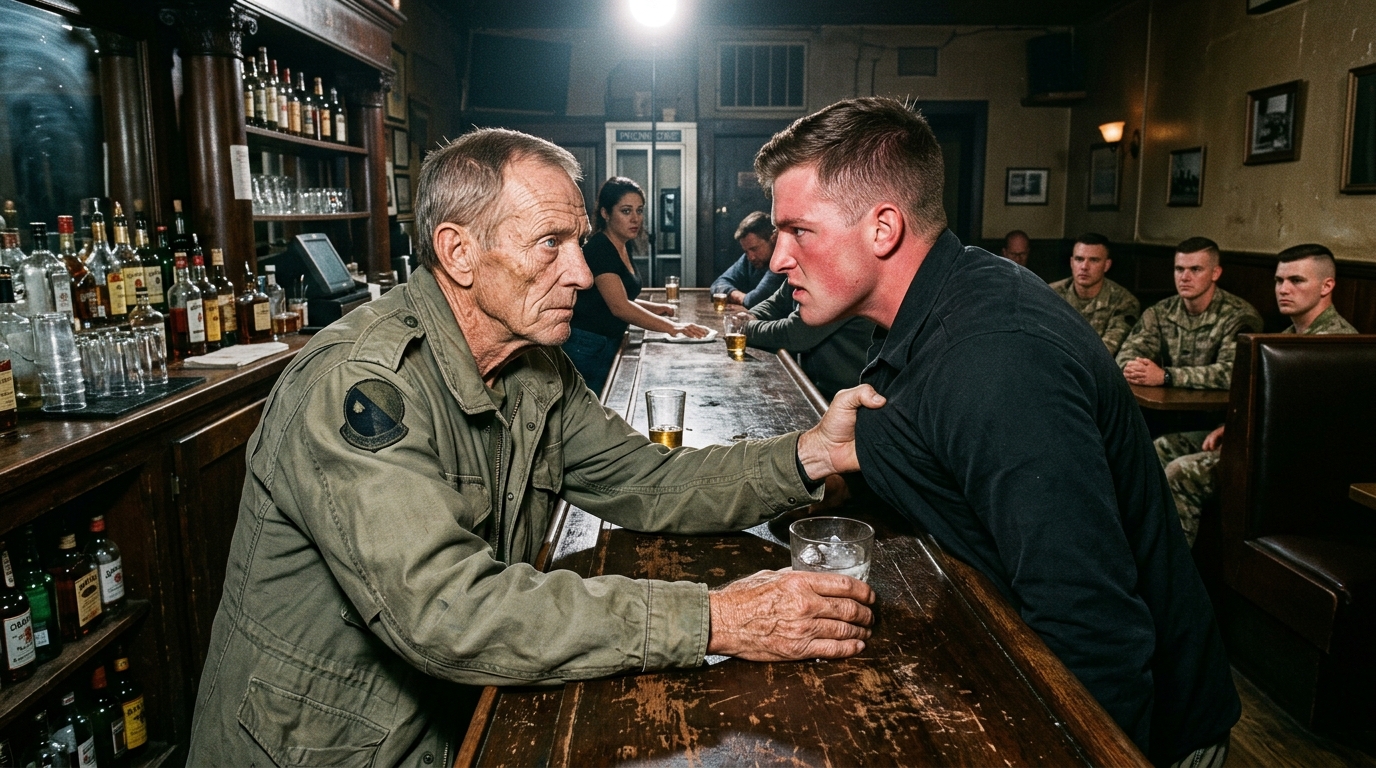
“I asked you a question, old man,” Jake said, his grip tightening around the fabric of Gordon’s sleeve with an escalating sense of entitlement. “What unit did you pull that nonsense from?”
Maria wiped down a dry spot on the far end of the counter, her movements stiff and mechanical, her eyes darting toward the phone booth in the back office. The patrons near the booths lowered their heads, pretending to study their beer labels, letting the heavy, suffocating silence do the talking.
Gordon didn’t jerk his arm away. To struggle would look like weakness; to comply would look like surrender. Instead, he simply turned his palm upward, letting the coarse grain of his skin grind against the younger man’s grip.
“You’re holding onto trash, son,” Gordon said quietly, his voice like dry leaves scraping over concrete. “Let it go before it cuts you.”
Jake scoffed, a sharp sound of disbelief that echoed off the wood-paneled walls. “Trash? That’s right, you won’t even own up to it because you know you’re wearing stolen valor.”
As Jake yanked the arm harder to pull the old man upright, a sudden, cold draft swept across the floorboards from the front door, carrying with it an inexplicable scent of wet canvas and engine oil that did not belong in the room.
Gordon didn’t blink, his pale blue eyes fixed entirely on the younger soldier’s overconfident jawline, silently calculating the exact amount of wasted breath it took for a boy to unmake a legend.
CHAPTER 3: THE COLD REALIZATION
The friction of boot leather catching on coarse wood kept Gordon anchored right where he was, refusing to yield an inch to the younger man’s muscle.
“You’re making a spectacle over nothing, son,” Gordon said, his voice dropping into that steady, unyielding register that didn’t invite argument.
Jake’s jaw tightened, the veins in his forearm bulging as he applied more force to drag the old man from the stool. “You don’t wear things you didn’t earn unless you’re hiding behind a lie.”
A sudden shift in the room’s ventilation blew a wisp of dust across the floorboards, cutting through the heavy smell of spilled lager and stale tobacco. Maria remained behind the back office door, her silence a heavy boundary that neither side dared to cross.
Gordon let out a slow, deliberate breath, his weathered fingers uncurling from the scarred glass to rest flat against the sticky wooden counter. He didn’t raise his voice, nor did he look for a rescue that wasn’t coming.
“Some things aren’t hidden,” Gordon murmured, his pale eyes locking onto the younger operator with a terrifying lack of fear. “They’re just waiting for someone foolish enough to dig them up.”
CHAPTER 4: THE HEAVY SILENCE
The wood beneath Gordon’s palm was cold, rough with the grain of decades of spilled drinks and heavy elbows. He didn’t pull back. He simply let his weight settle into his boots, forcing the younger operator to spend energy he couldn’t afford to waste.
“You think making noise proves something,” Gordon said, his voice level and dry as dust. “It just tells everyone else you’re scared of the quiet.”
Jake’s face flushed under the dim neon lights of the bar sign, his grip slipping a fraction of an inch on the old man’s sleeve. “I’m not scared of anything, old man. I’m calling out a fraud who wears a uniform he never earned.”
From the shadows near the back booths, Coyle shifted uncomfortably, his arms crossed over his chest as the expected easy victory turned into a heavy, grinding chore. The other patrons kept their eyes averted, pretending not to notice the sheer weight of stubbornness radiating from the stool.
Gordon let out a slow, measured sigh, his thumb brushing unconsciously against the frayed fabric of his field jacket where it draped over the wood. He didn’t need a uniform to know when a boy was playing soldier in a room too small for him.
“Earned things don’t need shouting,” Gordon murmured, his pale blue eyes staring straight ahead into the amber whiskey. “You’re screaming because you’re empty.”
CHAPTER 5: THE QUIET EXIT
The bar remained dead silent as Gordon finally straightened his hip, easing his weight off the stool without asking for permission or help from anyone in the room.
“Keep your apologies, son,” Gordon said, his voice quiet, steady, and utterly devoid of triumph. “You don’t owe them to me. You owe them to yourself.”
Jake stared down at his empty hand, the sudden loss of leverage leaving him looking smaller than he had all evening. Coyle stepped back from the booth, his expression hardening as he realized the old man had broken them simply by refusing to shatter.
Gordon reached behind the stool and grabbed his faded field jacket, slipping his arms into the worn sleeves with slow, deliberate care. He didn’t look back at the young men, nor did he look toward Maria, who watched from the office doorway with quiet, glistening eyes.
The heavy front door swung open under his hand, letting in a gust of crisp, cool night air that swept the stale smell of beer and ego out into the street.
“Good night, Maria,” Gordon said softly.
He stepped out into the dark, leaving behind a room full of soldiers who had finally learned the heaviest truth of all: respect isn’t demanded at the point of an accusation; it’s earned in the silence left behind.
CHAPTER 6: THE NEW NORMAL
The door behind him chimed with a soft, familiar ring that didn’t rattle the glass on the counter. Gordon kept his eyes on the amber liquid, his hands resting steady and unburdened on the scarred wood.
Footsteps approached, stopping two seats down before a familiar weight settled onto the adjacent stool.
“Evening, sir,” Jake said quietly, his voice lacking the sharp, arrogant edge of a boy trying to prove his uniform.
Gordon turned his head slowly, taking in the plain clothes and the sober stillness in the younger man’s eyes. The fire was banked, controlled, shaped by weeks of heavy reading and quiet reflection on what it truly meant to carry a legacy.
“You’re late, Jake,” Gordon said, his voice a dry, weathered rumble.
Jake swallowed hard, staring down at the polished wood between his hands. “I came to apologize for my behavior, for my disrespect, because there’s no excuse for it, sir—I was wrong.”
Gordon held his gaze for a long moment, measuring the weight of the words against the silence of the room. He raised a gnarled hand and motioned toward the end of the counter.
Maria didn’t hesitate, sliding a fresh glass across the wood without a word.
“You learn anything from all this?” Gordon asked, lifting his tumbler in a slow, silent salute.
Jake looked down into the dark glass, the arrogance entirely gone from his posture. “I learned that the quietest man in the room is often the one worth listening to the most—and that some medals are carried in a man’s memory, not on his chest.”
Gordon offered a small, rare nod, his pale blue eyes softening at the edges.
“That’s a good start,” Gordon said softly.
They sat together in the quiet warmth of the neighborhood bar, two men from different eras bound by the heavy, silent truth of what it takes to protect what matters. The glass rested flat against the wood, untouched by tension, anchored only by the quiet peace of a common-sense victory.