
The Geometry of Silence: How One Controller Dismantled a Suburban Tyrant via Federal Directive
CHAPTER 1: THE AERONAUTICAL OBSTRUCTION
The afternoon sun caught the spinning blades of the P-51 Mustang weather vane, casting a flicker of light that danced across the driveway. It was a rhythmic, peaceful sound—a metallic whisper that felt like my father’s presence.
Then came the voice. It wasn’t a sound; it was an intrusion.
“That thing,” she hissed. Karen. The president of the Oak Meadows HOA. She stood on the edge of the grass, her floral mumu straining against her frame. Her voice had that specific, grating vibration of someone who had never heard the word ‘no’ from a position of authority. “Is an unregistered aeronautical obstruction. A clear and present danger to every aircraft in this sky.”
I didn’t move. I didn’t breathe the air she was polluting. I watched her hand—the gaudy gold ring, thick and oversized, cutting into her flesh like a shackle—as she stabbed the air toward the roof.
“I am giving you 24 hours to remove it,” she commanded, the clipboard trembling in her other hand, “before I have it torn down myself and bill you for the privilege.”
She slapped the paper against my chest. The texture of the violation notice was crisp, heavy stock, printed with a malice that was almost professional. It listed a $5,000 fine for ‘endangerment of federal airspace.’
My neighbors were watching from their driveways. Mrs. Garcia was frozen near her garden hose, her eyes wide with a mixture of pity and terror. They were the audience. This was her arena. She thrived on the performance of public degradation, the slow stripping away of a man’s dignity until he was left standing in the ruins of his own yard.
I took the paper. I folded it once, twice, three times—slowly, geometrically, until it was a sharp, perfect rectangle. I tucked it into my back pocket with the surgical precision of an air traffic controller clearing a flight path through a storm.
“Karen,” I said. My voice was a low-frequency hum, devoid of the heat she was radiating. It was the voice I used when a pilot deviated from a flight plan, the voice that signaled that the game had officially changed. “You have absolutely no idea what you’ve just done.”
She stared at me, waiting for the defensive stutter, the excuse, the begging. It didn’t come. I looked past her shoulder, tracing the horizon where the real sky belonged, the one she would soon realize she had no business governing.
As she turned to stomp back to her car, her heels biting deep into my lawn, I noticed something that hadn’t been there before: a faint, dark smudge of grease on her right sleeve, entirely inconsistent with her pristine, suburban-tyrant ensemble. A minor detail. A discrepancy in the pattern.
She drove away, tires spinning gravel onto my curb, leaving a silence in her wake that felt heavy, charged, and entirely waiting to be filled. I didn’t reach for a lawyer. I didn’t reach for a gun. I reached for my phone. It was time to pull the flight plan.
CHAPTER 2: THE RADAR ROOM
I walked back into the house, the hardwood floor cool beneath my boots. The silence of the colonial home, usually a comfort after the high-decibel chaos of the tower, now felt different. It felt like a hangar waiting for the first piece of hardware to be rolled out. Sarah was in the kitchen, the soft clatter of a spoon against a ceramic bowl punctuating the quiet. She didn’t look up as I entered, her focus on the cooling steam of a late-afternoon tea.
I didn’t head for the living room. I didn’t go to check on Lily. I went straight to the small, windowless den—the space I’d converted into a study, though it looked more like a satellite office for the Northwood Regional control tower. My desk was a map of procedures, a physical grid of regulations and checklists. I sat down, the chair’s leather groaning under the shift in my posture.
The violation notice sat on the blotter, a white scar against the dark wood.
My mind didn’t jump to the insult. It didn’t churn with anger. It fractured, snapping into that familiar, sterile frequency I’d honed over twelve years. The transition was instantaneous. The ghost of the tower floor washed over me—the hum of the consoles, the rhythmic, disembodied voices of pilots cutting through the static, the absolute, crushing weight of maintaining order in a sky that wanted to collide. I remembered the nights when the clouds hung so low you couldn’t see the runway lights, when the only thing keeping metal from hitting metal was the internal metronome of the checklist.
Karen was a pilot who had just entered my airspace without a flight plan, buzzing the tower with a reckless lack of situational awareness. She thought she was the authority because she held a clipboard. She didn’t realize that in my world, authority wasn’t a title; it was the ability to document the deviation so thoroughly that the consequences became mathematically inevitable.
I pulled out a fresh legal pad. My movements were slow, deliberate. Step one: Documentation.
I began to draft a response, not to her, but to the reality of the situation. I needed to isolate the variables. The HOA’s claim was an aeronautical hazard. The procedure for such a claim didn’t involve yelling at homeowners; it involved the Federal Aviation Administration’s advisory circulars regarding obstructions. I knew the numbers by heart. I knew the height thresholds, the lighting requirements, the GPS signal interference protocols.
Every word I wrote was chosen for its neutrality. I was a professional controller documenting a technical inquiry. I didn’t mention the gaudy ring, the mumu, or the petty spite in her eyes. I focused solely on the structural specifications of the P-51 Mustang weather vane. If she wanted to play by the book, I would give her a library.
My phone vibrated against the desk—a sharp, buzzing intrusion. I ignored it. I was in the rhythm now, the “Predator-Prey” lens clicking into place. She was the predator, circling, trying to pick off the outlier. She didn’t realize that I was the one who had already mapped the terrain.
I looked up at the wall, at the framed photo of my father standing next to his own Mustang, his hand resting on the fuselage with the same possessive, quiet pride I felt for the house. The memory of his voice—measured, practical, a man who never looked for trouble but never stepped aside for it—grounded me. He hadn’t fought to win; he’d fought to maintain the flight path.
I finished the first draft of the letter. It was a masterpiece of bureaucratic coldness. It formally requested that the HOA provide the specific FAA regulation cited by the architectural review committee that categorized a thirty-inch steel structure as an ‘airspace obstruction.’ It asked for the name and credentials of the ‘consultant’ who had assessed the danger. It was a demand for accountability that smelled like an impending audit.
I leaned back, the tension in my shoulders easing just a fraction. I had the procedure. Now, I needed the network.
I thought of Mr. Henderson next door, his rose bushes, his silent, frustrated resignation. I thought of the GarcAs, their yard a battlefield of swing sets and playground mulch. They weren’t just neighbors; they were stakeholders in a system that had failed them. They were the ground witnesses to the pattern.
I stood up and moved to the window, peering out through the slat of the blinds. The street was quiet, the shadows of the oaks stretching long and dark across the pavement. Karen’s house sat at the far end, its curtains drawn tight, a bunker of self-appointed supremacy.
I tapped the glass with my finger, a rhythmic, metallic sound that echoed the spinning of the Mustang on my roof. The setup was complete. The tower was active. The only thing left was to see how long she could maintain her altitude before the reality of the flight plan forced her down.
I turned back to the desk, opened my email, and began to draft the formal notification to my supervisor. Not as a complaint. As a matter of professional transparency. The “conflict of interest” was my shield. If she wanted to trigger a federal investigation, I was going to be the one to hand her the pen.
CHAPTER 3: THE PAPER TRAIL
The cursor blinked. Once, twice, three times. It was the only rhythm in the room, a digital heartbeat for the web of bureaucracy I was spinning. Outside, the sky was bruising into a deep, early-evening violet. The streetlights of Oak Meadows flickered to life, casting long, jaundiced cones of light across the pavement. I watched them from my desk, seeing not a quiet neighborhood, but a grid of potential leverage.
I reached for the envelope. It was heavy, a standard-issue federal document folder I’d kept since my transition out of the Air Force. It smelled of old adhesive and paper dust. I began to assemble the exhibits. The HOA’s original notice was clipped to my written response, followed by a printed copy of the relevant FAA advisory circulars—highlighted in neon yellow where the language explicitly contradicted Karen’s “aeronautical obstruction” claim.
The weight of the paper in my hand felt substantial, grounding. Every page was a brick, and I was building a wall around her.
I walked to the front door, the house silent. My footsteps felt unnaturally loud, a rhythmic ticking against the hardwood. I didn’t turn on the porch light; I preferred the anonymity of the dusk. I stepped onto the lawn. The air was cooling, carrying the faint, metallic scent of the neighborhood’s sprinkler systems kicking on in the distance.
My house stood firm, the P-51 Mustang spinning slowly above me, a silent sentry.
I started across the street. The walk was short—maybe thirty paces—but it felt like a tactical maneuver across no-man’s-land. I kept my eyes on her porch. It was immaculate, a terrifying display of order. I climbed the steps, the wood creaking once, a soft, dry protest. I slid the envelope through the mail slot.
The clink of the heavy folder hitting the hardwood foyer floor sounded like a gavel drop.
I didn’t linger. I turned and walked back, my pace steady, my breathing calibrated. As I reached my own sidewalk, I saw a movement in the window of the Garcia house across the street. A curtain twitched—a fleeting, pale shadow—and then dropped back into place. They were watching. They were all watching. The neighborhood wasn’t just a collection of properties; it was a pressurized container, and the seal was starting to fail.
Back in the den, I didn’t relax. I sat down and pulled up a fresh document. If this was going to be a war of records, I needed to ensure my own house was in impeccable order. I began a new file: Internal Audit, Oak Meadows HOA.
I started with the bylaws. I had a digital copy of the entire binder, all two hundred pages of it. I used the search function, looking for the specific clauses Karen used to justify her fines. Article 4, Section 2B. All exterior attachments must receive prior written approval.
I cross-referenced it with the state statutes for homeowner associations. The law was clear: rules had to be applied consistently and fairly. I began to log every instance I could recall—Mr. Henderson’s roses, the GarcAs’ swing set, the welcome mat—creating a spreadsheet of grievances. It was monotonous, grueling work, but as the rows filled up, the narrative began to emerge. It wasn’t a governance issue; it was a record of targeted, systemic harassment.
I glanced at the clock. It was nearly midnight. My eyes burned, but my mind was sharpening. I felt the familiar, detached clarity of an air traffic controller handling a massive influx of traffic—the ability to look at the screen and see not just the blips of light, but the vectors of collision before they happened.
I realized then that I wasn’t just documenting her spite. I was documenting the HOA’s complicity. They had signed these notices. They had accepted these fines. They were the ones who had given her the power to act as their proxy.
A flash of doubt hit me—a flicker of the V-4 variance—as I stared at the screen. Was I really doing this for a weather vane? Or was the vane just the excuse I’d needed to stop being the one who followed the rules and start being the one who defined the parameters? The thought was fleeting, dismissed with a flick of the mouse. The objective was the same. The procedure was absolute.
I closed the file, the blue light of the monitor washing over my hands. I stood up, feeling the stiffness in my lower back, and walked to the kitchen for a glass of water. The kitchen was cold. I looked out at the backyard. The shadows were dense, but in the center, the new swing set stood like a promise of something else.
Tomorrow, she would find the letter. She would read the FAA references. She would see the cold, unyielding language of federal procedure. She would feel the shift in the pressure, the sudden, sharp drop in the barometric reading of her little world. And she wouldn’t even know that I was only just getting started. I poured the water, the glass cold against my palm, and stared into the dark, reflecting the calm, calculated focus of a man who had already won.
CHAPTER 4: THE INTERROGATION
Karen sat at the head of the long, dark-wood dining table, her posture rigid, her hands folded over a notepad with the forced stillness of a predator waiting for a strike. The room was aggressively tidy; every chair was pushed in at the exact same angle, and the scent of lemon polish was thick, almost cloying. I stood across from her, my own metal clipboard a stark, utilitarian object against the expensive mahogany. I wore my khaki pants and the navy polo with the generic aviation-style emblem. I didn’t look like a neighbor anymore. I looked like a federal auditor.
“Good morning, Miss Peterson,” I said, my voice maintaining that flat, professional frequency I’d practiced. “Agent Miller. Thank you for your cooperation. This shouldn’t take more than an hour.”
I didn’t wait for her to invite me to sit. I pulled out a chair, the legs scraping against the floorboards with a sound that felt like a surgical blade against glass. I set the clipboard down. It landed with a decisive, heavy thud that made her flinch.
“I’d like to conduct the interview portion first,” I continued, keeping my gaze fixed on the official report form in front of me. “A table where I can take notes would be appreciated.”
Karen’s face was a study in controlled fury. She opened her mouth, likely to protest the intrusion or challenge my authority, but I was already clicking my pen—a sharp, mechanical sound that cut through the silence.
“All right, Miss Peterson,” I began, my pen poised to record every syllable. “Let’s start with your first claim. You state in your complaint that the structure on the roof of 112 Oak Drive—and I’m quoting here—’could potentially blind pilots during critical landing phases due to its reflective surface.’ Can you please elaborate on the basis for this concern? Have you observed this phenomenon yourself?”
She blinked, her composure wavering for a fraction of a second. She reached out, adjusting a small, ceramic figurine on the table as if to regain some sense of physical dominance. “Well, it’s shiny,” she said, her voice dropping, losing its usual brassy resonance. “It’s metal. The sun hits it. It could reflect into a pilot’s eyes. It’s an obvious danger.”
I didn’t smile. I didn’t acknowledge the idiocy of the statement. I simply wrote: Source of concern: Speculative. No direct observation confirmed.
“It could,” I repeated, mirroring her words back to her as if they were evidence in a criminal proceeding. “So, you have not personally witnessed it causing a glare that reached aircraft altitude? You are speculating about a potentiality.”
“It’s a reasonable assumption,” she snapped, her knuckles whitening as she gripped the edge of the table. “I’m just being a concerned citizen. Someone has to look out for the neighborhood.”
“Of course,” I said, my tone smooth, clinical, and utterly dismissive of her indignation. “Source of concern: Assumption, not direct observation. Excellent.”
I watched her through the peripheral of my pen. Her skin was flushed, the blotchy red spreading from her neck to her cheeks. She was used to being the one with the clipboard, the one asking the questions, the one deciding who was in compliance and who was a violation. Today, she was the one being cataloged.
“Now,” I continued, pushing the boundary. “You also mentioned the structure is, again quoting, ‘sharpened.’ Can you describe the specific parts of the structure you believe to be sharpened and what kind of danger you believe this poses to an aircraft several hundred feet in the air?”
She stared at me, her mouth parting. The sheer, naked absurdity of the question hung between us, magnified by the cold, quiet environment of her home.
“The propeller and the wings,” she said, her voice sounding thin, almost vulnerable. “They’re pointy. If a plane… if a plane had to make an emergency landing…”
Her voice trailed off. She realized the trap. An emergency landing on a suburban street was already a catastrophe; the weather vane was a negligible variable. I didn’t let her recover. I started writing, my pen scratching loudly against the paper.
“An emergency landing,” I repeated, my voice steady, methodical. “And you believe the weather vane’s pointy edges would pose a more significant threat in that scenario than, say, the chimney, the roof trusses, or the entire two-story house itself?”
“You’re twisting my words,” she accused, but there was no force in it.
“Not at all, ma’am,” I said, looking up from the clipboard for the first time. I kept my expression blank, a mirror of absolute bureaucratic indifference. “I’m documenting your official statement for the FAA. Accuracy is paramount. So, to be clear, your concern is regarding the structural integrity of an aircraft that has already decided to land on a suburban rooftop.”
I watched her process this. I watched the realization dawning that she had documented her own malice on a federal record. She couldn’t walk it back. Every word she spoke was a brick in the foundation I was building under her house. The silence in the dining room became heavy, pressing in on her, and for the first time since I’d arrived, she looked small, trapped by the weight of her own invented rules.
CHAPTER 5: THE NETWORK
I didn’t stop. I couldn’t. The momentum of the interview was a live wire in my chest. I walked across the manicured lawn of Oak Meadows, the grass feeling unnaturally stiff beneath my boots, and navigated the quiet, suburban sprawl toward Mr. Henderson’s property. The streetlights buzzed overhead, a low-frequency hum that seemed to match the internal metronome of my resolve.
Every house I passed felt like a potential node in the network. For months, I had been an isolated blip on their radar, a singular point of resistance. Now, I was the aggregator.
I reached Henderson’s porch and knocked. The wood was weathered, soft with age. When he opened the door, his face was tight, his eyes flicking nervously toward the street before settling on mine. He was a man who had been kept in a state of perpetual, low-grade fear for years.
“Mr. Henderson,” I said, bypassing the usual pleasantries. I didn’t want to talk; I wanted to act. “I’ve started the formal FAA inquiry into the obstruction claim, and during the process, it’s become clear that my situation isn’t an isolated event. It’s part of a documented pattern.”
He leaned against the doorframe, his shoulders dropping. “She’s been watching again,” he whispered, gesturing vaguely toward the end of the street. “Ever since the first letter went out, she’s been pacing. She’s… she’s not herself.”
“She’s exactly who she’s always been, sir. She’s just losing control of the variables.” I pulled a document from my folder—not an FAA file, but a simple, clean affidavit template. “I need to document the history of the HOA’s enforcement actions. Your rose bushes. The fines. The notices.”
He looked at the paper, then at me. There was no hesitation this time, only a weary, desperate hope. He took the pen I offered, his hand steadying as he signed the line. It was the first strike in a sustained campaign.
My next stop was the Garcia house across the street. The mood there was different. Carlos stood in the doorway, his arms crossed over his chest, his jaw set. Maria hovered just behind him, her eyes bright with a mixture of apprehension and support. They had been the loudest advocates for the swing set they’d been forced to dismantle.
“You’re really doing it, aren’t you?” Carlos asked, looking at my clipboard.
“I’m following the procedure, Carlos. That’s all.”
I laid out the same request. They didn’t just sign; they brought out a box. A literal, physical box of notices, receipts, and hand-written letters from Karen, all dated, all logged with the obsessive precision of a victim who had been waiting for an excuse to fight back. Seeing the sheer volume of paper—the physical evidence of her petty, systematic cruelty—was jarring. It wasn’t just a nuisance; it was a career of intimidation.
I spent the next three hours moving from porch to porch. With every signature, the tension in the neighborhood seemed to shift. The air felt less like a stagnant, suffocating layer of HOA rules and more like a volatile, oxygen-rich atmosphere before a storm. I wasn’t just collecting signatures; I was collecting consensus.
By the time I made it back to my house, the midnight air had turned biting. My coat was damp from the mist, but the weight of the folder was substantial. I sat down at my desk, the den silent, and began to organize the affidavits. The spreadsheet I’d started the night before was no longer a list of grievances; it was a ledger of liability.
I was looking at the board of directors’ potential exposure. They had signed these notices. They had authorized the collections. They weren’t just bystanders; they were the mechanism.
I felt a sudden, sharp clarity. The V-1 variance of my own previous doubts was gone, replaced by the cold, hard logic of the legal reality. I pulled out my phone and dialed the number for Dave, my friend from the firm.
“Miller,” he answered on the second ring, his voice alert, ready.
“The evidence is mounting, Dave,” I said, my voice low. “It’s not just a pattern. It’s a portfolio of intent. I have the signed affidavits. I have the notice logs. I have the proof of inconsistent enforcement.”
There was a pause on the other end, and then, a soft, predatory laugh. “You’ve done it, haven’t you? You’ve turned the entire neighborhood into a witness box.”
“I’ve turned the neighborhood into a case file. And it’s ready for the hammer.”
I hung up, the silence of the den returning, but it was no longer heavy. It was expectant. I leaned back, my eyes tracking the glow of the monitor, and felt the first true, deep sense of momentum. The trap wasn’t just set; it was closing.
CHAPTER 6: THE AERIAL SURVEY
The morning air was razor-sharp, cutting through the thin fabric of my jacket as I stood on the asphalt of the local airfield. The sky above was a pale, uncaring gray, and the wind had picked up, snapping the tethered flags near the hangar with a rhythmic, impatient sound. My buddy, Dave, stood by the wing of his Cessna 172, a man who understood the value of a well-executed plan.
“You’re sure about this, Miller?” he asked, tapping the fuselage. “The approach is a bit turbulent today.”
“The turbulence is the point,” I said, sliding into the co-pilot seat. My movements were automatic, familiar—the check of the harness, the scan of the instruments, the mental alignment with the flight path. “I need to document the visual perspective from the flight vector. It’s part of the file.”
He climbed in, and the engine coughed to life, a rough, throaty sound that obliterated the morning’s stillness. We taxied to the runway, and as we lifted off, the world began to compress. The horizon expanded, shifting from the narrow, street-level view of Oak Meadows into a grid of squares, lines, and patterns.
The turbulence hit us almost immediately. The little plane shimmied, buffeted by the rising air currents. I felt the stick twitch in Dave’s hands as he compensated, the plane dropping and rising with a sudden, visceral gravity. I wasn’t just observing the flight; I was observing the environment as Karen would have seen it from her warped, fearful perspective.
We banked east, turning toward the residential sector. The neighborhood appeared below us, a cluster of beige and gray patches. I found my house, a tiny square in the geometric grid. The P-51 weather vane was invisible from this altitude, a mere speck in the broader complexity of the rooflines.
I pulled out the high-powered camera, the lens a cold, black eye. I began shooting, not just the roof, but the surrounding approach corridor. I captured the distance between the house and the published flight path, the lack of any significant obstruction, the way the sunlight hit the neighborhood. It was a forensic documentation of insignificance.
Then, the wind gusted. A hard, shearing force caught the wing, and the plane lurched, dropping twenty feet in a heartbeat. My stomach did a slow, sickening roll, but my hands remained steady, clutching the camera.
“Going to have to tighten the circle!” Dave shouted over the roar of the engine and the wind howling against the cockpit glass.
We banked hard, the plane dipping into a steep turn. The earth tilted, a dizzying, rushing blur of houses and trees. I focused the lens, framing my home, then Karen’s house. She was down there, likely watching from behind her drawn curtains, unable to see the person inside the plane but feeling the weight of the investigation circling above her.
I took the shot. Then another. And another. Every image was a piece of the dossier, a hard, physical reality that rendered her ‘aeronautical obstruction’ theory not just incorrect, but delusional.
As we leveled out, the adrenaline began to ebb, replaced by a cold, singular focus. This wasn’t just a survey anymore; it was an act of dominance. I was reclaiming the sky, the very airspace she had tried to weaponize against me. I felt the familiar weight of the procedure—the internal, unbending commitment to the path—that had guided me through every high-stakes shift in the tower.
“Got what you need?” Dave asked, the tension in his voice receding.
“I’ve got everything,” I replied, leaning back and watching the neighborhood shrink as we climbed back toward the clearer, smoother air above the clouds.
We weren’t heading home yet. We turned away from the neighborhood, the roar of the engine constant and comforting, a reminder of the order that reigned in the air. I looked at the camera screen, reviewing the images. They were sharp, clear, and perfectly composed.
The final pieces of the puzzle were in place. The FAA investigation report was no longer a draft; it was a finished, verified artifact. I realized, as the sun broke through the cloud cover and bathed the cockpit in a harsh, unforgiving light, that the truth was the most durable weapon of all. Karen had wanted a fight on the ground, in the dirt of her HOA rules. I had taken the battle to a level she couldn’t understand, let alone contest.
I felt the plane bank again, heading back toward the field, and for the first time in weeks, the tension in my chest loosened. I had documented the truth, and soon, it would be the only reality left.
CHAPTER 7: THE COURTHOUSE FLOOR
The community clubhouse was a vacuum of nervous energy. The air smelled of stale coffee and the artificial, floral scent of cleaning supplies—a sterile, suffocating odor that made my lungs feel tight. I stepped through the double doors with Dave at my side. He didn’t look like a lawyer; he looked like a man about to deliver a death warrant.
The room was packed. Neighbors stood shoulder to shoulder along the walls, their faces masked with a mixture of apprehension and hungry expectation. Mr. Henderson was near the front, clutching his hat, his knuckles white. The GarcAs stood by the exit, their expressions unreadable but fixed. The silence was absolute, a heavy, pressurized thing that seemed to hold the entire room in a state of suspended animation.
I walked down the center aisle, my boots clicking sharply against the linoleum. Every eye in the room was a vector, pointing directly at me. I didn’t look at them. I kept my gaze forward, toward the long, beige-covered table at the front of the room where the board of directors sat. They looked like statues, pale and sweat-streaked under the harsh fluorescent lights.
And then there was Karen.
She sat in the center chair, her posture as rigid as a steel girder. She was dressed in a dark, severe suit that seemed to drain the color from her skin. She didn’t acknowledge my presence, even as I took the seat in the front row, directly in her line of sight. She stared at the microphone in front of her with a fixated, predatory intensity.
“This emergency meeting of the Oak Meadows Homeowners Association is now in session,” George, the board’s treasurer, announced. His voice cracked, a thin, fragile sound that immediately drew a ripple of nervous movement from the crowd. “The first item on the agenda is the current legal situation.”
Karen didn’t let him continue. She snatched the microphone, the feedback whine cutting through the room like a physical blow.
“This meeting is a sham,” she said, her voice vibrating with a dangerous, shrill resonance. “It’s the result of a malicious, orchestrated attack by a resident who refuses to acknowledge the rules.” She didn’t look at me; she stared out at the crowd, her eyes wide, searching for the validation she was convinced was hers by right. “He has manipulated the systems we put in place to ensure order, all to protect his own petty, selfish interests.”
The room remained silent. It wasn’t the silence of submission; it was the silence of a fuse burning down to the powder.
Dave stood up. He didn’t raise his voice, but the calm, measured quality of his tone acted like a grounding wire in the storm. “My name is David Chen. I’m the attorney for Mr. Mark Miller.” He held up a thick, bound folder—the FAA report. It looked heavy, dense, and utterly final. “Before the board entertains any more fantasies, I think it’s important for every homeowner in this room to understand the reality of your current legal standing.”
He walked toward the table, placing the folder on the surface with a thud that echoed through the room. “This is not just a disagreement over a weather vane. This is a federally documented record of a malicious pattern of harassment.”
I watched Karen’s face as he spoke. The defiance was still there, but beneath it, the structure was failing. I saw it in the way her jaw muscles twitched, the way her eyes darted toward the exit, toward the crowd, looking for a loophole that didn’t exist. She was the pilot in a terminal stall, still checking the instruments, still convinced she could pull out of the dive if she just followed the checklist one more time.
“I have here,” Dave continued, his voice crisp and relentless, “sworn affidavits from twelve residents. I have records of illegitimate fines. I have proof of breach of fiduciary duty.” He began to read, his voice cutting through the stale, suffocating air. He read the details of the roses. He read the details of the swing set. Every word was a tactical strike, methodically dismantling her authority, layer by layer.
I felt the sudden, sharp memory of the tower’s terminal warning tone—that cold, high-pitched alarm that signaled a collision was inevitable. It was happening right here. Karen was staring at Dave, but she was looking through him, her eyes fixed on the empty space where her influence used to be.
“The question,” Dave concluded, his voice ringing with a cold, absolute certainty, “is not whether the board will be sued. It is whether you will be held liable for the actions of a single, unstable individual, or whether you will act now to restore the stability of this community.”
A murmur broke out, low and dangerous, growing in volume until it filled the room. The board members were looking at each other, their faces drained of blood. George was shaking. Karen was still holding the microphone, but her hand was trembling, the metal frame clattering against her chin.
She looked at the crowd. She looked for an ally, a defender, a believer. But all she saw were the people she had systematically marginalized and coerced.
The reckoning had arrived, and it was entirely, procedurally, and rightfully hers.
CHAPTER 8: THE QUIET SKY
Karen’s departure wasn’t a grand exit; it was a stumble. She pushed through the double doors of the clubhouse, her face a mask of pale, frozen shock, and vanished into the night. She didn’t look back. She didn’t have anything left to look at. The board members sat at their table, the beige room feeling suddenly, impossibly large around them. George, the treasurer, was the first to speak, his voice a brittle rasp against the stillness.
“We need a motion,” he said, staring at the empty seat at the center of the table. “To accept the settlement terms provided by Mr. Miller’s counsel.”
The remaining directors moved with the robotic precision of men who had seen their futures vanish and were now only interested in salvage. There was no argument. No debate. They voted, their hands rising in a synchronized, weary motion. The reign of terror hadn’t ended with a bang; it ended with a ledger entry.
Dave and I left the clubhouse shortly after. The cool night air hit us like a reprieve. We didn’t celebrate. We walked to the parking lot in silence, the weight of the previous months finally lifting from my shoulders. The systemic corruption—the way the HOA had been weaponized into a private militia for one person’s ego—was fully exposed, not by rumor, but by the cold, hard, legal reality of the settlement we had forced them to sign. The insurance company had cut the check, the liability had been neutralized, and the board had been legally compelled to dismantle the very mechanisms they had used to harass the neighborhood.
Over the next few weeks, the atmosphere in Oak Meadows underwent a tectonic shift. It wasn’t immediate, but it was absolute. The settlement required a total overhaul of the bylaws. The vague, weaponizable language that allowed for “aesthetic disruption” fines was stripped away, replaced by clear, objective criteria that left no room for interpretation. An independent committee of residents, not board members, was established to oversee any fines. The power had been returned to the people, but more importantly, the process had been immunized against future abuse.
The cleanup was the most satisfying part. We took the funds from the community restoration account—the leftovers from the settlement—and began the work of repair. We tore down the old, restrictive play equipment and replaced it with a new, open playground. I spent a Saturday morning helping Carlos Garcia bolt the final supports into the ground. It was hard, physical work, the kind of labor that leaves your hands stained with grit and your muscles aching, but every turn of the wrench felt like a corrective action.
A month after the meeting, the moving truck pulled up to Karen’s house.
I was in my driveway, cleaning the gutters, when the van parked across the street. I watched as the crew packed her life away into cardboard boxes. It was a mundane, almost clinical process. There was no anger left in me, only a distant, sharp satisfaction. When she finally stepped out of the house one last time, she didn’t glance toward my yard. She climbed into her car, her movements stiff and small, and drove away. She was gone. The threat she had posed—a threat I had neutralized with a clipboard, a GPS unit, and a stubborn adherence to the flight plan—was now just a memory, a ghost in the street’s history.
The final phase of the restoration was the most personal. I spent a long afternoon on my roof, the air clear and the wind steady. The P-51 Mustang weather vane needed maintenance; the pivot point had tightened over the months of constant spinning. I worked with a precision that felt second nature, cleaning the grime, lubricating the shaft, and ensuring the balance was perfect.
It wasn’t just a decoration. It was a monument to the process. My father had given it to me, but I had made it a symbol of something else—a testament to the fact that rules are only as good as the people who apply them, and that even the most entrenched bureaucracy can be redirected by a mind that understands how to use it.
Three months later, the neighborhood was unrecognizable. It wasn’t just the new playground or the garden where the pansies had been threatened; it was the vibe. People were out on their lawns, talking, laughing, sharing the small, messy details of their lives. The feeling of being watched, of being measured against an impossible, shifting standard, had vanished.
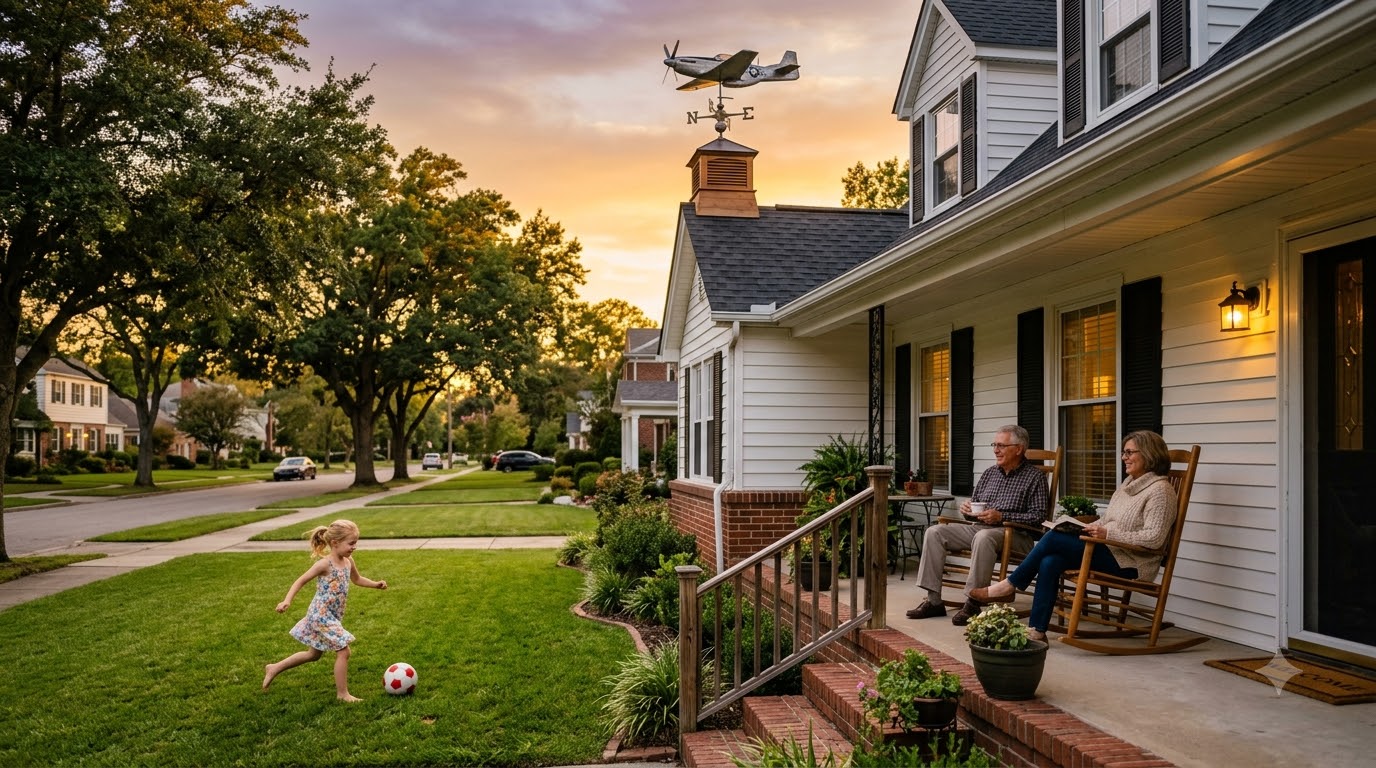
The sun was setting behind the oaks, casting long, gold-and-purple shadows across the street. I was sitting on my front porch with Sarah. Lily was in the yard, chasing a ball, her laughter rising to meet the twilight. The sky was clear, a vast, open expanse that felt truly peaceful for the first time since we’d moved in.
I looked up at the roof. The Mustang was spinning, its metal form catching the last of the light, a silent guardian pointing directly into the wind. The sky above Northwood Regional was a predictable, safe grid of light and path, just as it was meant to be. I took Sarah’s hand, the quiet of the house around us, the neighborhood settled, and the flight plan finally, perfectly, complete.