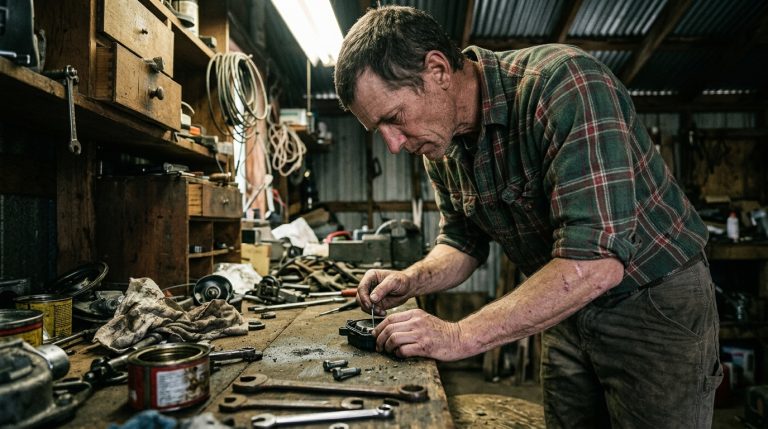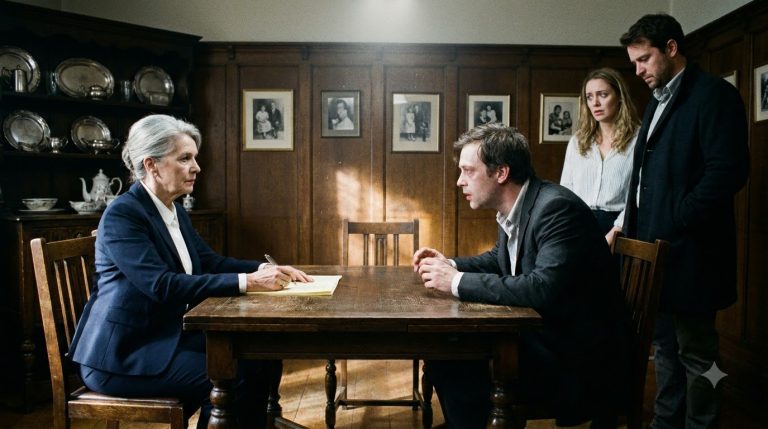
The Dust and the Deed: How One Man’s Ancestral Acres Shattered an Elite Suburban Empire
CHAPTER 1: The Weight of Iron and Stone
The sound was as old as the acreage itself—the sharp, grinding chatter of limestone gravel shifting beneath heavy rubber. Clayton Brewster kept his knees pressed into the dark, crumbly soil of Sarah’s memorial garden, his calloused fingers buried around the roots of an heirloom tomato plant that had survived three decades of Indiana summers. He didn’t turn around when the car door slammed. He didn’t need to. The sharp click of a sterling silver clipboard sliding against a leather portfolio was a cadence he had learned by heart over the past eight months.
“Mr. Brewster,” Veronica Ashford’s voice cut through the morning stillness, clipped and devoid of any pretense of neighborly warmth. She stood at the edge of the low stone-and-wire fence his grandfather had laid down in nineteen-fifty-two, her navy blazer catching the early sunlight like polished tin. Her pearl earrings swung with every crisp, deliberate movement of her head as she adjusted her grip on her laminated violation schedule. “We noted several unauthorized agricultural amendments during today’s routine aesthetic sweep. That soil composition violates municipal residential grading standards.”
Clayton finally rose, his joints popping with the dry friction of an old tractor engine. He wiped his palms against the thighs of his work trousers, leaving dark smudges of loam across the denim. He looked past her, toward the subdivision’s manicured emerald lawns rolling endlessly where his family’s cornfields used to stretch. A distant lawnmower whined, a sterile, high-pitched buzz that felt entirely out of place against the quiet rot of the old timber.
“This dirt was here before the blacktop, Veronica,” Clayton said, his voice low, raspy from years of breathing dust and well water. “My grandfather cleared these stones by hand. It’s not a garden bed to you, I know. It’s just a non-conforming variable on your spreadsheet.”
Veronica didn’t blink. Her eyes, sharp and calculating behind designer frames, flicked down to the freshly turned earth before returning to his face. “Property values in Willow Spring Estates rely entirely on uniformity, Mr. Brewster. Unregulated plots invite erosion, lower comparable market rates, and set a dangerous precedent for the other one hundred and twenty-six homeowners who respect our bylaws. You received the citation packet this morning. Three hundred and fifty thousand dollars in cumulative infractions is not a suggestion.”
She turned on her heel with military precision, her silver Lexus idling smoothly in the drive, waiting to carry her back behind the gates where the world was flat, gray, and orderly. But as she reached for the handle of her car door, a faint metallic clink echoed from the base of the old stone wellhouse twenty yards away—a sound like a loose horseshoe striking fieldstone. Clayton caught it instantly, his gaze darting toward the rusted iron hinge of the wellhouse door. It was slightly ajar, a dark sliver of shadow cutting across the sunlit wood where no shadow should have fallen.
CHAPTER 2: The Perimeter Inspection
The screech of the wellhouse hinge died hard, leaving behind only the distant, sterile drone of an automated lawn sprinkler three properties down. Clayton did not rush. A man of fifty-eight who had spent his life reading water tables and listening to the deep, slow subterranean shifts of the earth understood that panic was just wasted friction.
He left the spade upright in Sarah’s garden, the dark loam clinging to its steel blade like dried blood, and walked the ten paces across the dead grass toward the wellhouse. The structure was little more than a weathered cube of rough-cut timber and limestone blocks, built by his grandfather during the Eisenhower administration to house the manual pump mechanism before the county water lines clawed their way out this far.
As he stepped closer, the smell hit him—not the fresh, sweet decay of compost or the sharp tang of tomato leaves, but something stale and metallic. Stale grease. Fresh iron.
He gripped the edge of the swollen wooden door, his calloused fingers finding the familiar grooves where Sarah used to hang her canvas seed bags every spring. With a steady, deliberate pull, he swung it wide. The midday sun sliced into the cool interior, cutting through floating motes of dust to illuminate a scene that made the muscles in his back lock tight.
Leaning against the damp limestone wall was a heavy-duty aluminum tripod and a calibrated laser-measuring rig bearing the embossed inventory tags of the municipal engineering office. Next to it sat a half-empty thermos of coffee and a clipboard identical to the one Veronica carried—except this one was packed not with violation schedules, but with raw topological survey maps of the northern boundary wire.
Someone hadn’t just been inspecting the property; they had been mapping lines of sight. They had been preparing a second front.
Clayton reached out, his thumb tracing the cold, anodized leg of the tripod. The metal was clean, free of the fine layer of limestone dust that coated everything else in the old shed. It had been placed here recently—probably during his three-hour trip to the county records room yesterday morning. Marcus, the soft-bellied city inspector with the state trooper mustache, must have used his master key or a crowbar to pop the rusted latch, treating a sixty-year-old family outbuilding like a municipal supply closet.
A sudden, sharp memory flared behind Clayton’s eyes—not of maps or legal codes, but of Sarah standing right here five years ago, her sun-weathered hands wrapped around a porcelain mug, laughing as she pointed out how the wild morning glories were trying to choke out the northern fence post. ‘Let them climb, Clayton,’ she had said, her voice soft against the wind. ‘Some things belong to the land, not to the boundary lines.’
Now, those boundary lines were being weaponized against him.
He didn’t touch the equipment. To touch it, to move it, was to play their game—to acknowledge their presence and accept their rules of engagement. Instead, he stepped back out into the glare of the midday sun, pulling the wooden door shut with a heavy, final thud that rattled the rusted latch back into place.
The gravel drive crunched beneath his boots as he walked back toward the farmhouse. The porch steps groaned in protest under his weight, the old oak boards worn smooth by decades of boots, paws, and quiet footsteps. He settled into the wooden rocker by the front window, resting his forearms on his knees, and stared out at the silver Lexus parked down near the subdivision’s electronic security gate. Veronica was still visible through the windshield, her head tilted as she conferred with Marcus over another stack of papers inside his truck.
They thought the pressure was working. They thought the accumulating numbers—the fifty thousand, the eighty-five thousand, the two hundred thousand—were closing a net around an isolated old man with no leverage left to spend.
Clayton reached into his shirt pocket and pulled out the folded, yellowed carbon copy of the 1987 development lease he had slipped out of the courthouse archives before Nancy could bury it. The paper was thin, fragile as dried corn husk, but the ink stamped across the signature block was indelible.
He didn’t need to shout across the fence. He didn’t need to match their polished suits or their bureaucratic acronyms. He just needed to follow the legal logic of the land itself—layer by layer, stone by stone, right down to the bedrock.
He folded the paper back up, slid it into his pocket, and watched the silver Lexus finally shift into gear, its tires churning up a fresh cloud of limestone dust that drifted slowly across the emerald lawns of Willow Spring Estates, settling silently over the manicured grass like a gray shroud.
CHAPTER 3: The Basement Records
The transition from the glaring Indiana noon to the subterranean chill of the farmhouse cellar was immediate, marked by the smell of damp limestone, aged cedar, and sulfur from the old coal chute. Clayton did not turn on the overhead fluorescent strip; its harsh, flickering buzz always gave him a headache. Instead, he struck a wooden match against the brick of the chimney base and touched the flame to the wick of a heavy brass kerosene lamp left behind by his grandfather.
The yellow flame bloomed, casting long, wavering shadows across stacked crates of canning jars, spare well-pumps, and rows of heavy metal filing cabinets whose drawers were jammed shut with decades of rusted sliders.
He moved past the preserves toward the far corner, his boots clicking against the uneven concrete floor. Here, tucked behind an unused stack of oak floorboards, sat his grandfather’s surveyor chest—a heavy trunk of banded mahogany with brass corners tarnished the color of old pennies. He set the lamp down on an upturned apple crate, the glass chimney pinging softly as the metal heated up.
The leather straps were dry and cracked, snapping with a dry, splintering resistance when he pulled them free. He lifted the lid. Inside, beneath a layer of woolen surveyor’s blankets that still smelled faintly of mothballs and pipe tobacco, lay the cardboard boxes containing the 1987 archives.
Clayton’s fingers, steady and thick, sorted through the layers of onion-skin paper, blueprinted field maps, and ledger books. His grandfather had been a meticulous man—a hydrologist and surveyor who trusted neither banks nor county clerks. Every well drilled, every boundary staked, every dollar exchanged had been recorded in ink that refused to fade.
He needed the specific transfer receipts from the autumn of eighty-seven—not just the summary lease agreement he had pocketed from the courthouse, but the underlying banking schedules that proved whether Clearwater Development had ever cleared their final installment before going under in ninety-one.
A sharp draft swept through the coal chute overhead, carrying with it an unexpected sensory intrusion: the chemical, sharp scent of fresh hot asphalt. Out on the paved perimeter road bordering his northern pasture, someone was laying down new patch coats. It was an aggressive, unannounced intrusion, a reminder that the perimeter was shrinking day by day, walled in by the orderly march of suburban infrastructure.
Clayton ignored the smell and kept digging. Folder after folder of dry, crackling paper passed through his hands. Pike County Water District easement… Mineral rights waiver, 1984… Clearwater Development initial option contract, signed September 12, 1987.
His thumb hooked into a frayed manila tab marked Project Ledger – Clearwater Escrow.
He pulled it out into the yellow pool of lamplight and opened the cover. Inside, pinned with a rusted wire paperclip, was a handwritten bank draft ledger detailing the exact schedule of payments William Brewster had demanded from the developers. The terms were uncompromising: ninety-nine-year development rights leased for eighty-nine thousand dollars, payable in four structured installments, with a strict forfeiture clause specifying that any missed payment or corporate dissolution instantly reverted all physical and surface rights back to the Brewster family trust without arbitration.
And right there, entered in his grandfather’s sharp, sloping hand in the margin of the 1991 bankruptcy notation, was the final entry: Third installment defaulted. Company assets liquidated under Chapter 11. No final payment received.
The paper was thin, but the implication was heavy enough to crack the foundation of every luxury home built across the fence. They hadn’t bought the land. They had rented a shadow and built a kingdom on top of an expired lease.
Clayton closed the ledger with a soft, dull slap that stirred the dust motes around the lamp flame. He tucked the folder inside his work shirt, sliding it against his ribs where he could feel its stiff edges.
He straightened up slowly, his knees aching from the damp cold of the cellar floor, and blew out the lamp. In the sudden, absolute darkness, the smell of fresh asphalt drifted down through the chute again—nearer this time, pressing right up against the edge of his property line. They were paving right up to his gate, measuring the inches, testing how much pressure an old man could take before the ground gave way beneath his boots.
CHAPTER 4: The Survey Stakes
The sound was unmistakable—the sharp, repetitive thud of a heavy wooden mallet driving iron rebar into stubborn clay. Clayton didn’t rush across the yard. He kept his pace steady, his boots finding the familiar dips in the dry turf where the old tractor tracks used to run before the subdivision carved the horizon into neat, taxable rectangles.
By the time he reached the northern boundary line, where the unpaved scrub grass met the manicured perimeter sod of Willow Spring Estates, two men in high-visibility neon vests were already at work. Straddling the rusted barbed-wire fence his grandfather had strung up forty years ago, they were hammering bright orange plastic laths into the dirt—fully six feet inside what every local property tax map for the last three decades had recorded as Brewster acreage.
At the center of the operation stood Tom Bradley. At seventy-eight, Tom’s face was carved from the same weathered limestone as the wellhouse, his faded plaid shirt damp with sweat under the relentless July sun. In his gloved hands, he held an old-school brass-rimmed plumb bob, its cord pulled taut against the shimmering heat waves rising off the asphalt.
“You’re drifting south, Tom,” Clayton said, his voice cutting cleanly through the rhythmic thud of the mallet.
Tom didn’t jump. He lowered the plumb bob slowly, letting the heavy brass tip settle against a small, circular disk half-buried in the tall grass. He wiped a forearm across his forehead, smearing gray dust over his sun-spotted skin, and turned to look at Clayton with eyes the color of washed denim.
“I ain’t drifting, Clayton,” Tom rasped, his voice sounding like dry gravel sliding down a chute. “I’m following the steel my own crew drove into this pasture back in September of eighty-right. The men who bought this land after your grandfather cut the lease didn’t re-survey the corners. They just drew new lines on a desk in Indianapolis and pretended the old brass didn’t exist.”
Tom kicked gently at the dirt with the toe of his work boot, uncovering the rim of a weathered metal marker stamped with the initials W.B. – 1987.
“Look at this pin,” Tom continued, crouching down with a grunt of protest from his hips. “This ain’t just a boundary marker. It’s the primary anchor point for the entire north tract. When Clearwater Development laid out the blueprints for Willow Spring Estates, they were supposed to measure off this exact disk. Instead, their engineers shifted the baseline twenty feet south to maximize lot yields for the luxury builds. They stole twenty feet of your pasture frontage right out from under your grandfather’s nose before the ink on the lease was even dry.”
Clayton stared down at the rusted disk. The metal was pitted and cold, scarred by decades of silence. The physical reality of the land was suddenly shifting beneath his feet, stripping away the illusion of the neighborhood that hummed just fifty yards away behind its decorative brick wall. They hadn’t just built houses on his family’s dirt; they had re-engineered the coordinates to make the theft look official.
“Veronica’s engineer—that soft-bellied fellow Marcus—was out here yesterday afternoon with a laser rig,” Clayton said quietly, his gaze fixed on the bright orange laths fluttering in the hot breeze. “They’re trying to lock down this shifted boundary before the county assessment board meets next month.”
“Let them pound all the plastic they want,” Tom spat, standing back up and adjusting the brim of his faded ball cap. “Plastic rots in three seasons. Brass stays put until the earth splits open.”
Tom reached into his canvas utility bag and pulled out a heavy steel measuring tape, tossing the metal spool across the wire fence toward Clayton. The heavy chrome housing landed with a dull thud in the dust.
“If you want to stop them from rewriting your history, Clayton, you need to prove where the corners were before the asphalt trucks arrived,” Tom said, his tone turning sharp and pragmatic. “I got the original field notes in my truck, but we need to verify the western run by sundown before the municipal inspectors come back out to serve their next round of injunctions.”
Clayton picked up the tape measure, feeling its cold, dead weight in his palm. The spring inside hummed faintly as he pulled the metal tab, letting the silver ribbon unspool across the boundary line—bridging the gap between the world his grandfather built and the artificial empire waiting just beyond the wire.
CHAPTER 5: The Courthouse Incinerator
The asphalt along County Road 4 was cooling under a bruised twilight sky, throwing off the heavy, chemical stench of a summer day’s worth of municipal patching. Clayton didn’t go straight back to the farmhouse. Instead, he let the truck idle at the intersection before turning south toward the Pike County Courthouse, his headlights cutting long, pale arcs through the rising evening mist.
He parked across the street from the municipal annex, right behind a nondescript gray Honda Civic with a county clerk parking sticker peeling off the bumper. The courthouse annex was dark save for a single fluorescent rectangle glowing in the basement records bay—the narrow window where old plats, tax rolls, and municipal ledgers were kept behind reinforced wire mesh.
From his vantage point behind the steering wheel, Clayton watched the basement casement. The engine ticked softly as it cooled, the ticking rhythm matching the heavy, deliberate thud of his own pulse. He reached into his coat pocket and felt the stiff edge of the 1987 escrow ledger he had pulled from his cellar hours earlier. It proved his grandfather’s side of the contract, but it lacked the official municipal receipt stamp—the physical ink mark from the county treasurer’s office that verified the original default had been entered into the public record before Clearwater filed for bankruptcy protection.
Without that stamp, Veronica’s high-priced legal team could argue the ledger was a private family notation, easily dismissed in a civil suit. With it, the chain of custody was airtight.
A shadow crossed the frosted glass of the basement window. Then another.
The casement cranked open with a protesting screech of ungreased metal, and Nancy, the county clerk, pushed a heavy, reinforced cardboard box out onto the concrete well. A moment later, Veronica Ashford stepped into view beneath the yellowish glow of the security light. She wasn’t wearing her signature navy blazer tonight; instead, she wore a dark trench coat, her pearl earrings catching the harsh overhead light as she bent down to inspect the box.
Clayton didn’t hesitate. He killed his headlights, slipped out of the truck cab without a sound, and crossed the empty asphalt on foot, keeping his boots aligned with the deep shadows of the municipal hedge row.
By the time he reached the low brick wall surrounding the rear utility courtyard, Nancy had already rolled an industrial steel drum—the kind used by the sanitation department for confidential document disposal—out from the loading bay. Inside the drum, a coil of diesel-soaked kindling was already catching, casting a sickly, blue-tinted flame upward.
“Just burn the eighty-seven through ninety series,” Veronica’s voice carried clearly across the quiet yard, sharp and unyielding. “If anyone asks, the basement sump pump backed up during the spring thaw and ruined the file boxes. It happens to old municipal paperwork all the time.”
“Veronica, this isn’t just old paperwork,” Nancy muttered, her hands trembling as she clutched a thick manila folder against her chest. “These are primary registry books. If the title investigators pull the audit trail—”
“The audit trail starts and ends with what’s in front of you,” Veronica interrupted, stepping closer and pressing a heavy, sealed manila envelope directly into Nancy’s shaking hands. “The special assessment vote is in three weeks. Once the foreclosure liens are locked in, nobody will ever dig back into these files again. Take the cash, Nancy. Close the drawer.”
Clayton took two slow steps out from the shadow of the hedge, his boots crunching sharply against a patch of loose gravel.
The sound cut through the crackle of the burning kindling like a pistol shot. Both women froze. Veronica whipped around, her eyes widening as she recognized the broad, stooped silhouette stepping out of the dark.
“Mr. Brewster,” Veronica said, her voice tightening instantly, though she managed to keep her posture rigid. “You are trespassing on restricted municipal property after hours. I will call the sheriff’s office before you take another step.”
“You go ahead and call them, Veronica,” Clayton said, his voice level, carrying the heavy, unhurried weight of a man standing on his own land—even here, surrounded by concrete and municipal brick. He pointed a calloused finger directly at the open steel drum where the edge of a yellowed binder was already curling into ash. “Because when Deputy Martinez gets here, he’s going to find out why the woman running the homeowners association is paying the county clerk cash to warm her hands over a burning box of public records.”
Nancy dropped the manila envelope she was holding. It hit the concrete with a dull, heavy slap, spilling a thick wedge of banded currency across the soot-stained pavement.
The fire in the drum popped, sending a shower of orange sparks up into the evening air, illuminating the smoke that drifted slowly toward the distant rooftops of Willow Spring Estates. The paper trail was burning, but the heat of it was already beginning to melt the foundation beneath their feet.
CHAPTER 6: The Confession at the Counter
The heavy iron door of the courthouse utility bay slammed shut against the brick frame with a metallic echo that seemed to rattle the very mortar. Clayton did not chase Veronica as she spun on her heel and sprinted toward her idling Lexus parked across the tarmac; chasing panic was a fool’s errand. Instead, he kept his boots planted squarely on the soot-stained concrete, his eyes fixed on Nancy.
The county clerk was shaking so violently that her knees buckled halfway, sliding her down the rough brick pillar until she sat directly in the scattered wedge of currency. The bills—crisp, fifty-dollar denominations pulled fresh from a bank wrapper—lay like fallen autumn leaves around her sensible black flats.
“She… she told me it was just old indexing,” Nancy whispered, her voice cracking into a ragged wheeze as she stared up at Clayton through a blur of hot tears. “She said nobody would ever look back at eighty-seven. She said the state was digitalizing everything anyway, and paper copies were just taking up floor space in the archive bay.”
Clayton reached down, his large, calloused fingers pinching one of the fifty-dollar bills from the pavement. He held it up to the harsh yellow security light, examining the serial number before sliding it back down onto the concrete without a word. The silence between them was thick, weighted by the acrid smell of burning rag paper drifting from the open steel drum. Inside the drum, the edges of a municipal ledger still glowed a faint, dying ember-red.
“The papers you threw in that drum weren’t taking up floor space, Nancy,” Clayton said, his voice flat, stripped of anger or malice. “They were the only thing keeping your signature off a federal indictment for altering tract registry maps.”
Nancy covered her face with both hands, her shoulders heaving with dry, racking sobs. “I have a mortgage, Clayton. My husband’s medical bills… Veronica’s brother-in-law, Marcus, he arranged the county board maintenance contracts. They said if I didn’t help clear the title flags on the north tier, my position would be ‘restructured’ by the end of the quarter. It wasn’t my idea. It was hers. She runs the whole board like an executive suite.”
Clayton didn’t offer comfort. In the dusty gray world of property lines and broken contracts, pity was a luxury that cost more than it was worth. He stepped past her, walking toward the smoldering steel drum. Using a heavy iron fire poker left leaning against the brick wall, he hooked the rim of the drum and dragged it away from the building, spilling the glowing ash out onto the open gravel where the night air could snuff it out safely.
Before the last ember died in the dirt, he spotted something wedged beneath the heavy metal lip of the drum—a surviving fragment of thick, blue-lined index card that hadn’t fully burned. With the tip of the poker, he flipped it over. It was a handwritten cross-reference index tag bearing his grandfather’s handwriting: North Tier Escrow – Clearwater Default – Nov 1991.
The fire had charred the edges, but the core text—and the stamped seal of the Pike County Recorder—remained completely legible.
Clayton picked up the surviving fragment with two fingers, slipping it carefully inside his shirt pocket alongside the escrow ledger. He looked down at Nancy, who was still huddled against the brick pillar, staring at the scattered cash like it had turned to venom.
“Get up, Nancy,” Clayton said quietly. “Go inside, turn on the administrative terminal, and print out every electronic backup log for the North Tier development filings from nineteen-eighty-seven to the present morning. Because if those logs don’t match what’s left in this yard when the state investigators arrive tomorrow, the only thing Veronica will be sharing with you is the same cell block.”
He didn’t wait for her answer. He turned his back on the utility yard, walked across the empty asphalt to his truck, and pulled himself up into the cab. As he turned the ignition, the old diesel engine coughed to life, shaking the rusted chassis with a deep, reassuring vibration that cut right through the cold night air.
CHAPTER 7: The Shell Company Trail
The cab of the truck was dark save for the amber glow of the dashboard panel, casting faint amber lines across Clayton’s worn hands as he steered down the unlit stretch of Route 4. The charred fragment of the index card he had fished from the ashes lay on the rubber floor mat, held down by a heavy brass pocketknife to keep the midnight draft from blowing it away.
He didn’t head straight back to the farmhouse. Instead, he took the long gravel bypass that wound past the old grain elevator, cutting behind the commercial fringe of the county seat. If Veronica was willing to burn municipal record books to protect her foreclosure schedule, she wasn’t just defending architectural aesthetics or property values. She was protecting a financial engine.
Twenty minutes later, he turned the truck down a narrow alley behind the professional office park on Meridian Street, parking fifty yards short of a single-story brick building bearing a polished brass plaque: Ashford Legal Defense LLC & Associates.
The windows on the ground floor were dark, but a sliver of fluorescent light cut horizontally beneath the blinds of a second-floor corner suite. That was where the paper trail led—not to the county clerk’s basement, but to the private routing numbers where the homeowners association’s emergency funds were being funneled.
Clayton cut the engine, letting the truck roll silently into an unassigned slot near the rear service door. He didn’t lock the door as he stepped out into the gravel lot. He reached into his coat pocket, wrapping his fingers around the cold, textured handle of a heavy steel flashlight, though he had no intention of using it. In the dark, a light only gave away position.
The service door was fitted with an electronic numeric keypad, but the latch clicked lazily against the jamb as he tested the handle—an oversight born of suburban complacency, where residents believed gated entryways and polite society rendered mechanical locks redundant. Clayton pushed it open with the heel of his boot, stepping quietly into the carpeted stairwell.
The air inside smelled of fresh toner, expensive carpet glue, and stale microwave popcorn. He climbed the stairs one step at a time, keeping his weight close to the outer wall where the old oak framing wouldn’t groan under his weight.
At the top landing, the door to Suite 204 stood slightly ajar.
A low, steady murmur of conversation drifted out into the hallway—not an argument, but the clipped, transactional tone of a teleconference running late into the night.
“…the special assessment notices went out via certified mail yesterday morning,” a voice was saying—Marcus, the city inspector, speaking with a distinct lack of his usual swagger. “If eighty percent of the homeowners remit the twenty-five thousand before the county board certification deadline next month, the escrow account clears the liability balance. Brewster won’t have a leg to stand on.”
“And if he doesn’t fold?” a second voice replied—sharper, tighter, carrying the unmistakable cadence of Veronica’s legal counsel from Peton and Associates. “If he actually produces the original eighty-seven lease transfer before the judge signs the summary judgment?”
A short, heavy pause hung in the room, broken only by the hum of an overhead air handler.
“Then we accelerate the demolition order on the wellhouse and the northern fence,” Marcus answered smoothly. “Classify them as hazardous structures under emergency municipal code. Once the physical markers are leveled by the city contractor, the boundary lines default to the subdivision plat maps regardless of what’s written on a fifty-year-old piece of onion-skin paper.”
Clayton stood motionless in the dim hallway, his boots resting on the edge of the neutral-toned commercial carpet. They weren’t just fighting a legal battle on paper; they were planning to erase the physical evidence of his grandfather’s land before the court could schedule a hearing. Every stone wall, every fence post, every tomato plant in Sarah’s garden was targeted for administrative execution.
He slowly withdrew his hand from his pocket, the steel flashlight remaining untouched. He didn’t need to break in, and he didn’t need to record their voices. He had heard all the proof he required: an admission of premeditated destruction under color of municipal authority.
He backed down the hallway step by step, his eyes fixed on the sliver of light under Suite 204 until it vanished behind the corner of the stairwell wall. He pushed through the rear service door into the cool night air, climbed back into the cab of his truck, and pointed the hood north toward the dark, quiet expanse of the only land that mattered.
CHAPTER 8: The Arrival of Files
The headlamps cut across the frost-tipped blades of Sarah’s garden as Clayton killed the diesel engine. Before the motor could even settle into its final, clicking cool-down, the headlights caught the glint of a heavy, tape-sealed cardboard carton resting against the base of the front porch steps. It hadn’t been there when he left for Meridian Street.
He climbed down from the cab, his boots crunching against the gravel, and walked over to the package. The shipping label was stamped in heavy, faded blue ink: State Land Commission – Central Archives Division, Indianapolis. Across the top, written in a shaky, geriatric hand, was a note scribbled on yellow legal paper: Brewster file complete. Originals verified per Section 11. Good luck, son.
Richard Sterling had kept his promise.
Clayton scooped the box up into his arms, feeling the dense, dead weight of hundreds of pages of uncompressed public records, state land grants, and bankruptcy depositions. He carried it up the weathered wooden steps, kicked the front door open, and dropped the carton onto the center of the kitchen table.
The house was cold, wrapped in the deep, pre-dawn silence that always felt heaviest before the first light broke over the tree line. He struck a match, lit the wick of the oil lamp, and pulled out his heavy pocketknife to slice through the reinforced packing tape.
Inside lay a neatly ordered stack of manila folders, each labeled with red ink. The uppermost folder bore a title that made the hair on the back of his neck prickle: Clearwater Development – Master Title Assignment & Escrow Default Record, October 1991.
Clayton pulled it open. The pages inside weren’t photocopies or local municipal printouts; they were the original, high-rag-content state filings stamped with the embossed gold seal of the Indiana Department of Natural Resources and the Federal Bankruptcy Court of the Southern District.
As he turned the pages, the full architecture of the fraud became starkly transparent. Clearwater hadn’t just missed a payment; they had systematically fabricated secondary deeds to sell 127 individual home lots to buyers while the primary mortgage title remained legally encumbered by William Brewster’s 1987 lease terms. Every single homeowner in Willow Spring Estates held a warranty deed issued by a corporate entity that had zero legal standing to sell the underlying dirt.
Veronica Ashford wasn’t just an overzealous HOA president enforcing arbitrary lawn rules. She was sitting at the apex of a multi-million-dollar title laundering operation, using manufactured code violations and swift foreclosure threats to force homeowners into paying inflated special assessments—money designed to cover up the very land discrepancy she was now trying to bulldoze out of existence.
A sudden, sharp rapping at the front screen door broke the silence.
Clayton didn’t flinch. He didn’t reach for a weapon. He simply closed the folder, stood up from the wooden chair, and walked through the dark hallway to the front entry.
Standing on the porch, wrapped in a heavy wool coat against the morning chill, was his daughter Jessica. Her hair was pulled back in a tight travel knot, and under one arm she clutched a leather briefcase stuffed with environmental law briefs and federal court filing templates. Her eyes were sharp, wide awake, and burning with the cold clarity of a prosecutor smelling blood in the water.
“I caught the red-eye out of Portland as soon as I decrypted your text,” Jessica said, her breath pluming white in the chill air as Clayton pushed the screen door open. She stepped past him into the warmth of the hallway, dropping her suitcase by the coat rack. “The state attorney general’s office just picked up Nancy’s formal deposition from the county clerk’s office an hour ago. They’re ready to freeze the HOA’s operational accounts by noon.”
She paused, catching sight of the open box of state archives spread across the kitchen table. The yellow lamplight caught the glint of the gold embossed seals.
“Is that what I think it is?” she asked, her voice dropping to a low, steady hum.
“It’s the whole cake, Jess,” Clayton said quietly, walking back to the table and resting his hand on the heavy stack of papers. “Not just the icing. The whole foundation.”
Jessica stepped up to the table, her fingers tracing the edge of the 1991 bankruptcy deposition. A slow, thin smile touched the corners of her mouth—a look that bore an uncanny resemblance to her grandfather when he was staring down a dry well that refused to yield water.
“Then I guess it’s time we schedule a community meeting,” she said.
CHAPTER 9: The Silence on the Porch
The first heavy drops of rain struck the dry tin of the porch roof with a scattered, metallic rattle, kicking up the sharp, earthy scent of wet dust from the gravel drive. Clayton did not sit back down at the table. He stood by the kitchen window, his palms resting flat against the scarred wooden sill, watching the distant streetlights of Willow Spring Estates flicker on against the bruised purple of the approaching squall.
Jessica moved behind him, her boots clicking softly on the linoleum as she organized the state files into three distinct, leather-bound portfolios. Her movements were precise, devoid of the hesitation that had plagued her initial phone calls from Portland weeks ago.
“The county prosecutor is moving faster than Veronica anticipated,” Jessica said, her voice low and steady over the drumming rain. “They’ve already frozen the general operating funds of the homeowners association. But Veronica’s defense counsel just filed an emergency motion for a temporary injunction, claiming our title documents are unverified copies subject to chain-of-custody challenges.”
Clayton didn’t turn around. His gaze remained locked on the perimeter wire where the orange plastic laths Tom Bradley’s crew had hammered into the dirt were beginning to lean under the rising wind. “They’re trying to buy time until the special assessment checks clear from the escrow accounts,” he said, his voice grating like dry stone. “Once those checks clear, the money is gone—funneled into that shell company Marcus set up on Meridian Street.”
“Which is why we can’t wait for the civil court docket to crawl through next month’s calendar,” Jessica replied, stepping up beside him at the window. She pulled a folded sheet of heavy bond paper from her briefcase and laid it flat on the counter next to the sink. “We bypass the civil judges. We serve notice directly under the reversion clause of the eighty-seven lease. Not a lawsuit. An administrative repossession.”
Clayton looked down at the paper. It was a formal Notice of Lease Default and Surface Rights Reversion, drafted in strict accordance with federal bankruptcy guidelines. It didn’t ask for permission; it stated a legal fact that had been sitting in the state archives for thirty-three years waiting for someone with the patience to read it.
“If we serve this before the HOA’s mandatory meeting on Sunday night,” Clayton murmured, his eyes narrowing as he calculated the friction points, “Veronica won’t be able to hide behind her architectural bylaws or her sterling silver ruler. The entire neighborhood will have to choose between acknowledging who owns the ground beneath their feet or standing shoulder-to-shoulder with a criminal conspiracy.”
“And if they refuse to open the door?” Jessica asked, her eyes searching his face for any sign of doubt.
“Then they’ll be reading the notice off the front gate,” Clayton said, reaching for his heavy canvas work jacket hanging by the back door. “Because the ground doesn’t lie, Jess. And it’s time we walked the line.”
The rain outside picked up intensity, hammering the old farmhouse walls and washing the summer dust from the windows as father and daughter stood together in the gathering dark, preparing for the final push that would break the illusion once and for all.
CHAPTER 10: The Community Center Assembly
The parking lot of the Willow Spring Community Center was packed solid, its rows of silver sedans and polished SUVs gleaming under the harsh white glare of security floodlights. Inside, the massive multi-purpose hall hummed with a low, collective murmur—the anxious, agitated drone of one hundred and twenty-six households summoned by certified mail to vote on an emergency twenty-five-thousand-dollar special assessment.
Clayton pulled the heavy glass door open, his boots stepping off the wet asphalt and onto the smooth, polished linoleum of the foyer. Jessica walked right beside him, her leather briefcase tucked securely under her arm, carrying the heavy cardboard carton of state land commission archives. Tom Bradley and Jake Morrison followed close behind, their weathered faces bearing the hard, impassive lines of men who had spent a lifetime reading weather fronts before the wind broke.
The sudden shift in the room’s atmosphere was immediate.
Conversations died out row by row as heads turned toward the entrance. Veronica Ashford stood at the head of the auditorium behind a raised walnut podium, flanked by two corporate defense attorneys hired from Indianapolis. She wore her immaculate navy blazer and pearl earrings, her expression a mask of practiced corporate authority. But as her eyes locked onto Clayton walking down the center aisle, the color visibly drained from beneath her high-collar blouse.
“Mr. Brewster,” Veronica said into the stationary microphone, her voice echoing sharply off the high acoustic ceiling. “This is a private association meeting restricted to property owners and registered stakeholders. You have no legal standing to be inside this perimeter.”
Clayton didn’t stop walking. He kept his stride steady, his heavy work boots striking the linoleum with a rhythmic, measured cadence that filled the quiet hall. He stopped ten feet short of the raised stage, resting his calloused hands on the back of an empty folding chair in the front row.
“You’re right about one thing, Veronica,” Clayton said, his low, gravelly voice carrying cleanly across the room without amplification. “This is a private space built on private land. But you’ve got the name on the deed wrong.”
A sharp ripple of murmurs broke out across the middle rows. Several homeowners exchanged uneasy glances, shifting in their seats as Veronica’s attorneys hastily stepped up to whisper into her ear.
“Security,” Veronica snapped, her voice tightening into a sharp edge of panic as she pointed a manicured finger toward the back doors. “Remove him from the property immediately. He is in direct violation of the active foreclosure injunction.”
Before the door-side ushers could move, the heavy glass doors swung open once more. Deputy Martinez stepped into the foyer, flanked by two plainclothes state investigators holding official binder clips and federal identification badges.
“Hold on right there, Mrs. Ashford,” Deputy Martinez called out, his hand resting casually on the strap of his duty belt as he advanced down the side aisle. “Nobody is removing anyone tonight. We have a state court order freezing the association’s escrow accounts and a federal subpoena regarding corporate title fraud.”
The silence in the community center became absolute. The artificial empire of Willow Spring Estates—built on neat lawns, matching mailboxes, and automated gates—hung suspended in the heavy, electric tension of a truth that could no longer be paved over.
CHAPTER 11: The Projection of Truth
Veronica lunged forward, her fingers wrapping around the metal gooseneck of the podium mic with enough force to rattle the plastic housing. Her face, usually so meticulously controlled, had lost its pale composure, replaced by the desperate, frantic energy of an architect watching the final load-bearing wall crack down the middle.
“This is an illegal disruption of a duly authorized corporate meeting,” Veronica shouted into the feedback-shrieked speakers, her voice pitching high and sharp. “Mr. Martinez, you have no jurisdiction over private community governance matters. My attorneys have already filed for emergency protective relief in the county circuit court.”
“Your emergency filing was just denied by Circuit Judge Halloway, Mrs. Ashford,” Jessica said, her voice cutting cleanly through the room’s mounting panic as she stepped past Clayton and dropped the heavy cardboard carton of state archives directly onto the front edge of the stage. The box landed with a solid, heavy thud, scattering a small cloud of dry archival dust into the stark stage lighting. “And it was denied because the court verified what’s inside this box: thirty-three years of unexecuted title assignments, fraudulent warranty deeds, and deliberate concealment of corporate dissolution.”
One of Veronica’s high-priced Indianapolis attorneys stood up abruptly, his silk tie crooked, his hands raised in defensive protest. “Objection—these documents have not been subjected to formal discovery or independent forensic authentication—”
“They don’t need independent authentication, counselor,” a gravelly voice interrupted from the center aisle. Tom Bradley stepped forward, holding a worn canvas roll of original 1987 field plats against his chest like an old Bible. “I drove the steel pins into the frost line myself. Clearwater didn’t buy the land fee simple; they leased the development rights under a strict ninety-nine-year reversion clause that snapped back to the Brewster trust the moment their Chapter 11 filing hit the federal docket in ninety-one. Every house built on this tract is sitting on unassigned dirt.”
A wave of sharp, audible gasps rippled through the packed rows. Homeowners who had spent decades paying mortgages, property taxes, and association dues suddenly spun to look at one another, the reality of the legal architecture crashing down around them.
“Twenty-five thousand dollars,” a man in the fourth row muttered, his voice shaking as he stood up and glared directly toward the stage. “You told us that money was going toward community legal defense against a nuisance claim. You were embezzling it to cover up your own title fraud.”
“That is entirely false!” Veronica shrieked, slamming both palms down onto the walnut podium. “The community belongs to the association! We built these homes! We established these standards!”
“You didn’t build anything, Veronica,” Clayton said, taking two slow steps up the carpeted stage stairs, his heavy work boots creaking against the wood with a quiet, unrelenting weight. “You just put a fresh coat of asphalt over a graveyard of stolen paperwork and hoped nobody would ever look past the front gate.”
Clayton reached into his coat pocket, pulled out the surviving charred fragment of the index card he had rescued from the courthouse incinerator, and laid it flat on the stage floor right beside Veronica’s polished silver ruler. The burnt edges and the embossed stamp of the Pike County Recorder spoke louder than any argument her lawyers could invent.
The stage lights hummed, casting long, dark shadows across the floorboards as the last line of defense crumbled into ash.
CHAPTER 12: The Delivery of the Packets
The silence that followed was broken only by the hum of the fluorescent fixtures overhead. Jessica didn’t wait for Veronica’s attorneys to formulate a legal counter-move. She reached into her briefcase and pulled out a stack of heavy, manila-bound envelopes—one hundred and twenty-seven individual notices, identically sealed, bearing the formal seal of the Brewster Family Land Trust.
“We aren’t here to repossess your homes, and we aren’t here to evict anyone who has built an honest life on this dirt,” Jessica’s voice rang out, steady and resonant, cutting through the dense air of the auditorium. She stepped down from the stage, walking right up to the front row where Mrs. Henderson sat clutching her purse, her expression frozen in shock. “What you are holding in your hands right now is a formal accounting of the title fraud committed against every family in Willow Spring Estates.”
Jessica handed the first envelope to Mrs. Henderson, whose trembling fingers accepted it like fragile glass.
“For thirty-three years,” Jessica continued, moving steadily down the row, “you have been paying dues, special assessments, and property maintenance fees to an administrative body that had no legal ownership of the ground beneath your streets. The corporation that sold you these lots defaulted in nineteen-ninety-one. The land reverted back to the Brewster trust by operation of federal bankruptcy law. Veronica Ashford knew this. Her legal team knew this. And instead of telling you the truth, they weaponized municipal codes to trap you into funding a shell company.”
Pandemonium broke loose. Homeowners stood up all at once, shouting across the aisles, demanding answers from the paralyzed members of the HOA board. Several residents ripped open their envelopes right there in the aisle, their eyes scanning the legal text outlining their two legitimate paths forward: purchasing their lots outright at the original 1987 baseline price of eighty-nine thousand dollars, or entering into simple, stable ground-lease agreements without a single architectural restriction, fine, or penalty.
Veronica scrambled backward, attempting to slip past her legal counsel toward the rear exit door where Deputy Martinez stood blocking the path.
“Mrs. Ashford,” Deputy Martinez called out, his voice sharp and unyielding as he stepped directly into her path, clicking a pair of steel handcuffs loose from his belt loop. “You’re coming with us. State charges for public corruption, embezzlement, and conspiracy to commit title fraud are waiting downtown.”
Veronica froze, her manicured hands hovering near her pearl earrings as the cold reality of her engineered empire finally shattered into dust. The silver Lexus waiting in the parking lot would sit empty tonight, and the laminated rulebooks would feed the same county incinerator she had tried to use to bury her past.
CHAPTER 13: The Descent of Authority
The transition from the chaotic, noise-filled assembly hall to the cold, fluorescent brightness of the county holding annex felt like descending into a deep, limestone well. Clayton walked side-by-side with Deputy Martinez down the narrow, concrete-block corridor, his boots ringing flatly against the floor. Behind them, escorted by two state investigators, Marcus and Nancy shuffled forward in heavy silence, their eyes fixed on the gray tile.
Veronica was already seated at the end of the metal-processing bench, her navy blazer stained with fine dust from the community center stage, her pearl earrings removed and placed in a small plastic property bag by the intake officer. The high-priced Indianapolis attorneys who had stood beside her an hour ago were nowhere to be found; corporate loyalty, it turned out, ended the moment a federal wire-fraud indictment hit the court registry.
“You can’t hold me without a formal arraignment hearing,” Veronica said, her voice dry and cracked, stripped of its customary boardroom authority. She didn’t look up as Clayton stopped in front of her bench. “My counsel will file a writ of habeas corpus before midnight. The special assessment accounts were legally protected under Pike County municipal provisions—”
“The accounts weren’t protected, Veronica. They were frozen by federal order at four o’clock this afternoon,” Clayton interrupted, his voice dropping low, carrying the heavy weight of an old man who had finally finished clearing a choked drainage tile. He reached into his coat pocket and pulled out the original 1987 escrow ledger, setting it down flat on the metal intake counter right beside her plastic property bag. “And the municipal provisions you relied on? Nancy already signed the deposition detailing how you manufactured those code violations out of thin air to force foreclosures on land you never owned.”
Veronica stared at the worn leather binding of the ledger. Her fingers, unpolished and bare without their rings, twitched once against her knee before dropping into her lap. The illusion of the silver Lexus, the laminated rule sheets, and the pristine lawns had dissolved entirely, leaving behind only the stark, unyielding physics of the land and the law.
“What happens to the neighborhood now?” she asked, her voice barely audible over the hum of the intake room’s ventilation fan.
“They stay in their homes,” Clayton said quietly, turning his back on the bench. “They buy their plots at the fair market price established thirty-three years ago, or they lease them without a single petty fine hanging over their heads. The asphalt stays, but the gate comes down.”
He walked out of the holding annex into the cool Indiana night, leaving the quiet wreckage of the corporate machine behind him in the dark.
CHAPTER 14: The Return of the Horizon
The truck tires crunched over the limestone gravel of the driveway, the familiar sound rolling out across the dark pastures like a slow heartbeat. Clayton cut the engine, the sudden silence rushing in to fill the cab. He climbed down, his boots finding the familiar dip in the porch steps where the wood had worn smooth over thirty-five years of coming home.
The farmhouse was quiet. Inside, the oil lamp on the kitchen table burned low, casting a warm, steady circle of gold over the state archive boxes and the legal portfolios Jessica had packed neatly away. His daughter was upstairs, sleeping soundly in her old room for the first time in years.
Clayton walked past the kitchen out through the back door, stepping directly into the cool pre-dawn air. The rain from the previous night had scrubbed the sky clean, leaving behind a sharp, brilliant blanket of stars stretching from horizon to horizon over Willow Spring Estates. The automated security lights along the subdivision’s perimeter fence had been permanently switched off by the newly formed residents association, plunging the border back into the natural dark of the Indiana countryside.
He walked over to Sarah’s memorial garden. The soil was damp and rich, clinging to the toes of his boots with the heavy, fertile smell of earth after a storm.
Kneeling down in the dark, Clayton reached out and found the wooden stake supporting a heavy tomato vine that had taken a beating from the wind. The twine had snapped, leaving the main stem leaning precariously toward the dirt. From his shirt pocket, he pulled out a length of weathered baling wire—the same kind his grandfather had used to mend the pasture fences back in fifty-two.
With slow, deliberate movements, his calloused fingers looped the wire around the wooden stake and twisted it snug against the green stem, lifting the plant back toward the rising light of the eastern sky. The wire was cold and unyielding, but it held steady, bracing the weight against the morning wind.
Down the slope, the houses of Willow Spring Estates rested quietly under the starlight—no longer an artificial garrison walled off by fear and fines, but a community tethered once more to the deep, enduring logic of the soil. Clayton stood up, wiped his hands clean against his trousers, and looked out across the acreage. The past had been defended, the land had spoken, and for the first time in two long years, the horizon was completely clear.