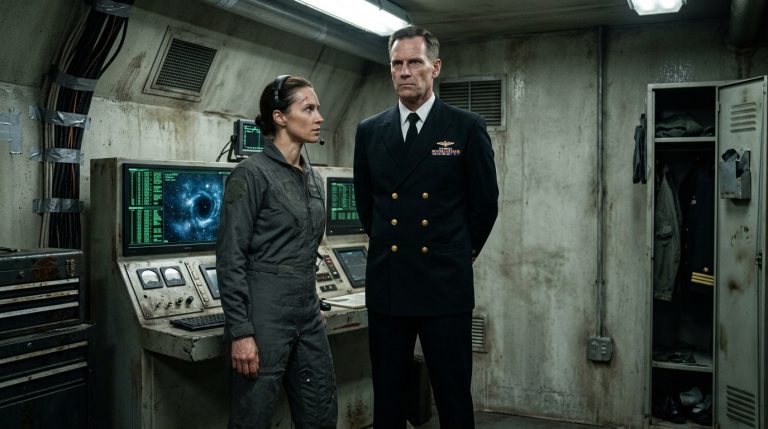
The Ghost of the Fraying Ridge: A Calculated Anatomy of Insubordination and Imperial Bloodlines
CHAPTER 1: THE WEIGHT OF SHARP EDGES
The wind off Coronado Bay carried a high, metallic tang of salt and spent nitrocellulose. It was 0612 hours. The fog hadn’t lifted from the water; it simply hung between the lane markers like frayed wool, catching the blue-orange flash of every cold-bore ignition. Harper Vance checked her posture against the concrete pad. Barely five-foot-three, her shoulder pocket was already dark with the carbon imprint of the rifle’s heavy recoil pad, but her ribs remained flat against the deck. She didn’t breathe until the crosshairs settled exactly four millimeters to the left of the target’s painted throat—an override for the standard three-knot crosswind coming off the piers.
“Clear and safe,” she said. Her tongue felt dry, tasting of lead dust and grease.
Behind her, the Master Chief’s clipboard didn’t move. The silence from his spotting scope was a heavy, physical thing, the kind of stillness that grows around an individual who has watched three generations of operators burn their barrels down to smooth-bore iron. He didn’t write anything down. He didn’t need to. The tenth hole had taken the bottom edge out of the ninth, leaving a ragged, black cloverleaf exactly where the target’s collarbone would meet the sternum.
“They’re calling you Ghost down at the logistics shed again, Vance,” the old man muttered. He didn’t look up from the glass. “Not because you’re quiet. Because nobody likes looking at a score sheet that looks like a machine did it.”
Harper stood, her knees clicking against the gravel. She didn’t perform the theatrical slap-clear common among the newer arrivals from sniper school. Her fingers were short, the skin across her knuckles split and stained with low-temperature gun oil, but her movements were small, transactional, and efficient. She locked the bolt back, verified the empty orange follower in the magazine well with a single glance, and rested the rifle on its bipod with the muzzle oriented toward the gray water.
“The brass doesn’t care about the score sheet, Master Chief,” she said, her voice dropping into the flat, even cadence she used to insulate herself from the range floor. “They care about the invoice.”
“Lieutenant Vance.”
The voice came from the gravel path behind the gear rack—clipped, thin, and smelling of laundry starch. A petty officer second class stood at attention, his eyes fixed firmly on the standard-issue trident pinned to her wet-weather top, explicitly avoiding the green glass of her stare. He was sweating despite the fifty-degree mist coming off the bay, his thumbs locked against his trousers with a stiffness that usually meant a flag officer’s driver was idling by the main gate.
“The Commander wants you in the office,” the boy said. “He didn’t give you five minutes to wash the oil off your fingers.”
Harper didn’t look at the Master Chief for confirmation. She picked up her transit case, the heavy plastic edges scraping against her flight trousers with a harsh, plastic rasp. The weaponized silence of the command staff was always louder than the firing line. She knew what was waiting in the main building: the administrative aftermath of thirty-seven confirmed headshots in the dry scrub outside Damascus, and the three-star shadow of Marcus Ashford waiting to see if his grease-pencil lines on the Pentagon map had finally found their mark.
“Tell him I’m in route,” she said. She strapped the transit case down, her thumb catching on the sharp steel edge of the latch until she felt the bite of the iron.
CHAPTER 2: THE ANATOMY OF THE BLIND ROTATION
The bite of the latch was cold, a narrow ridge of stamped iron that left a pale indentation across Harper’s thumb before the spring clicked home. She didn’t release her grip on the handle of the transit case until she reached the gravel border where the concrete range pad disintegrated into coarse sand. Behind her, the rhythmic, low-frequency thud of the Coronado surf continued, but the air closer to the administrative enclave grew dense with the smell of wet asphalt and diesel exhaust from the staff pool. Every step away from the firing line felt like a slow drop in atmospheric pressure.
She carried the case low, her forearm locked against her hip to absorb the dead weight of the Winchester Magnum. Her left ankle, stiff from the morning’s damp air, ground against the interior leather of her boot with a predictable, rhythmic friction. There was no shortcut through the security architecture of the compound. She crossed the open asphalt of the vehicle courtyard, passed the secondary verification terminal where a rotating security camera ticked through its ninety-degree sweep, and entered the long, lime-washed corridor of the main building.
The corridor was a gallery of institutional memory. The black-and-white grain of Vietnam-era operations faded into the high-contrast digital prints of the early millennium, every frame holding rows of identical, unblinking stares. She didn’t look at her father’s face as she passed the 1987 team portrait. Her eyes stayed level, tracking the small, rectangular gaps of light beneath the office doors. The silence in the hallway wasn’t empty; it was the specific, weighted quiet of an outpost waiting for an international signal to drop.
At the threshold of Commander Steel’s office, the young petty officer who had run the message pulled back, his hand lingering on the brass handle of the door without turning it. He looked at her fingers—still grayed around the cuticles with the graphite residue of the match-grade cartridges—then stepped to the side, his chin tucked into his collar.
“He’s alone, Lieutenant,” the boy muttered, his voice dropping into the flat, unaccented register of the administrative staff. “The brass from the regional logistics office left twenty minutes ago.”
Harper didn’t nod. She took the handle from him, her palm finding the smooth, worn brass, and pushed the door into the room.
The office was small, the air inside smelling of old stationery, damp wool wool from shipping crates, and the bitter dregs of a cold chicory roast. Commander Jack Ironhawk Steel didn’t turn around when the door clicked into its frame. He stood with his hands tucked into the small of his back, his heavy, sixty-three-year-old frame blocking the low light that managed to pierce the reinforced glass of the north window. Outside, three hundred yards downrange, the gray line of the Pacific met the low belly of the overcast sky in a single, leaden streak.
“You’re dragging the left heel, Harper,” Steel said. His voice was a low, gravelly scrape, the product of thirty years of saltwater inhalation and command-floor shouting. “You’ve been favoring that joint since the second drop into the Bekaa. If the medical board catches the hitch in that stride, they won’t even wait for Ashford’s signature to pull your clearance.”
“The board looks at the target cards, Commander,” Harper said, her voice remaining level as she set the transit case down vertically against the leg of the oak desk. The latch made a short, metallic chime against the wood. “They don’t check the boots until the paperwork is already filed.”
“Ashford isn’t looking at the target cards.” Steel turned slowly. His face looked as though it had been carved out of dry cedar, the lines around his eyes deep and white against skin that had survived four decades of operational exposure. He didn’t sit down behind the desk. Instead, he reached into his breast pocket and drew out a single, thin folder bound in double-weight red cardboard—the unclassified cover sheet for a summary court-martial assessment. “He’s looking at the logistics manifest from the Damascus sector. He wants to know why an overwatch asset authorized for three magazines of standard ball spent eighty-four rounds of high-velocity copper-jacket in a sector that was officially designated as a non-engagement zone.”
“Thirty-seven targets were inside the perimeter wire of the forward observation post,” Harper said. Her internal monologue didn’t expand; it verified the distance, the windage, and the failure of the air-support window. “The Marines had two operational radios, both water-damaged. If I stayed behind the sandbag line, the transaction would have concluded before the first pair of F-18s cleared the deck at Sigonella.”
“The law doesn’t care about the arithmetic of the skin, Lieutenant,” Steel said, his voice dropping an octave as he stepped toward the desk. He didn’t touch the folder; he simply let his thumb rest against the red border. “Ashford wants the line clear. He’s spent twenty-four months clearing every officer who remembers his name from the 2003 investigation out of the tactical planning loops. Your father’s name was the first one he crossed off the roster when the old command structure broke up.”
“My father died under five feet of slate in the Kunar province,” Harper said, her teeth clicking slightly on the final syllable. “Ashford can’t audit a ghost.”
“He can audit the bloodline,” Steel said. He reached across the desk, his short, thick fingers picking up a gray plastic data cassette—the standard encrypted transport drive for field intelligence transfers—and slid it exactly three inches across the polished wood toward her. “This came through the administrative channel forty minutes ago. Not from the Pentagon. Not from the Navy Special Warfare Command router. It was dropped into the local server from a commercial terminal in the San Diego port district. It’s an unsigned request for temporary detachment to an agency station in the Hindu Kush.”
Harper looked at the cassette. The plastic was new, the gray surface free of the grease stains and scuffs that marked the equipment used by the regular teams. A small, blue adhesive dot was stuck to the corner—the old filing mark of the Central Intelligence Directorate’s logistics division.
“Victoria Cross,” Harper said.
“She doesn’t sign her name to work like this,” Steel muttered, his eyes narrowing as he watched Harper’s hand move toward the edge of the desk. “She leaves a print like a dry boot on concrete. Eight operators from Team Five went silent seventy-two hours ago in the old sector—the exact basin where your father’s final patrol went off the screen. Ashford signed the stand-down order from his desk in Arlington before the first signal distress light went green.”
Harper didn’t take the drive. Her hand remained flat against the seam of her trousers, her fingers calculating the risk of the contact. The room was perfectly still, save for the rhythmic, dull clack of a teletype machine three doors down the hall.
“He’s closing the book,” Harper said quietly.
“He’s checking the locks,” Steel corrected. He leaned down, his face inches from hers until she could see the tiny broken vessels across the bridge of his nose. “Go home, Harper. Take the beach house. Wash the salt out of that rifle case and don’t touch a data terminal until the rotation turns over in November. If you pick up that cassette, you’re outside the umbrella. I can’t run interference for an operator who isn’t on the morning muster.”
Harper looked past his shoulder to the gray line of the ocean through the glass. Her father’s voice didn’t return as a memory; it returned as a physical habit—the way her knuckles tightened when the wind shifted three knots to the east. She reached out, her index finger catching the square edge of the gray plastic cassette, and pulled it across the oak wood until it sank into the palm of her hand.
“The wind is coming around to the south, Commander,” she said. “The fog won’t hold until noon.”
CHAPTER 3: THE STRATIGRAPHY OF THE SHORELINE
The edge of the gray plastic cassette remained pressed against the meat of Harper’s palm as she turned away from the desk, the mechanical click of the door frame behind her signaling the end of the commander’s official ledger. She did not slide the drive into her uniform pocket until she reached the outer steps of the facility, where the administrative salt-wash met the damp breeze of the shoreline. Her vehicle—a prime-painted utility truck with a stiff clutch and a rattle in the steering column—sat idling in the lower section of the personnel lot. Every gear shift down the coastal highway was an exercise in deliberate friction, the metal linkage grinding beneath her boot with a predictable, heavy resistance that kept her thoughts anchored to the dashboard.
The drive back to her rented frame house along the San Diego surf line required precisely forty-four minutes through the mid-morning logistical traffic. She kept her eyes off the rearview mirror, tracking the long, gray lines of the container cranes at the commercial docks instead. The house sat on a narrow plot of sand-grass where the shoreline began to turn into salt marshes. The timber of the small deck had warped from decades of exposure to the Pacific spray, its grain split and showing the white, mineral crust of dried brine.
Inside, the air was cold, smelling of stale coffee and the damp insulation of the floorboards. She set the weapon transit case down on the bare plywood of the living room floor, her movements small and quiet. She did not change out of her field trousers; she simply pulled a dark wool pullover over her shirt and sat at the small kitchen table where her personal terminal sat, its housing cased in heavy, industrial-grade plastic.
Before she cleared the screen, her fingers tracked a low-frequency hum from the base of the terminal wire. Her thumb dipped beneath the edge of the wood veneer, finding a raw, uninsulated copper ground line that had not been part of her original installation—a standard, three-millimeter tap wire with a civilian-grade shielding sheath. The tap didn’t use Navy Special Warfare encryption; it carried the specific, oily scent of fresh electrical tape and cheap resin.
“You’re late, Vance.”
The voice came from the screened porch behind the kitchen door—low, uninflected, and perfectly dry.
Victoria Cross did not move from the wicker chair where she sat with her ankles crossed, her charcoal-gray wool trousers free of the salt-dust that covered everything else within fifty yards of the breakers. Her silver hair was cropped with a geometric precision that made her face look like a stamped piece of zinc. She held no notebook, no briefcase; her hands rested flat against her knees, her short fingers steady as the tide.
“The drive from the range terminal took forty minutes,” Harper said, her voice remaining inside the narrow, professional register she used to report windage drift. “Steel said you were in the port district.”
“Steel operates under the assumption that the geography of the command matters,” Cross said. She stood up, her shoes making no sound against the split bamboo matting of the kitchen floor. She reached down and tapped the edge of the table exactly twice, her finger targeting the gray data cassette Harper had set beside the terminal. “Eight names went off the active monitoring registry at the Bagram node seventy-two hours ago. Two of them were my case officers; six of them were the tier-one detachment from your father’s old basin. Ashford’s office logged it as a tactical attrition event before the secondary distress signals finished their first burst sequence.”
“The drive isn’t routed through the Navy router,” Harper observed, her eyes tracing the clean, unmarred seam of the plastic cassette. “The blue dot on the housing belongs to a logistics station that was dismantled during the 2005 draw-down.”
“The logistics were dismantled, but the warehouse remained under a private lease held by an export firm out of Virginia,” Cross said. She stepped closer, her breath smelling faintly of wintergreen lozenges and cold iron. She did not lean over the table; she maintained an intentional, vertical posture that forced Harper to look up into the gray slate of her eyes. “Tyler Hawkins was the team leader on that patrol. He spent four hours at your father’s burial service holding the flag box while the administrative staff waited for the rain to clear. He doesn’t go silent because of a mountain squall, and he doesn’t leave his equipment behind for the local militia to inventory.”
“Ashford signed the stand-down before the logs were verified,” Harper said. Her internal monologue didn’t seek justification; it verified the timeline against the physical distance between the Pentagon’s communication suite and the Bagram node. “That requires a pre-formatted template on the secure network. You don’t build that file in five minutes while the birds are still over the ridge.”
“He built the file thirteen years ago, Vance,” Cross said softly, her hand moving to her pocket to retrieve a small, single-use decryption tab—the thin, metallic strip used to authenticate field-grade transfers. She laid the strip over the blue dot on the gray cassette, the adhesive backing sticking with a faint, plastic pop. “The names change, but the coordinates stay inside the same three-mile valley in the Hindu Kush. He doesn’t want a rescue team verifying what’s inside the lower cell blocks of that stone compound. He wants the basin cleared down to the bedrock.”
Harper’s hand stayed near the knife sheath at her hip, her thumb feeling the raised weave of the paracord wrap on the grip. The silence between them grew heavy, filled only by the rhythmic, low-frequency shudder of the surf against the pilings beneath the kitchen floorboards. The tap wire beneath the desk was still humming, its micro-current warm against her knee.
“The flight leaves Bagram at dawn tomorrow,” Cross said, her voice dropping into a dry, transactional whisper. “The orders are flagged as a logistics reassignment for an advanced sniper asset. If you cross that gate, you’re an unlisted line on the manifest.”
Harper picked up the gray cassette, the metallic strip cold against her thumb as the interface light on the drive turned a steady, unblinking red.
CHAPTER 4: THE CALIBRATION OF THE REAR GUARD
The unblinking red of the interface light cast a narrow, scarlet blade across the salt-grimed veneer of the kitchen table. Victoria Cross did not follow the drive’s initialization sequence with her eyes; her gaze remained fixed on the line of Harper’s jaw, tracking the small, mechanical pulse of the masseter muscle beneath the skin. The silence inside the frame house held for three complete breath cycles before Harper cleared the terminal screen with a single, downward sweep of her hand, breaking the connection.
“The log will register this terminal’s handshake within six minutes if the regional server performs its standard diagnostic sweep,” Harper said. Her voice didn’t rise above the low hum of the refrigerator’s compressor. “If Ashford’s security detail has the Coronado node under a persistent mirror block, the gate guards will have my administrative suspension flag on their monitors before I clear the bridge.”
“The gate guards utilize the primary garrison database,” Cross said, her fingers retreating into the pockets of her gray wool trousers with a slow, fluid economy. “The garrison database updates on a twelve-hour cycle, pinned to the shift change at noon. You have exactly fifty-two minutes before the administrative lockout cascades from the regional center down to the gate terminals. After that, your credential is a dead piece of plastic.”
Harper did not answer. She picked up the gray cassette, her thumb feeling the slight heat generated by the internal solid-state array, and slid it into the lower cargo pocket of her field trousers. Her movements were deliberate, mapped against the physical geometry of the room. She swung the heavy plastic transit case off the plywood floor, the weight of the Winchester Magnum inside shifting against its foam inserts with a dull, rubbery thud. She walked past Cross without a secondary glance, her boots striking the split bamboo matting with a measured, even cadence that took her through the rear door and out onto the gravel drive.
The utility truck’s cabin was cold, the vinyl of the driver’s seat stiffened by the salt air until it rattled like dry parchment against her spine. She turned the ignition key, waiting for the glow plugs to clear before the diesel engine caught with a heavy, metallic clatter that vibrated through the steering column. Cross did not follow her to the vehicle. When Harper looked into the side mirror while backing down the sand-grass lane, the porch was already empty, the wicker chair left exactly three inches from the wall rail.
The journey down the silver strand toward the Coronado naval enclave required precisely eighteen minutes of real-time transit. Harper kept the truck inside the right-hand lane, her speed pinned strictly to thirty-five knots to avoid the municipal radar traps. The air across the low dunes was thick with grey moisture, the sun nothing more than a pale, greasy smudge behind the high ceiling of the overcast. With every mile, her left ankle throbbed against the leather tongue of her boot, a dry, grinding reminder of the altitude she would face within thirty-six hours.
At the secondary perimeter gate, the chain-link barriers were slick with condensation. A single sentry stood inside the concrete watch box, his shoulders hunched against the mist. Harper rolled the window down three inches, letting the raw smell of marine diesel and stagnant tidewater flood the cabin. She held her credential card flat against her palm, extending it just far enough into the gray air for the barcode reader to catch the line.
The scanner made a short, dual-tone chirp. On the sentry’s terminal, the blue confirmation bar hovered for two seconds, its progress bar lagging as the local network verified her detachment status against the morning roster. Harper’s thumb rested against the steering wheel, her knuckle white. She didn’t look at the guard’s eyes; she watched the tiny indicator light on the side of his housing.
“Logistics detail, Lieutenant?” the boy asked, his finger hovering over the manual barrier release.
“Advanced sniper asset inspection,” Harper said, her tone flat, drained of any inflection that might suggest an administrative freeze. “The transit cases need to clear the armory cage before the noon muster.”
The guard nodded once, his thumb dropping onto the yellow button. The hydraulic arm lifted with a sharp, pneumatic hiss that whistled through the truck’s open window. Harper cleared the line without accelerating, her tires clicking across the rubber speed bumps with a heavy, unhurried rhythm.
She parked the truck in the shadow of Building 312—the low, windowless concrete structure that housed the special warfare gear cages. The air inside the loading dock smelled exclusively of volcanic stone wool, pulverized graphite, and the heavy, sweet scent of weapons preservative. She did not use the elevator; she carried the sixty-five-pound transit case down the raw concrete steps into the basement level, her boots leaving thin, wet crescent marks on the floorboards.
The cage wire was black iron, six-gauge, rising twelve feet to the exposed steel joists of the ceiling. Inside lane four, her personal storage locker sat behind a dual-stage digital lockbox. She swiped her card through the local reader, her skin cold against the plastic. The mechanism gave a heavy, mechanical clink as the locking bars retracted into the frame.
She stepped inside the cage, the wire door swinging shut behind her with a loud, iron rattle that echoed down the empty corridor. She did not unpack the rifle first. Instead, she sat the case flat across the steel workbench and pulled the small auxiliary diagnostic terminal out from its housing beneath the master parts rack—a legacy machine used for checking the internal tracking chips of match-grade barrels.
She pulled the gray data cassette from her cargo pocket, plugged it into the auxiliary terminal’s serial port, and watched the green phosphor screen flicker into life. Her intent was procedural: verify the source routing logs of the Mongoose 6 satellite transfer before she loaded her operational loadout. Her fingers moved across the mechanical keys with a rapid, unthinking velocity.
The code lines did not match the typical Pentagon formatting string. As the diagnostic tool stripped away the secondary encryption layers, the origin header emerged as a clean, unfragmented string of numbers. The packet hadn’t been routed down from an orbital array or passed through the central intelligence node in Virginia. The localized data packets showed an active, five-bounce relay that terminated at a civilian broadband terminal located precisely eight hundred yards from where she sat—inside the commercial harbor office leased to Travis Bennett.
The Mongoose 6 alert—the raw image of her father and the flash directive to break cover—was an internal construction, generated from a field terminal right here on the Coronado strand. The decoy was built to look like a national intelligence breach, a physical lure designed to pull her into an unmanifested deployment line before her command clearance could be formally stripped by the regular channels.
Harper did not take her hand off the terminal frame. The metal felt cold, greasy with the film of old preservative oil, but her fingers remained absolutely steady against the keys as the green light of the screen reflected across the sharp, level planes of her eyes.
CHAPTER 5: THE THRESHOLD OF THE HIGHER BASIN
The green glare of the diagnostic terminal did not flicker as Harper logged the final packet string, its phosphor lines leaving hard, horizontal bands across the curvature of her eyes. She did not download the log or forward the trace to the station router; she simply cut the primary breaker at the base of the rack with a single, down-stroke of her knuckle, returning the armory cage to the low, amber illumination of the overhead path lights. The transaction with the screen was complete. Her fingers moved immediately to the transit case latches, locking the heavy rubber seal down until the plastic ribs compressed with a uniform, dry rasp.
The administrative timeline had run to its margin. She walked out of the lower facility into the loading dock, the sixty-five-pound case balanced against her flank by the sheer mechanical leverage of her skeletal alignment. The utility truck sat where she had left it, its diesel engine still holding a trace of heat beneath the cowl, but she did not return to the driver’s seat. Instead, a gray agency panel van with standard commercial plates was already idling near the oil disposal dump, its rear doors unlatched exactly half an inch to reveal the dark, vulcanized rubber flooring inside.
She loaded the case into the dark interior, her boots clearing the asphalt without leaving a trace of loose gravel. Victoria Cross was not inside the vehicle; the driver was a silent tier-three logistics contract runner who did not check her credential as she took her position against the internal bulkhead. The transit from the Coronado sand-spit to the non-commercial terminal at Lindbergh Field required eleven minutes of continuous, unhurried motion, every acceleration mapped against the legal traffic limits to preserve the vehicle’s civilian profile.
The transition to the long-range transport was an unbroken sequence of physical hand-offs. She walked from the rear of the panel van straight onto the cargo ramp of a gray C-17 Globemaster with unpainted nose markings, her boots tracking the cross-hatched steel grating until she reached the secondary web seats behind the primary load logs. The interior smelled of hydraulic fluid, stale military box lunches, and the dry, freezing air of high-altitude oxygen lines. She did not unpack her personal gear during the eighteen-hour transit over the Atlantic corridor; she strapped her ankles against the lower cargo rings, pulled her watch cap down to the bridge of her nose, and simulated the flat, low-frequency pulse of a combat sleep cycle. Her brain did not trace the geographical shift; it monitored the internal countdown of the flight time against the remaining endurance of her clearance parameters.
When the cargo ramp dropped at Bagram airfield, the light that entered the hull was thin, gray, and saturated with the fine, volcanic dust of the Parwan basin. The air at eight thousand feet tasted of cold sulfur and aviation fuel, cutting the back of her throat with a raw, immediate burn. She carried her transit case down the ramp, her left ankle stiffening instantly as her boot hit the frozen gravel of the tarmac.
A high-clearance utility vehicle with no military insignia took her through the perimeter checkpoints to a windowless, concrete substation near the northern ordnance loop. The interior was lit by raw fluorescent tubes that hummed at sixty hertz, casting a cold, institutional glare across the maps pinned to the cinder-block wall.
Master Chief Petty Officer Grant Sullivan stood by the central planning table, his short, thick frame dressed in unbadged mountain gear that had been scrubbed of any unit insignia. His hair was a rigid, salt-and-pepper brush that looked as though it had been filed down with an emery board, and his hands were tucked into the belt of his load-bearing harness, his thumbs resting near the quick-release buckles.
“You’re thirty minutes outside the operational briefing window, Vance,” Sullivan said. He didn’t look up from the satellite overlay card. His voice had the dry, concussive rasp of a career spent behind large-caliber muzzle brakes. “The logistics detail from the station node said you were clearing an administrative inquiry at Coronado when the flight manifest was stamped.”
“The inquiry was cleared before the shift change, Master Chief,” Harper said. She stood with the transit case resting vertically against her shin, her fingers loose along the carrying handle. “The clearance is logged under the advanced sniper asset allocation. The router lines are verified.”
Sullivan turned his head slowly, his small, dark eyes tracking the line of her shoulder down to the heavy plastic casing of the Winchester Magnum. He did not offer his hand. In the corner of the room, Travis Bennett sat on a low packing crate, his expensive, civilian-issue altimeter watch catching the raw light of the fluorescent tube as he adjusted the sleeve of his field jacket. He smiled—a small, horizontal parting of the lips that didn’t disturb the skin around his eyes.
“The routing lines don’t matter once we clear the ridge line at Point Alpha,” Sullivan said, his finger dropping onto the center of the map overlay where the contour lines compressed into a narrow, vertical throat. “The basin is under a strict communication freeze signed out of the regional command office. We slide in quiet, we align the optics, and we wait for the confirmation sequence from the station terminal. If the local fighters move the prisoners before the confirmation drops, we do not shift the parameters of the blind overwatch.”
Harper looked at the map, then let her gaze shift to the layout of the perimeter sensors Sullivan had sketched across the margin. A sudden, cold clarity settled behind her temples—a recollection of the tactical baseline from her father’s 1998 sniper operations manual, the specific manual General Ashford had used to draft the standard operating procedures for the eastern sectors. The sensor placement Sullivan had marked wasn’t designed to detect a hostile approach from the valley floor; it was angled inward, optimized to trace the ignition flash and directional acoustic signature of an overwatch position on Ridge Alpha.
The perimeter wasn’t arranged to protect the sniper team from the local militia. It was configured to register their first shot within two milliseconds, sending a precise geographic locator directly to the regional command node before the spent brass could hit the shale.
“The sensor interval along the north ridge is tight, Master Chief,” Harper said, her tone flat and devoid of any analytical emphasis. “The reflection from the rock faces will give a dual-path echo if we use the standard standard-issue muzzle brakes.”
“The brakes are suppressed, Lieutenant,” Sullivan said, his jaw tightening until the old scar along his lower lip turned a dull, chalky white. He stepped closer to the table, his shadow blotting out the eastern approach routes on the map. “We use what the container manifest provides. We don’t adjust the windage until we’re on the line.”
In the corner, Bennett’s fingers stopped moving along the bezel of his watch. He looked up, his eyes narrowing as he checked the distance between Harper’s boots and the transit case against the wall.
CHAPTER 6: THE BALLISTIC MARGIN
Travis Bennett’s hand remained frozen over the titanium bezel of his altimeter watch, his pupils narrow and dark under the raw hum of the fluorescent tube. He did not shift his stance on the packing crate, but his shoulders squared by a fraction of an inch as Harper’s hand dropped cleanly away from the carrying handle of the transit case. The cold grease-pencil marks on the tactical overlay card suspended between them seemed to harden under the silence of the room.
“The windage profiles for the lower basin are already loaded into the range terminal,” Sullivan said, his voice dropping into the flat, rhythmic drone of an instructor cycling through an ordnance manifest. He stepped out from behind the central planning table, his heavy mountain boots scraping a line through the fine gray dust that coated the concrete floorboards. “If the advanced sniper asset requires a primary cold-bore verification, we clear the lane before the logistics detail closes the fuel gate at 1300.”
“The verification is procedural, Master Chief,” Harper said. Her gaze did not slide toward Bennett; it locked onto the zinc latches of her case. “The chamber density changes at eighty-four hundred feet. If the mechanical tolerance isn’t registered on the local block before we hump the spine, the first copper jacket out of the tube will drift four inches wide at the thousand-yard marker.”
She did not wait for an administrative confirmation. She lifted the transit case by its secondary steel handle, her left ankle holding its alignment despite the deep, cold burn that flared through the joint with every physical transition. She walked past Bennett’s shoulder, her shoulder-straps catching the draft from the room’s lower intake vent. The case made a rhythmic, heavy rasp against the fabric of her field trousers until she hit the heavy, iron-reinforced door that led to the substation’s rear testing trench.
The passage to the open range section was a ninety-yard cut through the limestone foundation of the airfield’s northern perimeter. The tunnel was low, unlit, smelling of old saltpeter, damp rubber insulation, and the cold, chemical rot of abandoned fuel drums. Sullivan followed exactly three paces behind her heel, his breathing short and regular, his load-bearing harness clicking with the dry, mechanical predictability of a metronome. Bennett brought up the rear, his step lighter but deliberate, his boots slipping occasionally across the frozen shale that had drifted through the ventilation shafts.
When they cleared the final concrete portal, the glare from the snow line hit the mountain basin with the force of a magnesium flash. The horizon was nothing but jagged, desaturated ridges of gray granite rising into a slate-colored sky. The range itself was a narrow throat of frozen rock, cleared down to the bedrock for six hundred yards, where a single, scarred plate of half-inch armor plate hung from two rusted hoist chains. The wind through the gorge was a live, whistling blade that carried the fine grit of the limestone flats, grinding into the mechanical threads of her gear before she could even lower the case.
Harper knelt in the gray gravel, her movements small, economical, and devoid of the performance routines of the training facility. She opened the zinc latches with two quick clicks of her thumb, the sound flat and sharp in the open thin air. The Winchester Magnum emerged from its form-cut foam block like a piece of dark machinery, its thirty-two-power optic cased in a matte, scratch-resistant oxide coat that swallowed the harsh glare from the peaks. She extended the steel bipod legs, settling the feet into the loose shale until the teeth bit into the harder ice beneath.
“The air is quartering from the left at twelve knots,” Sullivan murmured, his spotting scope already locked into its tripwire bracket three inches above her right shoulder. “The mirage off the lower flats is lifting by two mils every ten minutes. You need to take the shot before the surface heat distorts the plate border.”
“The mirage is static, Master Chief,” Harper said, her cheek finding the cold, hard rise of the composite stock. Her eye aligned with the glass, the reticle jumping into sharp focus against the gray iron target downrange. “The movement isn’t heat. It’s the exhaust plume from the auxiliary generator behind the fuel gate. Bennett’s log has the layout marked as an empty grid.”
Her internal monologue remained clear of emotion; it calculated the density altitude parameter against the twenty-five-grain weight of the propellant. She took up the slack in the two-stage trigger, the cold metal of the shoe flat against the first pad of her index finger.
Behind her, Bennett shifted his weight against the concrete portal wall, his hand sliding into the internal zipper pocket of his field jacket where his localized field terminal was stored. He did not speak, but the dry scratch of his nylon sleeve was a distinct, metallic note against the uniform whistle of the mountain wind.
Harper didn’t change her breathing rhythm. She held her count at four—in through the nose, holding the frozen air in the basin of her lungs until her pulse settled into a slow, seventy-beat thud between the iron markers of her ribs. The reticle did not drift; it sat precisely one half-mil high to absorb the vertical drop of the heavy bullet through the thin atmospheric column.
The ignition was a clean, concussive snap that slammed the stock directly back into her shoulder pocket with the unyielding force of a hydraulic hammer. The muzzle blast didn’t flare; the long suppressor swallowed the flame, turning the expansion into a low, metallic hiss that rattled the loose shale within ten feet of the bipod feet.
Through the thirty-two-power glass, the hit appeared before the sound of the iron impact could travel back up the trench. The point of impact was a bright, silver scar exactly three millimeters below the center bolt—a clean, unfragmented strike that left a tiny curl of lead gray lead smoke rising off the iron face.
“A three-inch group at six hundred,” Sullivan stated, his eye staying level behind the spotting glass. His hand did not move to his ledger. “The alignment is verified, Vance. The case closes at 1300.”
Harper didn’t clear the chamber immediately. She kept her eye behind the reticle, tracking the reflection of the limestone walls in the lower edge of her scope. In the gray glass, she watched the shadow of Bennett’s arm drop away from his jacket lining, his fingers empty as he stepped away from the portal. The local trace was still unspooling in her head—the five-bounce relay from the harbor district back in San Diego, and the internal tracking loop that placed the destination node right here, inside the case officer’s operational pouch.
The cold weight of the machine was still vibrating against her collarbone as she finally worked the bolt, the long, warm casing of the .300 magnum ejecting onto the frozen shale with a short, metallic ping that died instantly in the mountain air.
CHAPTER 7: THE GEOMETRY OF THE ASCENT
The tiny, metallic ring of the brass casing striking the shale died instantly against the frozen limestone basin, but the vibration remained inside the bone of Harper’s jaw as she rose from the firing line. She did not clear the carbon residue from her receiver; she simply pulled the bolt assembly back until it locked with a short, cold snap, verifying the empty chamber before she closed the zinc latches of the transport case. Beside her, Master Chief Sullivan was already swinging his main rucksack onto his shoulders, the thick canvas straps groaning under the sixty-five-pound load with a dry, rhythmic strain.
The transition from the testing trench to the infiltration transport took exactly four minutes of real-time physical coordination. They did not return to the administrative substation; they moved directly down the secondary drainage ditch toward the waiting rotors of a blacked-out utility aircraft idling at the margins of the runway loop. The air at nine thousand feet was turning increasingly sharp, carrying a dense, gray moisture that frozen into tiny crystals along the sleeve seams of her field jacket.
The flight across the northern sector was an unbroken sequence of dark, structural buffeting. Harper sat with her boots locked under the tie-down rings, her palms flat against the composite frame of her rifle box to monitor the small shifts in internal carriage temperature. Travis Bennett sat directly across the cabin floor, his fingers tracking a sequence of glowing parameters across the surface of his unmarked terminal screen. He did not raise his chin to meet her stare; the green glow of his display illuminated the deep, cold lines around his mouth, casting a geometric shadow that stretched across the aluminum ribbing of the fuselage wall.
When the pilot cut the internal lights, signaling thirty seconds to the drop point, the cabin floor tilted sharply into an eighteen-degree incline. The aircraft didn’t flare; it cleared the lower shelf of the ridge line with a narrow, three-meter margin, its skids skimming the loose slate of the landing zone before the crew chief kicked the side doors open. The mountain air rushed into the space like an iron plate, carrying the raw, chemical chill of high-altitude ice.
Harper cleared the threshold first, her case held low against her thigh as her boots hit the fractured granite shelf of Point Alpha. Her left ankle absorbed the impact with a clean, dry click that shot a narrow spike of heat toward her knee, but she didn’t alter her stride. She dropped into a low prone behind the first ridge line boulder, her optic tracking the blacked-out silhouette of the aircraft as it dipped back into the valley fog, its rotor wash disappearing into the immense silence of the peaks.
“The march up the spine is three thousand meters,” Sullivan whispered into the local bone-conduction loop. His shadow was already shifting through the gray scrub ten yards ahead, his body low, keeping the mass of his rucksack below the horizon line. “We follow the natural fault line. No active infrared strobes until the overwatch position is established.”
The ascent was a continuous calculation of friction and biological endurance. The trail was a vertical stair of loose slate and shifting scree that disintegrated beneath her boots with a soft, persistent rasp. Harper kept her breathing locked into the four-count baseline, her lungs pulling the thin air deep into her chest until her pulse synchronized with the rhythmic scrape of Sullivan’s pack frame. Behind her, Bennett moved with a heavier, more mechanical step, his hands catching the frozen edges of the stone to maintain his balance as the incline increased toward thirty degrees.
After forty-two minutes of real-time movement, the fault line opened onto a narrow, windswept wedge of granite—Ridge Alpha. The target compound sat exactly twelve hundred yards downrange, its low, stone-walled perimeter nested in the basin floor like an old scar.
Harper deployed her bipod on the lip of the rock face, her movements small and quiet as she settled into the shadow of a fractured slab. She brought her eye to the glass, her fingers moving to the parallax dial to clear the gray moisture that hung over the valley floor. The reticle settled on the central courtyard, tracing the stark, vertical lines of the eight wooden posts where the prisoners were secured.
Before her thumb could lock the windage turret, a sudden, high-velocity thermal shear screamed up the vertical face of the gorge. The air didn’t shift; it slammed into the objective line with the force of an explosion, the high-altitude pressure change causing the target images in her scope to break into a blurred, undulating dance. The mirage parameters she had calibrated on the Bagram range were gone; the atmospheric density inside the gorge was dropping by three percent every sixty seconds as the mountain storm cleared the lower ridge.
“The coordinates are breaking up, Vance,” Sullivan’s voice came through the earpiece—flat, thin, and tight. “The target is shifting four mils to the right in the glass. You can’t lock the solution while the shear is tracking through the throat.”
Harper didn’t remove her hand from the scope turret. She watched the gray distortion through the thirty-two-power glass, her internal monologue stripping away the movement to locate the fixed steel bolts at the base of the posts. Beside her, Bennett had his field terminal flat against the rock, his thumb hovering over the primary transmission key as the internal tracking array began to register the micro-flash of her location.
The absolute reality remained locked beneath the ice of the peak, but her index finger stayed level against the two-stage trigger, tracking the precise oscillation of the metal wire against the stone.
CHAPTER 8: THE RESIDUAL VELOCITY
The second stage of the trigger broke with the cold, uniform resistance of a shearing iron pin. Harper did not see the muzzle flash through the long, heavy cylinder of the suppressor; her world remained locked inside the thirty-two-power circle of glass where Malik Rashid’s silhouette sat precisely one half-mil below the horizontal line of the reticle.
The heavy copper jacket cleared the muzzle at twenty-eight hundred feet per second, cutting through the thin, sub-zero air of the gorge before the mechanical slam of the bolt could echo off the rear granite wall. Through the optic, the resolution was immediate. The single .300 magnum round struck Rashid exactly where the left collarbone met the line of his throat. The impact didn’t cause him to fall; the pure kinetic energy of the bullet drove his mass six inches back against the stone wall of the courtyard, his body slumping into a dark, deflated mound beneath the hoist chains before the sound of the rifle’s report could roll down the ridge line.
“Target down,” Harper said, her tongue dry against her teeth. Her hand did not leave the bolt knob. She worked the action with a flat, rapid execution, the spent casing flying over Sullivan’s left shoulder to drop with a short, icy ping against the shale.
Beside her, Travis Bennett’s arm did not return to his jacket lining. The green light of his field terminal flared once, a sharp diagnostic alert signaling that his tracking relay had been over-ridden by the administrative mirror block Victoria Cross had planted at Lindbergh Field. He looked down at the screen, his face draining of its professional color until the skin around his jaw looked like dry tallow.
“The relay is dead,” Bennett muttered. His fingers did not touch the transmission key again; they remained hovering above the glass, tracking the slow, blue progress bar of a remote purge sequence. “The network isn’t routing to the Virginia server. The file is being scrubbed from the Bagram loop.”
“The file was scrubbed thirteen years ago, Bennett,” Harper said. She didn’t turn her head to look at him. She kept her eye behind the glass, watching the secondary guard towers where the remaining fighters were breaking cover, their silhouettes scattering across the courtyard as the low, rhythmic thud of an extraction bird began to roll over the southern peaks. “You weren’t closing a case file. You were maintaining an invoice for a logistics network that didn’t exist on the books.”
Master Chief Sullivan did not check his spotting scope for confirmation. He stood up, his heavy rucksack frame clearing the shelf of the rock with a loud, nylon rasp. His short, thick hand dropped onto Bennett’s shoulder strap, his thumb locking into the webbing with the mechanical finality of a clamping vise.
“We move down the fault line now,” Sullivan stated, his voice devoid of any tactical urgency. It was the flat, transactional cadence of a yard master closing a manifest. “The bird hits the central zone in four minutes. The prisoners clear the wire before the local team realizes the command structure is unlinked.”
The descent through the vertical throat of the gorge was a kinetic loop of dust and shifting slate. Harper carried the rifle by its upper rail, her left ankle holding its alignment through sheer muscle memory as they hit the floor of the valley. The stone courtyard smelled of burnt fuel, wet lime wool, and the stale, bitter tang of old copper.
The eight survivors from Team Five were already breaking their restraints against the wooden posts, their hands grayed with frostbite but their fingers working the zinc buckles with the automatic efficiency of tier-one operators. Tyler Hawkins was the first to lift his chin as Harper cleared the wire gate, his swollen eyes tracking the lines of her face until they found the gold trident pinned beneath her field collar. He didn’t speak; he simply spat a mouthful of dark brine onto the gravel and reached for the clean carbine Sullivan extended from his pack.
The confirmation of Layer 2 unraveled with the methodical slowing of the engine rotors as the MH-60 Blackhawk touched down sixty yards out, its blades slicing the thin air into rhythmic, thumping intervals. Inside the main cabin, the space was empty of administrative personnel; the cargo decks held only the standard red transport crates used for unmanifested ordnance transfers.
Harper did not board the aircraft immediately. She stood by the rear stabilizer wing, her hand resting flat against the cold aluminum skin of the fuselage while the team loaded the survivors into the web seats. The high-altitude storm had cleared the upper shelf, leaving the granite walls of the valley sharp and desaturated against a white, silent sky.
She reached down into her lower cargo pocket and pulled out her father’s SOG knife, the heavy steel blade showing the white salt crust of the Coronado bayside. The paracord wrap on the handle was frayed at the edges where her palm had rubbed against the weave during the three-mile march up the spine. With small, deliberate movements, she took a cleaning stone from her utility pouch and began to slide it across the steel bevel, the dry rasp of the mineral against the metal the only sound remaining beneath the steady hum of the turbine exhaust.
“The registry is clear, Vance,” Sullivan said, stepping out from the cabin threshold. He did not look at the knife; he looked toward the northern peaks where the old supply routes crossed into the waste. “The command office in Arlington logged the mission as an ordnance verification failure due to weather. The paperwork has no names attached to the line item.”
“My father’s name stays on the 1987 roster, Master Chief,” Harper said, her finger tracing the carved initials CV on the crossguard. “Ashford’s ledger didn’t change the alignment of the barrel. It just changed the weight of the invoice.”
She slid the knife back into its leather sheath, the mechanical snap of the brass button closing with a sharp, final click. The work was done. Her face remained level, the green glass of her stare clear of any emotional residue as she stepped onto the cargo ramp, leaving the empty gorge to fade into the white mist of the higher basin.