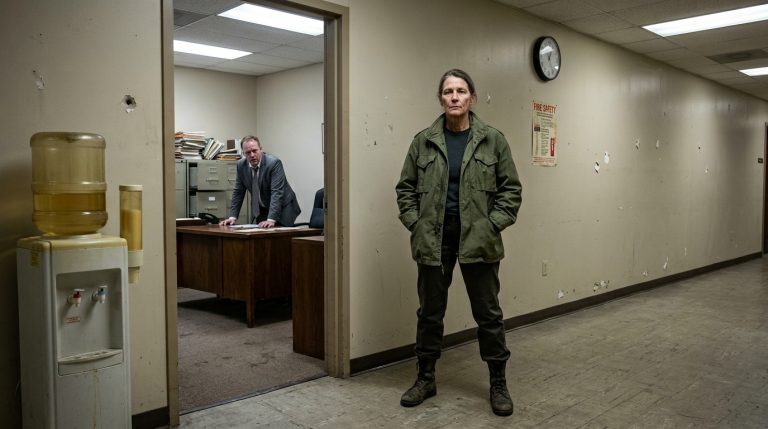
The Rusted Ledger: A Story of Broken Iron, Steeled Heritage, and the Long Ride for Truth
CHAPTER 1: THE COLD ARCHIVE
The radiator in the far corner of the Lakeside Public Library didn’t hiss; it clanked, a rhythmic, iron-on-iron strike that did nothing to shift the frost creeping up the lower pane of the tall sash windows. Elena Rose Bennett didn’t look at the window. She kept her eyes fixed on the grain of the oak table, her fingertips pressed flat against the wood to stop the slight, erratic tremor that had started in her left wrist around noon.
The gray coat was too large. It had always been too large, but now the collar sat away from her neck like a stiff funnel, letting the draft from the front doors slide straight down between her shoulder blades. The wool smelled faintly of the diesel exhaust from the Oak Street grate—the one where the steam rose thickest between three and five in the morning before the transit authority cycled the blowers.
Across the room, the mechanical stamp of the return desk went thud-clack. thud-clack. Dorothy Henderson was moving through the weekend processing cart with the mechanical efficiency of thirty-four winters spent in the same room.
Elena shift her weight. The movement was a mistake. A sharp, dry stitch caught the lower lobe of her left lung, forcing a short, choked cough into the sleeve of her coat. She tasted salt and old grease. Her backpack—the one with the green nylon strap held together by three loops of zinc wire—sat between her ankles like a dead weight. Inside it, her fingers knew the exact geometry of the space left behind: fifty-one missing sheets from the blue ledger.
The fifty-second square of paper was no longer in her possession. It was currently sitting inside a dark green cloth binding on the third shelf of the fiction stacks, waiting for the secondary check.
“Elena.”
The voice wasn’t loud. It came from the path between the reference indices and the microfiche cabinets. Dorothy Henderson wasn’t looking at her; she was looking down at a slip of white cardstock in her hand, her thumb rubbing the corner where the ink had smeared.
Elena didn’t rise immediately. Her knees felt stiff, the fluid inside them thick like frozen grease. When she stood, the room tilted three degrees to the left, the rows of black-bound periodicals blurring into a single solid mass of dark shadow. She held the edge of the table until the wood stopped vibrating against her palms.
“The closing bell isn’t for twenty minutes, Mrs. Henderson,” Elena said. Her voice sounded thin to her own ears, like paper being dragged over concrete.
“I know the time, Elena,” Dorothy said. She reached out, her fingers catching the frayed edge of Elena’s cuff. There was a small, white square of notebook paper tucked tightly into the palm of the librarian’s hand, the precise, geometric folds slightly creased from the moisture of a thumb. “The restroom under-sink cabinet. The third stall. Why is there grease on the hinge?”
Elena didn’t blink. Her gaze dropped to the small brass key fragment sticking out from the edge of Dorothy’s cardigan pocket—the number four stamped into the metal, small and dark with oil. “Because the latch catches if the humidity drops below freezing,” Elena whispered. “The bank closes its vault at four on Saturdays. You have exactly seven minutes before the time-locks engage.”
Dorothy’s grip tightened on the worn wool of the coat. Through the thin fabric, she could feel the sharp, prominent line of the girl’s radius bone, like a dry branch wrapped in cloth. “He has the paperwork from the county,” Dorothy murmured, her eyes scanning the empty rows of tables behind them. “He showed the patrol officers the runaway warrant three weeks ago. They signed off on it.”
“The warrant has the wrong middle initial,” Elena said. She didn’t look up. Her eyes remained on the small brass key. “He used my mother’s maiden name on the title transfer for the Woodland property. If you look at the ledger sheets under the ledger box, the signature doesn’t have the loop in the ‘B.’ He forgets the loop when he’s been drinking before noon.”
The air between them smelled of old paper and the sharp, chemical tang of the floor wax Dorothy used on Fridays. From the street outside, low and rhythmic, came a vibration that wasn’t the transit bus—a deep, metallic pulse that rattled the heavy glass of the front doors.
Elena turned her head toward the entryway, her vision narrowing as the cold air from the vestibule hit her face. On the reverse side of the folded paper Dorothy held, visible only under the harsh glare of the flickering fluorescent tube overhead, was a second line of handwriting that hadn’t been there when Elena tucked the note into the book—a line written in dark blue ballpoint fluid that read: Property cleared for extraction. Do not delay.
CHAPTER 2: THE RE restroom RUNG
The vibration through the floorboards didn’t die out; it settled into the marrow of the oak tables, a heavy, rhythmic thrumming that made the zinc wire on Elena’s backpack strap hum against the floor. Dorothy Henderson didn’t release her grip on the gray wool cuff. Her knuckles were yellowed with the pressure, the small white square of notebook paper crinkling under her thumb until the fibers of the sheet began to separate along the sharp, geometric creases.
“The library doesn’t keep blue ink at the main desk, Elena,” Dorothy said. Her voice dropped another octave, losing its standard institutional clarity, thickening with the dry grit of someone who had spent thirty years breathing the dust of decaying bindings. Her eyes remained locked on the reverse side of the square, where the ballpoint fluid had bled slightly into the cheap pulp of the paper. “Thomas was here on Tuesday. He sat by the microfiche cabinets for three hours with a black leather folder. He didn’t check out a volume.”
“He doesn’t read,” Elena said. She kept her chin tucked into the funnel of her collar, her gaze tracking the small brass key fragment that still protruded from Dorothy’s pocket. The second notch on the bit—the one that didn’t match the clean, standardized double-groove of a Community Trust Bank safety deposit lock—was rough-edged, dark with a crust of orange iron oxide. It wasn’t bank brass. It was municipal iron, the kind used for the heavy padlock shrouds on the drainage access panels behind the rail yard. “He was checking the county plat maps. The ones from seventy-four that aren’t digitized yet. He had a gray grease pencil.”
Dorothy turned the note over, her thumb covering the words Property cleared for extraction. The skin of her palm was dry, raspy against the notebook paper. “The police sedan from the second precinct is parked behind the municipal tank on Oak Street. It’s been there since three. They aren’t running the heater.”
“They’re waiting for the four o’clock bell,” Elena murmured. She forced her knees to lock, pushing her weight down through her heels until she could feel the cold iron screws holding the table leg to the joists. “The runaway report requires twenty-four hours from the last verified sighting before they can execute a physical transport across county lines. He filed the amendment at four yesterday.”
“Then we don’t wait for the bell,” Dorothy said. She let go of the sleeve, but her hand didn’t drop. She reached into her cardigan pocket, her fingers closing completely over the brass key fragment, the metal clicking against her wedding ring with a small, flat sound. “The basement stairs behind the biography stacks lead to the old boiler room. The coal chute hasn’t been bolted since the freeze in January broke the lower hinge. The grease on the restroom stall door—you didn’t put it on the latch to keep it quiet, did you?”
Elena didn’t answer with words. She reached down, her stiff fingers catching the wire loop of her backpack, lifting the dead weight of the nylon bag without letting the metal buckles scrape the floor. Her left hand, where the frostbite had left three dark, numb patches across the tips of her fingers, felt thick and clumsy, like she was wearing heavy leather gloves under her skin. She began to walk toward the narrow gap between the reference shelves, her boots making no sound on the worn linoleum runner.
Dorothy followed two paces behind, her breathing short and dry, the note tucked inside her palm like a stolen receipt. The library was empty except for an old man sleeping in the history alcove, his chin resting against the chest of his canvas coat, his breath a faint, whistling rasp that rose and fell between the clanks of the radiator.
The air in the stacks grew thicker, colder, smelling of damp lime and the sour iron dust that drifted up from the floorboards. At the end of the row, where the large-format biography volumes sat in dark, unread rows, the narrow wooden door to the basement sat three inches low in its frame, its cedar panels scarred by the friction of twenty decades of settling foundation stones.
Elena stopped before the latch. The iron handle was cold enough to stick to the bare skin of her palm if she held it too long. She didn’t touch it yet. She looked back at Dorothy, whose face had gone the color of old paper under the gray light from the overhead fixture.
“The phone call you made at noon,” Elena said, her voice dropping below the hum of the building’s water pipes. “The one to the county line. It wasn’t the department of services.”
Dorothy’s jaw tightened, the lines around her mouth hardening into deep, permanent creases. “Michelle Park was here on Wednesday, Elena. She was looking at the land registry maps for the western border. Her husband doesn’t work for the county. He doesn’t work for the city, either.”
From the front vestibule, the heavy brass latch of the main doors clicked—a sharp, distinct sound that carried through the empty rows of shelving like the snap of a dry branch. The bell didn’t ring; someone was holding the iron clapper with a gloved thumb.
“Go down,” Dorothy whispered, her fingers pushing against the small of Elena’s back, her hand cold through the gray wool of the coat. “The third rung on the ladder is loose. Step over it. The iron is rusted through the core.”
Elena dropped her weight into the dark opening of the stairwell just as the shadow of a long coat cut across the light at the end of the biography row, the sound of heavy leather soles striking the linoleum with a slow, deliberate cadence that didn’t belong to a patron.
CHAPTER 3: THE COAL CHUTE TRANSIT
The wood of the doorway scraped against the shoulder of Elena’s gray coat, releasing a small puff of dry wool fibers and pulverized charcoal dust that settled straight into her throat. She didn’t let herself breathe in. Her boots found the first wooden riser—thin, notched pine that groaned with a flat, dry squeak under her weight—and then her left hand reached blindly into the black space for the vertical runner of the iron ladder.
The metal was freezing. The cold of the handrail bit through the thin layer of salt and dirt on her bare skin, threatening to bond with her palm if she kept her grip static for more than a fraction of a second. Above her, the narrow cedar door click-latched into its frame with a dull, hollow thud. The sound was instantly followed by the heavy, deliberate strike of leather soles directly over her head, the timber ceiling joists flexing two inches downward under the weight of the intruder.
Elena dropped down two steps, bypassing the third rung entirely. Her eyes adjusted to the low-contrast gloom of the sub-basement, where the only illumination came from the yellowed light of three small, street-level coal grates thirty yards ahead. The floor down here was unpaved—compacted clay mixed with river silt and old slag from the nineteen-seventy boiler overhaul. Every breath tasted of iron filings, sulfur, and the sweet, rot-tinged dampness of subterranean brickwork.
Behind her, she heard the latch on the biography door rattle. It didn’t open immediately; the cedar panel bound against the frame when the building shifted in the winter, requiring a hard shoulder against the lower rail to clear the stone floor.
“Dorothy,” a voice called down from the upper stacks. The tone was professional, flat, completely devoid of regional inflection. It carried the precise, modulated authority of a state transit supervisor checking a manifest. “The registry books for the third quadrant are missing from the processing cart. The head librarian isn’t at the ledger desk.”
Elena didn’t wait for the reply. She shifted the weight of her nylon backpack, wedging the wired strap between her collarbones to reduce the bounce of the metal wire loops. Her fingers traced the rough, flaking iron of the wall rail as she crept along the foundation trench, her feet sinking half an inch into the dry silt with every step. The air grew tighter as the ceiling sloped down to clear the reinforced concrete piers of the main street sidewalk above.
To her left, the massive iron trunk of the low-pressure steam main thrummed. It was wrapped in deteriorating canvas insulation, the edges frayed into white threads that moved slightly in the draft from the coal chute. Elena kept her shoulder pressed against the cold limestone blocks of the foundation wall, her skin registering every microscopic change in the texture of the stone—from the dry, chalky mortar of the original nineteen-twelve build to the slimy, iron-slick condensation where the drainage pipe from the women’s restroom leaked behind the masonry.
The sound of the biography door clearing its frame echoed down the stairwell—a sharp, splintering crack that meant whoever was up there had used a pry-bar or a heavy boot to force the oak latch.
Elena accelerated her pace, her boots striking a patch of dry clinker that crunched like broken glass under her soles. She reached the base of the third coal grate, where the light fell in thin, greasy bars across an ancient iron hopper. The latch of the chute door was rusted into a solid wedge of orange oxide, but the lower hinge had failed entirely, leaving an eight-inch gap between the iron plate and the concrete sill.
She dropped to her stomach, the rough wool of her coat dragging through the silt as she shoved her backpack through the opening first. The zinc wire scraped against the iron frame with a high, metallic shriek that echoed back into the dark basement like an alarm.
Above her on the street level, thirty feet away, the engine of the patrol sedan purred. The exhaust pipe emitted a steady, gray plume of carbon that drifted down into the grate, smelling of unburned fuel and hot rubber. Elena slid her head and shoulders through the gap, the frozen metal of the frame catching the shoulder seam of her coat, stalling her forward momentum as she heard the first heavy boot hit the bottom of the basement stairs behind her.
Her fingers found the concrete edge of the sidewalk curb outside. She pulled with the remaining strength in her forearms, the rough gravel of the aggregate tearing at her skin until her hips cleared the iron edge of the chute. She lay flat on the frozen earth of the library alleyway, her face inches from the rusted iron wheel of a municipal water valve that had a fresh white tag tied to the stem with wire. The tag read: Secured for Commercial Appraisal— Richards Property Group.
The back doors of the library remained closed, but the shadow behind the frosted glass of the delivery entrance shifted, a long coat silhouette blocking out the yellow interior bulb. Elena pulled her backpack into her lap, her left hand locking onto the wire-wound strap as she rolled toward the dark recess between the brick wall and the green metal transformer box twenty feet down the lane.
CHAPTER 4: THE TWIN RESERVATION LOCK
The oil-scented casing of the green transformer box vibrated against the back of Elena’s skull, a low, mechanical growl that did nothing to mask the gravelly crunch of boots rounding the library’s delivery door. She kept her knees tucked tight against her chest, her fingers frozen around the zinc loops of her backpack wire. Below the rust-flaked rim of the metal utility enclosure, the dirt was black, dead, and saturated with old transformer fluid that smelled of copper and chemical decay.
A long, dark shadow stretched across the packed earth of the lane, the tip of a heavy canvas coat hem cutting through the gray exhaust plume from the idling patrol car.
“She cleared the line,” a low voice muttered. It wasn’t the man from the stacks. This voice carried the sharp, raspy edge of a regular smoker, the words clipped by the biting wind coming off the river. “The hinge on the hopper is fresh bright orange where the rust broke. She can’t have gone past the culvert before the perimeter unit set the light.”
A second set of boots stopped near the municipal water valve stem. A leather glove rasped over the paper tag attached to the iron wheel. “The Richards Group tag is still dry. If she’s running, she’s carrying the ledger sheets from the county book. Thomas needs the signature lines verified before the bank opens the secondary folder at midnight.”
Elena didn’t move her chin from her collar. Her left hand, where the skin remained dead and waxy from the January freeze, pressed down into the gravel until a sharp pebble embedded itself in her palm. She didn’t feel the bite of the stone, only the dead pressure. Her gaze was locked on the small brass key fragment protruding through a tiny tear in her coat pocket.
The second notch—the irregular, hand-filed tooth she had noticed in the library—was catching on a loose thread of her gray lining. It wasn’t just a municipal key. Her father had kept a duplicate set of five-pin tumbler keys in the old zinc toolbox at the pump house, each stamped with an identical notched profile to clear the secondary master locks on the county boundary grates. Richards didn’t know about the master profile; he only had the corporate balance sheets.
The boots shifted, the gravel popping under the thick soles as the men turned back toward the idling patrol car. The passenger door opened with a heavy, ungreased groan, then slammed shut, the chassis bouncing once on its worn springs before the tires bit into the dirt road and rolled toward Oak Street.
Elena waited until the vibration of the engine completely vanished from the iron pipe beneath her feet. She pulled herself up by the corner of the transformer box, the flaking paint scraping against her raw knuckles. The alley was dark now, the desaturated blue of the Michigan winter twilight settling over the brick structures like soot.
She didn’t take the road. She kept her spine aligned with the foundation line of the old warehouses, moving block by block toward the industrial canal basin where the Community Trust Bank branch sat like a square concrete block between two defunct grain terminals. Her boots found the narrow path along the retaining wall, where the river silt had dried into hard, cracked cakes that smelled of iron ore and dead weeds.
Every hundred yards, she stopped, listening to the heavy silence of the district. The only sound was the distant, hollow clang of an unmoored barge striking a piling out on the main current—a rhythmic, iron-on-wood thump that matched the steady, dry pulse in her ears.
At the corner of Fourth and River Street, she dropped behind a rusted fuel drum. The main entrance of the bank branch was sixty yards away, its single glass door illuminated by a stark, white security bulb that made the surrounding asphalt look like gray oilcloth. The operations sedan wasn’t in the lot, but a light was burning in the basement manager’s office—a narrow window that sat flush with the concrete foundation line.
Elena unzipped her backpack by two inches, her hand reaching past the remaining blue ledger sheets until her fingertips touched the cold envelope she had recovered from her mother’s vanity box before the locks were changed on Woodland Avenue. Inside the paper was a single sheet of watermarked bond—the original registration for the safety deposit box under her mother’s name, dated four years before the Richards corporate partnership was signed.
The brass key fragment in her pocket didn’t belong to box four-hundred and forty-seven. It belonged to the lower row—the unlisted municipal boxes that sat beneath the commercial vaults, where the city stored the old property charters before the county boundary was redrawn.
She rose from behind the fuel drum, her boots clicking once against a rusted iron tie-rod embedded in the concrete path as she stepped over the low curb and began the open crossing toward the side entrance of the vault corridor, her shadow stretching long and thin across the desaturated gray lot.
CHAPTER 5: THE VAULT SECTOR BREECH
The gravel didn’t roll silently beneath the instep of Elena’s boot; it made a sharp, flinty click that ran straight up the frozen downspout of the bank’s northern brick wall. She didn’t pause to check the security perimeter line. Her shoulder struck the flat, unpainted steel of the side courier entrance—a heavy emergency partition where the gray enamel had peeled down to the pitted iron skin beneath.
The latch didn’t give on the first push. The condensation inside the cylinder had turned to a plug of gray ice, locking the tumblers until her weight forced the frame two inches inward. Elena slipped through the narrow gap, the wire-wrapped strap of her nylon backpack catching on the strike plate with a short, metallic rasp that vibrated in her waxy fingertips.
Inside, the air was dead, smelling of iron filings, alkaline battery fluid, and the damp lime mortar of the lower vault corridor. A single low-wattage bulb burned over the sorting table forty yards down the hall, casting long, unmoving shadows of the steel reinforcement pillars across the bare concrete.
She didn’t use the stairs. Her feet found the iron ramp that led past the basement furnace lines, her palms tracking the cold, flaking surface of the pipeline shroud. Every five seconds, the massive intake blowers of the main terminal outside sent a rhythmic, low-frequency hum through the masonry—a heavy vibration that made the brass key fragment in her coat pocket click against the watermarked bond paper envelope.
“The deposit run from the county dock was logged at three,” a muffled voice said from the office behind the main barrier wall. It was Gregory Simmons, his words falling with the dry, transactional weight of an operation manager checking an overdue manifest. The scrape of an iron chair leg followed, dragging across the linoleum floor. “Thomas hasn’t brought the corporate seal from the Woodland property yet. The ledger sheets for the clearing option need to be in the vault folder before the midnight audit.”
Elena froze behind the third concrete pier, her spine pressed flat against the damp aggregate. Her left thumb moved into her palm, feeling the deep, rectangular indentation left by the gravel stone she had squeezed in the lane.
Through the four-inch gap between the pillar and the electrical box, she could see the edge of the operations desk. Simmons was leaning over a flat timber tray, his thumb sorting through a stack of desaturated pink slips—the original municipal tax exemptions that had been cleared by the Richards group during the January freeze. Beside his hand sat a heavy, long-barreled grease gun and a bundle of zinc wire identical to the loops on her own bag strap.
The key fragment she held wasn’t for the standard customer boxes in the main room. The second hand-filed notch—the one that had caught the thread of her lining—matched the specific profile of the heavy iron security locker beneath the drainage well. Her father had helped forge those plates during the nineteen-eighty river reclamation project, grounding the master keys on the old emery wheel in the pump house before the state took control of the registry.
A hard click echoed from the upper lobby door. The iron clapper didn’t ring, but the heavy draft from the vestibule hit the basement corridor, bringing the cold smell of unburned diesel and frozen wool.
“The girl cleared the library perimeter,” a voice called down the stairs. It was the driver from the patrol sedan, his heavy soles striking the iron steps with a rapid, uncalibrated cadence that lacked any official protocol. “She’s carrying the blue ledger sheets. Dorothy Henderson tried to lock the biography stack, but the latch was already thrown from the inside.”
Elena didn’t look back at the stairwell. She dropped her weight forward, her boots moving over the dry silt of the floor as she slid into the narrow space between the vault casing and the primary drainage pipe. The iron of the line was wet with greasy condensation, the smell of brackish river water rising through the cleanouts as she forced her shoulder past the main flange.
Her hand went into her pocket, her waxy fingers closing over the brass key fragment. The iron bit was freezing, the metal sticking to her thumb with a sharp pull that tore a small patch of dead skin from the tip. She didn’t let go. She reached into the dark recess beneath the lower lock row, her knuckle finding the irregular, unpolished keyway of box four-hundred and forty-seven.
The key went in halfway, then jammed against a crust of old lime deposit inside the barrel. Behind her, the sound of the chair leg scraping the office floor came again, sharper this time, accompanied by the distinct, dry slide of a bolt being drawn back on a metal locker door.
“Check the lower row,” Simmons said, his voice dropping into the flat register of an instruction being delivered over a radio link. “The master files for the clearance options aren’t in the corporate cabinet. If she has her mother’s duplicate key, she’s not looking for the cash. She’s looking for the original charter.”
Elena braced her heels against the base of the concrete wall, her teeth clicking together as she jammed her thumb against the head of the key, using the weight of her entire shoulder to force the hand-filed notch through the secondary tumblers of the iron lock barrel until the cylinder turned with a heavy, ungreased crack that echoed through the plumbing lines like a pistol shot.
CHAPTER 6: THE RUMBLE EXTENSION
The metallic echo of the cylinder’s teeth shearing the internal rust didn’t just rattle the plumbing lines; it hit Elena’s collarbone like a physical punch. She didn’t withdraw her raw hand from the heavy iron faceplate of safety deposit box four-hundred and forty-seven. Her fingers remained wedged against the cold, flaking edge of the drawer casing, holding the brass bit flat against the secondary pins so the counter-weights wouldn’t drop back into the grooves.
Outside the narrow vault recess, the scuff of a rubber boot sole came to a sudden, rigid halt.
“The low-pressure gauge on the main drainage trunk just dropped three pounds,” the driver from the patrol sedan said, his shadow cutting off the grease-spotted light that filtered down from the basement manager’s office window. “The pressure line doesn’t leak unless the bypass valve behind the lower row is forced past the notch.”
Gregory Simmons didn’t run. His heavy, unhurried steps moved across the linoleum runner toward the vault opening, the distinct, transactional clink of the zinc wire bundle against his belt marking each pace. “The emergency shut-off is secured by the county seal, Miller. If she’s inside the recess, she’s trying to clear the original registration before the midnight transfer cycles. Check the exterior breaker line.”
Elena didn’t let herself draw the sulfur-tinged air into her lungs. She pulled the metal box forward by six inches, the iron slide screeching over the grit-choked track with a dry, raw friction that made her teeth click together. Inside the sleeve lay a manila folder, the paper thick, stiff with waterlogged grime, and bound at the margin by three rusted steel staples that had bled dark orange circles into the fiber.
She didn’t open it here. She shoved the folder into the split nylon opening of her backpack, her waxy fingertips catching on the loose wire loops of her strap as she forced the bag closed. The second notch on the key fragment—the irregular hand-filed tooth that linked the bank barrel to the canal infrastructure—remained locked in the core, the thin brass bit twisting off completely beneath her thumb as she threw her weight toward the back cleanout hatch.
The iron plates of the floorboards above her head vibrated with a sudden, new resonance. It wasn’t the steady hum of the bank blowers or the distant thrum of the river barges. A deep, mechanical rumble was growing along the asphalt of Fourth Street—a low, disciplined cadence of heavy combustion engines moving in tight military formation toward the industrial canal basin.
“What is that?” Miller’s voice came from the stairs, losing its flat, professional modulation for the first time, rising into a thin, uncalibrated clip. “The county line didn’t log any heavy transport movements for this sector until Tuesday.”
“The transport doesn’t use low-ratio gears,” Simmons muttered. His boots stopped exactly two feet from the iron flange where Elena’s gray coat sleeve had left a smear of damp soot on the concrete. “That’s not the state crew. That’s iron from the Detroit chapter. They crossed the river bridge eight minutes ago.”
Elena dropped to her knees, her palms sliding over the cold silt of the drainage channel as she wedged her torso under the primary discharge pipe. The cold brine from the canal backup was rising through the weep holes, smelling of diesel sediment, dead weeds, and old rust. She could hear the distinct, rhythmic pulse of hundreds of motorcycle engines slowing down in the outer parking lot, their heavy iron pipes shaking the glass panes of the basement window until the mortar dust began to sift down from the ceiling joists like white flour.
A gloved hand struck the side courier door at the top of the ramp—not with a pry-bar, but with the heavy, unhurried impact of a steel-toed boot hitting the center rail.
Elena pressed her spine into the rusted curve of the water trunk, her waxy skin tracking every vibration as the outer wall of the vault took the weight of the perimeter mobilization. Through the narrow gap in the brickwork, she saw the desaturated blue light of the twilight parking lot disappear entirely behind a solid, unmoving wall of black leather vests and polished steel drive chains. They weren’t moving toward the entrance; they were forming a silent, three-deep guard line along the asphalt boundary, their crossed arms locking down every exit path from the concrete branch block.
Simmons’s shadow didn’t advance into the drainage recess. He stood by the main vault casing, his fingers remaining motionless against the handle of the tool tray as the deep, low-frequency roar of four hundred idling engines settled into the very concrete beneath his feet, locking the three men inside the basement in a absolute, vibrating silence.
CHAPTER 7: THE ENGINES OF WITNESS
The vibrating mass of the sub-basement floorboards didn’t subside; it rhythmicly amplified, a heavy, grease-thickened wave of low-frequency sound that travelled through the rusted iron cleanout plug straight into Elena’s left ribs. She didn’t adjust her posture beneath the slimy drainage main. Her forehead remained pressed into the damp river silt, her waxy cheek registering the exact structural frequency of the concrete foundation walls as they took the weight of the massive block outside.
Two feet away, the shadow of Gregory Simmons’s boot sole remained perfectly static on the linoleum runner. The transactional clink of the zinc wire bundle against his belt had stopped, replaced by the steady, metallic rattle of an unanchored iron conduit pipe on the ceiling joists above his head.
“The lane is blocked down to the old grain terminal,” Miller said, his voice coming through the gap in the partition with the thin, uncalibrated clip of a man counting a crowd through a narrow sight. He hadn’t moved his boots from the bottom step of the iron stairwell. “They aren’t cutting the ignitions. The exhaust from the perimeter row is backing up through the fresh-air intake vents on Fourth Street.”
Simmons didn’t lower his hand toward the tool tray. His gaze stayed fixed on the four-inch opening where the main drainage trunk met the masonry. “The Detroit registration has twelve hundred names on the master rolls, Miller. They don’t cross the county drainage boundary for a routine corporate filing. Thomas must have triggered the secondary notification line when he moved the ledger boxes from the pump house.”
Elena closed her fingers tighter around the waterlogged manila folder inside her backpack sleeve. The rough fiber of the paper wrapper was cold, damp with her own sweat, the three rusted steel staples catching the raw skin of her thumb where the dead tissue had peeled away.
Through the lower margin of the file casing, she could see the distinct, desaturated purple ink of her father’s office stamp—the original charter mark from nineteen-seventy-eight that preceded the establishment of the Richards partnership. The document wasn’t an option contract; it was the original eminent domain exemption block, signed by the three district regulators before the canal was drained.
The sound of the top courier door came again, but it wasn’t the impact of a steel-toed boot this time. The heavy brass latch-handle of the outer frame rose slowly, the iron bar scraping against the strike plate with a long, ungreased shriek that ran down the basement ramp like a wire.
“The branch manager is inside the vault room,” a voice called down from the upper entry deck. The tone was low, unhurried, carrying the dry, gravelly resonance of someone who had spent thirty years breathing the oil smoke of the state line highway. It wasn’t Wolf Hayes; the cadence was heavier, broader across the vowels, marked by the authority of the Great Lakes chapter presidency. “The county prosecutor has the digital copy of the tax exemptions. The seal on the lower row is invalid under the nineteen-ninety municipal code.”
Miller’s hand went down to the leather holster at his hip, the flap dry and stiff as it rasped against his canvas coat. “The runaway warrant is still logged on the terminal, Simmons. We have the statutory authority to secure the perimeter until the county unit verifies the signature lines.”
“The warrant has an unnotarized middle initial, Miller,” the voice from the top of the ramp said, the steps beginning a slow, deliberate descent down the concrete incline. The leather of the speaker’s vest creaked with every pace, a heavy, thick sound that cut through the low thrum of the idling engines outside. “The girl’s father left the estate registration under the original land block. If you draw that bolt before the prosecutor clears the lane, you’re executing an unauthorized seizure on an active municipal reservation.”
Elena shifted her weight half an inch to the left, her boot heel catching on the rusted iron cleanout flange. The iron was cold, flaking away into fine, black dust that mixed with the oily water around her knees.
Through the opening beneath the concrete pier, she saw Simmons’s hand slowly rise away from his belt, his palm flat and empty as the shadow of a tall, gray-bearded man in a leather vest with the word President stitched across the back cut off the yellow glare of the basement office lamp.
The silent wall of steel outside didn’t move, but the pitch of the four hundred engines shifted in unison, dropping into a deeper, synchronous low gear that made the window frames vibrate within their lime-mortar seals. The desaturated gray lot was no longer empty; it was an unbroken grid of iron, leather, and heavy mechanical witness that locked down the concrete branch block from the river wall to the edge of Fourth Street.
CHAPTER 8: THE CHARTER WAR
The vibration through the limestone joists didn’t snap, but it slowed, settling from a raw roar into a steady, seismic throb that smelled of cold iron dust and unburned fuel. Elena Rose Bennett didn’t lift her torso from beneath the discharge main. Her palms remained buried in the damp silt of the canal floor, her knuckles registering the slow, deliberate scrape of Raymond Thunder Kowalski’s boots as he reached the foot of the concrete ramp.
Simmons’s hand remained six inches above the tool tray, his empty fingers completely static under the yellow bulb. Miller had dropped his palm away from his holster, the stiff canvas of his sleeve hanging straight down like an unpinned sail.
“The registry doesn’t recognize a corporate option on a block that carries an unliquidated partition,” Raymond said. His voice was flat, carrying the dry, gravelly texture of the northern highways into the center of the vault room. He stopped two feet from the masonry flange, his leather vest creaking as he turned his shoulder toward the office. “The original charter—the one David Bennett pulled from the registry before the boundary line was re-drawn—is sitting inside that nylon backpack under the main discharge main. It’s been there since the cylinder turned.”
Thomas Richards didn’t run down the stairs. He came down the concrete steps with his hands already raised to the level of his ears, his fingers shaking against the grease-stained wool of his collar. His face was the color of unwashed salt, the lines around his jaw twitching with a frantic, uncalibrated motion as he looked at the silent grid of black leather vests filling the upper delivery doors.
“The land clearance option was verified by the county clerk,” Richards said. His voice had lost its casual, high-maintenance joke cadence, dropping into a thin, desperate rattle that echoed through the drainage tiles. “The beneficiary signed the provisional release forms in November. I have the ledger pages in the corporate folder.”
“The release has the wrong middle initial, Thomas,” Raymond murmured. He didn’t look at the paper folder in Richards’s hand; his gaze stayed on the four-inch space where the rusted cleanout plug met the masonry. “David Bennett didn’t structure the trust to be cleared by a guardian’s signature. He embedded the original eminent domain block directly into the base charter. If Elena turns eighteen without signing the title away alive, the whole option contract liquidates your entire personal estate to satisfy the regulatory default.”
Elena pulled her legs out from beneath the iron pipe, the wet silt clinging to the knees of her gray coat with a heavy, sucking friction. She stood up against the concrete pier, her fingers locking onto the wire-wound loops of her bag strap. Her left hand was numb, waxy from the old frostbite, but her thumb pressed down against the wet manila cover of the folder she had dragged from box four-hundred and forty-seven.
The document didn’t stay hidden. She pulled the watermarked bond paper from the sleeve, the three rusted steel staples catching the cold glare of the basement lamp.
“The signature line on the seventy-eight charter doesn’t match the option contract,” Elena said. Her voice didn’t rattle; it had the hard, even iron of a child who had spent eleven months listening to the mechanical blowers of the transit grates. “He forgot the loop in the ‘B.’ My father never left the loop out when he was signing an exemption line.”
Richards’s jaw dropped, his hands shaking against his ears as he took a short, uncalibrated step backward toward the iron stairwell. “There’s an adjustment disorder logged in her medical file,” he whispered, his eyes flicking toward Miller with a final, visceral calculation. “The school counselor signed off on the runaway report. She’s an unstable runaway. The documentation gives me the statutory right to control the property assets.”
“The counselor signed the file based on the fabricated tutoring invoices you processed through the main branch, Thomas,” detective Maria Gonzalez said from the top of the ramp. She didn’t use a siren, but her boots made a flat, official strike on the concrete as she descended beside assistant prosecutor David Chen. She held an unsealed white folder in her left hand. “The grand jury signed the indictment forty-five minutes ago. Aggravated financial exploitation, embezzlement, and scheme to defraud under the state code. Turn around. Hands behind your back.”
The cornered beast didn’t strike. Richards’s shoulders collapsed forward, his head dropping until his chin touched the greasy wool of his lapel as Miller stepped aside, his empty hands down at his sides. The click of the steel cuffs was small, flat, completely absorbed by the deep, continuous hum of the four hundred engines waiting in the twilight lot outside.
The pacing of the world slowed down to the crawl of the river current. Elena didn’t follow the officers up the concrete ramp immediately. She sat down on the edge of the low sorting table, the heavy nylon bag resting between her ankles as the cold morning light began to break through the bars of the basement window, turning the gray soot of the masonry into a pale, clean silver.
Raymond walked over to the table, his heavy leather boots making no sound on the silt-choked floorboards. He reached into his vest pocket and pulled out a small, steel-handled pocketknife—the old three-inch tool with the bone handle her father had used to trim the water pump gaskets in the pump house. He laid it flat on the wood beside her hand.
“The wire loops on that backpack strap are going to tear the nylon if you leave them twisted like that,” Raymond said quietly, his voice losing its command cadence, shifting into the guarded vulnerability of an old protector who had seen the line hold. “Use the small blade to clear the zinc loops. We have a fresh leather strap in the truck.”
Elena took the bone-handled knife. Her fingers were clumsy, her waxy skin red with the return of the blood flow under the warmth of the basement furnace lines, but she forced the steel point beneath the first loop of wire, twisting the zinc until it snapped with a flat, clean ping. The friction of the metal was gone. She wiped the blade on the hem of her gray coat, her thumb tracing the smooth, repaired hinge of the old tool before she closed it into the handle.
“The house on Woodland Avenue still has the original locks,” Elena whispered, looking up at the long row of black vests waiting by the delivery line. “The key fragment broke off inside the lower barrel.”
“Wrench has a whole set of municipal five-pin tumblers in the warehouse, Elena,” Raymond said, his hand resting briefly on the funnel of her gray collar, his thumb dry and rough against the wool. “We’ll change the cores before the evening freeze sets the ice on the lane. You’re not sleeping on the Oak Street grate tonight.”
The room was quiet now, the low thrum of the motorcycles outside dropping into a synchronous, peaceful idle that sounded like the steady pulse of a river barge moving downstream into the wide water. Elena Rose Bennett pulled her backpack onto her shoulder, her chin rising out of the gray funnel as she walked up the concrete ramp toward the open light of Fourth Street, her new red coat waiting on the seat of the lead escort truck.